
Makhana, also called fox nuts or lotus seeds, is now gaining more popularity among health-conscious consumers due to its light weight, bland taste, and wide applications. Roasting can be considered one of the crucial processes involved in preparing crispy and edible makhana from its raw state. Whether you are preparing it at home or planning commercial production, understanding how to roast makhana helps achieve better texture, flavour, and consistency.
Roasting technique can change according to the amount, machinery used, texture required, and type of end product. For small quantities, roasting can take place by just heating; however, in commercial processing, machinery is used specifically for the purpose of roasting.
How to Roast Makhana?
Learning how to roast makhana starts with selecting clean and properly dried makhana. The kernels should be free from excessive moisture, foreign particles, and damaged pieces before roasting.
A basic roasting process involves:
- Sorting: Discard any damaged material, contamination, and kernels that are not appropriate.
- Cleaning: Clean the makhana to remove the dust and surface contaminations.
- Pre-heating: Heat the roasting equipment or pan to the necessary temperature.
- Roasting: Roast the makhana by controlling temperature and movement throughout.
- Monitoring: Observe colour, smell, texture, and crispness during the roasting process.
- Cooling: Place the roasted makhana in a cooling system or spread it out for cooling.
- Seasoning: Season the makhana if necessary with appropriate ingredients like salt or spices.
- Packaging: Package the final product in appropriate moisture-proof packaging material.
The objective is to remove excess moisture and develop a crisp texture without excessively browning or damaging the makhana.
Makhana Roasting Process
The makhana roasting process needs controlled heat because uneven roasting can produce a mixture of under-roasted and over-roasted pieces. Proper temperature management also helps maintain the desired colour and texture.
Sorting and Cleaning
Sorting of the makhana needs to be done prior to the roasting process. It should involve sieving out dust, debris, damaged makhana, and smaller kernels.
Preheating the Equipment
The roasting surface or machine should reach a suitable operating temperature before the product is introduced. Consistent preheating helps maintain uniform heat transfer throughout the batch.
Roasting
Makhana goes through a process of roasting where it gets subjected to controlled heating while undergoing movement or agitation.
The temperature and time at which the roasting takes place depend on several things, including the size of the makhana, its moisture content, the type of machinery, among other things. Manufacturers should, therefore, conduct product trials to determine their operating parameters rather than using a constant temperature for all products.
Cooling
Cooling becomes a significant process since the product may still be warm after coming out of the roasting chamber. Effective cooling will help stabilize its texture and prepare it for seasoning or packaging.
Fox Nuts Roasting Method
There are several approaches to the fox nuts roasting method, ranging from simple batch roasting to automated commercial systems.
Pan Roasting
Pan roasting is suitable for small quantities. Makhana is placed in a heated pan and stirred continuously to distribute heat.
Although this method is simple, maintaining consistent heat and movement becomes difficult when the batch size increases.
Batch Roasting
Commercial batch roasting equipment provides better control over heat exposure and product movement. It can be suitable for manufacturers who require more output than traditional pan roasting while still operating in batches.
Continuous Roasting
Continuous roasting systems have been designed for large-scale production. Makhana goes through the roasting process in a regulated roasting area and allows production at a steady pace.
Choice of the roasting system depends on various factors such as production capacity, availability of space, level of automation, etc.
Factors That Affect Makhana Roasting
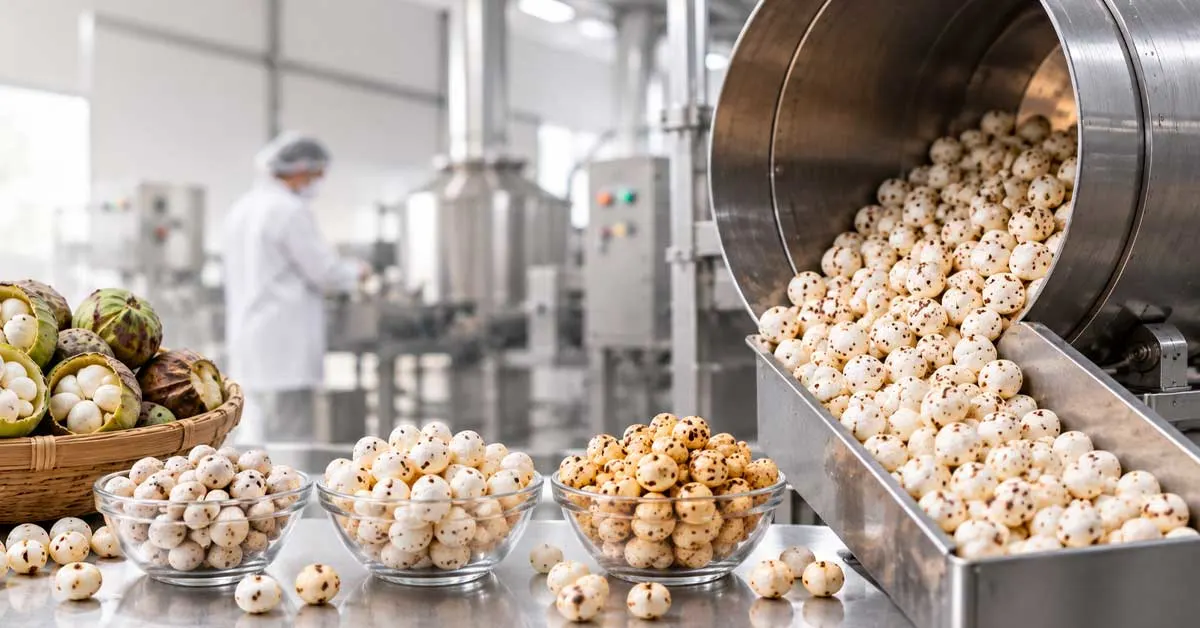
Understanding how to roast makhana also requires attention to the factors that influence roasting quality.
Makhana Size
Different sizes can respond differently to heat. Mixing significantly different sizes in the same batch may lead to uneven roasting because smaller pieces can heat faster than larger ones.
Moisture Content
Moisture plays an important role in the development of crispness. Excess moisture can increase roasting time, while excessively dry material may require careful heat control to prevent over-roasting.
Temperature
Temperature for roasting needs to be chosen considering the type of equipment and product features. High temperature could make the product browned or scorched, while low temperature could produce a less crispy product.
Roasting Time
The roasting process can last for different periods of time depending on the type of product being roasted, batch size, equipment used, and temperature of operation.
Product Movement
Consistent movement helps expose the makhana more evenly to the heating surface or hot air. This becomes particularly important in commercial production.
Cooling Conditions
After roasting, proper cooling prevents residual heat from affecting the final texture and helps prepare the product for seasoning and packaging.
Commercial Makhana Roasting
Commercial makhana roasting requires greater consistency than small-batch roasting. Manufacturers need to process larger quantities while maintaining similar colour, crispness, flavour, and overall quality from batch to batch.
Some of the features of a commercial roasting unit include:
- Heating mechanism
- Feeding mechanism
- Agitation/conveying system
- Temperature control
- Roasting chamber
- Cooling mechanism
- Control unit
- Proper food-grade construction materials
The design will vary depending on the requirements of production and the nature of the makhana product being made.
For larger production facilities, automated roasting can reduce repetitive manual handling and provide better control over processing conditions. It can also be integrated with subsequent stages such as seasoning, coating, conveying, and packaging.
How to Maintain Uniform Roasting Quality
Uniformity is one of the main challenges when scaling up makhana production. Manufacturers should consider the following practices:
- Use sorted makhana that has similar dimensions
- Maintain stable conditions for roasting
- Do not overload the roasting chamber
- Maintain steady product movement
- Check the color, smell, and crispness during production
- Let it cool enough before adding spices and packaging
- Maintain your roasting equipment properly
These practices help reduce batch-to-batch variation and support a more consistent finished product.
Traditional vs Commercial Makhana Roasting
| Factor | Traditional Roasting | Commercial Roasting |
|---|---|---|
| Production Volume | Small batches | Medium to large-scale production |
| Heat Control | Mostly manual | Controlled through equipment |
| Product Movement | Manual stirring | Mechanical or automated movement |
| Consistency | Depends on operator | More repeatable |
| Labour Requirement | Higher | Lower with automation |
| Scalability | Limited | Better suited to expansion |
| Process Monitoring | Manual | Integrated monitoring options |
Traditional roasting can work for household use or very small production, while commercial systems are designed to provide greater control and repeatability at higher volumes.
Benefits of Properly Roasted Makhana
Proper roasting can improve the eating quality and commercial appeal of makhana.
Better Crispness
Controlled roasting helps develop the light, crunchy texture commonly associated with roasted makhana.
Improved Flavour
Roasting can enhance the natural nutty character of makhana and create a better base for seasoning.
Better Seasoning Performance
A properly roasted and cooled surface can provide a suitable base for applying different flavours, depending on the product design.
Consistent Product Quality
Controlled roasting helps manufacturers achieve more consistent texture, colour, and flavour across production batches.
Commercial Equipment for Makhana Roasting
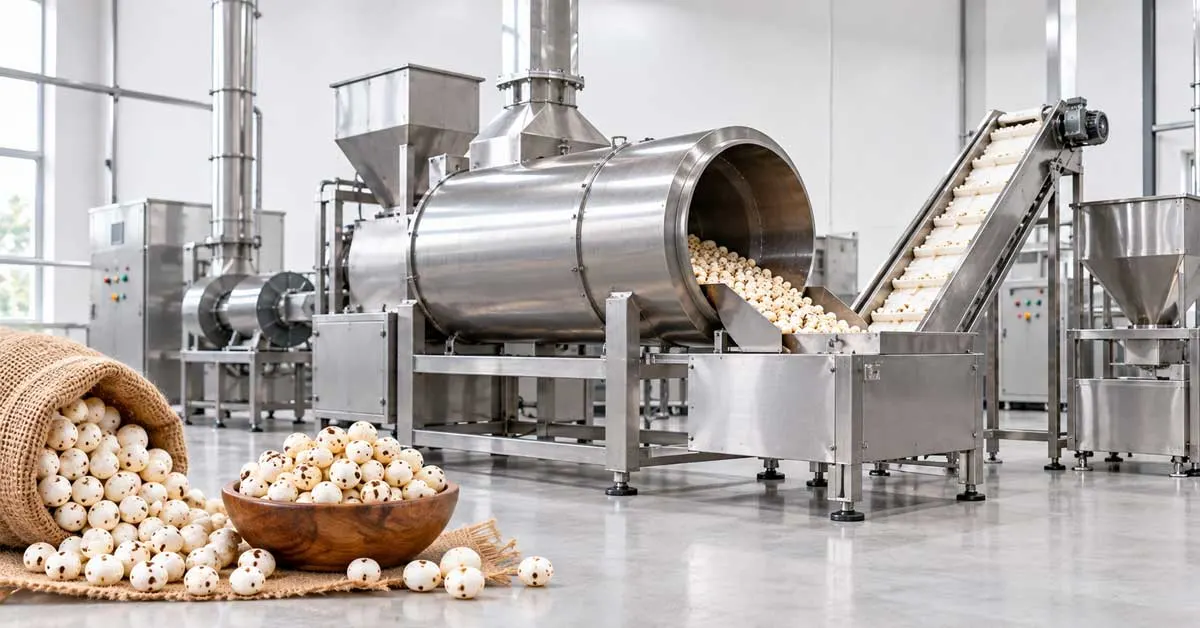
When selecting equipment for commercial makhana roasting, manufacturers should look beyond basic heating capacity. Important considerations include production output, heating method, product movement, temperature control, cooling requirements, construction material, cleaning access, and automation.
The food contact surface is usually made of stainless steel due to its durability and corrosion resistance, among other factors. It would be prudent to use a precise material depending on the food being processed and the prevailing circumstances.
Businesses planning an integrated processing facility may also consider how the roasting system will connect with seasoning, conveying, and packaging equipment.
Understanding how is makhana made can also help manufacturers identify where roasting fits within the complete processing chain and how different stages need to work together.
How to Choose a Makhana Roasting Machine
Before investing in commercial roasting equipment, consider:
- Required production capacity
- Batch or continuous operation
- Makhana size and product characteristics
- Heating technology
- Temperature control
- Product movement system
- Cooling arrangement
- Automation level
- Power requirements
- Available factory space
- Cleaning and maintenance requirements
- Future production expansion
In an ideal scenario, the machine should be tested using samples of the product before deciding on the final system. This will help ascertain whether the roasting process gives the desired color, crunchiness, speed, and quality.
A reliable makhana machine seller in India can also help manufacturers assess equipment configuration according to their production requirements rather than selecting a machine based only on nominal capacity.
Conclusion
Knowing how to roast makhana is important for achieving the desired crispness, flavour, colour, and consistency. While simple pan roasting may be suitable for small quantities, commercial production requires greater control over temperature, product movement, roasting time, and cooling.
It is necessary to choose the correct roasting machinery based on the production capacity, features of makhana, automation needs, floor space available, and plans for expansion. With the right machinery and process control, manufacturers will be able to produce roasted makhana consistently.
Have a Question? Let’s Connect
Need expert guidance on food processing machines, production setup, or process optimization? Our team is ready to help you choose the right solution for your business.
Frequently Asked Questions
How to roast makhana for a crispy texture?
Use well-dried and sorted makhana, use proper heating, ensure constant motion while roasting, and allow proper cooling after roasting. The actual operating conditions depend on the equipment and product.
What is the best makhana roasting process?
The suitable makhana roasting process depends on production scale and equipment. Small batches can use pan or batch roasting, while larger manufacturers may use automated or continuous roasting systems for better consistency.
What is the fox nuts roasting method used commercially?
Controlled roasting of batches or continuously can be performed by commercial producers. This process ensures even heating and movement of material in comparison with manual roasting in pans.
Why is cooling important after roasting makhana?
Cooling will help stabilize the product after the heating process as well as to prevent any residual heat from influencing its texture. Cooling will also help prepare the roasted makhana for flavoring and packaging.
Can makhana roasting be automated?
Certainly. Commercial roastery equipment allows for automated or controlled operation in different stages, which include feeding, heating, transportation of the material, temperature sensing, and cooling, among others. This depends on the type of equipment used.




