
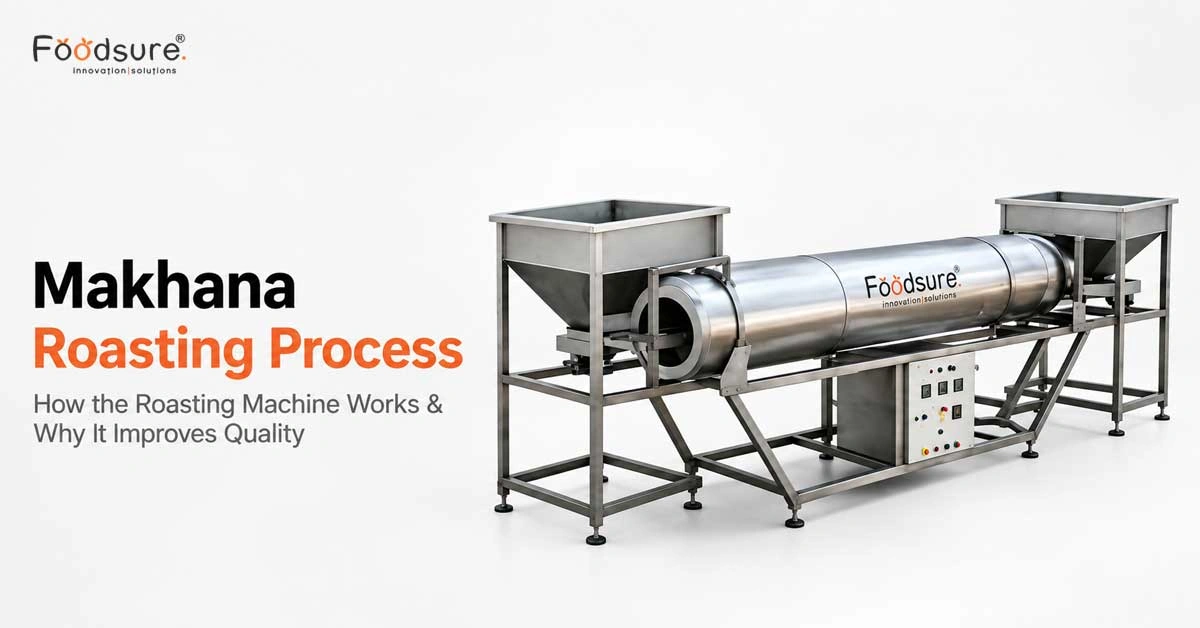
Makhana roasting is the only stage in the fox nut processing procedure that determines the final product to be crispy and golden or chewy and uneven. Makhana roasting is performed after grading and before flavouring. And probably, most issues of the batch quality are either resolved at this stage or caused by improper roasting.
In contrast to “roasting makhana until it is cooked,” this procedure involves the dehydration and the development of the desired texture. Even a few degrees or seconds difference in the roasting procedure result in the uneven, overcooked or soft product instead of crunchy.
This article is about informational topics, designed for processors, owners of snack brands and those who consider buying a roasting machine for their own factory. This article will discuss such aspects as manual roasting procedure, the commercial roasting of makhana on a machine, the benefits of automatic roasting of makhana, and the silent destroyers of the good batches of fox nuts.
What Is the Makhana Roasting Process?
The makhana roasting process is the use of heat to dry the graded fox nuts in order to develop a crispy texture and make them ready for flavoring or packaging.
It is done after grading but before flavoring or coating. The roasting process does not involve cooking the makhana since the raw material is dried and popped at this point. Roasting improves texture, color, and crispness to create a product that will last for weeks.
Role of Roasting in the Entire Production Process
- Harvesting and popping – drying and popping of the raw seeds to form the white kernel
- Grading – grading of the kernels on the suta scale
- Roasting – the topic of this guide; heat treatment of the product to achieve desired texture
- Flavoring/Coating – flavoring or coating with oil using the snack coating process
- Cooling/Packaging – cooling and packing of the product
Why Roasting Matters for Quality
Roasting impacts practically all sensory characteristics noticed by a consumer in their very first bite of the product – crispness, color, shelf life, and uniformity of taste.
- Crispness and texture – adequate roasting ensures removal of residual moisture to achieve characteristic crunchiness of makhana
- Color uniformity – even roasting ensures absence of patches resulting from uneven browning indicating poor processing
- Shelf life – insufficient roasting leaves kernels with residual moisture, resulting in reduced shelf life and tendency to become soggy
- Nutrient preservation – over-roasting at too high temperature may result in degradation of some of the amino acids and antioxidants occurring naturally in makhana
- Ability to absorb flavorings – properly roasted kernels absorb flavors better in the subsequent coating process
The simplest analogy would be – grading ensures size uniformity, while roasting texture uniformity of the end product.
The Manual Makhana Roasting Method
Before industrial roasters became common, and still in many smaller units today, roasting was done over open flame or in shallow iron pans (kadhai), with a worker manually stirring the kernels.
Manual Roasting Process
- Grade sorted makhana kernels are roasted in batches in heated pan or sand in traditional method setups
- The operator stirs or tosses the kernels constantly during the roasting to avoid local scorching
- The process is based on experience when the color change and sound (lighter rattle) determine the completion
- The roasted kernels are removed and cooled to advance to further processing stages
Limitations of Manual Roasting
The whole process is completely dependent on the operator’s skills, and such a dependency poses certain problems for large-scale operations:
- Non-uniform heating — different kernels roast in different ways depending on their location in the pan
- Operator fatigue — the quality gets deteriorated through the working shift due to the decreased attention and stirring
- Lack of temperature control — open flame heating method does not allow to maintain constant heating temperature range
- Lower throughput — small batches require more labor from one operator to process
- Higher rejection rate — due to inconsistent roasting process, the amount of rejected or downgraded kernels increases
These are the main reasons why commercial makhana processing plants switched from manual roasting process to mechanized and automated makhana roasting process lines not because manual roasting produces poor-quality makhana, but because it’s hard to achieve consistency of its production.
How a Commercial Roasting Machine Works
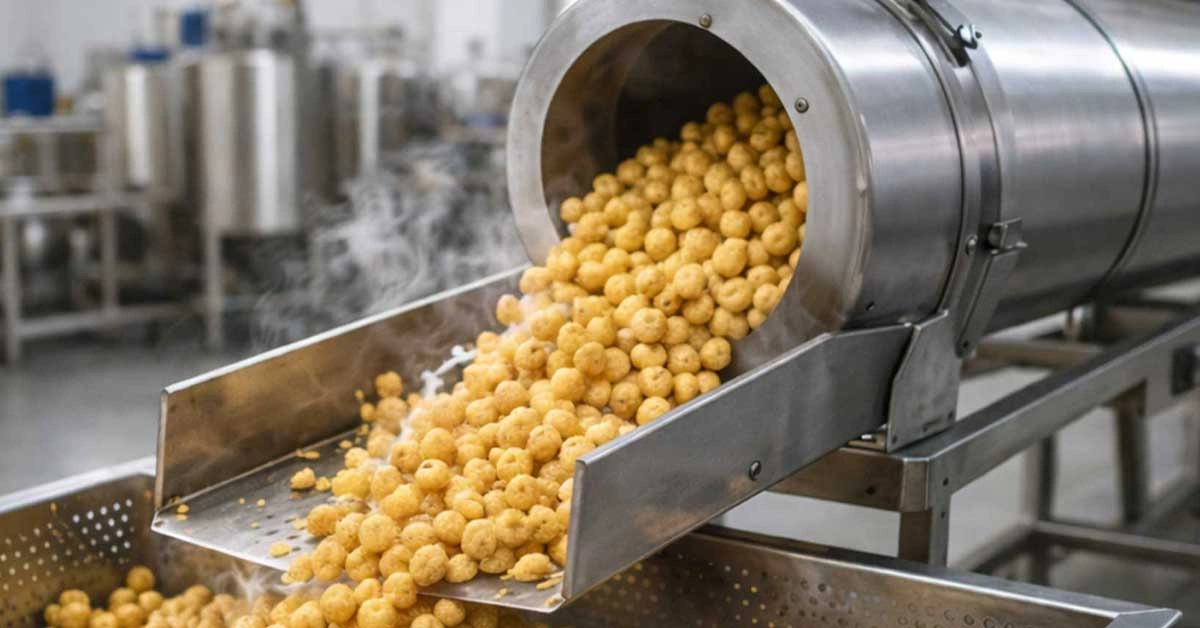
The commercial makhana roasting machine has been created in order to replace manual stirring and estimation process with the process of controlled and repeatable heat application.
In industry, roasting processes can be achieved by using two basic heating processes: either roasting in a rotating drum or roasting in hot air. In roasting in a rotating drum, stainless steel drums rotate kernels continuously through the heating process. Hot air roasting involves circulation of hot air over kernels, and this process eliminates the possibility of contact burns.
Components of a Roasting Machine
- Feed hopper/vibrator feeder-regulates the amount of grading makhana fed to the roasting chamber
- Roasting chamber or drum-the place where heat is applied, usually made of food grade stainless steel (usually SS 304)
- Source of heat-electric, gas or induction heating depending on fuel availability and costs
- Control of temperature panel-allows setting and maintaining the exact range of temperature
- Conveyor/rotation-keeps the kernels moving, ensuring consistent heat application
- Cooling section-cools roasted kernels to the appropriate temperature prior to flavouring
Typical Roasting Parameters
Roasting temperature and time vary by machine design and desired product style, but commercial setups generally work within a fairly narrow band to protect quality:
Manual Roasting vs. Automatic Makhana Roasting Process
Automation doesn’t just mean “faster.” An automatic makhana roasting process combines temperature control, roasting duration, and cooling into one coordinated cycle, cutting down the manual intervention points where inconsistency usually creeps in.
Common Mistakes in the Roasting Stage
With the aid of the best equipment, one is likely to face some problems while roasting. The following are the problems that processors face in their roasting process:
- Overloading of the roasting chamber – overfilling the roasting chamber causes poor heating due to lack of even heat distribution.
- Failure to account for the presence of moisture variability in the raw materials – kernels that have been sorted as the same may have a little variation in moisture.
- Application of same parameters regardless of kernel size – roasting time differs for large and small kernels of suta grades
- Lack of calibration of temperature sensors and heaters
- Hasty cooling of the roasted product
Best Practices for a Reliable Commercial Makhana Roasting Process
- Match roast temperatures to the suta grade instead of a single roast temperature for all sutas
- Regularly recalibrate the temperature sensor instead of only when the output doesn’t look right
- Wait for adequate cooling time before transferring the kernels to the snack coating phase
- Record batch parameters such as temperature, time, and output to detect the drift early, not later when complaints come in
- Train operators on how to determine the readiness of the kernels using visual and auditory cues
When to Choose Manual vs. Machine-Based Roasting
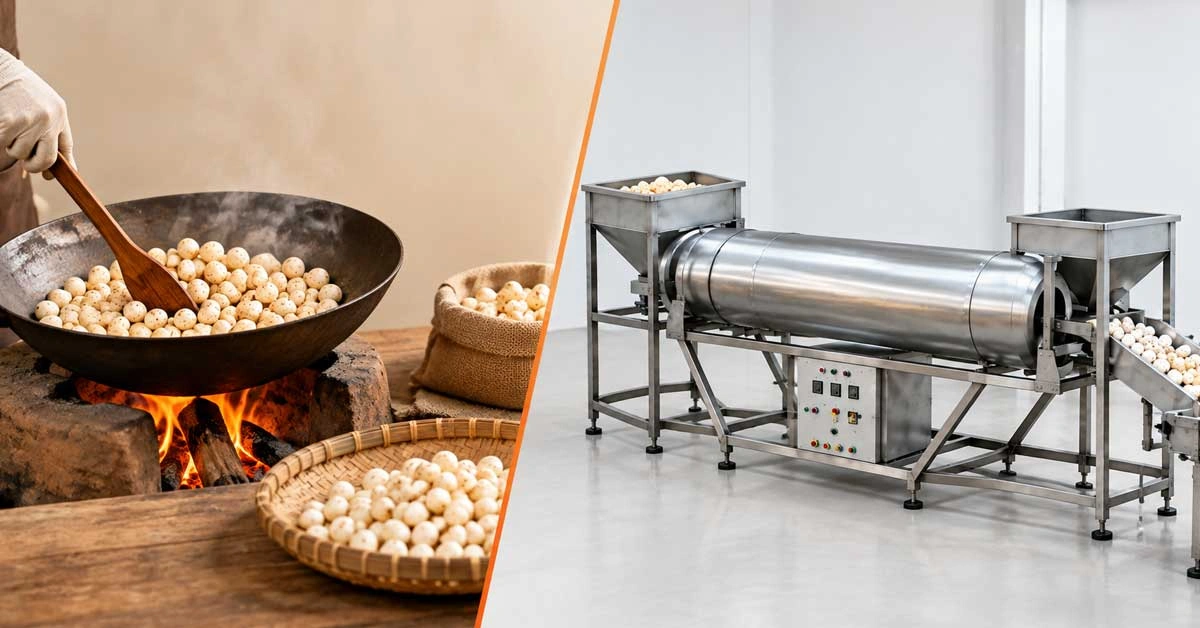
Manual roasting still works when:
- Product quantities are actually small (tens to low hundreds of kilograms per day)
- The product sells in local markets allowing some variance in texture
- No money exists for the acquisition of a roaster
A commercial or automatic roasting machine makes sense when:
- You provide organized retailers, private labels, or exporters looking for consistency.
- Your daily production exceeds the capabilities of manual stirring.
- Your labour costs or labour is the limiting factor.
- You are already using a grading machine, and you need consistency at your outlet end as well.
From Roasting to the Snack Coating Process
Roasting provides the starting point for all subsequent processes. Following roasting, the kernels exit the machine and cool down; then they enter the coating operation, during which edible oils and seasonings are added – typically in a rotary coating drum, which will rotate the kernels.
Undercooked kernels do not absorb the coating uniformly and become soggy easily. Overcooked kernels may have a bitter taste and will not absorb seasonings as well. This explains why roasting quality has a direct effect on the quality of the end product regardless of the quality of the coating process.When configuring or debugging a complete production chain, it is helpful to also look at how the size factor influences the above process – our article about the makhana grading process describes the suta size system, which affects batch uniformity prior to roasting..
Key Takeaways
- Makhana roasting is an intermediate step that helps reduce moisture content in addition to creating the crunchy texture, which takes place after grading and before coating.
- Manual roasting of makhana involves skills of the person and heating of the seeds using open flame or pan heating.
- Commercial makhana roasting equipment utilizes drum heating and hot air heating along with temperature control in the range of 140-160 degrees centigrade.
- Automated makhana roasting is a combination of temperature control, timing, and cooling all into one process.
- Quality of roasting greatly influences performance of kernels during snack coating process.
Conclusion
Whereas the process of roasting is often overlooked in favor of grading and flavouring, it actually carries out the more decisive function than both of those put together within the entire process. Getting the temperature and timing right, and everything else becomes easier in the process downstream.This is true whether you are still carrying out roasting manually or with an automated process of makhana roasting. The essential aim remains the same in either case: even heating, timed well and followed by cooling..
Have a Question? Let’s Connect
Need expert guidance on food processing machines, production setup, or process optimization? Our team is ready to help you choose the right solution for your business.
FAQs
What is the makhana roasting technique?
It involves controlled heating of graded fox nut kernels to remove moisture content and make them crunchy for flavoring and packaging.
What is the temperature required for makhana roasting?
It is in the range of 140°C – 160°C in most commercial makhana roasters, but continuous flow systems work at higher temperatures.
In what ways does the commercial makhana roasting process differ from manual roasting?
The commercial roasting process involves machine-controlled heating and time, whereas manual roasting involves subjective heating of kernels using an open flame.
How does the automatic makhana roasting process go beyond a simple machine process?
It combines temperature, roasting time, and cooling processes in one automatic cycle to avoid operator inputs.
How does roasting affect the snack coating process?
Well-cooked kernels absorb spices evenly, but uncooked or overcooked kernels do not take the spice mixture properly and also reduce their shelf life.
Can roasting have an adverse effect on makhana quality?
Yes, because over-roasting can reduce nutrients and lead to bitter taste and low shelf life of the kernels.
Is manual roasting still a viable option for makhana manufacturers?
Yes, it is viable for low volume production companies who sell locally.




