
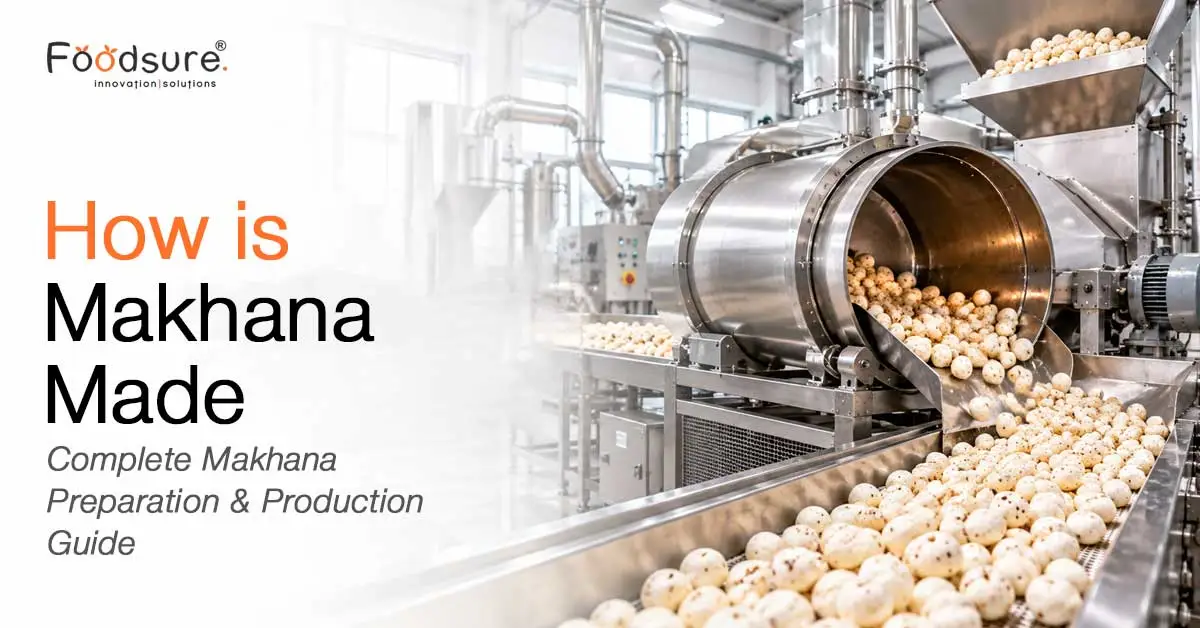
Makhana, also referred to as fox nuts or lotus seeds, has become a favourite raw material in the health snacks and food processing industries. Starting from roasted makhana, all the way through its flavoured and packaged forms, there is much that happens before the final product ends up in the consumer’s hands.
Understanding the complete makhana preparation process is important for businesses planning to enter makhana processing or improve an existing production setup. The processing method used at each stage can influence the final product’s texture, appearance, quality, and consistency.
What Is Makhana?
Makhana is derived from the seeds of the prickly water lily, commonly associated with the plant Euryale ferox. The seeds are collected from water bodies, dried, processed, and eventually transformed into the puffed makhana commonly used as a snack.
Raw makhana seeds are considerably different from the white, puffed product available in retail packs. They undergo multiple processing stages before they become ready for roasting and consumption.
Commercial manufacturers may further process the product into different grades and varieties depending on size, quality, and intended application.
How Is Makhana Made?
The answer to how is makhana made can be understood through the overall production sequence:
The exact procedure may vary based on the manufacturer’s size and whether the company deals with raw seed or popped makhana.
The traditional manufacturing process relies on several steps done manually, whereas factories may use specialized machines to improve efficiency and consistency.
Makhana Preparation Process: From Seed to Popped Makhana
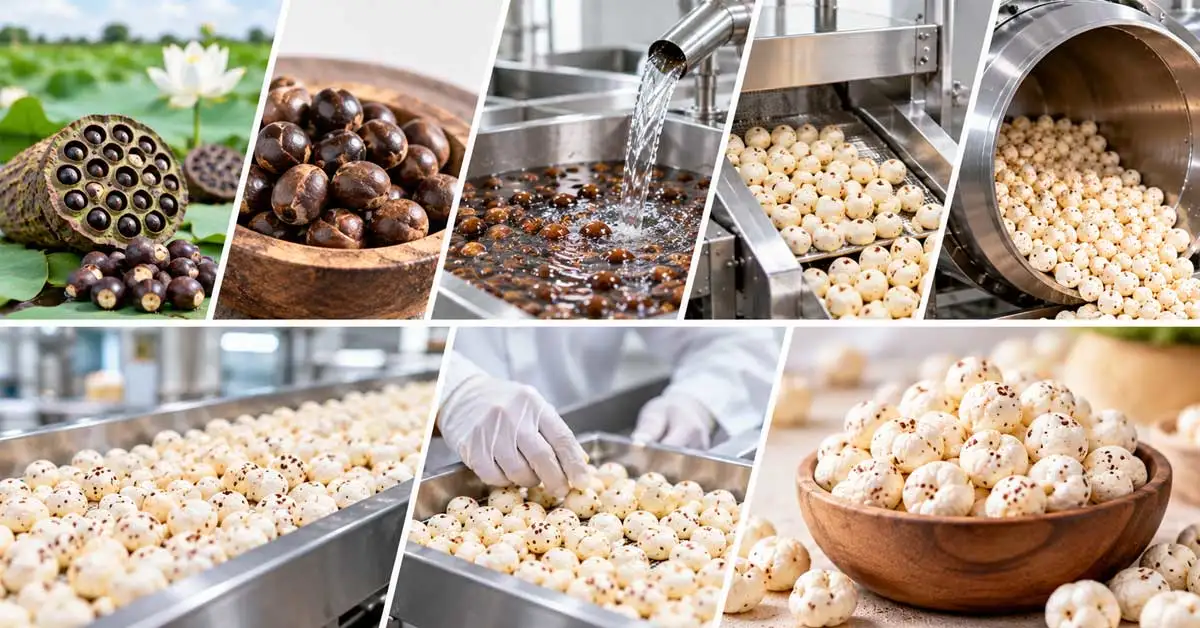
The starts well before roasting. Raw seeds need to undergo preparation so that they can be transformed into the characteristic white, puffed product.
1. Harvesting
Makhana seeds are harvested from the water sources where the plant is grown. The seeds are extracted from the plant material.
2. Cleaning
After harvesting, the raw material may contain dirt, plant debris, and other unwanted materials. Cleaning helps remove these impurities before further processing.
3. Drying
The cleaned seeds need to be dried to achieve suitable moisture conditions for subsequent processing. Proper drying is important because moisture can affect storage stability and the popping process.
4. Grading and Sorting
Seeds can be sorted according to size and quality. Grading helps create more uniform batches and can make subsequent processing easier.
5. Conditioning
The seeds may undergo conditioning or controlled preparation before popping. The objective is to create suitable conditions for the seed to expand during the popping stage.
6. Popping
The prepared seeds are then subjected to heating, resulting in the production of puffed makhana. The traditional process would be done manually and repeatedly, whereas in commercial manufacturing, controlled processing systems could be used for the same purpose.
The quality of the raw seeds, their moisture content, heating process, and other factors could influence the end product.
What Happens During Makhana Popping?
Popping is one of the key steps in the processing of makhana. The aim here is to convert the hard seed into the light, expanded product known as fox nuts.
While popping, the heat causes steam build-up within the seed due to the presence of moisture in the seed. In proper conditions, the steam pressure helps in expanding the seed.
However, all seeds do not pop alike. This can be affected by various factors, including quality of the seed, seed size, moisture content, and heating conditions.
Therefore, sorting of seeds prior to popping is essential for commercial production.
Makhana Roasting Process
Once the makhana has been popped and sorted, it can be roasted to develop a crisp texture and improve its eating characteristics.
The makhana roasting process generally involves exposing the product to controlled heat while maintaining appropriate product movement.
A typical commercial roasting flow is:
The roasting temperature should be regulated depending on the product and the machinery. Over-roasting may affect the taste, texture, and color, while under-roasting will make the product incapable of becoming crispy.
More information on roasting processes can be obtained by learning how to roast makhana before purchasing machinery for commercial production.
Commercial Makhana Production
Commercial makhana production involves converting raw or semi-processed makhana into a consistent finished product at a scale suitable for retail, wholesale, export, or food-service markets.
Unlike small-scale processing, commercial production requires greater attention to:
- Production capacity
- Batch consistency
- Product hygiene
- Raw material quality
- Process control
- Labour requirements
- Equipment selection
- Storage
- Packaging
- Quality inspection
A commercial processing setup may include separate equipment for cleaning, grading, roasting, flavouring, conveying, and packaging.
The exact production line depends on the final product. A manufacturer producing plain roasted makhana will have different requirements from one producing multiple flavoured varieties.
Traditional vs Commercial Makhana Production
| Factor | Traditional Processing | Commercial Processing |
|---|---|---|
| Production Scale | Small | Medium to large |
| Labour Requirement | High | Lower with automation |
| Process Control | Mostly manual | More controlled |
| Batch Consistency | Variable | More consistent |
| Production Speed | Lower | Higher |
| Equipment Requirement | Limited | Specialised machinery |
| Scalability | Limited | Better suited for expansion |
| Product Range | More limited | Multiple products possible |
Traditional methods can remain useful for small-scale operations, but commercial manufacturers generally require equipment that can handle higher volumes while maintaining consistent processing conditions.
Role of Machinery in Makhana Production
Machinery can be introduced at different stages of the processing line depending on production requirements.
Common equipment may include:
- Cleaning machines
- Grading and sorting systems
- Roasting machines
- Cooling systems
- Flavouring machines
- Coating equipment
- Conveyors
- Weighing systems
- Packaging machines
The goal is not to mechanize all the processes. Rather, companies should determine those places where machines can make improvements in terms of capacity, consistency, hygiene, and labor efficiency.
When purchasing machines, businesses should consider the makhana processing machine price along with other aspects like capacity, construction, degree of automation, maintenance, and amount of production.
How to Make Makhana for Commercial Snack Production
For businesses asking how to make makhana for the packaged snack market, the process does not end with popping.
After obtaining suitable popped makhana, manufacturers may roast the product and then introduce seasoning or coating depending on the desired product.
A commercial snack production flow can therefore look like:
In the case of flavoured snacks, uniform distribution of the seasoning is critical to the success of the process. Packaging will offer protection against environmental elements during storage.
Factors Affecting Makhana Quality
Several factors can influence the final quality of makhana throughout production.
Raw Material Quality
Good-quality seeds provide a better starting point for processing. Size, maturity, moisture condition, and physical condition can influence subsequent stages.
Moisture Control
Moisture needs to be managed during storage and processing because it can affect popping, crispness, and finished-product stability.
Heating Conditions
Both popping and roasting require appropriate heating conditions. Excessive or insufficient heating can negatively affect the final product.
Sorting
Removing damaged or unsuitable pieces can improve the overall appearance and consistency of the finished batch.
Handling
The popped Makhana is quite delicate. Breakages may be increased by too much mechanical handling; that is why the appropriate equipment needs to be chosen with regard to the nature of the product.
Packaging
Proper packaging helps protect the finished product from moisture and other environmental factors that can affect crispness.
Can Makhana Production Be Automated?
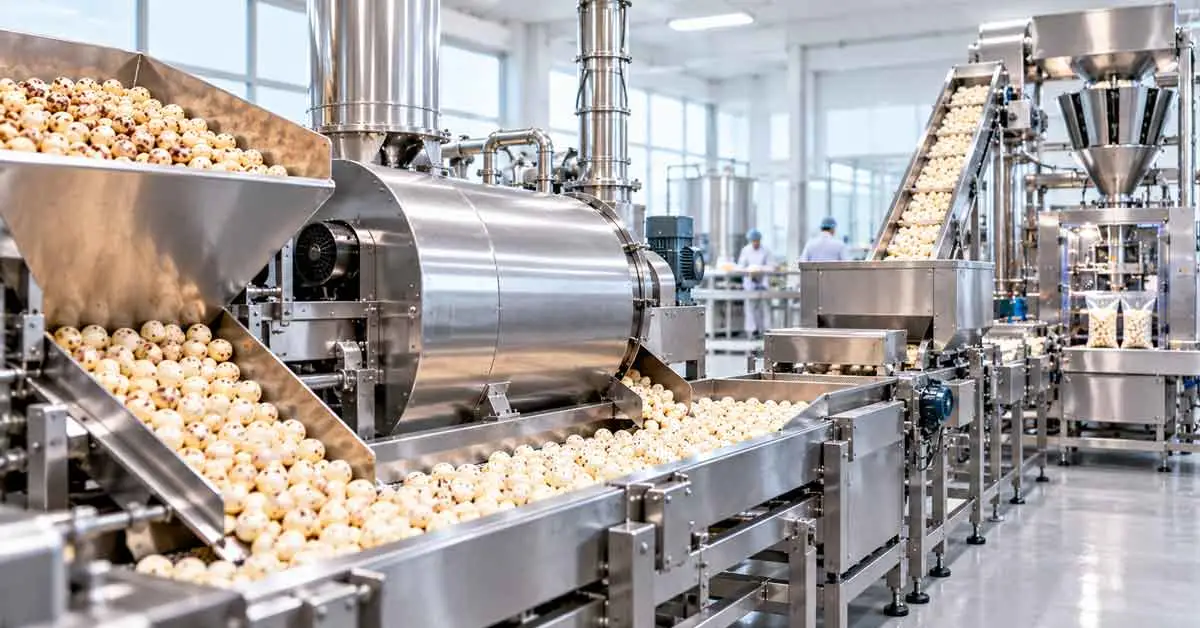
Yes, different stages of the manufacturing process can be either mechanized or automated, depending on the size.
A small-scale manufacturer can employ different machines for roasting and flavouring processes but still do loading and inspection manually. A large-scale manufacturer may combine different stages through conveyors, automatic feeding, roasting, seasoning, and packaging.
Automation can help improve:
- Production consistency
- Processing speed
- Labour efficiency
- Batch control
- Material handling
- Production scalability
However, automation should be selected according to actual production requirements rather than simply choosing the highest level available.
Hygiene and Quality Control
Hygiene is a major concern during the production of makhana at all stages of processing. In particular, hygiene becomes a matter of concern in the case of food manufacturing firms that produce packaged food items.
Processing areas should be kept clean, while product-contact surfaces should be suitable for food-processing applications. Equipment should also be designed to allow practical cleaning and maintenance.
Quality checks may include:
- Raw material inspection
- Size and grade checking
- Popping quality
- Roasting consistency
- Colour and appearance
- Texture and crispness
- Seasoning distribution
- Packaging quality
Consistent monitoring at different stages can help manufacturers identify process issues before they affect large batches.
Conclusion
Understanding how is makhana made means analyzing all stages of the process from the initial raw materials through to the end product. Cleaning, drying, grading, conditioning, popping, roasting, flavoring, and packaging are some of the procedures that help make the end product better.
The makhana preparation process can be carried out using traditional methods at a small scale, while larger manufacturers can introduce specialised equipment to improve capacity, consistency, hygiene, and production efficiency.
The controlled roasting of makhana is especially significant during the processing of makhana into a commercial snack because roasting has an effect on taste, texture, and the quality of the product.
As the demand for packed makhana products keeps opening up new possibilities for makhana producers, they can acquire appropriate machinery based on their manufacturing needs step-by-step.
For manufacturers planning commercial makhana production, the right combination of processing equipment, quality control, and packaging can help create a more consistent and scalable production operation.
Have a Question? Let’s Connect
Need expert guidance on food processing machines, production setup, or process optimization? Our team is ready to help you choose the right solution for your business.
Frequently Asked Questions
How is makhana made from raw seeds?
Makhana goes through the process of being cleaned, prepared, heated, and then popped to become a final product. The popped product is then sorted and can be roasted, flavored, and packed for use.
What is the makhana preparation process?
The makhana processing sequence usually includes harvesting, cleaning, drying, grading, conditioning, popping, sorting, and finally the processing stage, which includes roasting and flavoring.
What is the purpose of roasting makhana?
Roasting helps develop the desired crisp texture and eating characteristics of makhana. Controlled roasting is especially important in commercial snack production.
How is commercial makhana production different from traditional processing?
Commercial makhana production generally uses specialised equipment, higher processing capacities, structured quality control, and more systematic material handling compared with traditional manual processing.
Can makhana production be done using machines?
Yes. Machines can be utilised at various stages such as cleaning, sorting, roasting, flavoring, conveying, and packing. The degree of mechanization depends upon the scale of production and business needs.




