
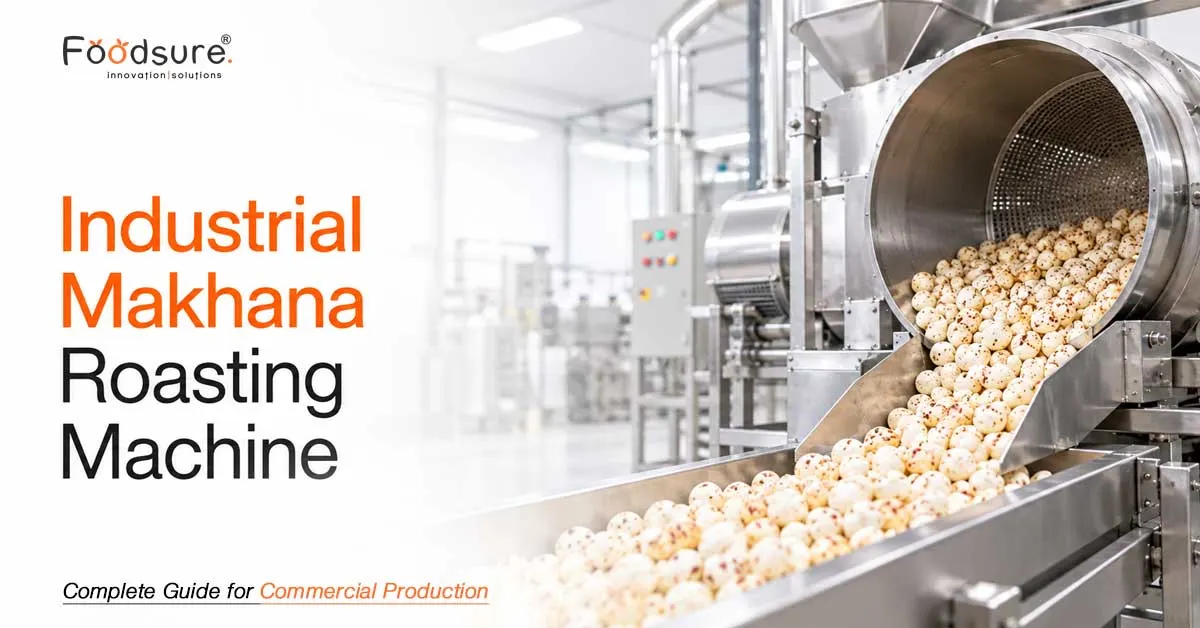
Makhana has emerged as one of the popular snack varieties both in domestic as well as foreign markets, leading to the creation of increased demand for the effective process technology. Roasting is an extremely crucial step in makhana processing due to its impact on texture, taste, moisture, and quality.
An Industrial Makhana Roasting Machine is used by producers to roast larger amounts of makhana in a consistent and regulated process. The selection of a suitable roasting machine for businesses that intend to increase their production capacity can help in enhancing efficiency and uniformity.
What Is an Industrial Makhana Roasting Machine?
An Industrial Makhana Roasting Machine is commercial food-processing equipment designed to roast makhana in controlled quantities using regulated heat and mechanical movement. Unlike traditional pan or manual roasting methods, industrial systems are designed for continuous or batch production with better control over temperature, residence time, and product movement.
This machinery enables producers to produce more while lessening their reliance on manual labor. According to their production needs, producers have the liberty of choosing their roasting machinery depending on its size, heat source, automation, available space, and compatibility with other processing machines.
A properly selected industrial makhana roaster can help maintain consistent roasting conditions throughout production. This is particularly important for commercial products where every batch needs to achieve a similar colour, crispness, and texture.
Why Is Industrial Makhana Roasting Important?
Roasting is not just the process of cooking makhana. It requires careful control to avoid such problems as under-roasting, over-roasting, uneven cooking, or moisture absorption.
For commercial production, an Industrial Makhana Roasting Machine offers several operational advantages:
- Consistent roasting: The management of operating conditions facilitates the achievement of consistency in roasting.
- Higher production capability: Industrial equipment is capable of processing much higher amounts compared to traditional manual processing.
- Greater process control: Temperature, roasting time, and product movement can be better regulated.
- Reduced labour input: Semi-automatic and automatic processing requires less physical work.
- Hygienic: Use of food grade materials and better-controlled processing can lead to hygienic production.
- Scalability: Industrial roasting systems can be chosen based on current and expected production volumes.
These factors make industrial roasting particularly relevant for manufacturers supplying packaged snacks, flavoured makhana, private-label products, and large retail markets.
How Does an Industrial Makhana Roaster Work?
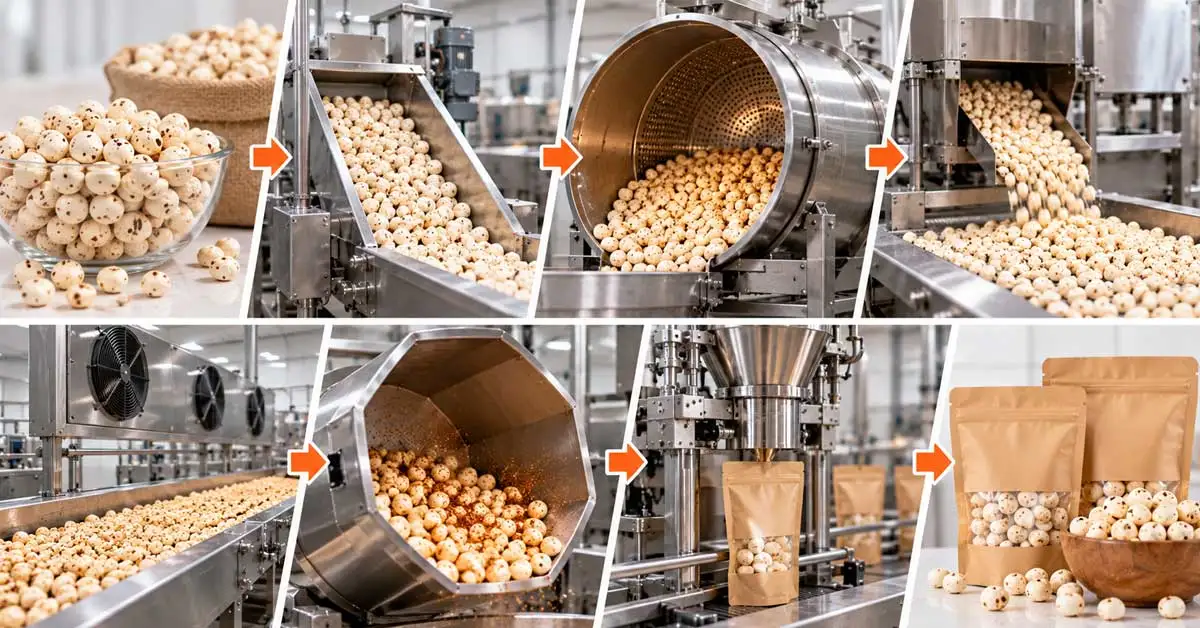
An industrial makhana roaster generally works by exposing makhana to controlled heat while maintaining continuous or controlled product movement. The exact working mechanism varies according to the machine design and heating configuration.
A typical roasting operation involves:
Makhana enters the roasting process in its raw form. It is then subjected to controlled heat as it goes through the roasting chamber. The motion in mechanical form exposes the pieces to heat available within.
Cooling may be the next process after roasting for further processing of the product. This is important because hot makhana may affect packaging efficiency.
Key Features of a High-Capacity Makhana Roasting Machine
A high capacity makhana roasting machine is designed for manufacturers who need to process larger quantities without compromising roasting consistency.
Important features may include:
Controlled Heating System
The controlled heating system helps ensure that the manufacturers provide the right roasting conditions during the whole process.
Continuous Product Movement
Mechanical movement keeps the makhana moving through the roasting zone, helping distribute heat more evenly and reducing the chances of localised overheating.
Food-Grade Construction
The machinery used in the processing of food must have proper material for the parts that come in contact with food products. The use of stainless steel could be considered for this purpose.
Capacity-Based Design
Each company has specific requirements for its production. It would therefore be more appropriate to select a roaster based on the volume that it is likely to produce per hour.
Easy Operation
The modern methods may also incorporate control panels which enable the operators to monitor and manipulate certain parameters. This is an easier way to produce compared to the completely manual roasting.
Integration with Other Equipment
The roasting stage can be connected with cooling, seasoning, coating, conveying, and packaging systems to create a more streamlined makhana processing line.
Industrial Makhana Processing Equipment for Commercial Production
Roasting is only one part of commercial makhana manufacturing. Businesses planning an integrated production facility may require several machines working together.
Industrial makhana processing equipment may include:
- Makhana cleaning and sorting machines
- Roasting machines
- Cooling conveyors
- Flavouring/seasoning machines
- Coating machines
- Weighing and packing machines
- Sealing and packaging machines
- Conveyors/material handling machines
This is determined by the product range and volume of production. For instance, a producer that is manufacturing plain roasted makhana will have a different setup compared to that of a flavoured snacks manufacturer who will need more equipment for seasoning and packaging.
For large-scale manufacturers, automation can be used to link all the stages of production.
Manual Roasting vs Industrial Roasting
| Factor | Manual Roasting | Industrial Roasting |
|---|---|---|
| Production Volume | Limited | High |
| Labour Requirement | Higher | Lower |
| Roasting Consistency | Operator-dependent | More controlled |
| Process Monitoring | Mostly manual | Systematic |
| Scalability | Limited | Better suited for expansion |
| Integration | Difficult | Easier |
| Commercial Production | Less suitable at large scale | Suitable |
Manual roasting may work for small-scale operations, testing, or very limited production. However, businesses supplying larger markets generally require more consistent and scalable roasting systems.
Benefits of Using an Industrial Makhana Roasting Machine
Investing in an Industrial Makhana Roasting Machine can provide several benefits for commercial manufacturers.
1. Higher Production Efficiency
Industrial roasting equipment can process larger quantities within a controlled production cycle, helping businesses meet increasing market demand.
2. Consistent Product Quality
Uniform operating conditions can help manufacturers achieve more consistent roasting results. This is particularly important for packaged products where consumers expect similar texture and flavour across purchases.
3. Lower Manual Dependency
Mechanised roasting reduces repetitive manual operations and allows workers to focus on monitoring, quality control, and other production activities.
4. Better Process Control
Controlled heating and product movement provide greater control over the roasting stage compared with traditional methods.
5. Easier Production Scaling
A suitable industrial system can support higher production volumes as a business expands into new markets, retail channels, or product categories.
6. Improved Hygiene Management
Improved hygiene practices within the manufacturing process may be achieved by controlled material handling and food-grade equipment construction.
Choosing the Right Industrial Makhana Roasting Machine
Choosing the roasting machines needs more than just comparing prices of the machine. It is important to consider the total production needs first.
Production Capacity
First determine the required output per hour. A small manufacturer may not need the same system as a large snack-processing facility. Selecting capacity according to actual demand can help avoid unnecessary investment.
Heating Method
Evaluate the available heating system and how effectively it can provide consistent roasting conditions. Energy consumption and operating requirements should also be considered.
Automation Level
Businesses should determine if they require manual operation, semiautomatic operation, or highly automated operations. Automation could be beneficial in situations where there is large-scale production that requires process control.
Machine Construction
Check the material used for product-contact components, overall build quality, accessibility for cleaning, and suitability for food-processing applications.
Maintenance Requirements
The equipment should be easy to inspect, clean, and maintain. Ease of access and simple maintenance can contribute towards minimizing downtime for production.
Future Expansion
If the business expects production volumes to increase, it may be useful to consider equipment that can support future expansion or integration into a larger processing line.
Role of an Automated Hex Type Roaster for Makhana
An automated hex type roaster for makhana can be considered when manufacturers are looking for controlled roasting combined with automated operation. The design can support systematic product movement and controlled exposure to heat during roasting.
Automated systems help to minimize repetitive operator intervention and offer better control over the parameters of production. For the manufacturing business, when selecting among various types of roasters, considerations of capacity, characteristics of the product, heating system, floor area, and automation requirements should be taken into account.
Prior to choosing the particular type of roaster, manufacturers should assess the place of the machine in the entire production line process.
Maintenance of Industrial Makhana Roasting Equipment
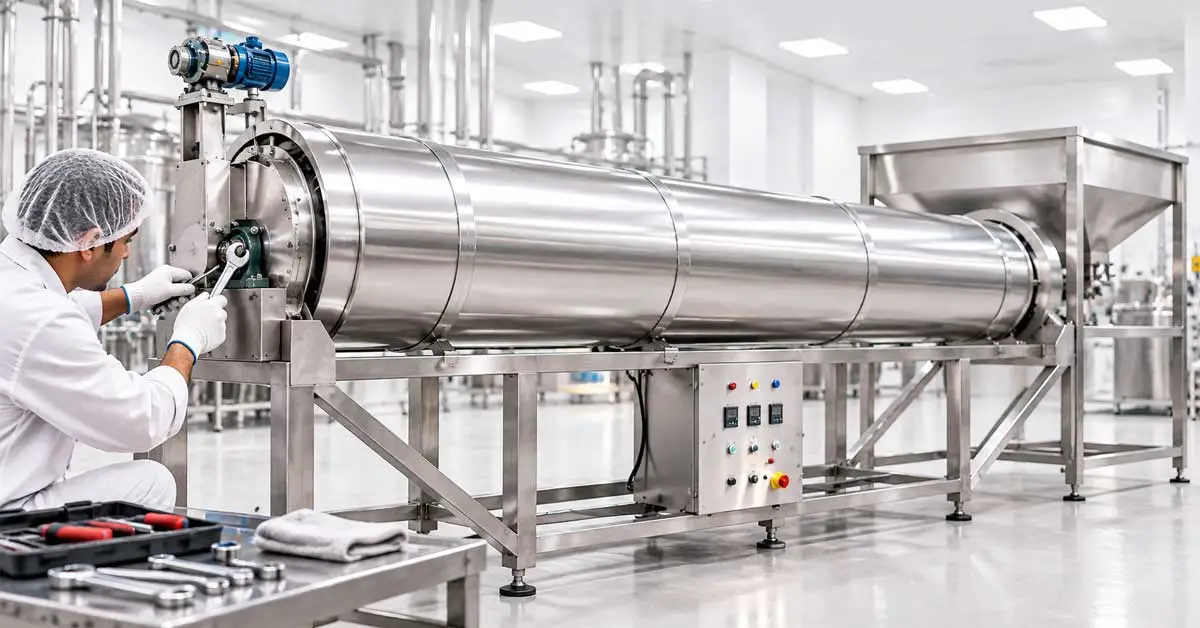
Maintenance is important for ensuring consistent performance in roasting. Even a perfectly designed machine will encounter problems when cleaning and maintenance are overlooked.
Key maintenance practices include:
- Cleaning the surface that comes into contact with cleaning productsInspecting moving parts
- Inspecting heaters and temperature controls
- Cleaning off food residues
- Inspecting electrical connections
- Lubrication of components, according to the manufacturer’s instructions
- Inspection of belts and bearings
- Maintenance as per the schedule suggested by the manufacturer
The cleaning process should be done considering the equipment design and food safety regulations. Maintenance activities should also be done in accordance with machine safety regulations.
Integrating Roasting into a Makhana Processing Line
For commercial manufacturers, roasting can be connected with subsequent processing stages to create a more efficient production flow.
A typical commercial setup may follow:
Raw Makhana → Cleaning/Grading → Roasting → Cooling → Flavouring → Coating → Packaging
It can help minimize unnecessary movement of products between individual machines. It also helps manufacturers set up a better production process with well-defined processing stages.
In the case of businesses that manufacture multiple flavors, the roasting process may form the common processing stage for various seasoning or coating processes.
Cost Factors to Consider
The investment required for an industrial roasting setup depends on several factors rather than one fixed machine price.
Important cost considerations include:
- Machine capability
- Heating equipment
- Level of automation
- Machine build quality
- Control system
- Further conveyors
- Cooling systems
- Installation requirements
- Compatibility with other machines
- Post-sales and maintenance assistance
Instead of just considering the cost of acquisition, the business needs to consider the total need for equipment and its operation costs. Issues like energy use, labor, maintenance, and expected output are some things that might influence the economics of the system.
Why Choose a Reliable Makhana Machine Supplier?
The role of the supplier becomes critical during the installation of commercial processing machinery. A trustworthy makhana machine supplier India can assist in assessing the production needs and choosing the appropriate machinery.
Before finalising a supplier, manufacturers should consider:
- Construction of the machine
- Materials used
- Capacity of production
- Customization opportunities
- Support during installation and startup
- Availability of spare parts
- Maintenance services
- Technical support
- Experience in commercial food-processing machines
An ideal supplier must know the whole processing process and not just supply a machine in isolation without considering how it will function in the production line.
Conclusion
An Industrial Makhana Roasting Machine is an essential component in today’s modern process of making makhana. This is through ensuring that the heating process is controlled, systematic movement of the product, and increased processing capacity, which will enable producers to be more efficient.
Choosing an industrial makhana roaster involves considering several factors such as capacity, roasting technology, automation, structure, maintenance, energy use, among others. With the correct industrial makhana roasting machine that is high capacity, companies will benefit from increased production needs.
For businesses planning a complete production facility, choosing suitable industrial makhana processing equipment across roasting, cooling, flavouring, and packaging can create a more efficient and scalable manufacturing setup.
Have a Question? Let’s Connect
Need expert guidance on food processing machines, production setup, or process optimization? Our team is ready to help you choose the right solution for your business.
Frequently Asked Questions
What is an Industrial Makhana Roasting Machine?
Industrial Makhana Roasting Machine refers to commercial roasting machine used in roasting of makhana in controlled amounts through controlled heat application and physical movement of the product.
What capacity is suitable for commercial makhana roasting?
The capacity requirement depends upon the amount of production by the firm, the demand in the market, the number of working hours, and the future plans for expansion of the firm. The capacity should be decided according to the projected hourly output.
Can industrial makhana roasters be integrated with other machines?
Yes. Industrial roasting systems can be integrated with cooling, flavouring, coating, conveying, and packaging equipment to create a more streamlined processing line.
What should I check before buying a makhana roasting machine?
Critical considerations are capacity, method of heating, degree of automation, type of equipment, cleaning needs, power usage, servicing assistance, and compatibility with other parts of the manufacturing process.
Is an industrial roasting machine suitable for small businesses?
This is dependent on the production needs of the business. Businesses with small scale of production may have to use machines with smaller capacity, while businesses that need more production will require industrial machines.




