
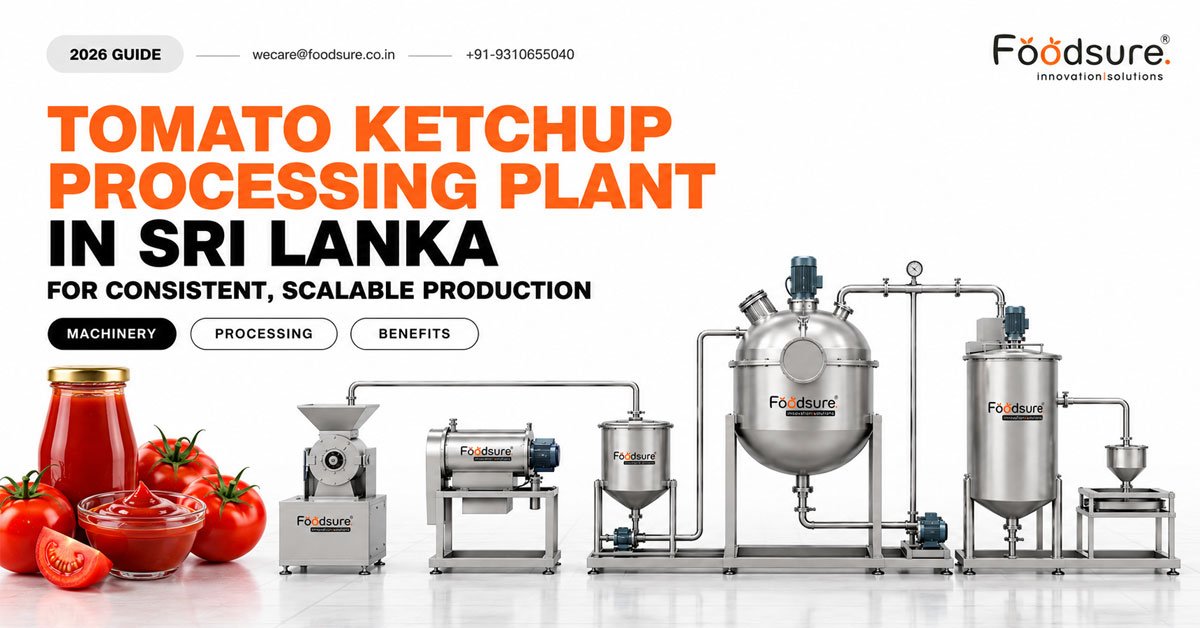
There are opportunities to produce tomato products of added value from the food processing sector of Sri Lanka. Ketchup is commonly consumed by individuals, hotels, quick-service restaurants, catering firms, and restaurants. A well-planned tomato ketchup processing plant in Sri Lanka will be able to ensure commercial production of this product.
Modern ketchup plants incorporate fresh tomato processing, filling, sealing, and labeling. Suitable equipment will increase efficiency, ensure uniform consistency, minimize manual handling, and facilitate expansion in the future.
Why Is Tomato Ketchup Production an Opportunity in Sri Lanka?
Tomatoes may be processed to produce ready-to-shelf products like ketchup that would appeal to both the food service industry and retail sectors in different packaging sizes. A Tomato Ketchup Plant in Sri Lanka could also allow for expansion into other tomato products in the future.
Some of the opportunities that exist include:
- Increasing trend in the consumption of convenience foods: The use of ready-to-use condiments is common in both homes and commercial food preparation.
- Several different customer segments: Ketchup can be marketed to retailers, restaurants, hotels, caterers, and food services.
- Added value: The processing of tomatoes to make ketchup adds more value commercially than the sale of the raw product.
- Packaging versatility: Manufacturers can package the ketchup in bottles, pouches, sachets, among others.
- Future growth: An easily scalable facility will allow the manufacturers to increase production or introduce other tomato products in the future.
Therefore, this makes a tomato ketchup production plant in Sri Lanka an investment option for companies wishing to establish a structured processed food manufacturing company.
Why Set Up a Tomato Ketchup Processing Plant?
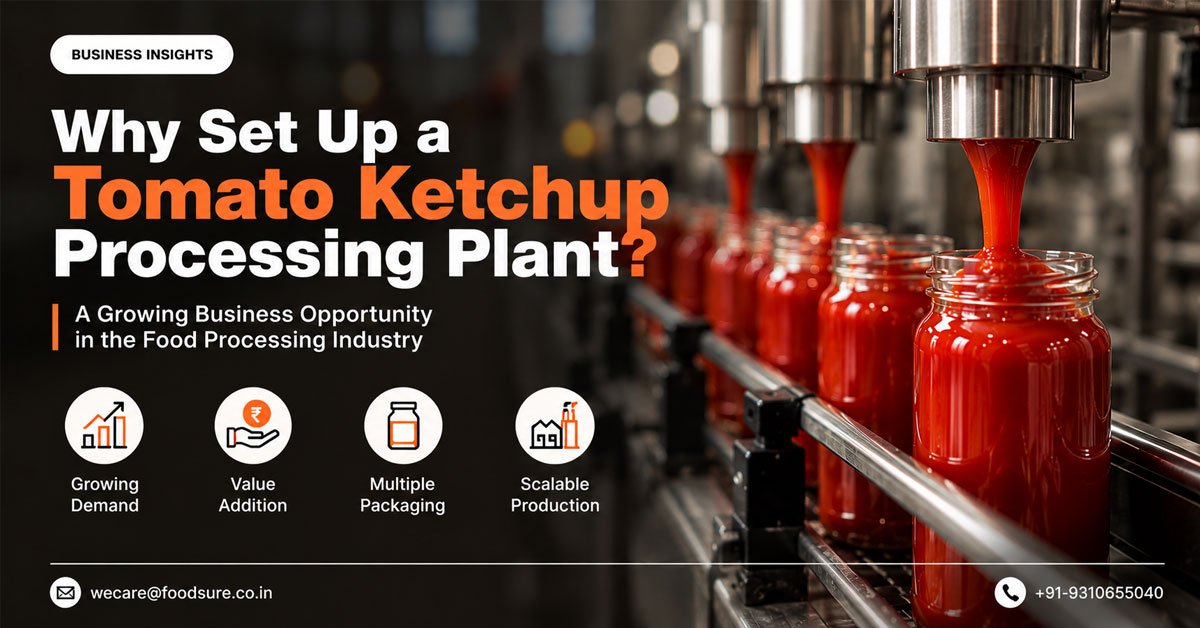
Ketchup manufacturing comprises tomato processing, tomato pulp, cooking, blending, homogenization, filling, and packaging. Having an Integrated tomato ketchup manufacturing plant in Sri Lanka ensures efficient and quality manufacturing.
- Maintaining consistency in the texture and look of the product
- Maintained processing parameters
- Efficient use of the raw material
- Reducing manual labor
- Improvement in production efficiency
- Hygienic processing
- Consistency in filling and packaging
- Easy monitoring of production
- Future capacity expansion
The production plant can also be designed depending on the needs of the manufacturer. The smaller plants can opt for a semi-automatic plant, whereas the large-scale commercial plant should have an automatic processing and packaging line.
From Fresh Tomatoes to Bottled Ketchup
The entire process starts by identifying and preparing tomatoes that will be used in the production of ketchup. Raw tomatoes are cleaned and sorted to get rid of any soil and damaged or unfit tomatoes. After this, the tomatoes are crushed and pulped to separate the pulp from the peels and seeds.
The pulp is then subjected to cooking and mixing processes whereby the pulp is processed to get the right consistency. The homogenization process may help to ensure uniformity of the product before it is stored and filled into bottles.
This process ends with filling, capping, labeling, and packaging of the bottles.
Tomato Ketchup Production Flow
Fresh tomatoes are carefully processed through each stage to achieve the desired ketchup consistency, flavour, and quality.
Fresh Tomatoes
↓
Washing
↓
Sorting
↓
Crushing
↓
Pulping
↓
Cooking
↓
Mixing & Blending
↓
Homogenisation
↓
Storage
↓
Bottle Filling
↓
Capping
↓
Labelling
↓
Final Packaging
However, the precise flow may differ based on the nature of the product, production capacity, degree of automation, and packaging needs at the Tomato Ketchup Processing Plant in Sri Lanka.
Raw Tomato Preparation: The First Step in Ketchup Production
Ketchup’s quality is determined by the quality of the tomatoes that go into its production. Prior to the processing phase, tomatoes have to be handled in such a way as to avoid any contamination.
Washing
Tomato washing facilitates cleaning of the raw material from any soil, dust, or other impurities. Good cleaning is necessary for obtaining more favorable initial conditions for the following stages of the process.
Sorting
Sorting allows distinguishing damaged, overripe, unripe, or otherwise undesirable tomatoes among the good quality raw material. Sorting may be conducted either manually or by means of special machine devices.
Crushing
After the tomatoes are washed and sorted, they are crushed into pieces. In this way, they are prepared for pulp extraction.
Thus, proper raw material preparation plays an important role in maintaining the productivity of a commercial ketchup factory.
Tomato Ketchup Processing Steps
Production of bottled tomato ketchup is made up of various interconnected processes, whereby each process contributes to the quality and consistency of the end product. Proper integration of the tomato ketchup processing plant in Sri Lanka would integrate these processes into an efficient production line.
Washing and Sorting
It starts with washing of freshly harvested tomatoes in order to clean out soil, dust, and other contaminants from their surfaces. In addition to this, tomatoes are sorted in order to eliminate those that are damaged, rotten, unripe, and generally unsuitable for further use. Correct washing and sorting ensure a higher quality of raw material for further processing steps.
Crushing
After sorting, tomatoes are crushed. This facilitates subsequent processing and pulp extraction. A proper crushing setup will enable the transition from processing of raw material to pulping in a smooth manner.
Pulping: Extraction of Tomato Pulp from Skin and Seeds
The processed tomatoes will then be fed into the pulping machine, which will separate the tomato pulp from the skin, seeds, and other fibrous components of the tomato. This process is very vital as the quality of the pulp obtained can determine the texture of the final ketchup.
Some of the benefits of an effective pulping system include:
- Greater pulp yield
- Smooth texture of end-product
- Uniform pulp quality
- Less waste material
- Optimal use of raw materials
The pulper must be chosen based on the desired processing capacity and raw material properties.
Cooking and Concentration
Tomato pulp that has been extracted will then go through the process of cooking, which will help in developing the right product qualities. In cases where concentration is needed according to the product specifications, concentration can also be used during this process.
It is important that cooking be controlled for effective processing in the Tomato Ketchup Production Plant in Sri Lanka.
Mixing and Blending
The blended tomato pulp is mixed with the desired components to form the base of the ketchup. Efficient mixing systems would help achieve the necessary distribution of the components.
Proper mixing may help in achieving the following:
- Uniform distribution of components
- Consistency in taste and texture
- Consistency from one batch to another
- Control of product characteristics
- Efficient commercial processing
Mixing machines need to be chosen depending on several factors.
Homogenisation
Homogenization assists in making the ketchup more homogeneous and smooth by decreasing the size of the particles.
The right homogenizer must be chosen depending on the viscosity of the product, processing capacity, and texture requirement. Correct homogenization allows for maintaining the consistent properties of the product prior to packaging and storage.
Storage Before Filling
The completed ketchup can then be transported to the appropriate storage or holding tank before the filling process. This gives way for an additional controlled step prior to packaging.
A well-designed storage tank will be able to ensure the quality of the product and ensure that there is always a constant supply of ketchup to the filling machine. This becomes especially important in an automated Tomato Ketchup Plant in Sri Lanka.
Bottling and Packaging
When the ketchup is ready to be packaged, it is put in bottles, packets, sachets, or any other container. The process involves filling, sealing, labeling, and packaging. Proper filling and sealing ensure the quality of the product when stored or transported.
Key Machinery Required for a Tomato Ketchup Plant
Machinery arrangements are dictated by production capacity, product requirements, plant layout, and degree of automation. Arrangements in a business Tomato Ketchup Manufacturing Plant in Sri Lanka could comprise:
- Tomato Washing Machine: Used for washing off dirt and dust particles from freshly plucked tomatoes.
- Sorting Machine: Used for separating those tomatoes which cannot be used from usable raw material.
- Tomato Crusher: Used for crushing tomatoes in order to make their processing easier.
- Tomato Pulper: Helps separate tomato pulp from the skin, seeds, and other fibers.
- Cooking and Concentration Machine: Helps in the heating process to reach the required ketchup consistency.
- Mixing and Blending Tanks: Help in ensuring uniform mixing of the raw material.
- Homogeniser: Helps in making the product uniform and smooth in nature.
- Storage Tanks: Store prepared ketchup before sending it to the filling section.
- Filling Machine: Used for filling an exact quantity of ketchup in the required bottles or containers.
- Capping Machine: Used for closing the container in a sealed form.
- Labelling Machine: Used for putting appropriate labels on products.
- Packaging Machine: Used in packaging prepared ketchup.
- Conveyor: Links all machines and helps in maintaining proper flow of operations.
Instead of selecting the machinery individually, manufacturers should think about how these machines would fit in as an entire process line. There is also the option to investigate the right Tomato Ketchup Machine in Sri Lanka according to their capacity requirements and packing needs.
Benefits of an Integrated Tomato Ketchup Processing Line
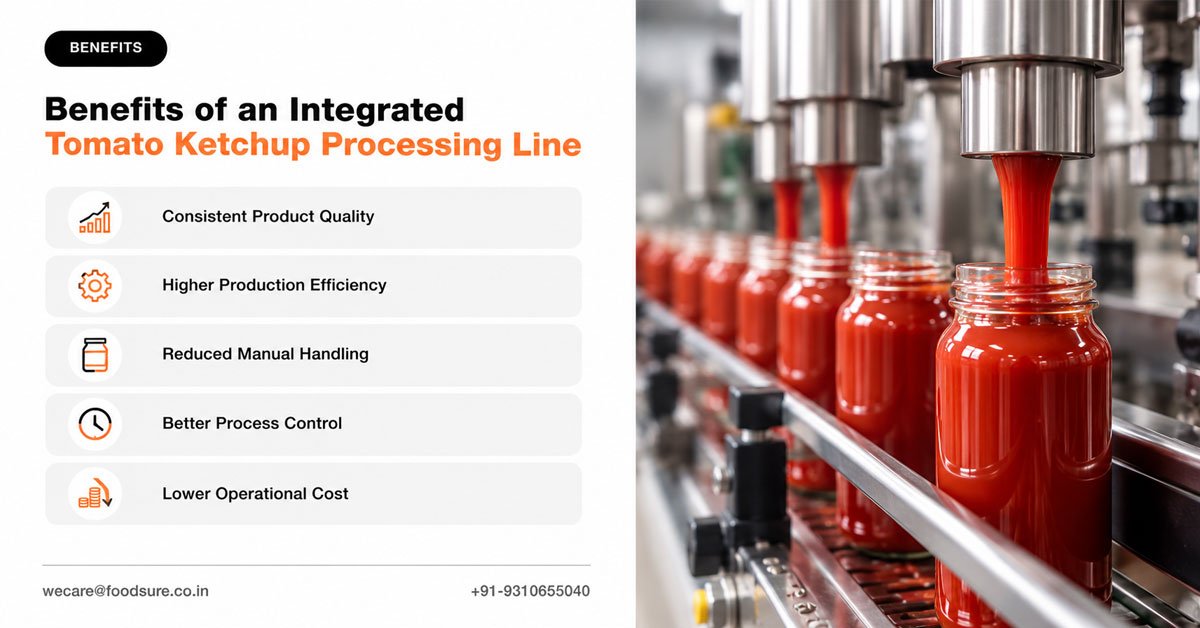
Integrating a ketchup processing plant’s processing and packaging machinery creates an efficient process. Rather than treating washing, pulping, cooking, filling, and packaging as separate operations, integration lets the whole process work together as a line.
A well-designed Tomato Ketchup Processing Plant in Sri Lanka can provide:
- Consistent output: Machinery that is uniform allows for a constant processing rate.
- Manual handling reduced: Automation can eliminate unnecessary movement and contact with products.
- Increased efficiency: Machinery may increase production capacity.
- Process monitoring: Processors will be able to monitor key processing points easily.
- Hygiene improved: Controlled movement of materials facilitates clean production.
- Space use improved: Proper machinery placement will provide an organised factory setup.
- Production capacity scalable in future: The plant can be scaled in the future to cope with increased production.
Role of Automation in Tomato Ketchup Production
The value of automation increases when the scale of production is high. For instance, A Tomato Ketchup Production Plant in Sri Lanka may choose either semi-automation or full automation.
Benefits of automation are:
- Lower human involvement: Automation of routine processes.
- Process uniformity: Provides a uniform production process.
- Effective monitoring: Facilitates process monitoring for important stages.
- Enhanced efficiency: Enables an efficient production process.
- Easier scaling: Can handle future expansion in production capacity.
Quality and Hygiene Considerations
The standards of quality and hygiene should be maintained throughout the process of manufacturing ketchup. These include:
- Raw material quality: Inspection and cleaning of the tomatoes prior to processing.
- Hygienic equipment: Use of hygienic equipment that is suitable for food processing.
- Ease of cleaning: Equipment that can be easily cleaned.
- Process control: Proper cooking, mixing, and homogenization of the ketchup.
- Hygienic filling: Hygienic filling and packing of the processed ketchup.
All the above factors ensure product quality and hygiene at a Tomato Ketchup Plant in Sri Lanka.
Choosing the Right Capacity for a Ketchup Plant
Capacity must be determined based on the level of demand, availability of raw materials, factory space, packaging, and future plans of the business.
Inability to match capacity to the required level can cause either hindrances in growth or over-investment and inefficient use of machinery. Manufacturers will thus have to know how much they expect to produce before making decisions about the design of the plant.
Capacity of each machine must also be correctly considered since if one process is much slower than the others, it will become a bottleneck, causing inefficiency for the whole tomato ketchup manufacturing plant in Sri Lanka.
Design of a scalable plant will allow the manufacturer to expand its production capacity whenever necessary.
Factory Layout and Utility Planning
Machine selection should run parallel to the planning of the factory. The production process line requires enough space to install machines, transport raw materials, transport products after completion, clean up, carry out maintenance activities, and gain access for operators.
The following should also be taken into consideration in the assessment of utility requirements of the plant:
- Electricity
- Water
- Steam or heating requirements
- Drainage
- Compressed air
- If required
Proper planning could result in minimizing unnecessary movement of materials.
Factors Affecting Tomato Ketchup Plant Investment
The amount of investment needed for setting up the plant for producing ketchup is not just based on the machinery but is determined by some other factors as well.
Some important factors are:
- Production capacity
- Degree of automation
- Processing equipment
- Packaging requirements
- Factory infrastructure and utilities
- Material handling
Therefore, the price of the Tomato Ketchup Production Plant in Sri Lanka needs to be evaluated based on the complete plant setup.
Foodsure Machines for Tomato Ketchup Processing in Sri Lanka
Foodsure Machines provides comprehensive food processing systems for companies that plan to manufacture tomato ketchup facilities. The food processing line can be customized depending upon the production capacity, product needs, degree of automation, plant layout, and packaging format.
Foodsure Machines can assist manufacturers in machinery selection, process planning, line integration, installation, commissioning, and operator training. Thus, companies will be able to design their own processing system as per their production needs rather than sticking to a standard machine design.
Solutions for Tomato Sauce Production Line in Sri Lanka can also be considered by manufacturers for extending their product range besides ketchup.
Conclusion
The properly designed Tomato Ketchup Processing Plant of Sri Lanka processes Washing, Pulping, Cooking, Homogenization, Bottling, and Packing of tomatoes effectively. Using proper machinery and automation, the Tomato Ketchup Manufacturing Plant of Sri Lanka can be set up by manufacturers. Foodsure Machines designs custom solutions according to production requirements and objectives.
Frequently Asked Questions
1. What type of machines should be purchased for a tomato ketchup processing line?
The plant could consist of a tomato washing machine, sorting machine, crushing machine, pulping machine, cooking machine, mixing machine, homogenising machine, storage tank, filling machine, capping machine, labeling machine, and packing machine. However, the actual set of equipment will depend on the capacity and needs.
2. Is it possible to make a customized Tomato Ketchup Processing Plant in Sri Lanka?
Yes, it is possible. The plant can be adjusted according to the production capacity, automation level, product type, factory design, and packaging.
3. How do fresh tomatoes become bottled ketchup?
Fresh tomatoes are washed and sorted, then crushed and pulped. Pulp is cooked, mixed, homogenised, stored in the storage tank, and taken to the filling machine, then bottled, capped, labeled, and packaged.
4. Can one use the same machinery for tomato sauce processing?
Similar processing operations may be implemented, but the machinery and processing conditions could differ according to the end product. A custom Tomato Sauce Production Line in Sri Lanka can be designed for both types of product producers.
5. Does Foodsure Machines provide end-to-end ketchup processing solutions?
Yes. Foodsure Machines can assist in equipment selection, process design, system integration, installation, commissioning, and training for ketchup processing applications involving tomatoes.




