
Protein bars have become an integral part of the packaged food industry in India, with new entrants venturing into this sector. Production on an industrial level requires appropriate machinery, efficient production planning, and consistent product quality.
The setup of protein bar production aids businesses in streamlining their production process from the mixing stage to the packaging one. There are a number of aspects to take into consideration when selecting the necessary machinery.
In this blog, you can find information about the required machinery, important aspects of selection, and other production setup-related aspects.
Why Invest in Protein Bar Manufacturing Process Equipment?
Protein bars should have a standardized shape, texture, size, and composition. Consumers expect each bar in the pack to be the same in appearance and flavor.
Manual manufacturing becomes challenging as production levels increase. There is variation in weight, size, and texture, but output levels remain low and labor requirements high.Investing in the right machinery for protein bar manufacturing will help overcome these challenges.
Important advantages include:
Improved production efficiency: Machines complete repetitive operations quicker than humans and increase production levels.
Uniform size of products: Automatic cutting ensures uniform weight and size of bars.
Improved process control: Mixing time, temperature, and moisture content can be controlled.
More efficient material handling: The use of conveyors and linked machines makes material handling easier.
Flexible production: Machinery can be programmed for various formula mixes, bar sizes, and coatings.
Coordination of processes: Each process leads to another and keeps production organized.
Choosing the proper machinery will depend on the type of formula, production levels, and the available space.
What Is a Protein Bar Manufacturing Process Setup?
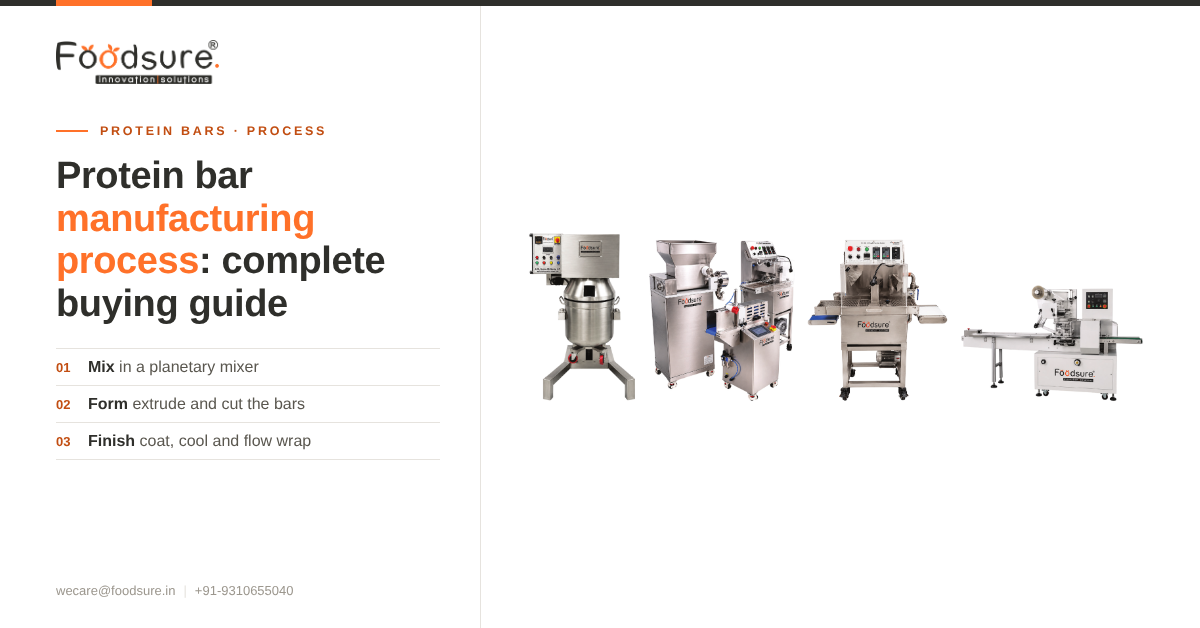
It is a series of equipment which transforms raw materials into final packaged protein bars. The machine may contain batch preparation, blending, forming/extrusion, cutting, cooling, coating, inspection, and packaging.
Protein Bar Production Process Solution may be used at a certain manufacturing step, for example, mixing, or it may be a whole production line. The same principle concerns Protein Bar Production Process Flow Chart – it may illustrate a specific stage or the entire factory.
A typical manufacturing workflow is:
Mixing → Forming / Extrusion → Cutting → Cooling → Coating (if applicable) → Packaging
Not every product needs the same processing sequence. Coating, for example, is optional. Machinery should be selected according to the intended product.
Essential Equipment for a Protein Bar Production Line
A commercial setup may include several machines working together. The exact mix depends on formulation, capacity, and product specifications.
- Mixing machine
Dry components like protein powder, oats, and nuts are combined with liquid binder in a mixer. Ribbon mixer and planetary mixer can be used.
The selection is based on the size of the batch, how sticky the mixture is, and the output required.
- Extruder
After mixing, the mixture is fed into an extruder where it forms a continuous rope or sheet. Extruding works well for large-scale production, whereas slabbing is appropriate for heavy protein bars.
This will depend on the formulation and the output required.
- Forming and Cutting Machine
A continuous sheet is formed into individual bars through a forming and cutting machine. This can be done using an automated guillotine cutter.
Weight uniformity, bar size, and edge trimming are among the important factors to consider in this step. Proper cutting will help reduce waste in the protein bar production process.
- Cooling and Coating Machines
The freshly sliced bars are cooled in a cooling tunnel in order to stabilize them.
Coating may or may not be used. In case it is needed, it is done by means of enrobers and coaters, which apply chocolate, yogurt, caramel, or protein cover. The selection of a particular system depends on the type of coating that is used.
- Packagers
Packaging ensures bar protection from moisture, oxidation, and contamination. Individual packages are packed using flow wrappers while cartoners perform the packaging of multi-packs and cartons. Other common features include date and batch coding, metal detection, and check weighing.
Packaging capability should be matched with production rate in order to avoid accumulation of unpacked bars and idle packers.
Automatic vs Semi-Automatic Protein Bar Production
The choice depends on production requirements, workforce availability, and investment priorities.
| Factor | Semi-Automatic Setup | Automatic Setup |
|---|---|---|
| Operation | Some stages are handled by operators | Stages run in a connected sequence with little manual handling |
| Production volume | Suits low to moderate output | Suits higher, regular output |
| Labour | Needs more operators | Needs fewer operators |
| Flexibility | Easier to change between small batches | Best for steady runs of defined products |
| Integration | Machines often work as separate units | Mixing, forming, cooling, coating and packing are linked |
| Expansion | Machines can be added step by step | Capacity is planned for the whole line |
A small business may begin with a semi-automatic setup. A manufacturer with regular commercial orders may consider a fully integrated line. The decision should rest on realistic demand, not automation level alone.
How to Choose the Right Protein Bar Manufacturing Process Equipment
Review these points before shortlisting any supplier.
Production Capacity
Calculate the required output for your current needs and future plans over the next few years. Each machine in your line should have capacity to match.
Product Formulation
The protein, binders, and inclusions influence the behavior of your mix. Make sure that your mixer and extruder are appropriate for your recipe.
Bar/Product Dimensions and Weight
Establish bar size and weight early on. Your forming and cutting equipment, as well as your packer, will depend on these parameters.
Degree of Automation
Determine what stages will be automated and what stages will remain manual, depending on production volumes and available manpower.
Floor Area and Utilities Available
Assess the available floor space, power requirements, and raw material flow. Designing an optimal layout from the beginning prevents bottlenecks.
Maintenance and Technical Assistance
Enquire about spare parts, maintenance services, and operator training. Machines that are easy to clean contribute to food safety as well.
Protein Bar Manufacturing Process Price: What Affects the Investment?
The cost is dependent on the machine configuration and production needs of the organization. The cost of one machine and a full-line setup varies greatly.
Consider the equipment required and the operation needs rather than just the purchase cost.
Important factors include:
- Capacity and automation
- Mixing, forming, extrusion and cutting setup
- Cooling, coating and packing equipment
- Installation and commissioning
- Electricity and infrastructure
- Cleaning, maintenance and spares
- Training and technical assistance
When you ask for a quotation for the machine, you need to tell the company about the product being produced, its target production rate, its size, and what level of automation is needed.
Overall plant layout cost includes costs for the building, utilities, storage, packaging, etc.
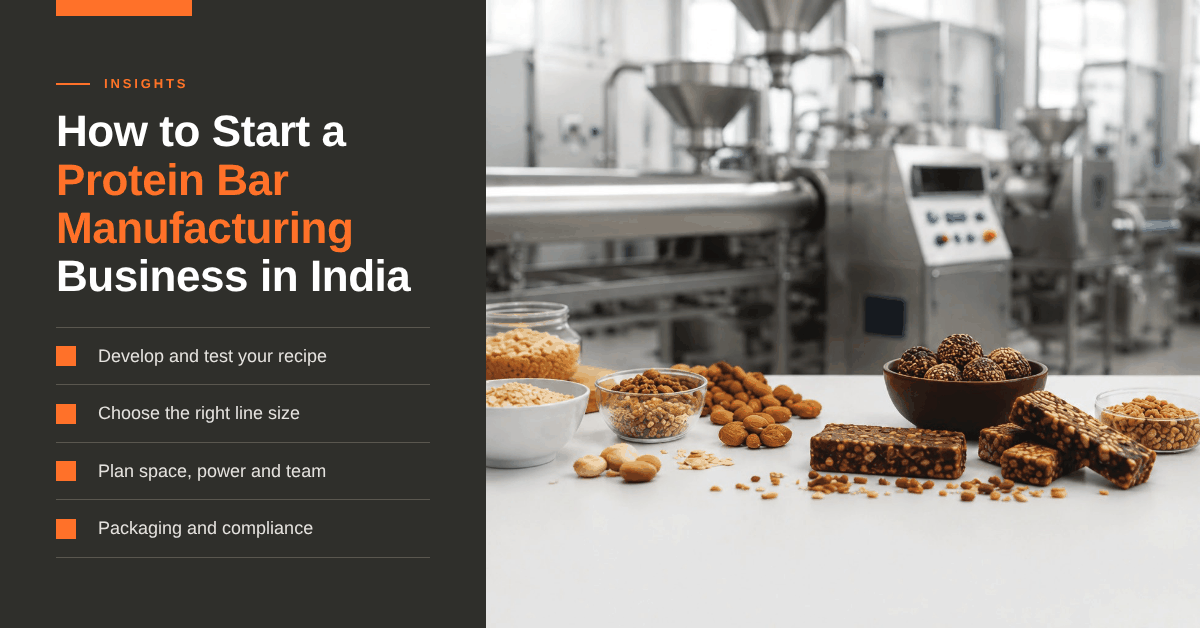
How to Start a Protein Bar Manufacturing Business in India
Starting involves both commercial planning and manufacturing preparation.
Step 1: Defining the Product
Set parameters for formula, bar size, flavors and coating, and formulate the product.
Step 2: Market Analysis
Do market research related to customers, competing products and distribution channels prior to deciding upon plant capacity.
Step 3: Manufacturing Plant Design and Layout
Plan the layout of the machinery from input storage to finished goods warehouse. Establish supplier certification and quality management systems.
Step 4: Compliances
FSSAI licensing, food safety procedures and labeling must be sorted out before going into commercial production.
Step 5: Machinery Selection and Validation of the Protein Bar Manufacturing Process
Select machinery according to your product and validate the protein bar manufacturing process.
Step 6: Packaging and Distribution Planning
Finalise packaging design and formats, then set up storage and distribution routes.
Small-Scale Protein Bar Production for Startups in India
A small-scale system would work well for entrepreneurs willing to start production on a small scale and later expand their production in line with their increasing demands.
The startup automatic system would be chosen based on the production output needed and the degree of automation. This ensures that the production process of the protein bars is manageable.
Before investing, consider:
- Expected first-time production quantity
- Variety of products
- Dimensions and weight needed
- Available space and labour
- Compatibility with the formula
- Prospects for future equipment addition
Starting with an appropriately sized setup helps you grow without overbuying machinery.
Why Choose Foodsure Machines for Protein Bar Machinery?
Foodsure Machines is a food processing consultation and machinery manufacturing solutions company. The company helps companies ranging from conceptualisation to large-scale production of food products through product development, factory setting, regulatory affairs, and process optimization.
The company can assist in analysing your requirements in regard to machinery, machine setting, automation and processing steps integration. Their solutions can range from mixing machines, extruding machines, cutting machines, cooling tunnels, coating machines, and automated packaging lines.
Before placing your order, make sure that you understand all aspects related to equipment setting, installation, training, and maintenance. You can consult Foodsure Machines regarding your production needs.
Conclusion
The protein bar production cycle encompasses all steps from ingredients selection to packing and distribution. When deciding on equipment procurement, one should consider product specification, capacity, automation, infrastructure, and technical support.
When choosing a protein bar machine producer, one should find out the range of items offered by each producer and then choose between a small plant and an integrated line depending on their requirements.
Correct batching, mixing, forming, cooling, and quality control will ensure uniformity of products. A properly planned production line will facilitate the process.
Frequently Asked Questions
- How to Select Protein Bar Manufacturing Process Machine?
Consider the type of machines suitable for your formula, output, bar dimensions, and degree of automation. Space, utilities, and technical assistance can also be considered.
- Factors that Influence the Price of the Equipment Used for Protein Bars Manufacturing?
Machine capacity, automation, setup, installation, infrastructure, spare parts, and training influence the initial investment.
- Is there an Automatic Machine for Startups in the Protein Bar Manufacturing Process?
Yes. The machine will be selected on the basis of output, range of products, and degree of automation, and additional machines can be procured in future.
- What should I Ask a Supplier about Machines for Protein Bars Production?
Ask questions regarding scope of machines, installation, training, spares, and technical assistance. Provide information about your products, output, and bar dimensions to get an accurate quote.
- Is it Possible to Buy a Line for Making Protein Bars?
Yes. Line will comprise of all processes like mixing, extrusion, cutting, cooling, coating, and packaging. It is the method of protein bar manufacturing, either as individual machines or as one line.




