
Protein bars are becoming increasingly popular in the packaged snack and nutrition industry. Starting from high protein bars and date bars to nuts and cereals bars, there is a need for equipment that can ensure quality and commercial production.
Protein bar manufacturing equipment will assist businesses in simplifying the processes of mixing, forming, cutting, cooling, and packing the ingredients. There is no single piece of production equipment that works on its own because of different recipes or manufacturing quantities.
One needs to understand the equipment that exists along with the forming methods and manufacturing quantity.
What Is Protein Bar Manufacturing Equipment?
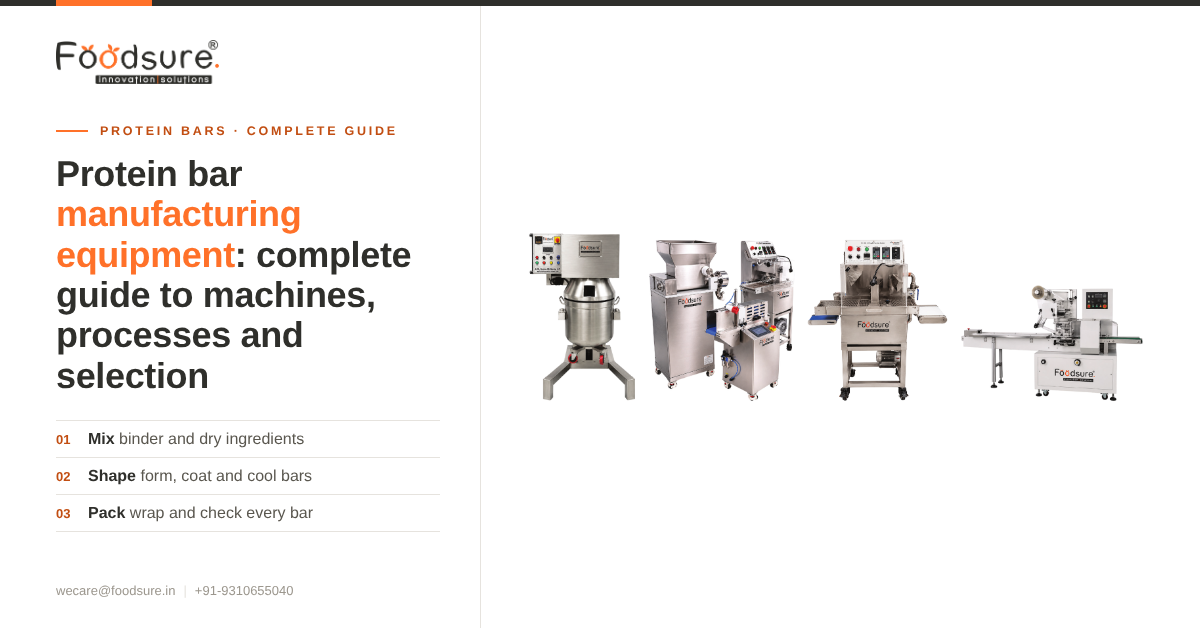
Protein bar manufacturing equipment refers to the machinery used to convert prepared ingredients into finished protein bars. A commercial setup can include equipment for ingredient preparation, mixing, forming, cooling, cutting, optional coating, and packaging.
A typical production line may include:
- Ingredient preparation and handling units
- Mixer units for ingredient mixing and binding process
- Extruder or slab forming unit
- Cooling conveyors or tunnels
- Forming units for cutting the bars
- Chocolate or compound coating units
- Conveyors and product transfers
- Packaging units
The exact configuration depends on the product formulation, ingredient structure, required bar dimensions, production capacity, and desired level of automation.
Types of Protein Bar Manufacturing Equipment
Different protein bar recipes require different processing methods. Selecting suitable equipment helps maintain product quality and improve production efficiency.
Mixing Equipment
Mixers provide a homogeneous mix of powdered proteins, cereals, nuts, seeds, dates, and binding agents.
Different mixing processes may be needed based on the structural makeup of ingredients, their moisture content, and viscosity requirements. Machines should efficiently mix the ingredients without destroying the larger particles.
Protein Bar Extruder
A protein bar extruder pushes a prepared mixture through a forming die to create a continuous strip or profile. It can be suitable for dense, cohesive, and sticky mixtures, including certain date-based bars and products containing binders or nut pastes.
The forming die and operating settings should match the recipe and required product dimensions.
Protein Bar Forming Machine
A protein bar forming machine shapes the prepared mixture into a continuous strip or slab before it is divided into individual bars.
Extrusion forming might work well for cohesive blends, whereas slab forming might work well for blends that include bigger nuts, seeds, cereals, and granolas.
Forming technique depends upon the consistency and composition of the blend.
Cooling Equipment
Some types of protein bars need to be cooled or stabilised after their formation. Cooling equipment can assist in the preparation of the product for cutting, coating, or packaging, based on the formulation.
The requirement for cooling depends on the composition of the product, size of the product, and nature of the binder system used.
Cutting Equipment
Cutting machinery divides the formed product into individual bars of the required length. The system should be compatible with the product texture and forming method to minimise deformation, breakage, or uneven portions.
Coating Equipment
Some protein bars will need chocolate coating or compound coating. If the product is supposed to have a coating, an optional coating system can be added in the production line.
More cooling might be required before packaging the bars after the coating process.
Packaging Equipment
The packaging machines package the bars for storage, distribution, and sales. The packaging must be appropriate for the nature of the product and the distribution conditions.
How Does a Protein Bar Production Line Work?
A typical protein bar production line follows a sequence of coordinated processing stages. The exact workflow depends on the recipe and the equipment configuration.
Ingredient Preparation
Ingredients like proteins, cereals, nuts, seeds, dates, and binders are processed based on the formulation. Any roasting or reduction in size required by the recipe is done before mixing.
Mixing
The mixture is made from the prepared ingredients to get the desired uniformity. It is important that the mixing machine is appropriate for the formulation and the structure of the ingredients.
Forming
The blend is subjected to either an extrusion or slab forming process. The device molds the substance into a continuous form for further processing.
Cooling and Cutting
Cooling of the finished product is necessary prior to cutting. Cutting of the product into bars is done according to the required dimensions.
Coating and Packaging
When necessary, the bars are subjected to a coating process and any cooling process. The bars are then fed into packaging machines.
Coordination of these steps ensures that there is no unnecessary movement of products, and that no single machine becomes a bottleneck in the process.
How to Choose the Right Protein Bar Making Machine
Understanding how to choose a protein bar machine requires evaluating the product, production targets, and overall manufacturing workflow rather than comparing individual machine features alone.
Product Formulation
Determine whether you will be manufacturing protein-dense bars, date-based bars, nut bars, or cereal bars. The ingredients used will affect the mixing and formation process.
Required Production Capacity
Estimate the expected output per hour and account for bar weight, dimensions, forming speed, cutting speed, and packaging requirements.
Forming Technology
Choose whether to use extrusion or slab molding depending on your mixture. Dense and heavy mixtures may be suitable for extrusion, whereas those containing big inclusions would be better off with slab molding.
Bar Dimensions and Cutting
State the required bar weight, width, thickness, and length. Make sure that the forming and cutting system is capable of producing the specified dimensions.
Cooling and Coating
Evaluate whether the product requires cooling before cutting or coating. The selected equipment should support the recipe and the planned production sequence.
Hygiene and Maintenance
The material used for the food-contact parts should be food-grade and be easy to clean. Make sure that the maintenance process is convenient.
Automation and Integration
Determine if you require stand-alone equipment or a complete production line. The mixer, former, cooler, cutting machine, and packaging equipment must be compatible with each other.
Best Protein Bar Making Machine for Startups
The best protein bar making machine for startups is one that matches the intended recipe, current production demand, and available infrastructure.
A startup company may start with necessary equipment for mixing, forming, and cutting, and then move on to automation once demand increases. A modular approach allows flexibility without necessarily having each process of manufacturing be automated at the outset.
Before selecting equipment, consider:
- Type of product and components used
- Forming technology required
- Production volume anticipated
- Dimensions and weight of bars
- Size of available factory and utility facilities
- Cooling and packaging needs
- Training and support requirements
- Opportunities for expansion
A business producing cohesive, sticky bars may need an extrusion-based system, while one manufacturing bars with large nut or granola inclusions should evaluate slab forming.
Protein Bar Machine Capacity per Hour
The protein bar machine capacity per hour depends on the complete production process rather than the forming machine’s speed alone.
Important factors include:
- Ingredient uniformity and formula
- Weight of bar and its dimensions
- Feeding stability
- Forming rate
- Number of production rows
- Cutting rate
- Cooling needs
- Cleaning and changeover time
- Packaging capacity downstream
A machine that makes bigger bars will make fewer bars per hour than a machine that makes smaller bars. Likewise, a machine that forms at a high rate will not reach its maximum production if there is inadequate cooling or packaging capacity.
In comparing machines, find out whether the stated capacity means the input rate, the forming rate, or the output rate after cutting. Test the performance with your formulation and dimensions.
Understanding Protein Bar Machine Price and Investment Factors
Price of the protein bar making machine is dependent on the capacity, automation of the machine, forming system, cutting system, and other accessories.
For organizations interested in purchasing the automatic protein bar machine price in India, it is important to evaluate the cost of the complete machine setup and not just the core forming machine.
Consider the following factors:
| Investment Factor | What to Evaluate |
| Equipment configuration | Single machine or assembly line |
| Production capacity | Throughput and final product requirement |
| Forming technology | Extrusion or slab forming |
| Cutting system | Dimensions and method of cutting the bars |
| Cooling equipment | Product-specific cooling requirements |
| Automation | Manual, semi-automatic or integrated operation |
| Packaging | Compatibility with the intended packaging format |
| Installation | Commissioning, utilities and layout requirements |
| Technical support | Training, maintenance and spare-parts availability |
The total investment will also include mixing machinery, conveyor systems, coating machines, and packaging systems. The company should specify the entire process flow before calling for proposals.
How to Evaluate a Protein Bar Machine Manufacturer in India
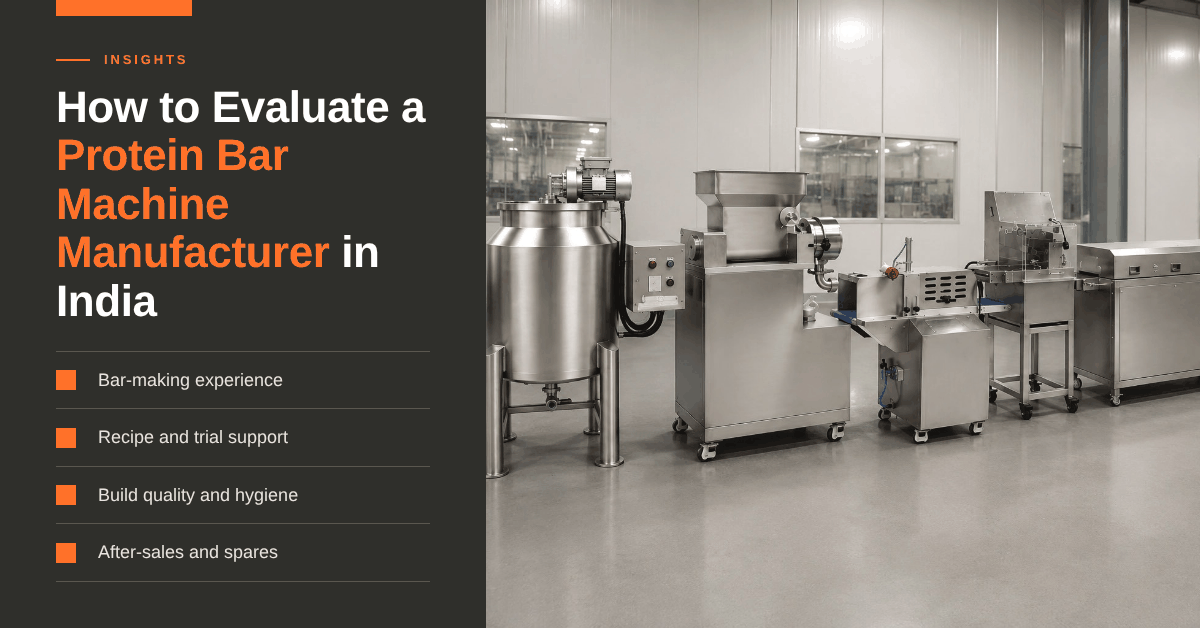
Selecting a trustworthy protein bar machine manufacturer in India is crucial in setting up a reliable production process.
Before selecting a supplier, evaluate:
- Experience with commercial food processing equipment
- Knowledge of protein bar recipes/formulations and forming requirements
- Machine configuration/specifications
- Compatibility with your recipe and required bar dimensions
- Installation/Commissioning of equipment
- Training/Maintenance services available
- Spare parts availability
- Compatibility with existing or future equipment
A suitable protein bar machine supplier should understand your production requirements and explain the capabilities and limitations of the proposed equipment.
Before you buy protein bar machine equipment, share your recipe, target output, bar dimensions, packaging requirements, and facility details. This helps the supplier recommend a suitable configuration.
Why Choose Foodsure for Protein Bar Manufacturing Equipment?
Foodsure offers equipment for businesses looking to manufacture commercial protein bars. Selecting the right equipment setup depends on several key criteria.
In case you want to make a quote for the protein bar machine, you should tell us all information related to your recipe, capacity, dimensions of the bar, forming process, and packaging type.
Conclusion
Protein bar manufacturing equipment allows manufacturers to optimize the process of mixing, shaping, cutting, and packaging of the product, ensuring efficient commercial manufacturing processes. The appropriate selection depends on the formula, structure of the ingredients, production volume, and degree of automation needed.
Prior to selecting a protein bar extruder or a full protein bar production line, consider factors like formability, precision cutting, cooling, hygiene, packaging, and supplier support. Comparison of whole machine systems can be of great assistance to companies in setting up their protein bar manufacturing facility.
Frequently Asked Questions
1. What is protein bar manufacturing equipment used for?
Equipment for making protein bars is used to process the prepared ingredients into protein bars. The equipment may be composed of equipment for mixing, forming, cooling, cutting, coating, and packaging.
2. What is the difference between a protein bar extruder and a forming machine?
A protein bar extruder is where a sticky mixture is forced through a forming die, while a forming system can either be by way of extrusion or slab forming, depending on the formula.
3. What determines protein bar machine capacity per hour?
The capacity depends on the formula, size of the bars, feed stability, forming speed, cutting speed, cooling requirements, and packaging capacity. It is necessary that the capacity be validated for the particular product.
4. What affects the automatic protein bar machine price in India?
The investment depends on production capacity, automation, forming technology, cutting and cooling equipment, packaging integration, installation, and technical support.
5. What should I check before requesting a protein bar machine quote?
Specify the recipe, size of bars, volume required, automation process, packaging, and plant installation requirements. Explain the terms of warranty, training, maintenance, and after-sales service offered.




