

Grading of makhana makes up the difference between the randomly assorted, freshly popped lotus seed and the sorted and sellable makhana that we see on the market shelves. You may wonder why one bag of makhana looks perfect and snow white, while the other one has random sized pieces and poor-quality kernels.
First and foremost, grading of makhana is the process of sorting popped lotus seeds by size, color and surface texture after roasting and popping. It will determine all further processes — prices, packaging, visual appeal and the final decision whether to export the product or sell it locally in bulk.
Grading of makhana is mostly an informational topic, and this article is meant exactly for those who want to know about makhana processors, newly established makhana businesses and their potential customers. In our article, we will talk about the manual sorting of makhana, grading system based on the suta grade classification, working principle of makhana grading machines and the future of automated makhana grading.
What Is Makhana Size Grading?
Makhana sizing classification refers to the sorting of popped fox nuts into different standardized sizes, usually by the old-fashioned suta scale, ensuring all batches have the same size, appearance, and quality.
Sizing does not serve an aesthetic purpose; the size of the kernel influences how long it takes to roast as well as its performance. A mixture of sizes will ensure that some kernels will be overcooked, while others will be undercooked during the roasting period.
Sorting and grading of makhana occur after harvesting, cleaning, roasting, and popping and not prior to these processes. The seeds are initially harvested from the ponds, sun dried, roasted in batches to enable popping, and then sorted for grading by size and quality. Sizing and grading refer to the process of sorting the fox nuts by size, appearance, texture, and quality after popping.
Why Grading Matters So Much in the Makhana Trade
- Uniform popping and roasting — kernels of uniform size ensure that they pop uniformly in the subsequent batch.
- Accurate pricing — bigger and cleaner kernels attract higher prices while smaller and broken kernels sell at lower prices.
- Exports — foreign customers demand specific sizes and defect levels.
- Quality — a packet of well-graded, pristine white makhana is an indication of high-quality makhana.
- Less wastage — broken or under-popped kernels are removed before quality issues arise.
Highly graded makhana attracts higher prices in the market.
The Suta System: How Makhana Size Is Actually Measured
If you ask any expert in the field as to how sizes are measured, the one word that will come into play is suta. Suta is an old Indian measuring term which is equivalent to 1/8th of an inch, that is, 3.175mm. In the case of makhana grading, it denotes the diameter of the processed seed.
The commercial grading of makhana varies between 3 suta to 7 suta, where the bigger the size, the greater the suta number.
Suta Grade Reference Table
Here’s a fast myth busting: just because it’s larger doesn’t mean it’s better. The 5 suta roasted product, if well-processed, may prove more efficient than the 6+ sugar snack, as grade is an input requirement, not a guarantee of the quality. The extra expense on large kernels when they are intended to be crushed or coated is usually money wasted.
In terms of institutional or catering bulk purchasing, when looks are not as important as price, mid-grade suta usually provides more bang for the buck. Very high grades (6+) are also produced in smaller amounts and therefore should not be considered for bulk purchases.
Manual Sorting: How Grading Traditionally Worked
Manual grading remains prevalent until today before the widespread use of mechanization in most makhana clusters. After cleaning and drying, the process starts with grading by size which can be either manual, using sieves or other methods of sorting.
In its classical form, the process of grading by size includes:
- Initial sorting – visual separation of seeds by mismatched sizes and damages
- Size sorting by sieves – kernels are sorted out with a number of handheld or table-mounted sieves of various mesh diameter
- Color and damages control – color of seed, presence of black spots, breakage are visually controlled
- Final inspection – even after mechanical operation, kernels must undergo visual inspection for damaged or discolored seeds
Limitations of Manual Grading
The manual inspection is indispensable in quality control process as it is now implemented both in manual and mechanized units but in itself has the following limitations:
- Limited throughput – in order to process several hundreds kilos per day, a small unit requires several people involved in sorting
- Human error – the process involves errors and inconsistencies due to the possibility of mix-ups between grades because of the human factor
- Subjective inconsistency of the process between workers – different workers have slightly different criteria to judge what size belongs to grade A
- Dependence on labor force – manual inspection and sorting require a lot of effort and attentive workers
This is exactly where the automated machines come into play.
How a Makhana Grading Machine Works
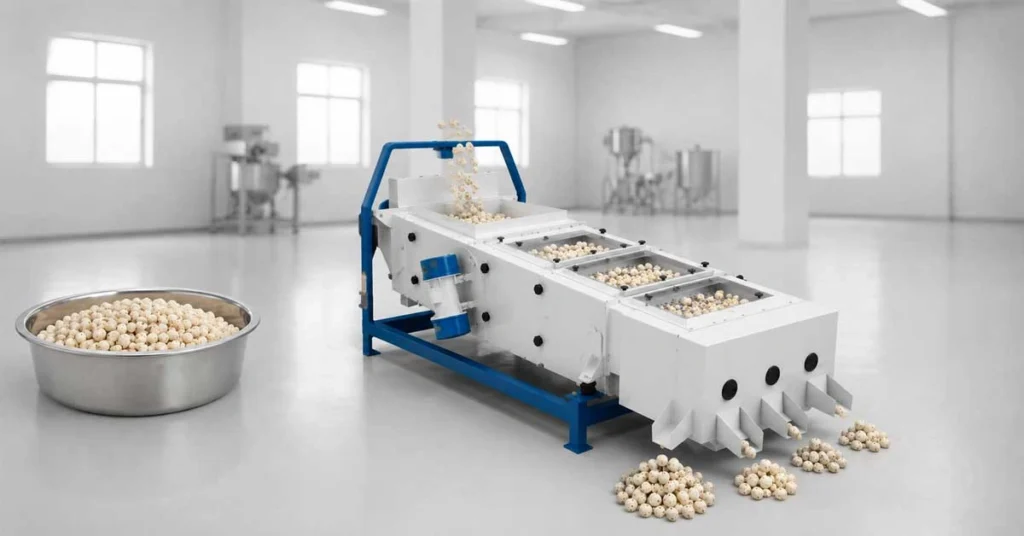
The purpose of a makhana grading machine is to perform the same functions mechanically that a line of hand sieves performs manually, but much more efficiently.
A mechanical grader makes use of various sizes of sieves along with vibratory screens to grade the seeds according to size and weight after the preliminary sorting has been done manually. The popped makhana is put into the grader, and the vibrations or rotation of the grader cause the kernels to move over different sized screens.
Core Components of a Makhana Grader
- Feeding hopper – kernels are fed in a regulated manner
- Vibrating/rotating sieve deck – several sieves with progressively larger hole sizes are used to segregate kernels according to their sizes
- Dust & debris separation system – most graders have some system for separating dust and debris, which increases the cleanliness of the graded produce
- Separate output outlets – one outlet for each of the size grades, segregated by kernels
- Drive motor – provides power to the vibrational/rotational system
In the case of popped makhana, the post-harvest research institutes have developed a standardization process. The ICAR-CIPHET popped makhana grader classifies the kernels into three categories based on their size – above 18mm, 15-18mm and 13-15mm – using the round-hole sieve screens, and it also separates the flattened/un-popped kernels. A compact version of this machine uses a single 1HP drive motor and requires just two unskilled laborers to operate, and processes 150kg of popped makhana an hour.
Benefits of Mechanical/Automated Makhana Grading
A well-adjusted grader machine will make sure that each batch produced is consistent in size, resulting in consistency in quality and a much better-looking end product. Apart from this:
- Processing speed — the speed at which a higher number of batches can be processed
- Hands off sorting — since automation helps in grading, it will give workers the opportunity to take up other tasks
- Fewer times of sorting — automated grading using sensors can do sorting based on size, shape, color, and defects in one process
- Hygiene — the food contact surfaces of a modern grader are usually made of stainless steel
Manual Sorting vs. Mechanical vs. Automated Grading
No single method is “wrong.” A very small home-based operation may not justify the cost of an automated line, while an export-oriented unit can’t realistically hit consistency targets without one.
Common Mistakes in the Makhana Grading Process
Some of the problems that keep occurring in processing units, small and mid-sized:
- Omitting manual inspection after mechanical grading-sieves separate grains according to size but not colour or brokenness; therefore, omitting manual inspection allows poor-quality grains to enter premium grades
- Using sieve screens that are worn out or different in sizes-old sieve screens with bigger or uneven holes create blurred lines between adjacent grades
- Feeding excess amounts into the grading machine -adding more kernels than the machine is able to deal with results in size overlapping of the output streams
- Failure to take into account narrow size difference -sieving machines may have difficulties separating grades with a small difference in diameter, where both medium and small grains can end up in premium grades
- Grading without proper drying of the grains -wet kernels act unpredictably on vibrating screens
Best Practices to Avoid Grading Losses
- Keep sieve screens calibrated and clean, replacing those that wear out
- Perform manual checking after mechanical screening, regardless of the system being used
- Make sure that the capacity of the machine is suited to the volume of the batch
- Keep track of the grading loss information – proper handling according to the batch, the peak loads, and the products can help to cut down loss from grading and not storage or output.
When to Choose Manual vs. Automated Grading
There’s no universal right answer here — it depends on scale and market.
Manual sorting still makes sense when:
- Low daily output (only a few hundred kilos per day or less)
- Finances for equipment have not yet been arranged
- The produce is marketed locally, where size tolerance is allowed
Automated/mechanical grading makes sense when:
- Consumers insist on standardization, especially in exports
- The daily production output is higher than that which a manual workforce can sort out
- Your objective is in high-end retail, gift, or HoReCa categories where appearance determines price
- Labor cost and availability have become a limiting factor in peak periods
Grading’s Role Before the Makhana Roasting Process

It should be mentioned that there is a strong connection between grading and roasting even though they are performed at different stages. Prior to the makhana roasting process, usually, the first sorting according to sizes takes place in order to ensure the homogeneous popping of the kernels during the roasting process. After that, the roasting process, a second sorting according to the suta size takes place. Not performing the first sorting is among the most silent reasons for the irregular popping.
If you are establishing the new production line, it is advisable to consult both the guide on the roasting process and this one, since they are tightly connected.
Key Takeaways
- The makhana grading system is used to separate popped fox nuts based on their size (using suta measurement), color, and percentage of defects for uniformity of batches.
- Grading of makhana size uses the suta measurement as a standard and varies from 3 suta to 7 suta, the higher the number indicating larger size.
- Manual grading is accurate but time-consuming, labor-intensive, and is appropriate for very small-scale processing.
- A makhana grading machine reduces time taken for grading, while automated systems grade both color and defects at once.
- Manual grading still plays an important role even after mechanical or automated grading, because grading of color and surface defects cannot be done solely by machines.
Conclusion
Makhana grading technology has come a long way from manual sieving to sorting by hand, but it is still far from being fully automated and maybe it shouldn’t be. The most efficient systems consist of a combination of automated or mechanized sieving with human vision to confirm the result.
If you operate in the realm of makhana grading in your house or want to automate your business up to an export-quality level, your target is clear: uniform size, cleanliness, and conformity to the promised grade.
Have a Question? Let’s Connect!
Need expert guidance on food processing machines, production setup, or project planning?
Our specialists are ready to answer your questions and help you choose the right solution.
FAQs
What is the makhana grading process?
It is the classification of roasted popped fox nut kernels according to their size, colour and quality using the suta grading system and manually or mechanically.
What is the basis for makhana size grading?
The grading process is based on the diameter of the kernel that is measured using the traditional suta unit.
What is the difference between cleaning and makhana sorting & grading?
Cleaning involves removing dust, husk and other unwanted materials, whereas makhana sorting and grading involve separation of cleaned kernels according to their size and quality.
What is the mechanism of operation of a makhana grading machine?
It involves the use of vibrating or rotating sieve screens with different hole sizes to sort the kernels according to their sizes.
What advantage does automated makhana grading offer over simple sieving?
Automated makhana grading sorts the kernels according to their size, shape, colour and surface defects.
Do modern makhana units utilize manual sorting?
Yes, manual sorting is done in addition to mechanical sorting in order to identify any discolored or defective kernels.
Which suta grade is premium in the makhana market?
Suta 6 and Suta 6+ grades are regarded as premium and are used for exports and gift packs.




