

Growing demand for easy, healthy, and protein-rich food products has created many possibilities for food firms in Sri Lanka. Protein bars, vegetable snacks, high-protein bites, and similar food products can target consumers who prefer to have a healthy and fit body.
While deciding to manufacture their product, selecting the most appropriate Protein Snack manufacturing machines in Sri Lanka becomes essential for companies to ensure that their product remains consistent, efficient, and scalable.
This blog discusses the different machines involved in making protein snacks and also the criteria that food companies in Sri Lanka must consider before acquiring an entire set-up of machines.
Why Protein Snack Manufacturing Is Growing in Sri Lanka
Protein-packed snacks provide convenience to cater to the increasing preference for healthy foods. Food manufacturing companies can create products tailored to various categories of consumers with the use of ingredients such as plant-based proteins, nuts, seeds, grains, and many more.
The well-planned Protein Snacks Manufacturing line will help manufacturers:
- Maintain consistent product quality
- Improve production efficiency
- Reduce manual handling
- Support higher production volumes
- Develop multiple product formats
Therefore, commercial food processing equipment is necessary for developing a successful business.
Types of Protein Snacks Sri Lankan Companies Can Manufacture
Before choosing a machine, the manufacturer should establish what product will be made. The type of snack being made will determine the required manufacturing process technology.
Protein Bars
Protein bars have become one of the most widespread commercial protein snacks. The production of protein bars requires proper mixing, forming, cutting, and packaging.
Plant-Based Protein Snacks
Plant-based snacks can be soya-based snacks, protein bites, and other textured proteins. Such snacks can cater to consumers who prefer plant-based protein sources.
Protein Bites and Energy Snacks
The manufacture of small-formatted protein bites and energy snacks allows for making such snacks in various sizes and forms. Due to this property, the format is suitable for both retail and foodservice markets.
High-Protein Granola and Cereal Snacks
High-protein granola and cereal snacks are made from a combination of grains, nuts, seeds, and protein components. Proper mixing, forming, and packaging equipment ensures product consistency during manufacturing.
Best Protein Snack Manufacturing Machines
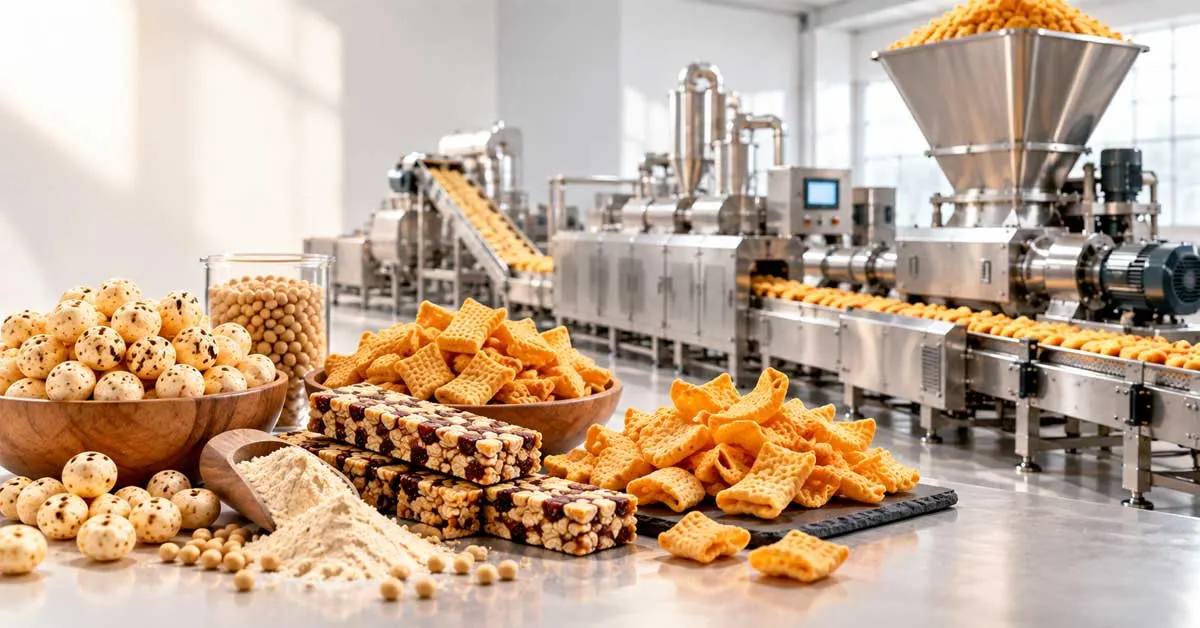
The entire configuration of the Protein Snack manufacturing Machine can consist of various processing and packaging lines that depend on the product itself and on the manufacturing capacity.
Industrial Mixer
The industrial mixer is designed to blend the components of the protein snack evenly.
Protein Bar Forming Machine
The forming machine compacts and forms the mixture into a homogeneous slab or bar form. This ensures uniformity in the product and minimises the labour involved in production.
Cutting Machine
Once formed, the product is cut to predetermined sizes. Using an automatic cutter can ensure uniformity in the size of the products and minimise wastage of the product.
Extrusion System
The extrusion process is important for some products made from plants and textured proteins. It can assist in forming certain shapes and textures.
Cooling System
Cooling is used to stabilize the products after processing in preparation for further handling or packaging. It can help ensure that the desired texture and shape are maintained.
Packaging Machine
Automated packaging machines increase the speed and accuracy of packaging and ensure product safety. The suitable packaging machine will depend on the size of the product, material used, and production capacity.
Recommended Production Capacities for Sri Lankan Food Companies
| Production Scale | Suggested Capacity | Suitable For |
|---|---|---|
| Small | 50–100 kg/hour | Startups and local brands |
| Medium | 100–200 kg/hour | Growing manufacturers |
| Large | 200–500+ kg/hour | Commercial production |
A manufacturer should avoid selecting equipment only according to current demand. Planning for future growth can help prevent capacity limitations and unnecessary machinery replacement.
How a Protein Snack Production Line Works
A typical production sequence depends on the product format, but a commercial setup may follow this general workflow:
An integrated Protein Snack Processing Line helps maintain a smoother flow between different production stages and can reduce unnecessary manual handling.
Factors to Consider Before Buying Protein Snack Manufacturing Equipment
Both the needs for the current production process and future business plans must be considered when selecting the appropriate machinery.
Product Type
Different kinds of protein-based snacks may need different processing lines depending on the type of product.
Production Capacity
Capacity should be proportional to market demand and working hours to ensure that the selected capacity does not underproduce or produce excess.
Automation Level
There are manual, semi-automatic, and fully automatic processing lines which can be chosen depending on the extent of automation desired.
Machine Construction
Machine parts that come into contact with foodstuffs should be made of food-grade material. The material of choice for food processing is usually stainless steel.
Packaging Requirements
Protein-based snacks will have to be packaged in packages that are moisture-proof, tamper-proof, and strong enough to prevent mechanical damage.
Investment Planning for Protein Snack Manufacturing
This is dependent on the machinery set-up, capacity, degree of automation, plant facilities, utilities, packaging, installation, and commissioning.
In this regard, companies need to look into the total cost of the project instead of just looking at the cost of each protein snack making machine.
This will help them start at the appropriate capacity and then scale up the line as the market demands.
Opportunities for Plant-Based Protein Snack Production
Soy-based protein snacks represent another possibility that food manufacturers in Sri Lanka could consider when seeking to diversify their offerings of snacks. A turnkey Soy processing plant in Sri Lanka is also possible for those companies considering investing in the production of soy at larger volumes. A turnkey Soya Nugget factory in Sri Lanka is also another possibility that represents another opportunity for the production of soy-based protein snacks.
Key Factors for Selecting Protein Snack Manufacturing Machines
Selecting the most appropriate Protein Snack manufacturing machines in Sri Lanka involves balancing the need to meet certain product requirements, the level of production, automation, and future business plans. A machine that serves one type of snack might not suit the other.
Product Form and Texture
Protein bars, bites, granola snacks, and protein plants have varying needs in terms of processing. The selection of machinery would depend on the desired form, texture, density, and final product characteristics.
Production Capacity
Before selecting machinery, manufacturers are advised to evaluate the estimated daily and monthly production. The selected Protein Snack Production Line should cater to the current and future production needs.
Automation Needs
The degree of automation will influence the labor needs, throughput rate, and process control. Semi-automated systems could work well for small firms, while bigger firms would benefit from fully automated systems for weighing, shaping, cutting, and packaging.
Ease of Cleaning and Maintenance
Since proteins can form deposits during the processing procedure, machines that have a hygienic design will be easy to clean and maintain.
Protein Snack Manufacturing Process
Protein Snack Manufacturing Process depends on the type of product, but normally in commercial production plants, the process follows a controlled sequence.
Preparation of Raw Materials
Ingredients like protein powders, grains, nuts, seeds, binders, flavors, and sugar are tested and measured before mixing and processing.
Mixing and Blending
The blending is done to ensure that all ingredients are uniformly distributed. This ensures consistency in flavor, texture, and nutritional value.
Forming and Shaping
The processed raw materials are formed into the desired shape. The forming process depends on the type of product manufactured and can include processes like slab forming, extrusion, molding, and others.
Cutting and Cooling
The formed snack products are cut into desired sizes and cooled.
Packaging
The snack products are packed using appropriate packing machinery.
Benefits of Automated Protein Snack Production
Modern Protein Snack Manufacturing Equipment can bring some benefits when compared to highly manual manufacturing lines.
Consistent Product Quality
Automation will help ensure that all the production runs are of the same weight, shape, size, and texture.
Increased Efficiency
Automation will enable companies to transport their products efficiently from one stage to another without unnecessary delays.
Decreased Dependence on Labour
The automation of weighing, forming, cutting, and packaging of products will decrease the need for manual labour.
Increased Production Control
Advanced equipment will make it possible to monitor and keep consistent production conditions.
Protein Snack Manufacturing Opportunities for Sri Lankan Companies
Some potential consumer segments for protein-based snacks from Sri Lankan food companies include retail consumers; however, there are more opportunities for sale among commercial customers.
Retail and Supermarket Sales
Protein snacks may be delivered by using supermarkets, groceries, distributors, and even internet sales channels. The packaging in various sizes would allow reaching both individuals and families.
Fitness and Wellness Market
There are also gyms, fitness centers, and sports nutrition stores which might serve as appropriate marketing channels for high-protein snack bars.
Hotels and Foodservice
Hotels, cafes, catering services, and institutional kitchens will buy large volumes of protein snacks. It means that this segment may create business-to-business opportunities.
Private-Label Production
Food producers also have an opportunity to manufacture private-label protein snacks for those companies that don’t have their own processing plants.
Role of Soy-Based Protein Snacks
The plant-protein range in soya-based products can be a cost-effective choice for companies wanting to introduce more types of protein snacks in their lineup. Various soya-based products can be produced for retail, foodservice, and food industry use.
Those thinking about developing a more advanced soy processing plant can opt for a Turnkey Soy processing plant in Sri Lanka.
If companies are interested in developing their own soya nuggets, then setting up a Soya Nugget factory in Sri Lanka will help them succeed.
Cost Considerations for Protein Snack Manufacturing
Protein Snack manufacturing machine investment will be dependent on production capacity, degree of automation, product type, machine design, packing needs, and existing plant facilities.
Manufacturers should consider the costs of the entire project instead of comparing prices of individual equipment.
Machinery and Production Line
It is necessary to know the quantity and type of machinery to be used to determine the investment level. The mixing machine, forming machine, extruder, cutting machine, cooling machine, and packaging machines can all add up to the total investment.
Utilities and Infrastructure
Power, factory space, ventilation, storage, and others are some utilities that must be considered before installation of the production line. It ensures the smooth running of the production line.
Installation and Technical Support
The installation process, commissioning, operator training, maintenance of spare parts, and technical support may affect the total project costs. It can also help reduce downtime after installation of the production line.
Future Expansion
The Protein Snack Production Line provides scalability options to increase production according to market demand.
Quality Control in Protein Snack Manufacturing
It is important to have good quality control to ensure that there is consistency in protein snacks from each production batch.
There are several ways to do a quality control check. These are:
- Raw material inspection
- Weighing of ingredients
- Checks of blend and processing
- Checking the weight of the snack
- Moisture and texture check
- Packaging inspection
This will ensure that manufacturers are able to develop customer trust and prevent product rejection.
Packaging Requirements for Protein Snacks
Package design is significant in ensuring the safety of protein snacks during storage and transport. The choice of the package design will be influenced by the type of product, shelf life, packaging materials, and production capabilities.
Individual Packaging
Individual flow packaging is recommended for protein bars and snack bars that are sold through the retail market channel.
Bulk Packaging
Bulk packaging may be ideal for food service organizations, institutions, and other commercial buyers who have larger volume needs.
Automated Packaging
Automated weight and pack designs would be more ideal for large-scale producers.
Choosing a Complete Protein Snack Manufacturing Solution
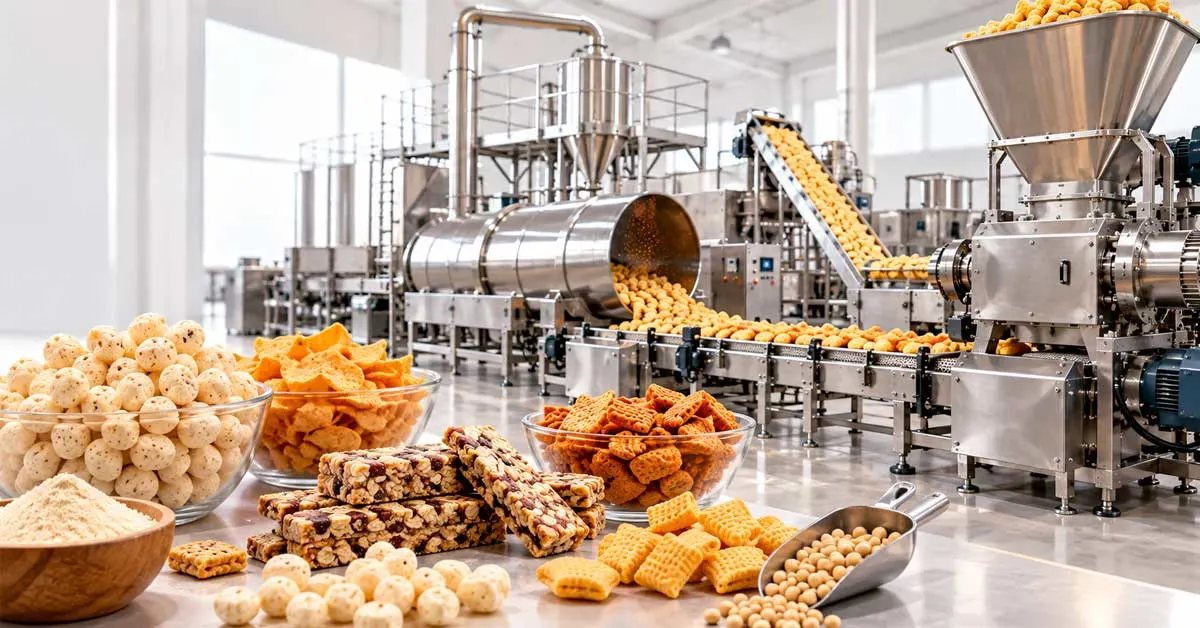
Instead of acquiring each machine from various manufacturers individually, food companies can go for a complete package in the form of a Protein Snack processing line. Such a solution will enable all the machines for processing, molding, cooling, and packing to come together based on the production needs.
This will not only make the installation process easier but also training and maintenance, apart from making future expansion possible.
For those in Sri Lanka who are looking into plant-based protein production, a Turnkey Soy processing plant in Sri Lanka could be considered.
Foodsure Machines for Sri Lankan Food Companies
Foodsure Machines supplies machinery and processing technologies to companies that wish to set up their business in producing protein snacks. Machines can be customized based on the product, production capacity, degree of automation, plant floor space available, and future expansion plans. The services provided can encompass machine procurement, production line designing, plant layout, manufacture of machines, installation and commissioning, operator training, and technical assistance, among others. Companies that plan to establish their Soya Nugget factory in Sri Lanka can take advantage of processing technologies based on their capacity requirements.
Conclusion
Proper protein snack manufacturing machines in Sri Lanka would enable food manufacturers to generate standardized, scalable, and commercially profitable protein-rich products. Whether it is protein bars, protein bites, plant-based snacks, or soy-based products, various machine setups can cater to varied business possibilities.
By choosing appropriate capacity, automation, processing equipment, and packaging machinery, manufacturers will be able to create an efficient production system and pave the way for future growth. An integrated system will facilitate the easy entry of manufacturers into new business possibilities such as soy-based protein products.
Have a Question? Let’s Connect
Need expert guidance on food processing machines, production setup, or process optimization? Our team is ready to help you choose the right solution for your business.
Frequently Asked Questions
What would be the most efficient machines for protein snacks manufacturing?
It depends on the product, but generally the mixers, forming machines, extruders, cutters, cooling and packaging machines could be used.
What factors influence the price of Protein Snack Manufacturing Machines?
Capacity, level of automation, machine configuration, product needs, packaging equipment, installation, and factory infrastructure may have an impact on the cost.
Can the protein snack manufacturing machines produce different products?
Yes. Depending on the machine configuration, one can produce protein bars, protein bites, granola-based snacks, and some kinds of plant-based protein snacks.
Is a complete Protein Snack Production Line better than individual machines?
A complete production line can help to optimize the production process, installation, operation, and maintenance while reducing unnecessary manual work.
Could a company in Sri Lanka manufacture soya-based protein snacks?
Yes. The company can develop different soya-based protein snacks according to its market and production needs. A proper Soya Nugget Factory in Sri Lanka could cater to retail, food service, wholesale, and institutional customers.




