Protein bars are not only for professional athletes and bodybuilders anymore. They can be applied to various situations of every-day life for example, for breakfast on the go, after exercise, as a product to take along on the hike, or even as something quick before going to work and then straight to college.
It does not mean that all kinds of protein bars will be good businesses. The case of Nepal should be viewed from both sides on the one hand, what kind of protein bars people are willing to purchase, and on the other hand, what companies can manufacture such products effectively.
There is an interest in the production of healthy and convenient snacks in general, and market research shows the relevance of protein and fiber in the snack products in Nepal. There is specific market research that is conducted in order to monitor the market of protein bars in Nepal in supermarkets, convenience stores, specialized stores, and online retailers.
However, there is also the reality of Nepal’s food manufacturing industry to consider.
This guide explains how to set up a protein bar manufacturing business in Nepal, starting with market research and recipe development and taking the product all the way to commercial production.
Why Protein Bars Could Work in Nepal
Protein bars are not only about fitness.
Nepal has a fairly youthful demographic. According to Digital 2026 Nepal, a report by DataReportal with information from late-2025, the average age in Nepal is 25.3 years. The same report gives 16.6 million people as internet users and 14.8 million social media accounts at the end of 2025.
This is significant in that food discovery is becoming more tied to digital activities for younger consumers.
The U.S. Department of Commerce reports that online usage in Nepal is centered in Kathmandu and a number of other cities, with mobile devices having a key role in internet usage and ecommerce.
For a protein bar brand, this creates several possible demand occasions:
- Fitness and gym nutrition
- Quick breakfast or between-meal snacking
- Office and workday consumption
- College and university students
- Hiking and trekking
- Travel
- Outdoor activities
- Consumers looking for more nutritious packaged snacks
- Parents looking for convenient snack options, depending on the product and age group
These should be treated as potential customer segments, not measured market shares. Nepal does not currently have a widely available public dataset that gives a reliable percentage split of protein bar consumers across these groups.
That distinction matters when preparing a business plan.
What Is Driving Demand for Protein Bars in Nepal?

Several broader food and consumer trends support the category.
1. Interest in More Nutritious Snacks
Research on Nepalese consumers has found that snack choices are influenced by factors such as quality, familiarity and taste. A Kathmandu study examining front-of-pack nutrition claims also found that nutrition claims affected perceptions of healthfulness, while taste-related perceptions were important predictors of purchase intention.
For a protein bar manufacturer, the lesson is simple:
Protein alone is not enough.
A bar still needs to taste good, have a pleasant texture, look trustworthy and make sense at its selling price.
2. Fitness and Active Lifestyles
Protein bars naturally fit gyms, sports, running, hiking and other active-use occasions.
But a Nepalese protein bar brand does not have to position itself only as sports nutrition. A more accessible positioning could focus on convenient nutrition for everyday consumers.
That creates room for different formulations:
- High-protein bars
- Protein and fibre bars
- Oat-based bars
- Nut and seed bars
- Date-based protein bars
- Plant-protein bars
- Low-sugar formulations
- Functional bars with carefully selected ingredients
The final positioning should come from the product formulation, target customer and regulatory requirements rather than from marketing language alone.
3. Digital Discovery and Ecommerce
Nepal had 16.6 million internet users at the end of 2025, according to DataReportal. The U.S. Department of Commerce reports that ecommerce is developing particularly in urban areas and that mobile internet access is important to online commerce.
For a new food brand, that means digital channels can play a role in:
- Product discovery
- Education
- Direct-to-consumer sales
- Customer feedback
- Repeat purchases
- Influencer and fitness partnerships
However, online sales should not be treated as the only route to market.
Who Could Buy Protein Bars in Nepal?
Instead of thinking about one large audience, divide the market by use case.
| Consumer Segment | What They May Want | Possible Product Direction |
|---|---|---|
| Gym and Fitness Consumers | Protein and convenience | High-protein bar |
| Working Professionals | Portable snack | Moderate-protein everyday bar |
| Students | Affordable convenience | Smaller, accessible pack |
| Trekkers and Hikers | Portable energy and nutrition | Dense, durable bar |
| Outdoor Consumers | Easy-to-carry food | Shelf-stable bar |
| Health-Conscious Consumers | Better ingredient profile | Protein + fibre / clean-label positioning |
| Travel Consumers | Long shelf life and convenience | Compact individually wrapped bar |
| Parents | Convenient snack option | Carefully formulated family-oriented product |
Again, these are commercial planning segments, not percentages of Nepal’s population.
A good manufacturer should test these segments before investing heavily in production capacity.
Nepal’s Protein Bar Market: What the Available Research Tells Us
Publicly available Nepal-specific market data for protein bars is limited compared with larger markets.
Commercial market research firms currently track Nepal’s protein bar market and identify channels including supermarkets/hypermarkets, convenience stores, specialty stores and online retail. Nepal’s broader snack market is also segmented by functional snacks, ingredients such as protein and fibre, packaging formats and consumer preferences.
That gives manufacturers useful signals, but it does not justify claiming a precise national protein-bar consumer share without a reliable primary dataset.
For a new business, the better approach is to conduct a local market study covering:
- Existing protein bar brands
- Imported products
- Local products
- Retail prices
- Pack sizes
- Protein content
- Ingredient lists
- Flavours
- Packaging formats
- Customer reviews
- Retailer margins
- Gym and fitness distribution
- Online pricing
- Distributor requirements
This research should happen before the final recipe is locked.
How to Research the Protein Bar Market in Nepal
Start with Kathmandu Valley and then expand your research to other target markets such as Pokhara, Bharatpur, Biratnagar and other cities relevant to your distribution plan.
Do not assume that a product that sells well in one location will perform equally everywhere.
Build a competitor sheet like this:
| Factor | What to Record |
|---|---|
| Brand | Brand name |
| Product | Bar type |
| Pack Size | Grams per bar |
| Protein | Claimed protein per serving |
| Price | NPR per pack |
| Ingredients | Main ingredients |
| Sweetener | Sugar, dates, syrup, etc. |
| Flavour | Chocolate, peanut, fruit, etc. |
| Positioning | Fitness, healthy snack, energy, premium |
| Channel | Retail, gym, ecommerce |
| Reviews | Positive and negative feedback |
| Origin | Local or imported |
This exercise will often tell you more about the product opportunity than a generic market-size paragraph.
What Protein Bar Should You Manufacture?
Before buying machinery, decide what type of bar you are actually going to make.
1. Whey Protein Bar
Usually designed around whey protein concentrate or isolate.
Potential positioning:
- Fitness
- Sports nutrition
- High protein
- Recovery
The formulation needs careful control because high protein levels can affect hardness, chewiness, flavour and moisture balance.
2. Plant Protein Bar
Common protein sources can include:
- Soy protein
- Pea protein
- Rice protein
- Chickpea or other pulse-based proteins
Plant proteins can support vegan or plant-based positioning where the complete formulation meets the relevant requirements.
3. Date and Nut Protein Bar
Dates can provide sweetness and binding while nuts and seeds add fat, texture and flavour.
This format can also support a more familiar food profile than a highly technical sports-nutrition bar.
4. Oat and Protein Bar
Oats can provide structure and texture while protein ingredients increase the nutritional value.
This format can work for breakfast and everyday-snacking positioning.
5. Filled or Coated Protein Bar
A more premium format can include:
- Nut or chocolate filling
- Chocolate coating
- Flavoured layers
- Crunch inclusions
These products require more processing control and can increase machinery and packaging complexity.
How to Develop a Protein Bar Recipe for Commercial Production
A commercial protein bar recipe is not simply a kitchen recipe multiplied by 1,000.
A formula that works at 1 kg can behave very differently at 100 kg or 500 kg.
The formulation process normally needs to consider:
- Protein source
- Protein percentage
- Binder system
- Sweetness
- Fat level
- Fibre
- Moisture
- Water activity
- Texture
- Flavour
- Shelf life
- Packaging
- Processing temperature
- Cutting behaviour
- Production cost
- Regulatory requirements
The goal is not just to make a tasty bar.
The goal is to create a bar that is tasty, stable, compliant, affordable and manufacturable at scale.
A Starting Protein Bar Recipe Framework
For a commercial product, the exact formulation should be developed and validated through laboratory trials. However, the recipe can be planned around five main groups.
| Component | Examples | Main Purpose |
|---|---|---|
| Protein | Whey, soy, pea, rice protein | Protein contribution |
| Base | Oats, grains, nuts, seeds | Structure and texture |
| Binder | Date paste, syrup or suitable binder | Binding |
| Fat Component | Peanut butter, nut paste, selected fats | Texture and mouthfeel |
| Flavour System | Cocoa, vanilla, coffee, fruit, spices | Taste |
The percentages should not be copied into a commercial production batch without product development work.
Foodsure’s own protein-bar formulation workflow describes recipe development, lab trials, sensory validation, shelf-life testing, costing and pilot-scale validation before commercial production.
That sequence is important because recipe development and machinery selection should influence each other.
Step-by-Step Protein Bar Formulation Process
Step 1: Define the Product
Before selecting ingredients, decide:
- Who will buy it?
- What should one bar weigh?
- How much protein should it provide?
- What price range are you targeting?
- Is it a fitness product or an everyday snack?
- Will it be plant-based?
- Will it be coated?
- Will it need refrigeration?
- What shelf life do you need?
Step 2: Select the Protein Source
The protein source affects:
- Taste
- Texture
- Cost
- Solubility
- Processing behaviour
- Nutritional profile
For example, whey and plant proteins behave differently in a bar matrix.
Step 3: Build the Binder System
The binder holds the bar together.
Possible systems include:
- Date paste
- Syrups
- Nut butters
- Other food-grade binding systems
The right choice depends on the desired texture and shelf life.
Step 4: Balance Texture
A protein bar can fail even when its nutrition profile looks excellent.
Common texture problems include:
- Too hard
- Too dry
- Too sticky
- Crumbling
- Oil separation
- Poor cutting
- Excessive chewiness
The formulation needs to be tested under actual storage conditions.
Step 5: Conduct Sensory Trials
Test:
- Taste
- Aroma
- Sweetness
- Chewiness
- Hardness
- Aftertaste
- Appearance
- Overall acceptance
Do not rely only on the founder’s opinion.
Use a structured consumer or sensory testing process.
Step 6: Test Shelf Life
Shelf life should be established through testing rather than simply printing an expiry period based on experience.
Evaluate:
- Moisture
- Water activity
- Microbiological stability
- Texture changes
- Rancidity
- Flavour
- Packaging performance
Step 7: Validate the Commercial Recipe
The final recipe should be tested on production equipment before full-scale manufacturing.
This is where pilot trials become important.
Why Pilot Trials Matter Before Buying a Protein Bar Plant
The pilot stage connects the recipe to the factory.
A formulation may work well in a laboratory mixer but fail during:
- Continuous mixing
- Slab forming
- Extrusion
- Calibration
- Cutting
- Cooling
- Packaging
Foodsure’s formulation services describe pilot validation as part of the process of moving a product from formulation to commercial production.
For a Nepalese manufacturer, it is worth asking the machinery supplier to test your actual formulation, not just a standard sample recipe.
Protein Bar Manufacturing Process
A typical commercial protein bar line may follow this sequence:
Ingredient preparation → Mixing → Slab forming or extrusion → Calibration → Cutting → Cooling/setting → Optional coating → Packaging → Coding → Inspection
The exact process depends on the formulation.
Step 1: Raw Material Inspection
Check:
- Ingredient identity
- Supplier specifications
- Batch information
- Moisture where relevant
- Packaging condition
- Contamination risks
- Storage condition
Step 2: Weighing and Preparation
Ingredients are weighed according to the approved formulation.
This is where batch accuracy matters.
Even small changes in protein powder, binder or fat can affect texture.
Step 3: Mixing
Protein powders, grains, nuts, binders and other ingredients are combined.
The mixing system should be selected according to the product’s viscosity, particle size and formulation.
Step 4: Slab Forming or Extrusion
The mixed mass is formed into a continuous slab or bar profile.
This is one of the most important stages because it determines:
- Thickness
- Density
- Shape
- Uniformity
- Cutting behaviour
Step 5: Cutting
The continuous sheet is cut into individual bars.
A commercial system needs to maintain consistent bar length and weight.
Step 6: Cooling or Setting
Cooling allows the product to reach the required structure before packaging.
This becomes especially important for formulations containing fats, chocolate, syrups or temperature-sensitive ingredients.
Step 7: Coating
For chocolate-coated products, an optional enrobing stage can be added.
Step 8: Packaging
Individual bars can be wrapped and coded.
Packaging needs to protect the bar from:
- Moisture
- Oxygen
- Physical damage
- Contamination
Step 9: Finished Product Inspection
Check:
- Weight
- Dimensions
- Appearance
- Seal quality
- Coding
- Packaging integrity
- Product texture
Machinery Required for a Protein Bar Manufacturing Plant

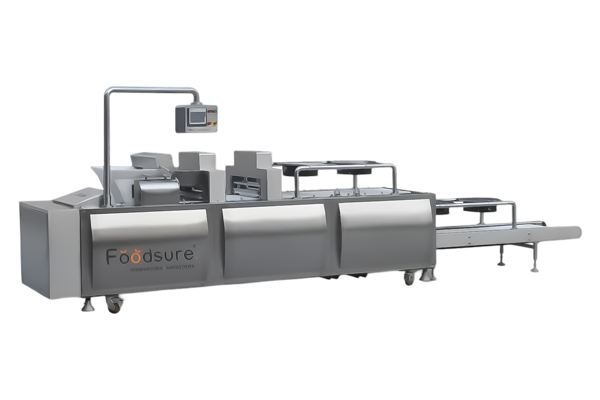
A commercial protein bar plant can include:
- Raw material handling equipment
- Weighing systems
- Mixer
- Slab former or extruder
- Calibrating rollers
- Slitter
- Guillotine cutter
- Cooling tunnel
- Chocolate enrober, where required
- Packaging machine
- Batch coder
- Metal detector
- Checkweigher
- Conveyors
The exact line should be designed around the recipe, capacity and packaging format.
How to Choose Protein Bar Machine Capacity in Nepal
Do not choose capacity simply because the largest machine looks more attractive.
Start with expected sales.
For example:
If your business plans to sell 10,000 bars per day and each bar weighs 50 g:
10,000 × 50 g = 500 kg of finished product per day.
But that does not automatically mean you need a 500 kg/hour line.
You also need to consider:
- Working hours
- Production days
- Batch losses
- Changeovers
- Cleaning
- Packaging speed
- Future demand
- Storage capacity
The right capacity is the one that fits the actual production plan.
Protein Bar Machine Options from Foodsure
For manufacturers evaluating a commercial line, Foodsure currently lists protein bar systems at several capacity levels.
Its published specifications include:
| Capacity | Published Power | Published Area |
|---|---|---|
| 50 kg/hr | 12 kW | 800 sq. ft. |
| 100 kg/hr | 26–27 kW | 3,500 sq. ft. |
| 200 kg/hr | 60 kW | 5,500 sq. ft. |
| 500 kg/hr | 75 kW | 10,000 sq. ft. |
Foodsure notes that actual plant planning should be based on the selected configuration and production requirements. Its published machine specifications also list SS304 for food-contact construction, SS302 for non-contact parts, 415 V three-phase power and a one-year warranty for its protein bar machine.
These figures should be treated as published machine specifications, not a universal factory requirement. A Nepal plant should have its final layout, utilities and line configuration confirmed against the selected formulation and equipment.
Factory Setup for a Protein Bar Manufacturing Plant in Nepal
A protein bar plant needs more than production equipment.
Your planning should cover:
Production Area
Allow space for:
- Ingredient handling
- Mixing
- Forming
- Cooling
- Packaging
- Finished goods
Raw Material Storage
Separate ingredients according to their storage requirements.
Packaging Material Storage
Keep packaging materials clean and protected.
Finished Product Storage
The storage environment should match the product’s validated requirements.
Quality Control Area
Depending on your operation, this may include:
- Sampling
- Weight checks
- Product inspection
- Documentation
- Testing coordination
Personnel and Hygiene Flow
Plan movement of people and materials so that hygiene is easier to maintain.
The Department of Food Technology and Quality Control specifically asks food-industry applicants to provide a technical plan covering raw-material sources, machinery, sanitation arrangements, production method, technical personnel and quality-control arrangements.
That makes factory planning part of the regulatory conversation, not something to consider after the machinery arrives.
Business Registration and Food Licensing in Nepal
This is an area where a Nepal-specific guide needs to be precise.
The Department of Industry provides an industry-registration process and lists documents such as the industry application, project proposal, company registration documents where applicable, and environmental approval where required.
For food manufacturing specifically, the Department of Food Technology and Quality Control operates the Nepal Food and Feed Industry Licensing System, or NeFFILS.
DFTQC explains that NeFFILS is designed to facilitate the process of obtaining a recommendation before establishing a food/feed industry and the permission required before taking products to market.
So your project plan should separately account for:
- Business/company registration
- Industry registration
- Food-industry approval and licensing
- Product requirements
- Labelling requirements
- Environmental requirements where applicable
- Quality and food-safety systems
- Any additional permissions applicable to the specific product
Because regulatory requirements can change, manufacturers should confirm the current requirements directly with the relevant Nepal authorities before commercial launch.
Protein Bar Labelling Requirements in Nepal
Labelling should be planned during product development, not after the packaging artwork is finished.
DFTQC’s published FAQ states that packaged food labels should include details such as the food name, ingredients with quantities, industry name and address, registration number, production date, expiry/consumption date and batch number. It also specifies disclosure where colours or preservatives are used.
Nepal’s Food Regulation also states that labels for foods making claims about vitamins, minerals or other nutritional substances need to specify the relevant nutritional information, and claims about such nutrients cannot simply be made without the required declaration.
That matters for a protein bar.
If the front of your pack says:
High Protein
the formulation and nutrition information need to support the claim under the applicable requirements.
Do not formulate first and decide the nutritional claim later.
Is a Protein Bar a Food or a Dietary Supplement?
This should be checked early if the product is being positioned as a specialised nutrition or supplement product.
DFTQC’s dietary supplement rules define dietary supplement products to include products containing substances such as vitamins, minerals, proteins or amino acids intended to support nutrition and health, and the framework includes requirements relating to production, sale, distribution and import/export.
The correct classification depends on the actual product, composition, presentation and claims.
So if your protein bar is being positioned beyond an ordinary packaged food, get the classification and regulatory requirements checked before finalising the commercial label.
How to Make a Protein Bar Shelf Stable
Shelf life is one of the biggest technical challenges in protein bar development.
A bar can look perfectly fine on day one and still develop problems later.
Watch for:
- Hardening
- Drying
- Stickiness
- Oil migration
- Rancid flavour
- Moisture migration
- Microbial growth
- Chocolate bloom
- Colour changes
The solution is rarely just one ingredient.
Shelf life depends on the interaction between:
Recipe + processing + water activity + packaging + storage
This is why shelf-life testing should happen before commercial launch.
Protein Bar Packaging for Nepal
Packaging needs to protect both the product and the brand.
For an individually wrapped bar, evaluate:
- Moisture barrier
- Oxygen barrier
- Seal strength
- Film compatibility
- Transport durability
- Printing and coding
- Pack size
- Storage conditions
Nepal’s distribution environment also matters. The U.S. Department of Commerce notes that road infrastructure and mountainous terrain can make delivery to remote locations more challenging.
That makes transport testing especially useful if the product is intended for distribution outside major urban markets.
How Much Does It Cost to Start a Protein Bar Factory in Nepal?
There is no responsible single investment figure that applies to every protein bar plant.
Your investment depends on:
- Production capacity
- Automation level
- Product formulation
- Number of SKUs
- Packaging format
- Factory size
- Machinery configuration
- Utilities
- Quality-control requirements
- Storage
- Working capital
- Distribution strategy
A small semi-automatic line and a fully automated national-distribution plant are two very different projects.
A proper feasibility study should therefore calculate:
Capital expenditure
Machinery + factory setup + utilities + installation
Product development cost
Formulation + testing + pilot trials
Working capital
Raw materials + packaging + labour + inventory + distribution
Cost per bar
Total manufacturing cost ÷ saleable bars
Contribution per bar
Selling price − variable cost
Break-even volume
Fixed costs ÷ contribution per bar
This is much more useful than quoting an arbitrary profit percentage.
How to Calculate Protein Bar Manufacturing Cost
Start with the recipe.
Suppose one bar contains:
- Protein ingredient
- Oats
- Dates
- Nut paste
- Seeds
- Flavouring
- Packaging
Calculate the cost of every ingredient used to make one batch.
Then add:
Ingredient cost
- Packaging
- Direct labour
- Electricity and utilities
- Production wastage
- Quality testing
- Factory overhead
- Distribution
This gives you a more realistic product cost.
Only after this calculation should you decide whether your intended retail price is commercially realistic.
How to Sell Protein Bars in Nepal
A protein bar brand does not have to depend on one channel.
Gyms and Fitness Centres
Useful for reaching consumers who already understand protein and sports nutrition.
Supermarkets
Useful for building visibility and reaching consumers outside the fitness category.
Convenience Stores
Potentially useful for impulse and on-the-go purchases.
Ecommerce
Useful for direct-to-consumer sales, bundles, subscriptions and product education.
The U.S. Department of Commerce identifies supermarkets, online shopping portals and growing ecommerce activity in urban Nepal as part of the country’s evolving retail environment.
Cafés and Wellness Businesses
A protein bar can be positioned as an add-on product with coffee, smoothies or other wellness offerings.
Trekking and Outdoor Channels
This is a particularly relevant segment to test in Nepal.
A compact, shelf-stable bar can be useful for:
- Hiking
- Trekking
- Travel
- Outdoor work
- Adventure activities
But the product should be developed around the actual requirements of these users rather than simply adding “trekking” to the packaging.
Should You Start With a 50 Kg, 100 Kg or 200 Kg Line?
There is no universal answer.
The decision should come from your expected demand.
50 kg/hr
Can make sense for an early commercial operation or a brand that wants to validate demand before moving to higher production.
Foodsure currently lists a 50 kg/hr protein bar machine configuration with published power of 12 kW and a published area figure of 800 sq. ft.
100 kg/hr
Can suit a brand moving into regular commercial production and broader distribution.
Foodsure lists a 100 kg/hr configuration with 26–27 kW published power and a 3,500 sq. ft. published area figure.
200 kg/hr
Makes more sense when the business has stronger production requirements and a clear route to market.
Foodsure lists a 200 kg/hr configuration with 60 kW published power and a 5,500 sq. ft. published area figure.
The important point is to size the plant around demand rather than buying capacity first and searching for customers later.
Common Mistakes When Starting a Protein Bar Business
The recipe should be validated before finalising the production line.
Making the Bar Too High in Protein
More protein does not automatically mean a better product.
High protein levels can affect taste and texture, so the nutritional target needs to work with the eating experience.
Ignoring Cost Per Bar
A product can receive excellent feedback and still fail if the economics do not work.
Launching Too Many Flavours
Start with a manageable number of SKUs.
Every additional flavour adds complexity in:
- Raw materials
- Inventory
- Production
- Packaging
- Quality control
Treating Shelf Life as an Afterthought
Shelf life should be part of formulation and packaging development.
Making Claims Without Checking Them
Claims such as high protein, low sugar, natural or other nutritional statements should be reviewed against the applicable requirements before printing the packaging.
Copying Imported Products
An imported protein bar may have a price, recipe and positioning designed for a different market.
A Nepalese brand should build its own proposition around its target consumer.
How Foodsure Can Support a Nepal Protein Bar Manufacturing Project
For a new manufacturer, the machine is only one part of the project.
Foodsure works across the formulation and manufacturing side, including protein bar formulation, pilot development, manufacturing alignment and commercial machinery. Its published formulation services cover custom protein bars, plant-based and whey formulations, texture and shelf-life optimisation, scale-up and compliance support.
On the machinery side, Foodsure publishes protein bar production systems across multiple capacities, with food-contact SS304 construction and configurations designed around commercial production.
That means a Nepal project can be approached as a connected process:
Rather than buying a machine first and trying to make the recipe fit later.
For manufacturers who already have a formulation, the next step can simply be a machine trial using the actual product.
Protein Bar Manufacturing Plant Checklist for Nepal
Before investing, make sure you have answered these questions:
Market
- Who is the customer?
- What competing products are already available?
- What price can the customer realistically pay?
- Which cities or channels will you target?
Product
- What protein source will you use?
- What will the bar weigh?
- What flavour will you launch?
- What texture are you targeting?
- What is the target cost per bar?
Recipe
- Has the formulation been tested?
- Has sensory testing been completed?
- Has the formula been tested on production equipment?
- Has shelf-life testing started?
Factory
- How much production capacity do you need?
- How much floor space is available?
- What power supply is required?
- How will raw materials move through the factory?
- Where will finished goods be stored?
Compliance
- Is the business registered?
- Is industry registration complete?
- Has the relevant DFTQC process been checked?
- Is the product classification clear?
- Does the label meet current requirements?
- Are nutritional claims supported?
Commercialisation
- Who will distribute the product?
- Will you sell through gyms?
- Will you use supermarkets?
- Will you sell online?
- Do you have a distributor?
- What is your launch budget?
Final Thoughts
Starting a protein bar manufacturing business in Nepal is not just a machinery investment.
The stronger approach is to build the project in the right order:
Research the market → identify the customer → select the product → develop the recipe → test the product → validate shelf life → calculate the cost → select machinery → set up the factory → complete compliance → launch through the right channels → scale with demand.
Nepal’s developing healthy-snack and protein-bar categories create room for new products, but the opportunity should be tested rather than assumed. Available market research points to interest in healthier and functional snacks, while Nepal’s retail and ecommerce environment is becoming more developed in urban markets.
For a manufacturer, the biggest advantage may not be simply producing a bar with more protein. It may be developing a product that tastes good, fits the customer’s budget, survives Nepal’s distribution conditions, meets regulatory requirements and can be produced consistently at commercial scale.
That is where formulation and manufacturing need to come together.
If you are planning the plant, start with the product and production target. Then select the machinery around them.
Have a Question? Let’s Connect
Need expert guidance on food processing machines, production setup, or process optimization? Our team is ready to help you choose the right solution for your business.
Frequently Asked Questions
Is protein bar manufacturing profitable in Nepal?
Protein bar manufacturing can be commercially viable, but profitability depends on the product’s ingredient cost, selling price, production efficiency, packaging, distribution and actual demand. A fixed profit margin should not be assumed without a product-specific cost model.
What is the investment required for a protein bar manufacturing plant in Nepal?
Investment depends on capacity, automation, factory setup, packaging, utilities, formulation, testing and working capital. A 50 kg/hr plant and a 200 kg/hr automated plant can have very different capital requirements, so the project should be costed after defining the production plan.
What ingredients are used to make protein bars?
Common ingredients include whey or plant proteins, oats, nuts, seeds, dates, nut pastes, sweeteners, cocoa and flavouring ingredients. The final recipe depends on the target nutrition, taste, texture, shelf life and cost.
How do you manufacture protein bars?
A typical process involves ingredient preparation, mixing, slab forming or extrusion, calibration, cutting, cooling or setting, optional coating and final packaging. The exact process changes with the formulation.
Which protein is best for protein bars?
There is no single protein that works best for every bar. Whey, soy, pea, rice and other proteins have different effects on taste, texture, nutrition, cost and processing behaviour. The protein should be selected according to the product concept.
What machinery is needed for protein bar production?
A commercial line can include a mixer, slab former or extruder, calibrator, cutter, cooling system, optional coating equipment, packaging machine, coder, metal detector and checkweigher. The exact configuration depends on the recipe and production capacity.
What protein bar machine capacity should I choose?
Choose capacity based on expected sales, working hours, product weight, packaging speed and future demand. Foodsure currently lists 50, 100, 200 and 500 kg/hr protein bar configurations.
What are the food labelling requirements in Nepal?
DFTQC’s published guidance requires packaged food labels to include information such as product name, ingredients with quantities, manufacturer details, registration number, production date, expiry or consumption date and batch number. Additional requirements can apply depending on the product and claims.
Can I manufacture protein bars for gyms and supermarkets?
Yes, these can be potential sales channels. However, retailers and distributors may have their own requirements relating to pricing, margins, packaging, shelf life, documentation and supply capacity.
Can protein bars be sold online in Nepal?
Yes. Nepal’s ecommerce market is developing, particularly in urban areas, and mobile internet access is important to online commerce. Online sales can therefore be one part of a broader distribution strategy.
Can a Nepalese protein bar manufacturer export?
Export is possible, but the requirements depend on the destination market. The manufacturer needs to evaluate the importing country’s food regulations, labelling, product documentation, shelf life, packaging and importer requirements separately.