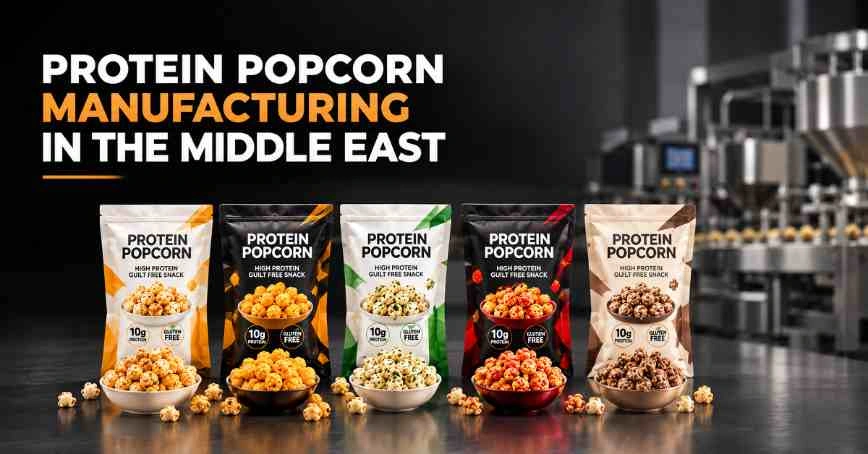
Protein popcorn is regular air-popped corn, already a whole grain and naturally containing fibre, enriched with pea, whey, or other protein ingredients to compete in the same aisle as protein bars, protein puffs and other functional snacks. Across the GCC, rising interest in fitness, preventive nutrition and functional foods is creating new opportunities for manufacturers entering better-for-you snacking.
The GCC functional food and beverage market was valued at USD 18.20 billion in 2025 and is projected to reach USD 56.80 billion by 2036 at a 10.9% CAGR, according to Future Market Insights. The report includes functional snacks within its product segmentation and identifies rising health awareness, urbanisation and government-led nutrition initiatives as important market drivers.
For anyone evaluating a protein snack manufacturing plant in Saudi Arabia, the UAE or the wider Gulf, the opportunity needs to be assessed through product-market fit, regulatory readiness, sourcing, distribution and manufacturing economics rather than market growth alone.
Read more :- extruded protein snacks
Is Protein Popcorn a Good Business Opportunity in the Middle East?
Protein popcorn is entering a broader protein-snacking environment that is expanding globally. Growth Market Reports estimates the global protein popcorn market at USD 578 million in 2025 and projects it to reach approximately USD 1.387 billion by 2034, representing a 10.2% CAGR.
The wider protein snacks market provides additional context. Persistence Market Research estimates the global protein snacks market at USD 37.3 billion in 2026 and projects it to reach USD 72.2 billion by 2033 at a 9.9% CAGR.
These figures do not establish the size of the GCC protein popcorn market specifically. They indicate a broader environment in which protein-led snack formats are gaining attention. For a GCC manufacturer, the opportunity still depends on halal-compliant sourcing, applicable GSO and national labelling requirements, product quality, pricing and distribution.
What Is Protein Popcorn?

Protein popcorn starts with popcorn kernels that are popped and then combined with a protein-containing coating, seasoning or formulation system. Depending on the product concept, manufacturers may work with pea protein, whey protein, soy protein, milk proteins or other suitable ingredients.
The format shares shelf space with protein bars, protein chips, protein puffs and conventional popcorn, but offers a different eating experience. Its appeal comes from combining the familiarity of popcorn with protein-focused positioning.
The global protein popcorn market was valued at USD 578 million in 2025 and is forecast by Growth Market Reports to reach USD 1.387 billion by 2034. The same source reports a 10.2% CAGR during the forecast period.
The broader protein snacks category is considerably larger. Persistence Market Research estimates it at USD 37.3 billion in 2026, with projected growth to USD 72.2 billion by 2033.
This broader category includes protein bars, chips and crisps, cookies and biscuits, dairy snacks, nuts and seeds, jerky and other formats. Protein popcorn therefore sits within a much wider shift toward snacks that combine convenience with nutritional positioning.
How Protein Popcorn Differs from Regular and Flavoured Popcorn
Plain popcorn already has a nutritional profile that differentiates it from many conventional salty snacks. It is a whole-grain food, while protein popcorn adds another functional element through protein enrichment.
The formulation objective is not simply to add protein powder. The manufacturer needs to balance protein content with:
- Taste
- Texture
- Crispness
- Coating adhesion
- Moisture control
- Ingredient compatibility
- Shelf life
- Allergen management
- Regulatory requirements
Flavoured popcorn can be built around caramel, cheese, butter, chocolate or other flavour systems. Protein popcorn instead adds a nutritional positioning layer to the familiar popcorn format.
This means the product needs to deliver both sensory and nutritional value. A technically high-protein snack that has an unpleasant texture or poor flavour will still struggle to achieve repeat purchase.
Fibre and Satiety Positioning
Popcorn is naturally a source of dietary fibre because the whole kernel is retained through processing. This can provide a useful product-positioning advantage when compared with some conventional fried snacks.
However, manufacturers should avoid turning general nutritional characteristics into unqualified health claims. Any claim used on commercial packaging should be assessed against the applicable regulations in the target GCC market.
The same principle applies to statements such as “high protein,” “source of protein,” “low sugar” or “keeps you fuller for longer.” The final product composition needs to substantiate the claim.
Key Consumer Trends Driving Demand in the Middle East
Several trends are converging across GCC food markets.
Functional Food and Beverage Growth
Future Market Insights estimates that the GCC functional food and beverage market was worth USD 18.20 billion in 2025 and projects it to reach USD 56.80 billion by 2036, growing at a 10.9% CAGR. The report identifies preventive health consumption, rising disposable incomes, urbanisation and government-led nutrition initiatives among the market drivers.
Functional snacks form part of the market definition, alongside categories such as functional dairy and fortified beverages. This creates a broader environment for manufacturers developing protein-focused snack products.
Fitness Culture
Fitness and wellness are increasingly visible across GCC markets, creating potential consumption occasions for protein snacks.
However, fitness participation statistics should be treated as market indicators rather than proof that consumers will automatically purchase protein popcorn. Product sampling, retailer feedback and consumer testing remain important before commercial scale-up.
Health and Nutrition Awareness
Saudi Arabia’s 2024 Health Determinants Statistics publication reported that 23.1% of Saudis aged 15 and above were classified as obese and 45.1% as overweight. The same publication reported that only 10.2% consumed five or more servings of fruits and vegetables daily. GASTAT notes that the data is based partly on self-reported information and health surveys.
These figures provide public-health context for the growing focus on nutrition and active lifestyles, but they should not be presented as direct evidence of demand for a particular snack.
Protein Popcorn vs Competing Protein Snacks

Protein popcorn competes within a wider protein-snack category that includes bars, puffs, chips, cookies, nuts and other products.
Persistence Market Research estimates the global protein snacks market at USD 37.3 billion in 2026, with protein bars representing the largest product category in its segmentation.
The comparison therefore needs to focus on product attributes rather than simply market size.
Protein popcorn therefore does not have to replace protein bars. It can occupy a different consumption occasion.
Middle East Market Opportunity for Protein Popcorn
The Middle East has a developing market for healthier and functional packaged foods. Rising awareness of nutrition, expanding modern retail and the growth of online grocery provide multiple routes to market.
Grand View Research has previously reported growth in the Middle East and Africa protein-snack and protein-bar categories, while the broader GCC functional food market provides a larger context for protein-led products.
The GCC healthy packaged snacks market is estimated by Ken Research at approximately USD 1.5 billion. The report identifies the UAE and Saudi Arabia as important markets within the region and links growth to health awareness and convenient snacking.
This should be treated as the broader healthy packaged snacks market, not as the market size for protein popcorn.
UAE Market Landscape
The UAE offers a highly developed retail environment for premium and imported food products.
McKinsey’s State of Grocery Retail 2024 report found that modern trade represented approximately 87% of grocery retail in the UAE in 2023, compared with 46% in Saudi Arabia. McKinsey’s analysis is based on Euromonitor and other retail data sources.
This structure gives manufacturers several possible entry points, including:
- Hypermarkets
- Supermarkets
- Specialty food stores
- Fitness retailers
- E-commerce
- Quick commerce
- Foodservice
- Direct-to-consumer sales
The UAE’s expatriate population also means that brands can reach consumers who may already be familiar with protein bars, protein snacks and functional foods from other markets.
Instead of assuming that consumers will automatically pay a premium, manufacturers should validate price acceptance through retailer discussions and product testing.
Saudi Arabia Market Landscape
Saudi Arabia represents another important market for protein popcorn because of its population size, expanding retail infrastructure and increasing focus on health and lifestyle.
GASTAT’s 2024 data reported obesity among 23.1% of Saudis aged 15 and above and overweight status among 45.1%. Only 10.2% met the recommended daily intake of five or more servings of fruits and vegetables.
Saudi Arabia also has an established popcorn category. GlobalData’s Saudi Arabia popcorn market report states that the market recorded sales of SAR 150.81 million in 2024, with sales increasing 8.81% compared with 2023. The report covers the broader popcorn market, including ready-to-eat, microwaveable and unpopped popcorn.
This is useful category evidence, but it should not be interpreted as a USD 150.81 million protein popcorn market.
Broader GCC Snapshot
Qatar, Kuwait, Oman and Bahrain can provide additional opportunities for premium snack manufacturers.
Each market should be assessed separately for:
- Population size
- Retail structure
- Import requirements
- Distributor availability
- Consumer preferences
- Local competition
- Product registration
- Halal requirements
- E-commerce penetration
A manufacturer should avoid assuming that a product successful in the UAE will automatically perform identically in Saudi Arabia, Qatar, Kuwait, Bahrain or Oman.
Consumer Demographics and Purchasing Behaviour
Knowing the target consumer is more useful than relying only on overall market size.
Young Professionals
Young professionals may look for convenient snacks suitable for office, commuting and travel occasions.
Fitness Consumers
Fitness consumers are already familiar with protein shakes, bars and other high-protein products. Protein popcorn can provide variety within this existing consumption pattern.
Millennials and Gen Z
Younger consumers are more exposed to food trends through social media, creators, fitness communities and e-commerce platforms.
Families
Families may look for snacks that balance taste and nutritional positioning, although child-focused claims must be carefully assessed before being used commercially.
Across these groups, purchasing decisions can be influenced by protein content, sugar level, ingredient transparency, flavour, halal status, convenience and brand credibility.
Retail and Modern Trade Growth in the Region
McKinsey reports that modern trade represented approximately 87% of grocery retail in the UAE and 46% in Saudi Arabia in 2023. Its analysis also highlights continued expansion in modern retail across the region.
For manufacturers, this creates several possible routes to market:
- Hypermarkets
- Supermarkets
- Convenience stores
- Specialty nutrition stores
- Online grocery
- Quick-commerce platforms
- Gyms
- Cafés
- HORECA
The channel mix should be selected according to product positioning and target consumer rather than relying on supermarket distribution alone.
Regulatory and Licensing Requirements
Building a Protein Snack Manufacturing Opportunities for the GCC requires attention to food safety, labelling, halal requirements, ingredient documentation and import procedures.
The Gulf Standardization Organization provides common technical standards across the GCC, while national regulators such as the Saudi Food and Drug Authority apply country-specific requirements.
Compliance should be addressed during product development rather than after the product and packaging have already been finalised.
Halal Certification Requirements
Protein popcorn may contain ingredients that require halal verification, including:
- Whey protein
- Milk proteins
- Cheese powders
- Flavour systems
- Emulsifiers
- Processing aids
- Enzymes
The halal status of the finished product therefore depends on more than the popcorn kernel itself.
GSO halal standards should be reviewed alongside the requirements of the target country and the selected certification body.
SFDA Registration in Saudi Arabia
Companies entering Saudi Arabia need to consider applicable SFDA requirements covering food products, manufacturers, importers, labelling and claims.
For protein popcorn, documentation can include:
- Product specifications
- Ingredient information
- Allergen information
- Product labels
- Certificates where applicable
- Manufacturer details
- Health or halal documentation where required
- Nutritional information
Importers and manufacturers should confirm the latest SFDA requirements before commercial shipment because regulatory procedures can change.
GSO Standards
Relevant GCC standards include GSO 9 for labelling of prepackaged foods, GSO 2233 for nutritional labelling and GSO 2055 for halal products and certification.
Future Market Insights’ current GCC functional-food research also references GSO halal requirements and SFDA oversight of functional, health and nutrition claims.
The important point for manufacturers is to design the product and label around the applicable standard rather than treating regulatory compliance as a final-stage packaging check.
Labelling, Nutritional Claims and Protein Content Regulations
This is particularly important for protein popcorn because the product’s main selling proposition may depend on its protein claim.
Saudi food labelling requirements cover areas such as:
- Product name
- Ingredients
- Allergens
- Net quantity
- Country of origin
- Manufacturer information
- Dates and batch information
- Storage information
- Nutrition information
Claims such as “High Protein” or “Source of Protein” should only be used when the finished product meets the applicable regulatory requirements.
The final nutritional composition should therefore be validated before packaging artwork is approved.
Import and Export Documentation for Raw Materials and Machinery
Raw materials and machinery may require documentation depending on the country, supplier and import route.
Typical documentation can include:
- Commercial invoice
- Packing list
- Certificate of origin
- Product specifications
- Technical documentation
- Health documentation where applicable
- Halal documentation where applicable
- Customs documentation
Manufacturers should work with experienced customs, regulatory and logistics partners when importing equipment or ingredients.
Business Models for Entering the Protein Popcorn Market
There is more than one way to enter the category.
The GCC healthy packaged snacks market is estimated at approximately USD 1.5 billion by Ken Research, with the UAE and Saudi Arabia identified as important markets.This supports several possible business models.
Private Label and Contract Manufacturing
Contract manufacturing allows a brand to enter the category without immediately investing in a complete production facility.
The brand can focus on:
- Product concept
- Formulation
- Packaging
- Marketing
- Distribution
- Retail relationships
The manufacturing partner manages production and may also support packaging, quality and technical operations.
Advantages
- Lower initial capital requirement
- Faster market testing
- Reduced equipment responsibility
- Easier SKU experimentation
- Potential access to an existing food-safety system
Own-Brand Manufacturing
For companies with established demand, owning a manufacturing line provides greater control over:
- Formulation
- Production scheduling
- Quality
- Manufacturing costs
- Product development
- Future SKU expansion
The model requires more capital, technical staff, facility planning and operational management.
B2B Supply to Gyms, Cafés and Retailers
Gyms, fitness studios, cafés, offices and specialty nutrition retailers can provide useful early channels.
B2B sales can also provide valuable feedback on:
- Flavour acceptance
- Pack size
- Repeat purchases
- Consumer response
- Price sensitivity
Franchise and Licensing Route
Once a brand has established demand, licensing can provide a route into additional territories or product categories.
The model can involve another company manufacturing, distributing or marketing the product under agreed brand and quality requirements.
Business Model Comparison
Most brands do not need to remain in one model permanently. A company can validate demand through contract manufacturing, build B2B and retail demand, and later transition into owned manufacturing.
Protein Popcorn Manufacturing Process
Before Protein Popcorn Machine selection, it helps to understand the complete process.
A typical process includes:
1. Raw Corn Kernels
The process starts with consistent popcorn kernels.
Kernel quality affects:
- Expansion
- Flake size
- Crunch
- Breakage
- Coating behaviour
2. Popping
Popping can be hot-air based or oil based, depending on the desired product profile.
Hot-air popping may support a lower-oil positioning, while oil-based systems may be selected for specific flavour and coating requirements.
3. Protein Coating
This is the stage that differentiates the product from conventional popcorn.
Protein ingredients can be applied through a coating, slurry, syrup or seasoning system depending on the formulation.
4. Cooling
Cooling allows the coating to stabilise before additional seasoning or packaging.
5. Seasoning and Flavouring
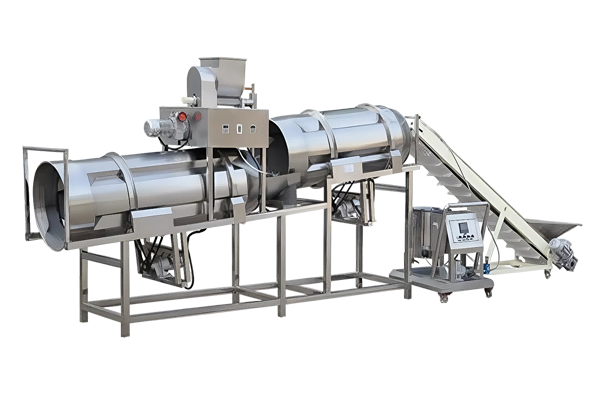
Seasoning can be applied through rotating drums or other controlled systems.
Possible flavours include:
- Cheese
- BBQ
- Chocolate
- Caramel
- Salted butter
- Peri-peri
- Sour cream
- Honey cinnamon
- Zaatar
- Shawarma spice
- Chilli lemon
- Cardamom
- Date and cinnamon
6. Quality Inspection
Quality control can include:
- Metal detection
- Check weighing
- Visual inspection
- Moisture testing
- Texture evaluation
- Flavour checks
7. Nitrogen-Flushed Packaging
Popcorn is sensitive to moisture and oxygen, so packaging needs to be designed around the required shelf life.
Nitrogen flushing can help reduce oxygen exposure inside the package. Packaging suppliers such as HonorPack specifically recommend nitrogen flushing and barrier films for popcorn packaging.
Machinery Required for Protein Popcorn Production
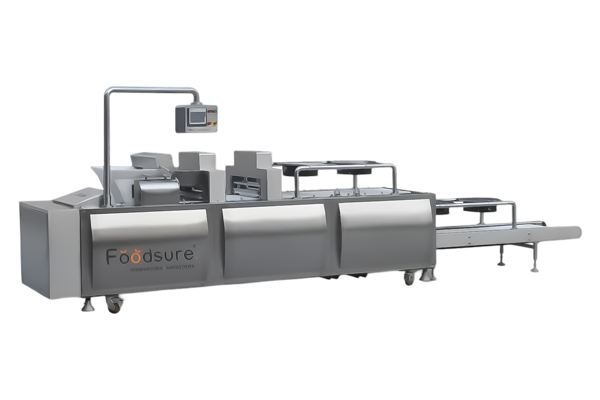
Unlike standard popcorn production, a protein popcorn line generally requires an additional coating or enrobing stage.
A typical line can include:
- Popcorn popping machine
- Kernel handling system
- Cooling conveyor
- Protein coating/enrobing system
- Seasoning drum
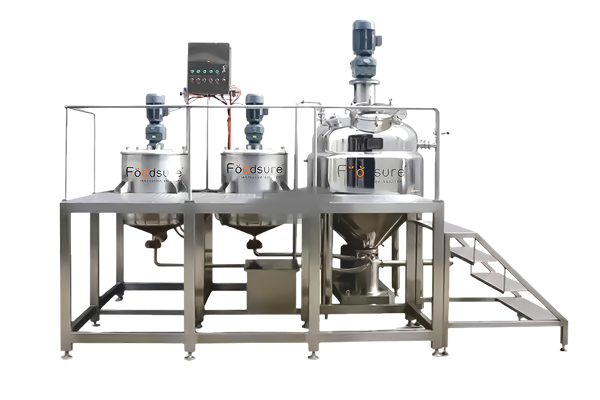
- Mixing system
- Multi-head weigher
- VFFS packaging machine
- Nitrogen flushing system
- Metal detector
- Check weigher
- Date coding machine
- Carton packing equipment
- Conveyors
The right equipment combination depends on the product formulation, packaging format, required automation and expected demand.
Popcorn Popping Machine Types and Capacity
Batch poppers can suit startups, product trials and smaller production requirements.
Continuous systems are more appropriate for larger manufacturing operations where uninterrupted processing, consistency and reduced manual intervention are priorities.
Instead of selecting a machine based only on its advertised capacity, manufacturers should consider:
- Actual operating hours
- Cleaning time
- Changeovers
- Product losses
- Packaging constraints
- Labour requirements
- Future expansion
Protein Coating and Enrobing Machines
The coating system is central to the product.
Protein ingredients need to be distributed consistently without making the popcorn soggy or excessively dense.
The coating process should be evaluated for:
- Viscosity
- Temperature
- Mixing
- Adhesion
- Drying
- Breakage
- Uniformity
Pilot trials are particularly important before selecting a commercial coating system.
Flavouring and Seasoning Application Systems
Seasoning systems can apply dry powders, oils, liquid binders or combinations of these.
For GCC markets, manufacturers can develop both international flavours and regional profiles.
Regional options could include:
- Zaatar
- Date and cinnamon
- Honey cardamom
- Shawarma spice
- Harissa
- Saffron caramel
- Pistachio
- Arabic coffee-inspired profiles
Packaging Machinery for GCC Climate
Packaging is one of the most important parts of the production line because the final product needs to maintain crispness during storage and distribution.
HonorPack’s popcorn packaging guidance lists nitrogen flushing, barrier films and packaging speeds of approximately 60–120 bags per minute depending on the film and popcorn type.
These are equipment-level specifications, not universal production guarantees. Actual output depends on bag dimensions, product characteristics, machine configuration and operating conditions.
A typical packaging system can include:
- Multi-head weigher
- VFFS machine
- Nitrogen flushing
- Metal detection
- Check weighing
- Date coding
- Carton packing
Choosing Machinery for Small and Large-Scale Units
The important decision is not simply buying the largest available line. Equipment should be matched to actual demand and future expansion plans.
Automation vs Semi-Automated Lines
For companies still validating the market, semi-automated production can provide flexibility. Once demand becomes predictable, additional automation can be introduced.
Raw Material Sourcing for Protein Popcorn
A reliable supply chain is essential.
The key raw materials include:
- Popcorn kernels
- Protein ingredients
- Seasonings
- Oils
- Sweeteners
- Functional ingredients
- Packaging materials
Popcorn Kernel Sourcing
IndexBox estimates that Saudi Arabia relies on imports for approximately 85–95% of its bulk popcorn kernel supply, with the United States, Argentina and Ukraine among the major origin markets.
This import dependence makes supplier selection particularly important.
Manufacturers should evaluate:
- Kernel size
- Moisture
- Popping performance
- Expansion
- Foreign matter
- Consistency
- Lead time
- Storage requirements
Regional ingredient distributors can also be considered when smaller purchase quantities are required.
Protein Source Options
Whey Protein
Whey offers strong consumer recognition and works well in dairy and dessert-style flavours. Its dairy origin means the sourcing and certification documentation needs to be reviewed carefully.
Pea Protein
Pea protein can suit plant-based and lactose-free product positioning.
Soy Protein
Soy protein can offer functional and cost advantages, although allergen and consumer-positioning considerations need to be evaluated.
The final protein source should be selected based on formulation performance, consumer positioning, cost, allergen requirements and target-market regulations.
Flavouring and Seasoning Ingredients for Regional Palates
GCC consumers should not be treated as one homogeneous group.
International flavours such as:
- Cheese
- Caramel
- Chocolate
- Butter
- BBQ
- Sour cream
can be combined with regional concepts such as:
- Zaatar
- Shawarma
- Harissa
- Saffron
- Honey
- Cardamom
- Dates
- Cinnamon
The final flavour portfolio should be based on consumer testing rather than assumptions.
Packaging Material Suppliers in the GCC
Packaging needs to withstand the intended storage and distribution environment.
Manufacturers should evaluate:
- Food-grade compliance
- Moisture barrier
- Oxygen barrier
- Seal integrity
- Film structure
- Printing capability
- Nitrogen-flush compatibility
- Shelf-life performance
- Minimum order quantity
- Lead time
Gulfood can also be used to identify packaging, ingredient and machinery suppliers from across the region and international markets.
Cost and Investment Breakdown
The investment required for a protein popcorn project varies significantly according to:
- Business model
- Production scale
- Automation
- Packaging format
- Facility requirements
- Utilities
- Product range
- Quality-control requirements
- Installation
- Working capital
Because supplier quotations differ significantly by configuration, generic online machinery prices should not be treated as a final project investment figure.
Machinery Investment
Instead of using a fixed universal price range, manufacturers should request quotations based on their actual requirement.
A supplier quotation should clearly separate:
- Machinery
- Installation
- Commissioning
- Electrical work
- Conveyors
- Packaging
- Spare parts
- Training
- Taxes and freight
- Facility modifications
Raw Material and Operational Costs
Raw materials remain a major cost consideration because protein ingredients can be substantially more expensive than conventional snack ingredients.
The operating-cost structure should include:
Rather than applying a universal percentage to every factory, businesses should calculate these costs using their own supplier quotations and production assumptions.
Licensing and Certification Costs
Regulatory expenses can include:
- Company registration
- Food manufacturing licence
- Municipality approvals
- Product registration
- Halal certification where applicable
- HACCP or ISO 22000 certification
- Laboratory testing
- Nutritional analysis
- Packaging compliance
These should be included in the initial feasibility study.
ROI and Payback
There is no reliable universal payback period for a GCC protein popcorn facility.
The actual result depends on:
- Selling price
- Gross margin
- Production utilisation
- Distribution margin
- Retail listing costs
- Marketing expenditure
- Working capital
- Product wastage
- Number of SKUs
- Export share
A contract-manufacturing model will have a very different financial structure from a fully owned factory.
Distribution and Retail Channels in the Middle East
The GCC healthy packaged snacks market is estimated at approximately USD 1.5 billion by Ken Research. The report identifies health awareness, convenience and demand for nutritious products as key growth factors.
A protein snack brand can therefore evaluate several channels.
Modern Trade and Hypermarkets
McKinsey reports modern trade penetration of approximately 87% in the UAE and 46% in Saudi Arabia in 2023.
Potential retail channels include:
- Carrefour
- LuLu
- Spinneys
- Waitrose
- Choithrams
- Panda
- Danube
- Tamimi Markets
- Union Coop
- Specialty nutrition retailers
LuLu Retail reported 267 stores at the end of 2025 and announced plans to open an additional 50 stores between 2026 and 2028.
Gyms, Fitness Studios and Wellness Retail
Fitness locations can be useful for product sampling because consumers visiting these outlets may already be interested in protein and functional nutrition.
Potential channels include:
- Gyms
- Fitness studios
- CrossFit facilities
- Yoga studios
- Nutrition stores
- Wellness cafés
E-Commerce and Quick Commerce
Online channels allow brands to test products without depending entirely on traditional supermarket distribution.
McKinsey’s regional grocery analysis identifies strong growth in modern retail and e-commerce across GCC markets.
Online platforms can also provide useful data on:
- Best-selling flavours
- Repeat purchase
- Pack-size preference
- Geographic demand
- Promotional performance
HORECA and Café Opportunities
Hotels, restaurants and cafés can provide additional channels.
Potential applications include:
- Single-serve snack packs
- Hotel minibars
- Corporate catering
- Café counters
- Wellness events
- Travel and hospitality
Export Opportunities Within GCC
Once a product has been designed for applicable GCC requirements, manufacturers can evaluate neighbouring markets individually.
Expansion should still include market-specific checks for:
- Registration
- Labelling
- Import procedures
- Distributor requirements
- Halal documentation
- Product claims
A regional expansion strategy should therefore be planned market by market.
Competitor Analysis: Protein Popcorn Brands in the GCC
The Saudi popcorn category provides a useful benchmark. GlobalData reports Saudi popcorn sales of SAR 150.81 million in 2024, with the category growing 8.81% year on year.
A separate 2026 retail study covering 28 stores across the UAE and Saudi Arabia found that 85.7% of the snack SKUs observed were imported, while 14.3% were locally sourced.
That finding is relevant to local manufacturers because it indicates a strong presence of imported snack products, while also showing that locally sourced products already occupy part of the category.
Existing Regional and International Players
Regional popcorn brands and international snack companies provide useful benchmarks for:
- Protein positioning
- Pack sizes
- Flavours
- Ingredients
- Retail placement
- Brand identity
- Price positioning
One particularly relevant current example is PopCorners Protein. PepsiCo states that PopCorners Protein provides 9 grams of protein per serving and is available in flavours including Zesty Cheddar, Hickory BBQ and Cinnamon Delight.
This demonstrates that large snack companies are extending protein positioning into popped and corn-based snack formats.
Positioning Gaps and Differentiation Opportunities
Gap 1: Protein-Focused Popcorn
A brand can differentiate by combining the familiar popcorn format with a clearly substantiated protein proposition.
Gap 2: Regional Flavours
Regional flavours can provide differentiation from imported products.
Potential concepts include:
- Zaatar
- Date and cinnamon
- Honey cardamom
- Shawarma spice
- Saffron caramel
- Pistachio
- Arabic coffee
Gap 3: Fitness Plus Indulgence
A product does not have to choose between fitness positioning and enjoyable flavours. The formulation can target both.
Gap 4: Local Manufacturing
The 2026 UAE and Saudi retail study found that imported snacks represented 85.7% of observed snack SKUs, compared with 14.3% locally sourced SKUs.
Local manufacturing may provide advantages in replenishment, product customisation and regional flavour development, although the actual commercial advantage depends on manufacturing economics.
Gap 5: Clean Label Plus Halal
A product can combine:
- Protein positioning
- Halal certification
- Recognisable ingredients
- Appropriate sugar positioning
- Transparent labelling
The exact claims should always be validated against the applicable regulations.
Pricing Benchmarks
Pricing should be based on competitor research rather than applying a fixed GCC-wide benchmark.
The price a consumer is willing to pay will depend on:
- Pack size
- Protein content
- Ingredients
- Brand positioning
- Retail channel
- Country
- Imported versus locally produced positioning
- Promotional activity
A useful competitive-pricing exercise should record actual shelf prices in the target market and compare them on a per-gram and per-serving basis.
Final Considerations
Protein Popcorn Manufacturing should be approached as a complete product-development and manufacturing project rather than simply a popcorn-machine purchase.
The process starts with the product concept and formulation, followed by pilot testing, ingredient sourcing, packaging development, regulatory validation and machinery selection.
For Protein Popcorn Manufacturing in Middle East markets, manufacturers should pay particular attention to:
- Protein formulation
- Popcorn kernel quality
- Coating uniformity
- Moisture control
- Packaging barrier performance
- Nitrogen flushing where required
- Halal documentation
- GSO and national labelling requirements
- Retail strategy
- E-commerce
- Distributor selection
- Production scalability
The global protein popcorn market provides a useful indication of category growth, while the wider protein snacks and GCC functional-food markets show the broader environment in which the product is developing. Growth Market Reports estimates the global protein popcorn market at USD 578 million in 2025 and USD 1.387 billion by 2034, while Future Market Insights projects the GCC functional food and beverage market to reach USD 56.80 billion by 2036.
For manufacturers considering Protein Popcorn Manufacturing in Middle East markets, the strongest approach is to validate the product locally, design the packaging and claims around the target country’s requirements, and scale machinery only after demand and production economics have been established.
Have a Question? Let’s Connect
Need expert guidance on food processing machines, production setup, or process optimization? Our team is ready to help you choose the right solution for your business.
Frequently Asked Questions
Is Protein Popcorn Manufacturing profitable in the GCC?
Protein Popcorn Manufacturing can be commercially viable, but profitability depends on formulation cost, selling price, manufacturing utilisation, packaging, distribution margins, retail fees, marketing expenditure and repeat purchase.The wider protein snacks market is projected to grow at 9.9% CAGR globally between 2026 and 2033, while the global protein popcorn market is projected by Growth Market Reports to grow at 10.2% between 2026 and 2034.These figures provide market context, not a guaranteed return on investment.
What machinery is needed to start a protein popcorn business?
A typical Protein Popcorn Manufacturing line can include a popcorn popping system, protein coating or enrobing equipment, cooling system, seasoning equipment, weighing, packaging, nitrogen flushing, metal detection and check weighing.The final configuration should be based on the formulation, pack size, production requirement and level of automation.
Is Halal certification mandatory for protein popcorn export in the GCC?
Requirements vary by country and product. However, halal documentation can be highly important for products containing dairy proteins, flavourings, enzymes and other ingredients.Manufacturers should review the applicable GSO requirements and the requirements of the importing country before launch.
What is the investment required to start protein popcorn manufacturing?
There is no single reliable investment figure for every plant.
The project cost depends on:
- Production capacity
- Automation
- Popping technology
- Coating system
- Packaging
- Facility size
- Utilities
- Installation
- Certification
- Working capital
For this reason, manufacturers should obtain a project-specific quotation rather than relying on generic online machinery-price ranges.
Which GCC country should a manufacturer evaluate first?
The answer depends on the intended business model.The UAE offers a highly developed modern-retail environment, with McKinsey reporting modern trade at approximately 87% of grocery retail in 2023.Saudi Arabia has a large domestic food market and an established popcorn category. GlobalData reports Saudi popcorn sales of SAR 150.81 million in 2024.
Rather than assigning one country an overall “best” position, manufacturers should compare the UAE, Saudi Arabia and other GCC markets based on their product, target consumer, regulatory requirements, distributor network and investment model.