
Extruded Protein Snacks are snacks manufactured by extruding a mixture of ingredients which is rich in proteins in an extruder using heat, pressure, and mechanical shear. The list of ingredients includes oats, whey, pea protein, soy, nuts, dates, among others, to come up with puffed, crispy, chewy, or structured snacks.
In the Gulf Cooperation Council (GCC) region, shifting preferences, an increasing interest in health and fitness, as well as government-led healthy-lifestyle and local-food-production initiatives, present opportunities for producers venturing into high-protein snacks.
The benefits to food entrepreneurs go beyond the end product. With extrusion, manufacturers are able to create various textures and forms through one processing platform. This makes it ideal for brands that are interested in expanding their range of products as opposed to sticking to one snack SKU.
What Are Extruded Protein Snacks?
Simply put, the ingredients are mixed into the appropriate formula and fed into an extruder. The process is then subjected to heating, pressure, moisture, and mechanical forces, which will convert the material.
The material will then move through the die, which will define the shape and form of the final product.
By changing the formulas and the conditions of processing, one can produce puffs, crisps, textured snacks, nuggets, etc.
Such adaptability is one of the main advantages of the process. It allows a line to be adapted for different formulas by changing processing conditions, dies, and the rest of the equipment.
For brands entering the Extruded Protein Snacks in the Middle East category, this flexibility can be particularly useful because consumer preferences vary between savoury snacks, protein-rich convenience foods, date-based products, and sweet or coated formats.
How Extrusion Technology Works: Twin-Screw vs Single-Screw Extrusion
Choice of the type of extruder will have a direct impact on the formulation and product possibilities available to the manufacturer.
The single screw extruder utilizes only one screw to convey, cook, and form the product. Such types of extruders are generally appropriate for simple formulations where there is no need for thorough mixing of ingredients and their even distribution.
The twin screw extruder involves the use of two screws within the same barrel. The twin screw technology will give better mixing and more control over the process conditions and will thus be helpful for complex formulations with proteins, fibers, starches, fats, binders, and flavor components.
There is a possibility that protein formulations may have different properties from traditional cereal snack formulations. Moisture, distribution, residence time, temperature, and mechanical energy will affect the texture of the product.
For a manufacturer planning multiple Extruded Protein Snacks, rather than a single basic product, twin-screw extrusion can provide a more versatile production platform.
Common Extruded Protein Snack Formats
The same extrusion concept can be adapted to produce several product formats.High Protein Chips Manufacturing is just one of them, listed below are a few more areas our machines cover:
Protein Puffs
Puffed products are created when the material exits the die and experiences a rapid pressure change. Moisture expands and contributes to the characteristic light and porous structure.
Manufacturers can develop different shapes and textures through formulation, die configuration, and processing conditions.
For brands specifically targeting puffed protein snacks, a dedicated Protein Puffs Machine can be integrated with the wider production system depending on the desired product structure and capacity.
Protein Crisps
Protein crisps are denser and crunchier than traditional puffs. They can be sold as standalone snacks or incorporated into bars, clusters, and other products.
The formulation and extrusion conditions determine the density, bite, expansion, and final texture.
Protein Bars and Structured Pieces
Extrusion can also be combined with downstream forming, cooling, cutting, coating, and packaging equipment to create structured protein products.
Bars can use proteins, cereals, nuts, dates, syrups, fats, or other functional ingredients depending on the product brief.
Protein Nuggets
Small extruded pieces can be developed as convenient snack formats. These can be seasoned, coated, or packed as individual servings.
This flexibility gives Extruded Protein Snacks manufacturers room to develop multiple product concepts from a common processing platform.
Why GCC Is Becoming Attractive for Protein Snack Manufacturing
There is also a more general trend of shifting towards healthier foods, as well as to foods which are connected with fitness and convenience.
The public health and physical activity issues are among the important sectors for development under Saudi Arabia’s Vision 2030. The Health Sector Transformation Programme emphasizes prevention, healthy lifestyle and better public health.
In addition, 2025 Vision 2030 Annual Report states that in 2025 already 59.1% of adults in Saudi Arabia achieved the adequate amount of weekly physical activity, reaching the programme’s goal for 2027.
This general trend of increased physical activity makes it relevant to develop food products targeted at active lifestyle, including protein products.
For manufacturers evaluating Extruded Protein Snacks in the Middle East, Saudi Arabia and the UAE are therefore worth considering as part of a regional market strategy.
Government Support for Local Food Production
The chance is not only confined to the demand of consumers.
The UAE’s National Food Security Strategy 2051 explicitly states that the strategy will focus on enhancing the production capabilities within the region, adopting technology, diversifying food sources, improving the nutritional policy, and making the food system more robust.
This provides an ideal strategic setting for food producers who want to manufacture food items locally rather than depend solely on imports.
Locally produced protein snacks can be advantageous due to various reasons.
For entrepreneurs entering Extruded Protein Snacks in the Middle East, local manufacturing can therefore be considered alongside importing, contract manufacturing, or regional distribution.
Consumer Demand for Convenient Protein Foods
Protein products can very well complement several emerging consumption occasions including post-workout consumption, office snacking, travel occasions, school /university consumption occasions, and meals between consumption occasions.
Local ingredients like dates, nuts, cereals, plant protein, dairy protein and others may be used in the formulation to make the product more relatable to GCC consumers.
There are possibilities beyond the traditional western style protein bars. There can be protein crisps, date-based protein products, plant protein products, puffed products and others.
Extruded Protein Snacks vs Traditional Snack Manufacturing
Before investing in a production line, manufacturers should understand how extrusion compares with baking and frying.
For a brand positioning itself around protein-rich, convenient, and potentially lower-oil snacking, extrusion can provide greater flexibility than a production setup designed around only baking or frying.
The important point is that nutrition outcomes depend on the formulation and complete process, not simply on the use of an extruder. Protein quality, heat exposure, moisture, ingredient selection, and post-processing all need to be evaluated during product development.
Machinery Required to Manufacture Extruded Protein Snacks
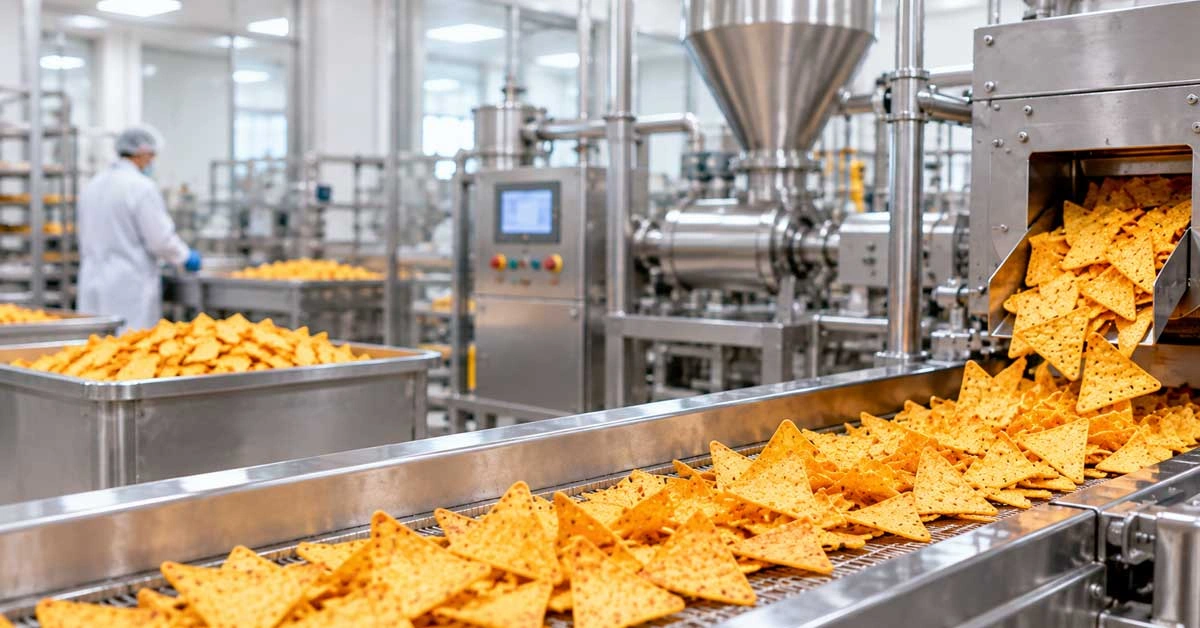
The exact machinery required depends on the product format, formulation, automation level, packaging style, and desired production scale.
A typical production system can include:
- Raw material dosing and weighing
- Mixing
- Twin-screw extrusion
- Die and cutting system
- Cooling
- Drying, where required
- Seasoning or coating
- Cooling tunnel
- Inspection
- Flow wrapping
- Nitrogen flushing or modified-atmosphere packaging
- Cartoning and secondary packaging
The line should be designed as one connected system rather than selecting every machine independently. Product characteristics, line speed, transfer points, cooling requirements, and packaging dimensions all need to work together.
Twin-Screw Extruder
The extruder is the core processing unit.
A commercial protein snack extruder should be selected according to the formulation rather than capacity alone. Important considerations include screw configuration, feeding system, torque, temperature control, moisture management, die design, and ease of cleaning.
Food-contact components should be manufactured from suitable food-grade materials. PLC and HMI-based controls can also help operators monitor processing conditions and maintain repeatability between batches.
Capacity should be established through product trials and the manufacturer’s formulation requirements rather than relying on a generic machine rating.
For a new Extruded Protein Snacks brand, selecting a line that can accommodate future formulations can be more valuable than simply choosing the largest available extruder.
Cooling and Drying Systems
Extrusion is only one stage of the manufacturing process.
After extrusion, the product may require controlled cooling to stabilise its structure before cutting, coating, or packaging. Depending on the formulation, drying may also be required to achieve the desired moisture level and texture.
The cooling system should therefore be designed around the actual product rather than treated as a separate machine.
Coating Systems
Premium protein snacks may use chocolate, compound coatings, yoghurt-style coatings, seasoning, or other finishing systems.
A coating section can include product feeding, coating application, excess removal, settling, and controlled cooling.
For products sold across the GCC, coating stability is particularly important because transport and storage conditions can expose products to elevated temperatures.
Packaging Line Integration
Packaging plays a major role in maintaining product quality.
Horizontal flow wrapping is commonly used for individually packed bars and snack pieces because products can be transferred directly into the packaging film.
For oxygen-sensitive products, nitrogen flushing or modified-atmosphere packaging can be considered. The correct packaging structure depends on the formulation, water activity, oxygen sensitivity, fat content, distribution conditions, and intended shelf life.
Packaging should therefore be developed alongside formulation and process design rather than added at the end of the project.
Production Flow for Extruded Protein Snacks
The exact sequence can change depending on whether the final product is a puff, crisp, bar, nugget, coated snack, or another format.
Capacity Planning for a Protein Snack Plant
Production capacity should not be selected only on the basis of the machine’s stated hourly output.
Manufacturers should consider:
- Product density
- Formulation
- Moisture content
- Die configuration
- Product dimensions
- Operating hours
- Changeover requirements
- Packaging speed
- Expected demand
- Future SKU expansion
Foodsure Machines currently lists functional bar production lines in multiple capacity configurations, including 50 kg, 100 kg, and 200 kg per hour models, with different power and space requirements.
These figures are useful as equipment benchmarks, but the appropriate capacity for a GCC project should be confirmed through the manufacturer’s product trials and plant planning process.
For Extruded Protein Snacks in the Middle East, capacity planning should also account for the distribution model. A plant serving one domestic market may require a different configuration from a facility designed to supply multiple GCC countries.
Cost and Investment Considerations
There is no single cost for an extruded protein snack plant.
The investment depends on the selected extruder, automation level, downstream equipment, packaging system, utilities, factory infrastructure, installation requirements, formulation development, testing, and regulatory requirements.
Instead of using a generic online project-cost figure, manufacturers should request a project-specific quotation based on:
- Product type
- Target formulation
- Required capacity
- Automation level
- Packaging format
- Factory layout
- Utilities
- Installation requirements
- Testing and commissioning
- Export requirements
This approach produces a more useful capital estimate than applying a broad cost range to every GCC project.
Regulatory and Compliance Requirements in the GCC
GCC food manufacturers and exporters need to consider applicable Gulf technical regulations along with country-specific requirements.
GSO 9 covers labelling of prepackaged foods and references requirements relating to nutritional labelling, food packaging, food additives, health and nutrition claims, and halal food.
GSO 2233 covers nutritional labelling requirements for packaged food products. The GCC Standardization Organization has also published an updated 2025 edition of the nutritional labelling regulation.
For protein products, manufacturers should pay particular attention to nutrition declarations and any claims made on the packaging. A claim such as high protein, source of protein, low sugar, or other nutritional positioning needs to be evaluated against the applicable requirements before commercial launch.
Saudi Arabia Food Compliance
Saudi Arabia’s food regulatory framework is administered by the Saudi Food and Drug Authority.
For imported food products, SFDA requires importers to comply with applicable technical regulations and register establishments and food products through the relevant electronic systems. SFDA’s current food clearance requirements specifically refer to establishment and product registration through its Ghad platform.
Manufacturers planning to sell Extruded Protein Snacks in the Middle East should therefore build Saudi regulatory review into the product development and export planning stages.
UAE Food Compliance
UAE food products are subject to applicable federal requirements as well as requirements imposed by relevant local authorities.
For manufacturers using national conformity marks, MoIAT provides digital conformity services and requires supporting documentation and applicable assessments.
Food businesses should confirm the exact registration, labelling, product approval, and local authority requirements applicable to their product and emirate before launch.
Halal Requirements for Protein Snacks
Halal compliance is particularly important when developing products for GCC markets.
The UAE’s Ministry of Industry and Advanced Technology administers the UAE Halal National Mark framework. The ministry identifies UAE.S 2055-1 as the standard covering general requirements for halal food and also references standards relating to halal certification bodies, slaughtering requirements, food hygiene, and food labelling.
Halal considerations should cover more than the primary ingredients. Manufacturers should review processing aids, flavours, emulsifiers, fats, enzymes, coatings, packaging materials where relevant, and the possibility of cross-contamination.
Using approved or recognised certification bodies can help manufacturers prepare the required documentation for GCC market entry.
Export Considerations for GCC Markets
A manufacturer targeting multiple GCC markets should design the product for regional distribution from the beginning.
The product formulation, packaging material, shelf-life validation, labelling, halal status, storage conditions, and regulatory documentation should all be considered together.
This becomes particularly important for Extruded Protein Snacks in the Middle East because products may move through different climatic conditions, distribution channels, and retail environments.
A product developed only for a controlled domestic market may require reformulation or packaging changes before being suitable for broader regional distribution.
Why Foodsure Machines for Extruded Protein Snack Manufacturing
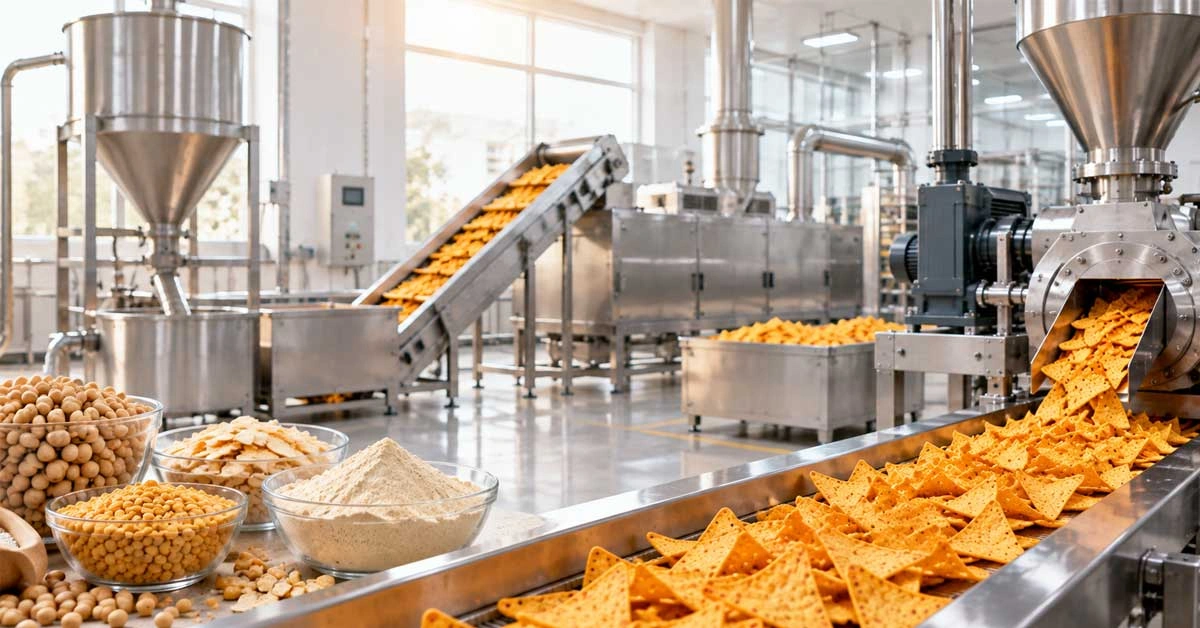
Turnkey Plant Setup
Building a protein snack plant involves much more than purchasing an extruder.
The production line needs to connect formulation requirements with mixing, extrusion, cooling, cutting, coating, packaging, utilities, factory layout, installation, commissioning, and operator training.
Foodsure Machines develops food processing lines with in-house engineering and manufacturing support. Its functional bar manufacturing line is designed around connected stages including forming, cooling and cutting, with food-grade stainless-steel construction.
For a new GCC manufacturer, this integrated approach can reduce the challenge of coordinating multiple equipment suppliers and help ensure that the individual machines work together as one production system.
Product and Capacity Planning
The right line should be selected after understanding the product rather than before.
Foodsure Machines can help manufacturers evaluate the intended product format, formulation, capacity requirement, processing stages, factory layout, and packaging requirements before finalising the equipment configuration.
This is especially important for manufacturers developing multiple Extruded Protein Snacks, because a line designed around one product may not automatically be suitable for every future formulation.
After-Sales Support
Equipment support continues after installation.
Operator training, commissioning, maintenance guidance, spare parts, troubleshooting, and technical assistance all contribute to maintaining production continuity.
For international manufacturers, after-sales support becomes even more important because technical issues need to be addressed across geographical distance.
Ready to Build Your Protein Snack Brand in the GCC?
The GCC offers an interesting environment for manufacturers developing protein-rich convenience foods. Fitness initiatives, local food-production strategies, changing consumer preferences, and demand for convenient nutrition are creating room for new product concepts.
But successful manufacturing requires more than identifying a promising category.
The formulation, extrusion process, equipment configuration, cooling, coating, packaging, shelf-life strategy, regulatory requirements, and factory layout all need to work together.
If you are planning an Extruded Protein Snacks manufacturing plant for the GCC, Foodsure Machines can help with equipment selection, production-line design, factory planning, installation, commissioning, and after-sales support.
Have a Question? Let’s Connect
Need expert guidance on food processing machines, production setup, or process optimization? Our team is ready to help you choose the right solution for your business.
FAQs
What are Extruded Protein Snacks made from?
Extruded Protein Snacks can be formulated using ingredients such as oats, whey, pea protein, soy protein, nuts, dates, cereals, fibres, binders, and seasonings. The exact ingredient combination depends on the desired nutrition profile, texture, flavour, and product format.
How is an extruded protein snack manufactured?
The ingredients are dosed and mixed before entering the extruder. Controlled heat, moisture, pressure, and mechanical energy transform the mixture. The extruded material is then cooled, cut, dried or coated where required, inspected, and packaged.
What machine is used for protein puffs?
Protein puffs are generally produced using an extrusion system designed for the required formulation and expansion characteristics. The extruder, die, cutting arrangement, drying and seasoning equipment should be selected together based on the final product specification.
What factors determine protein snack production capacity?
Capacity depends on the extruder configuration, formulation, product density, die, moisture content, operating schedule, downstream cooling and drying requirements, packaging speed, and desired automation level. Capacity should therefore be finalised after product and process evaluation.
Are protein snacks suitable for GCC markets?
Protein snacks can fit several GCC consumption occasions, including fitness, convenience snacking, travel, and on-the-go nutrition. However, commercial suitability depends on formulation, pricing, flavour preference, packaging, shelf life, regulatory compliance, and distribution strategy.
What food regulations should be considered for GCC protein snacks?
Manufacturers should review applicable GCC technical regulations covering food labelling, nutritional information, packaging, food claims, and halal requirements, alongside country-specific requirements. GSO 9 covers prepackaged food labelling, while GSO 2233 addresses nutritional labelling.
Is halal certification important for GCC protein snacks?
Halal compliance is highly relevant when selling food products in GCC markets. UAE’s MoIAT identifies UAE.S 2055-1 as the standard for general halal food requirements and maintains a framework for recognised halal certification.
Can one production line make different protein snack formats?
A suitably designed extrusion line can support different product concepts, but not every extruder can produce every format. Die design, screw configuration, formulation, moisture level, downstream equipment, and processing conditions must be evaluated for each product.




