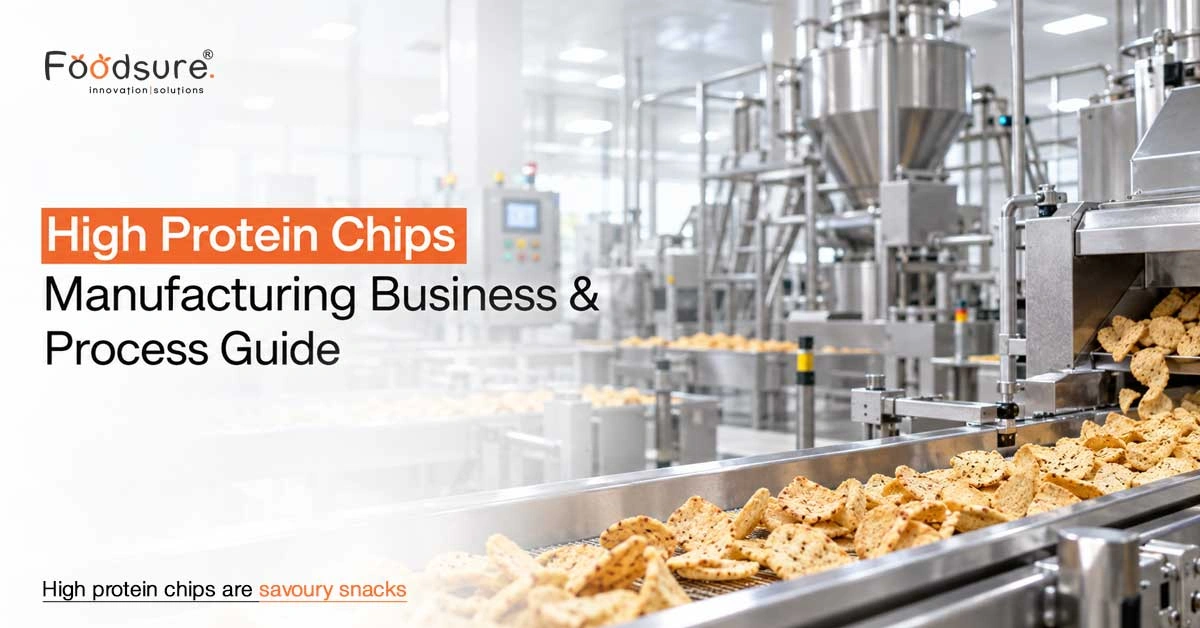
High protein chips are savoury snacks formulated with protein-rich ingredients such as chickpea, lentil, pea, soy, whey protein or other protein concentrates. Depending on the formulation and processing method, they can be baked, fried, or produced through extrusion.
For manufacturers evaluating High Protein Chips Manufacturing, the opportunity is closely linked to the growing interest in protein-focused snacks, convenient nutrition, plant-based ingredients and better-for-you alternatives. The Middle East is particularly relevant because protein crisps are already an identifiable category within the regional snack market. Grand View Research estimates that the Middle East and Africa protein crisps market generated about US$43.5 million in 2024 and could reach US$63 million by 2030, with a projected CAGR of 6.4% between 2025 and 2030. Saudi Arabia is identified as one of the markets expected to show strong growth during this period.
This guide covers the product concept, formulation considerations, manufacturing process, machinery requirements, regulatory considerations, sourcing strategy and business planning factors for setting up a protein chip production facility.
What Are High Protein Chips?
High protein chips are formulated to deliver more protein than conventional snack chips while retaining the crisp texture, flavour and convenience consumers expect from a savoury snack.
Instead of relying primarily on potato, corn or other starch-rich ingredients, manufacturers can use chickpea flour, lentil flour, pea protein, soy protein, whey protein or combinations of these ingredients.
The formulation determines whether the finished product is better suited to baking, frying or extrusion. Protein-rich formulations behave differently from conventional starch-based doughs, so moisture, temperature, screw configuration, die design and processing conditions need to be developed around the selected protein system.
This is where High Protein Chips Manufacturing becomes more than a simple snack-processing exercise. The manufacturer has to balance protein content with expansion, hardness, flavour, colour, crispness and process stability.
How High Protein Chips Differ From Regular Potato or Corn Chips
The primary differences come from the ingredient system, processing method and nutritional positioning.
Base ingredients
Conventional chips generally depend heavily on potato, corn or another starch-based raw material. High protein formulations replace part of that starch base with protein-rich ingredients.
Chickpea, lentil and pea flours can provide both protein and fibre, while protein concentrates and isolates can be used when a higher protein level is required.
Cooking method
High protein formulations can be processed through baking, frying or extrusion. Extrusion is particularly useful for products where the manufacturer wants to combine mixing, cooking, shaping and expansion in a continuous process.
Research on protein-rich extruded snacks shows that increasing protein concentration can influence expansion, density and hardness. One study on rice starch and pea protein snacks found that a 10% pea protein isolate formulation produced the highest expansion and the lowest bulk density and hardness among the tested formulations.
Nutritional positioning
The protein level of the finished product depends entirely on the recipe. There is no universal protein content that applies to every high-protein snack, so manufacturers should formulate the nutrition panel and any front-of-pack claim according to the requirements of the target market.
For High Protein Chips Manufacturing, this means nutritional claims should be considered during formulation rather than added after the product has already been developed.
Common Protein Sources Used
For a Middle East-facing product, manufacturers may also consider halal status, allergen management, ingredient traceability and regional flavour preferences during formulation.
Nutritional Profile and Consumer Appeal
The nutritional profile of a protein chip depends on its raw materials and manufacturing process.
A legume-based formulation can contribute protein and fibre through chickpea, lentil, pea or other pulse ingredients. Protein isolates can be incorporated when the product needs a higher protein concentration.
The manufacturing method also influences the final nutritional and sensory profile. Extrusion research on legume-based snacks has shown that processing conditions can affect expansion, hardness, digestibility and other product characteristics.
The commercial opportunity is therefore not simply about adding more protein. A successful product has to deliver a combination of:
- Sufficient protein per serving
- Pleasant flavour
- Crisp texture
- Controlled oil content
- Stable shelf life
- Acceptable ingredient cost
- Clear nutritional positioning
- Regulatory-compliant claims
Why Sri Lanka Can Be Considered for Protein Chip Manufacturing
Sri Lanka can be evaluated as a manufacturing location where access to agricultural ingredients, food-processing capability, export infrastructure and regional trade opportunities can support a snack-processing operation.
The strongest opportunity is not necessarily based on producing every ingredient locally. Instead, manufacturers can develop a hybrid sourcing model in which protein concentrates or specialised ingredients are imported while locally available pulses, spices, seasonings and packaging inputs are incorporated where commercially suitable.
Sri Lanka also has an established food-processing sector and a formal standards and food-safety infrastructure. The Sri Lanka Standards Institution provides HACCP and ISO 22000 certification services for food businesses, with requirements covering food-safety systems, hazard control, monitoring and record keeping.
For companies considering High Protein Chips Manufacturing in the Middle East, producing in a nearby South Asian market can also provide an alternative to manufacturing directly inside the target market, provided the complete export, food-registration, logistics and regulatory requirements are evaluated before investment.
Regulatory and Compliance Requirements in Sri Lanka
Food manufacturers need to establish their compliance requirements before commercial production begins.
Food safety systems
HACCP and ISO 22000 can provide a structured food-safety framework for the facility. SLSI offers certification for both systems and identifies requirements covering food-safety policies, food-safety teams, prerequisite programmes, hazard-control plans and monitoring of critical control points.
Product standards
Depending on the product category and applicable standards, manufacturers should determine whether SLS certification or another conformity requirement applies to the finished product.
The exact regulatory route should be confirmed against the current Sri Lankan food regulations and the product’s ingredients, claims and intended market.
Labelling
The label needs to be developed around the applicable Sri Lankan food-labelling requirements and the destination market.
Protein-related claims should be substantiated using the finished product’s validated nutritional composition. A manufacturer should not assume that a product can automatically use a high-protein claim simply because protein ingredients were added to the recipe.
Export compliance
When the finished chips are intended for Saudi Arabia or another GCC market, the exporter must separately assess the destination country’s food-registration, labelling, ingredient, documentation and certification requirements.
Saudi Arabia’s SFDA operates a Saudi Halal Center that provides halal certification services for food-related businesses and publishes requirements for halal certification.
This makes halal planning an important part of High Protein Chips Manufacturing when the finished product is intended for Saudi consumers.
Raw Material Sourcing for High Protein Chips

A reliable raw-material strategy is one of the most important parts of building a protein snack production line.
Pulse-based ingredients
Chickpea, lentil, pea and other pulse flours can form the base of a protein chip. They can contribute both protein and fibre while supporting a recognisable ingredient story.
The formulation team should evaluate particle size, moisture, protein content, starch behaviour, flavour and consistency between suppliers.
Protein concentrates and isolates
Pea, soy and whey proteins can be used when the product requires additional protein density.
However, higher protein inclusion can change extrusion behaviour. Research on pea-protein-fortified extruded snacks found that increasing protein concentration can reduce expansion while increasing density and hardness.
This means protein sourcing cannot be separated from process development. A cheaper ingredient is not necessarily the better ingredient if it makes the finished chip difficult to expand or negatively affects texture.
Seasonings
Seasoning is another major product-development consideration. Regional flavours can help differentiate a protein snack from conventional imported products.
For Middle East markets, manufacturers can explore profiles such as chilli, cheese, barbecue, za’atar-inspired seasoning, herbs, paprika or spice blends, subject to formulation and regulatory requirements.
Packaging materials
Protein chips require packaging that protects the product from moisture, oxygen, light and physical damage.
The final packaging structure should be selected through shelf-life testing rather than simply choosing a standard snack pouch. This is particularly important when the product will move through hot and humid supply-chain conditions.
High Protein Chips Manufacturing Process
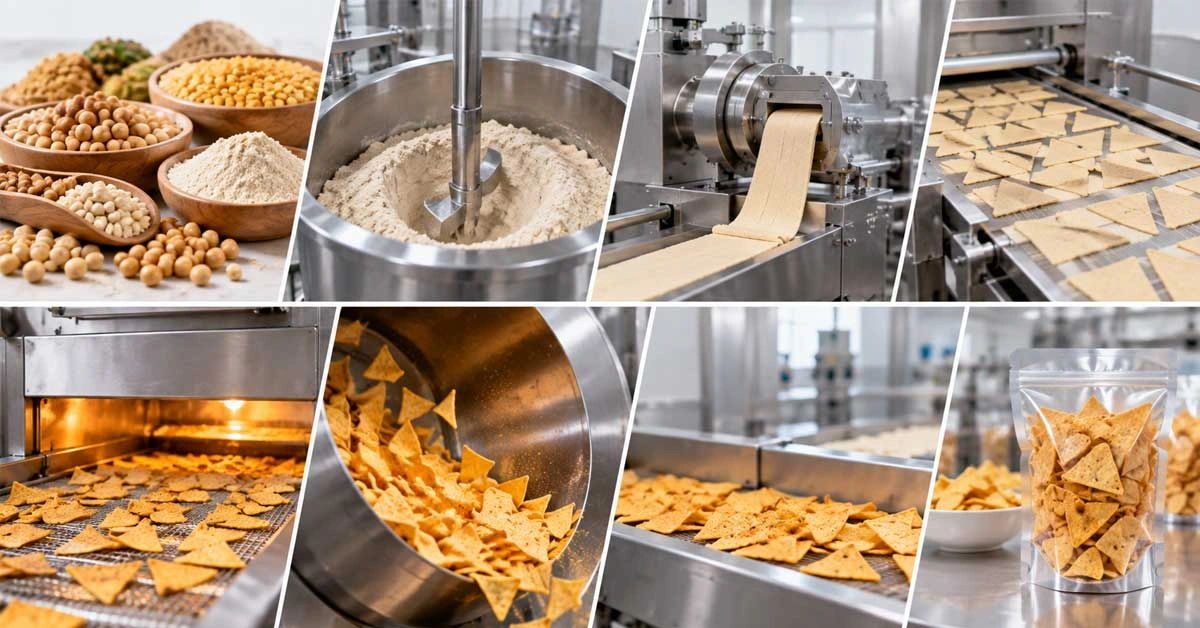
The production process can vary depending on whether the product is baked, fried or extruded.
A typical extruded process can be structured as:
Step 1: Raw Material Preparation and Mixing
Protein powders, pulse flours, starches and other dry ingredients are weighed according to the formulation and transferred to a mixer.
Ribbon or paddle mixers can be used to distribute ingredients evenly before the material enters the next processing stage.
Moisture is particularly important. Protein ingredients can interact with water differently from starches, which means the water level used for a conventional snack recipe may not work for a protein-rich formulation.
Step 2: Conditioning and Extrusion
The prepared mixture is conditioned before entering the extruder.
Inside the extruder, the material experiences controlled mixing, shearing, heating and pressure. The cooked mass then moves through a die that determines the shape and cross-section of the product.
Extrusion is particularly useful for Extruded Protein Snacks because the technology can integrate several processing functions into one continuous operation.
Research on legume extrusion demonstrates that processing conditions and die configuration can significantly influence expansion, hardness, crunchiness and sensory properties.
Step 3: Baking, Frying or Puffing
The next stage depends on the product design.
Baking can be used when the objective is to develop a lower-oil snack profile. Frying provides a familiar crisp texture but increases oil uptake. Extrusion-puffing can create an expanded product directly through the pressure and temperature conditions inside the extruder.
There is no single processing method that works for every protein formulation. Product development trials should determine the right combination of feed moisture, temperature, screw configuration, die design and post-extrusion treatment.
Step 4: Seasoning and Flavour Coating
After cooking, the chips are transferred to a seasoning system.
Seasoning can be applied as a dry powder or through liquid or slurry-based coating, depending on the product surface and flavour system.
The coating system needs to provide consistent distribution without damaging the fragile structure of the chips.
Step 5: Cooling and Quality Control
The product should be cooled before packaging.
Quality control can include checks for:
- Product weight
- Moisture
- Texture
- Colour
- Protein content
- Seasoning distribution
- Foreign-body contamination
- Packaging integrity
- Microbiological safety
Metal detection and other inspection technologies can be incorporated according to the plant’s food-safety plan.
Step 6: Packaging
Once the product has reached the required temperature and quality specifications, it moves into the packaging section.
Vertical form-fill-seal packaging systems can be configured for nitrogen flushing where the product and packaging structure require oxygen reduction.
The appropriate packaging material and gas-flushing conditions should be established through shelf-life validation rather than using a fixed specification across every product.
Machinery Required for High Protein Chips Production
A commercial production line may include:
- Raw material handling system
- Flour and protein dosing system
- Ribbon or paddle mixer
- Conditioning system
- Single-screw or twin-screw extruder
- Die and cutting system
- Dryer or baking oven
- Frying system where applicable
- Seasoning tumbler
- Cooling conveyor
- Metal detector
- Checkweigher
- Packaging machine
- Nitrogen flushing system
- Date coding and labelling equipment
Single-Screw vs Twin-Screw Extrusion
A twin-screw system can be particularly useful when a manufacturer needs greater control over mixing and processing of multiple protein and starch ingredients. However, equipment selection should follow product trials rather than being based only on the machine type.
Capacity Planning for a Protein Chip Plant
Production capacity should be decided after establishing the expected sales volume, SKU mix, operating schedule and market-entry strategy.
Instead of selecting a machine only because it offers a high hourly output, manufacturers should consider:
- Actual required production volume
- Number of operating shifts
- Product changeover frequency
- Number of SKUs
- Packaging speed
- Seasoning capacity
- Storage requirements
- Utility availability
- Future expansion plans
A line that is significantly larger than the initial market requirement can create unnecessary capital and operating costs. On the other hand, an undersized line can restrict growth once distribution expands.
This is why High Protein Chips Manufacturing in the Middle East requires capacity planning around the target market rather than around machine specifications alone.
Cost of Setting Up a High Protein Chips Manufacturing Unit
There is no reliable universal investment figure for a protein chip plant because the cost changes substantially with the formulation, production capacity, automation level, building condition, utilities, packaging format and export requirements.
Instead of using a generic online machinery price, a project budget should be developed around:
Machinery
Major capital items normally include the mixer, extruder, forming system, baking or frying equipment, seasoning system, cooling conveyor, inspection equipment and packaging line.
Factory and utilities
The facility may require electrical infrastructure, water systems, compressed air, ventilation, drainage, food-grade flooring, storage areas, production rooms and quality-control facilities.
Raw materials
The working-capital requirement depends heavily on whether the formulation uses imported protein isolates, locally available pulse flours or a combination of both.
Packaging
Packaging costs vary with pouch size, film structure, printing requirements, nitrogen flushing and order volume.
Quality and compliance
Laboratory testing, food-safety certification, product registration, halal certification where applicable and export documentation should all be included in the project budget.
For this reason, any investment figure quoted for High Protein Chips Manufacturing should be treated as a project-specific estimate rather than a standard industry cost.
Why the Middle East Is an Important Target Market
The regional opportunity is supported by the development of the protein-crisps category itself. Grand View Research projects the Middle East and Africa protein crisps market to grow from US$43.5 million in 2024 to US$63 million by 2030, representing a 6.4% CAGR during the forecast period. Pea protein crisps are identified as the fastest-growing product segment in the same research.
For manufacturers evaluating High Protein Chips Manufacturing in the Middle East, this indicates that protein crisps are developing as a distinct snack category rather than remaining limited to the sports-nutrition segment.
Saudi Arabia is particularly relevant for manufacturers targeting the Gulf because the country has a large consumer market and an established food-import and retail ecosystem.
The UAE can also function as an important commercial and distribution market for brands seeking wider Gulf exposure.
Business Model for High Protein Chips
There are several possible routes to market.
B2C retail
Supermarkets and modern retail can provide large-scale consumer visibility but usually require strong distribution, packaging, pricing and promotional support.
Fitness and sports nutrition
Gyms, fitness studios and sports-nutrition retailers can provide a more focused entry point because the target audience already understands protein as a product benefit.
E-commerce
Online retail allows a new brand to test different flavours, pack sizes and bundles without immediately requiring nationwide physical distribution.
Export
Export-oriented production can be attractive when the plant is specifically designed around the requirements of the destination market.
A manufacturer targeting Gulf consumers should develop its product, packaging and compliance strategy around the destination market from the beginning rather than treating export preparation as a final step.
Branding High Protein Chips for GCC Consumers
Protein alone does not guarantee product success.
The brand needs to communicate why the snack deserves a place alongside conventional chips.
Potential positioning directions include:
- High-protein everyday snacking
- Plant-protein chips
- Legume-based savoury snacks
- Better-for-you snacking
- Fitness-friendly snacking
- Clean-label positioning where substantiated
- Regionally relevant flavours
- Halal-certified formulations where applicable
Taste remains critical. A protein chip that delivers a strong nutrition panel but has an unpleasant texture or flavour is unlikely to generate repeat purchases.
Research on protein-rich extruded snacks confirms that protein concentration can affect expansion and hardness, reinforcing the importance of formulation and process optimisation.
Halal and GCC Export Considerations
Halal requirements should be incorporated into the formulation and sourcing strategy from the beginning when Saudi Arabia or other Muslim-majority markets are the target.
Saudi Arabia’s SFDA operates a Saudi Halal Center that provides halal certification services and publishes requirements for halal certification. SFDA also distinguishes between a halal certificate and a certificate of consignment for products that require halal certification.
Manufacturers should therefore verify the exact certification and shipment requirements applicable to their product before export.
Ingredient sourcing is equally important. Whey, flavour systems, emulsifiers, enzymes and processing aids should all be assessed for their halal status where relevant.
Challenges in High Protein Chips Manufacturing
Maintaining crisp texture
Protein-based formulas will become increasingly dense and hard as the protein content rises.
Controlled formula development is the solution in relation to protein content, moisture, starch matrix, temperature, screw speed and die design.
Controlling flavour
There are protein sources which may impart specific flavours to products which will be discernable at high inclusion rates.
Flavour masking, seasoning selection and complementary ingredient use will go a long way to addressing consumer acceptability issues.
Keeping costs low
Protein isolates may be quite costly compared to pulse flours. It will be beneficial, therefore, to develop a composite formula where the aim is to increase the protein content substantially without increasing the cost of production excessively.
Production consistency
Formulas which contain protein are sensitive to fluctuations in raw material quality compared to starch-based formulations.
Supplier specifications and incoming material inspection and process control will have to be incorporated in the production process.
Development of proper product texture
Extrusion parameters will influence product expansion, hardness and textural attributes. Research work on legume based extruded snacks reveals this point clearly.
Conclusion
The opportunity in protein chips is not simply about putting more protein into a conventional snack. The strongest products combine nutritional positioning with the texture, flavour, convenience and price expectations of everyday snacking.
For manufacturers considering High Protein Chips Manufacturing, extrusion provides an attractive processing route because it can combine mixing, cooking and shaping while allowing manufacturers to work with pulse flours and protein-rich formulations.
The regional opportunity is also becoming more defined. The Middle East and Africa protein crisps market is projected to grow steadily through the decade, with pea protein crisps identified as a particularly fast-growing segment.
For companies evaluating High Protein Chips Manufacturing in the Middle East, the next step should be product formulation and process validation rather than selecting machinery from a catalogue. The formulation determines the raw-material system, extrusion requirements, seasoning approach, packaging structure and ultimately the economics of the project.
Foodsure Machines can support manufacturers evaluating protein snack processing lines, extrusion systems, seasoning equipment, packaging solutions and complete plant setups. The right machinery configuration can then be developed around the required product, capacity, automation level and target market.
Have a Question? Let’s Connect
Need expert guidance on food processing machines, production setup, or process optimization? Our team is ready to help you choose the right solution for your business.
Frequently Asked Questions
Is high protein chips manufacturing profitable?
Profitability depends on formulation cost, selling price, production utilisation, packaging, distribution margins and the target market. A reliable profitability calculation should be developed using actual machine quotations, ingredient prices and confirmed sales assumptions rather than generic online estimates.
What machinery is needed to start a protein chip factory?
A typical line can include a mixer, conditioner, extruder, forming system, baking or frying equipment, seasoning system, cooling conveyor, inspection equipment and packaging machine. The exact configuration depends on the product and production target.
What certifications are required for high protein chips?
Requirements depend on the manufacturing country and destination market. Food-safety systems such as HACCP or ISO 22000 may be relevant, while export markets can have additional registration, labelling and halal requirements. SLSI provides HACCP and ISO 22000 certification services in Sri Lanka.
How much protein should a high protein chip contain?
There is no single formulation level that applies to every market. The required level depends on the desired nutritional profile and the claim regulations of the target country. Any high-protein claim should be substantiated using the finished product’s validated nutritional composition.
Can protein chips be exported from Sri Lanka to Saudi Arabia?
Yes, subject to meeting the applicable Sri Lankan export requirements and Saudi Arabian food-import, labelling, registration and certification requirements. Saudi Arabia’s SFDA provides halal certification services through its Saudi Halal Center.