
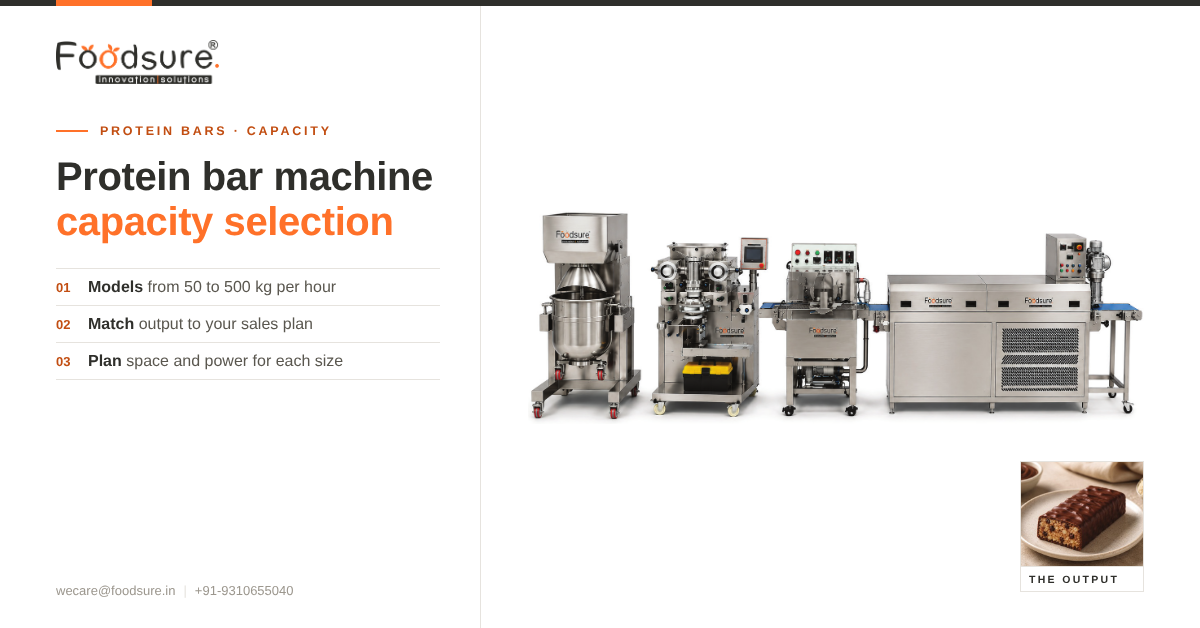
Correct selection of the smart protein bar machine capacity begins from the quantity of bars per month, and not with the largest capacity available in budget. Calculate the demand in kg, divide by the number of operating hours, allow a buffer for maintenance and expansion, and choose a machine with an equivalent kg/hr rating.
Too small, you will lose sales and work overtime; too large and you will have to pay for energy and maintenance that you do not need.
This paper provides detailed explanation of the procedure with practical examples, includes tier-by-tier analysis of capacities from 50 to 500 kg/hr, and covers line balancing overlooked by many buyers.
What Does Protein Bar Machine Output per Hour Really Mean?
Short answer: Output per hour of protein bar machine production is the maximum rate of production expressed in kg per hour. Your true output will be smaller than the rated one due to downtime and other operations.
There are two figures to consider, and they are frequently mistaken for each other:
- Rated capacity: the maximum number of kg/hour produced when running at the rated speed
- Effective output: what you manage to package per shift once downtime, changeover time and other operations are accounted for
- Rated capacity is always exceeded in practice; most companies work far below it throughout a shift. Consider effective output in planning, which is measured through overall equipment effectiveness (OEE) in the industry, and use rated output only as a theoretical limit.
To calculate bars from kg/hour, divide your kg/hour output by the weight of one bar in kg. See the table for examples.
| Rated capacity | 40 g bars per hour | 50 g bars per hour | 60 g bars per hour |
|---|---|---|---|
| 50 kg/hour | 1,250 | 1,000 | 833 |
| 100 kg/hour | 2,500 | 2,000 | 1,667 |
| 200 kg/hour | 5,000 | 4,000 | 3,333 |
| 300 kg/hour | 7,500 | 6,000 | 5,000 |
| 500 kg/hour | 12,500 | 10,000 | 8,333 |
These are arithmetic ceilings, not promises. Bar weight, recipe stickiness and line speed all pull the real figure down.
Protein Bar Machine Capacity Selection Guide: A 5-Step Method
Follow these steps in order. Each one feeds the next.
- Determine monthly demand based on proven orders, distributor orders and a realistic sales strategy for the coming year.
- Convert from bars to kilogram weight. Multiply bars per month by the weight of one bar in kilograms.
- Determine your operating hours. Calculate number of shifts per day and number of days per month minus planned downtime.
- Use an efficiency ratio. Dividing by 60 to 75 percent rather than 100 percent will yield a reliable rated capacity.
- Include a growth allowance and match a model. Find the closest rated capacity which exceeds the calculation and ensure power and floor space.
Worked Example
For example, consider production of 280,000 bars of 50 g each per month. This results in 14,000 kg of bar mass.
You produce during one 8-hour shift for 25 days in a month, totaling 200 hours. With 70% efficiency, you have 140 effective hours. Therefore, dividing 14,000 kg by 140 hours equals 100 kg/hour.
The 100 kg/hour configuration suits the above scenario, but with small room to maneuver. In case of possible growth within one year, inquire about the 200 kg/hour configuration or adding another shift. The efficiency figure in this scenario is just an assumption.
Protein Bar Machine Capacity Tiers From 50 to 500 kg/hr
Here’s how the capacity range breaks down. Foodsure’s protein bar machine models are 50, 100 and 200 kg/hour. Power and area are approximate and should be confirmed at quotation.
| Capacity | Power (approx.) | Area (approx.) | Typical buyer |
|---|---|---|---|
| 50 kg/hour | 14–18 kW | 2,000 sq ft | Start-ups, pilot production, smaller contract runs |
| 100 kg/hour | 30–35 kW | 5,000 sq ft | Growing brands and food processing companies with steady demand |
| 200 kg/hour | 50–55 kW | 10,000 sq ft | Larger-volume manufacturers limiting manual work |
| 300–500 kg/hour | Confirm with supplier | Confirm with supplier | High-volume plants and exporters, usually a configured line |
What Capacity Protein Bar Machine Do I Need? Quick Scenarios
Real businesses rarely fit a formula perfectly. These common situations show how the method plays out.
| Business | Likely starting size | Why |
|---|---|---|
| New brand selling online and through a few stores | 50 kg/hour | Demand is still being proven, and lower power and space needs reduce risk |
| Established brand adding retail chains | 100 kg/hour | Repeat orders justify steady daily production |
| Contract manufacturer serving several clients | 100 or 200 kg/hour | Multiple recipes and volume commitments favour higher output and flexibility |
| Exporter with confirmed bulk contracts | 200 kg/hour or a configured line | Volume is contractual, so manual limits matter more |
If your situation sits between two rows, start with the smaller model and confirm an upgrade path. If you already hold signed bulk orders, size up.
Protein Bar Machine Capacity Selection India: Power, Space and Utilities
Your capacity determines the amount of electricity required and your space requirements. The Foodsure protein bar machine needs 415 V, 3 phase, 50 Hz electricity, and the connected load increases from about 14–18 kW to 50-55 kW in the three models.
- Before you settle on a capacity, consider the following site requirements:
- Three phase supply and approved load at your site
- Transformer capacity and backup generator for increased load
- Space available for complete installation, not just the machine
- Ingredient handling space, movement of trollies and cleaning space
- Height of ceiling and width of doors for installation
The machine itself requires space of about 2,375 × 690 × 1,630 mm (L×W×H). But the space available in the capacity table is much higher than this.
Balance the Whole Line, Not Just the Machine
A forming machine is only as productive as the slowest stage around it. If your mixer can’t keep up, or your packing line runs at half the speed, a bigger forming machine won’t raise output.
Check these stages against your chosen capacity:
- Mixing and binder mixing: can it give the mass continuously in kg/hour?
- Cooling: is it appropriate for bar temperature and time of handling?
- Coating or enrobing: if required, can it keep up with the cutting rate?
- Packing: can your packing line handle your bars per hour without piling up?
- Quality control: is the weighing and metal detection keeping up?
Oversizing vs Undersizing: Which Mistake Costs More?
| Oversized machine | Undersized machine | |
|---|---|---|
| Upfront cost | Higher investment | Lower investment |
| Running cost | Higher power load for idle capacity | Overtime and extra shifts |
| Space | Takes space you may not need | Fits easily, but may need replacing |
| Risk | Capital locked in unused capacity | Missed orders and lost customers |
| Best remedy | Start smaller with a planned upgrade | Add a shift, or plan a second machine |
Neither mistake is fatal. Both are cheaper to avoid with a proper demand estimate than to fix after installation.
How Seasonality and Growth Change Your Capacity Decision
Not all protein bars will experience steady demand throughout the year. Peak demand periods may result from fitness season introductions, gift giving at festivals, retail promotions, and exporting.
Determine the size of the plant assuming the average month, and then figure out how to cope with peaks. You have three possible options:
- Run additional shifts in the months when the demand is high
- Build excess inventory before the peak period if the shelf life permits
- Purchase additional equipment as soon as peaks become a rule
Planning on the peak will lead to having excess capacity throughout the rest of the year.
One Larger Machine or Two Smaller Ones?
When your calculation lands near 200 kg/hour, you might wonder whether two 100 kg/hour machines would be smarter. There’s no universal answer, but the trade-offs are clear.
| Factor | One larger machine | Two smaller machines |
|---|---|---|
| Floor space | One compact unit per output | More total space and utilities |
| Uptime | Line stops during breakdown or service | Half the line keeps running |
| Flexibility | One recipe at a time | Two recipes or bar sizes in parallel |
| Labour | Fewer operators per kg | More operators overall |
| Growth path | Fixed ceiling | Add machines step by step |
If you run many flavours or serve several clients, two smaller machines often make operational sense. If you make one core product at volume, one larger machine is simpler.
Why You Should Test Capacity With Your Own Recipe
- Rated Capacity is determined by a reference mass. Your formula may be more sticky, dry, or fibrous, which makes the rate of processing in the machine slower.
- Make sure to ask for a test run with your formula before ordering. Make note of the kg/hour capacity, the weight fluctuation per bar, and the behavior of the mass after one hour of running.
A Simple Pre-Order Checklist for Capacity
- Conform the monthly demand and growth you can support.
- Note the bar weight and convert demand into kg/hour.
- Conform your running hours and efficiency factors used.
- Verify the power supply, back-up and floor space requirement for the model selected.
- Conform the blending, cooling and packaging can support the capacity.
- Trial the machine with your own formula.
- Conform the delivery, warranty, installation and training terms in writing.
Capacity and Running Cost: What Changes as You Scale
The capacity influences more than just the price of the unit. As you go from 50 to 200 kg/hour capacity, several operational expenses go with it.
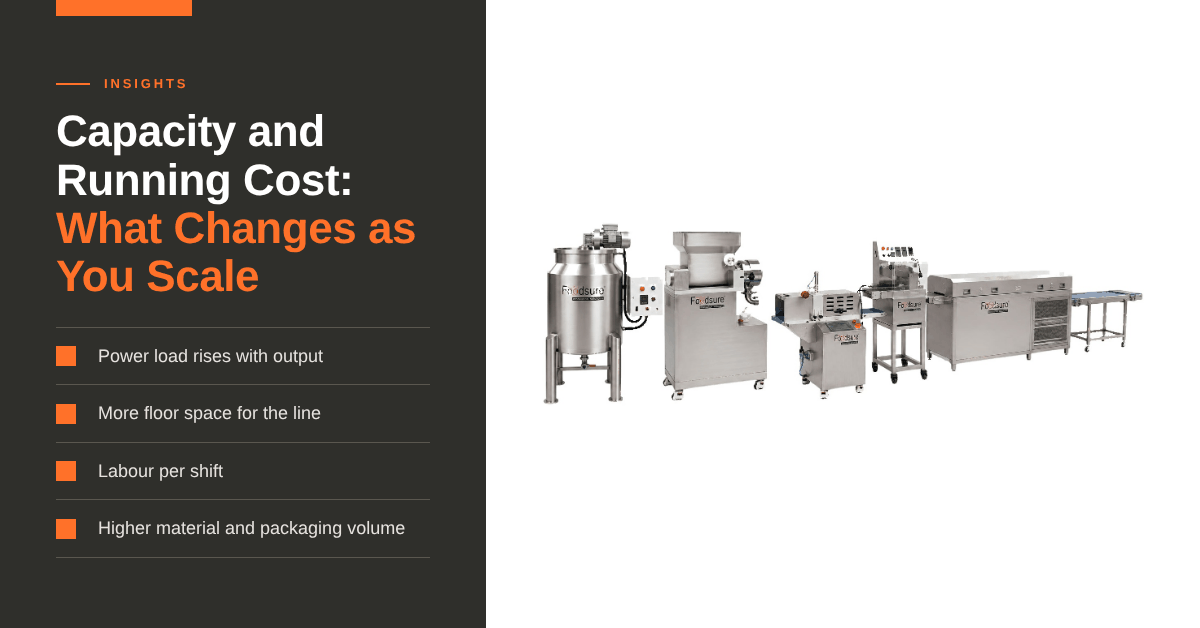
- Power Consumption: The connected load goes from 14–18 kW to 50–55 kW
- Area: The required space goes from 2,000 sq ft to 10,000 sq ft
- Labour: Increased capacity will distribute the operator labour on increased production
- Cleaning: Larger areas increase cleaning time, so schedule accordingly
- Service/Spares: Increased capacity also increases spare parts requirement
- Cost per Bar is the key. The large machine working at 30% of its capacity can be expensive on a cost-per-bar basis than a smaller machine working at full capacity.
Request your vendor to give your anticipated utilisation at each capacity level before comparing quotations.
Common Mistakes in Capacity Selection
- Sizing to peak season requirement instead of average requirement
- Taking 100% efficiency assumption into account
- Ignoring bar weight, which means that kg/hr does not equate to bars/hr
- Failure to consider that packing and refrigeration require equal capacity
- Neglecting the power and floor space verification step
- Selection on basis of machine price and not bar production cost
Key Takeaways
- Begin with your month’s bar demand in kilograms and divide by realistic number of operating hours.
- Rated kilograms per hour is only a theoretical maximum; plan with achievable throughput after cleaning and changeover times.
- For Foodsure’s protein bar production line, throughput is 50 kg/hour, 100 kg/hour and 200 kg/hour and higher throughputs require configuration of a line.
- Assess electrical power requirements, available floor space, mixing, cooling and packaging capacity before making a decision.
- If uncertain, start with a smaller production line with possibilities of upgrading later on.
Conclusion
Selecting proper machine capacity for protein bar making is mostly just math and integrity: real needs, real efficiency, and real restrictions on space and power. Get that done first, and most often the right machine reveals itself.
Gather your protein bar weight and monthly production numbers, follow those five steps, and request a quote. The Foodsure Machines will verify the proper machine capacity for you.
FAQs
Which capacity of the protein bar machine should I consider for my start-up?
Start-up starts with 50 kg/hour as standard. Verify by converting monthly sales to kilograms per hour.
What is the hourly output rate of a protein bar machine?
It’s the rated kg/hour output per bar mass formation and cutting. Bars per hour = (kg/hr / weight per bar)
Is protein bar machine capacity selection for Indian Protein Bar manufacturers different from others?
It is mainly in utilities. Verify the availability of 415 V three-phase power supply, power back-up and seasonal demand of yours.
Is there any difference in capacity selection of protein bar machines in 2026 from previous years?
It is the same as earlier years. The method is demand, bar weight, hours & line balancing. Confirm the specifications of the current model at quotation.
What is the power requirement of each capacity of a protein bar machine?
Approximately 14 -18 kW at 50 kg/hr, 30 – 35 kW at 100 & 50 -55 kW at 200 kg/hr.
What is the floor area requirement for each capacity of a protein bar machine?
Approximately 2,000 sq. Ft., 5,000 sq. Ft. & 10,000 sq. Ft. Ask what is the area calculation.




