
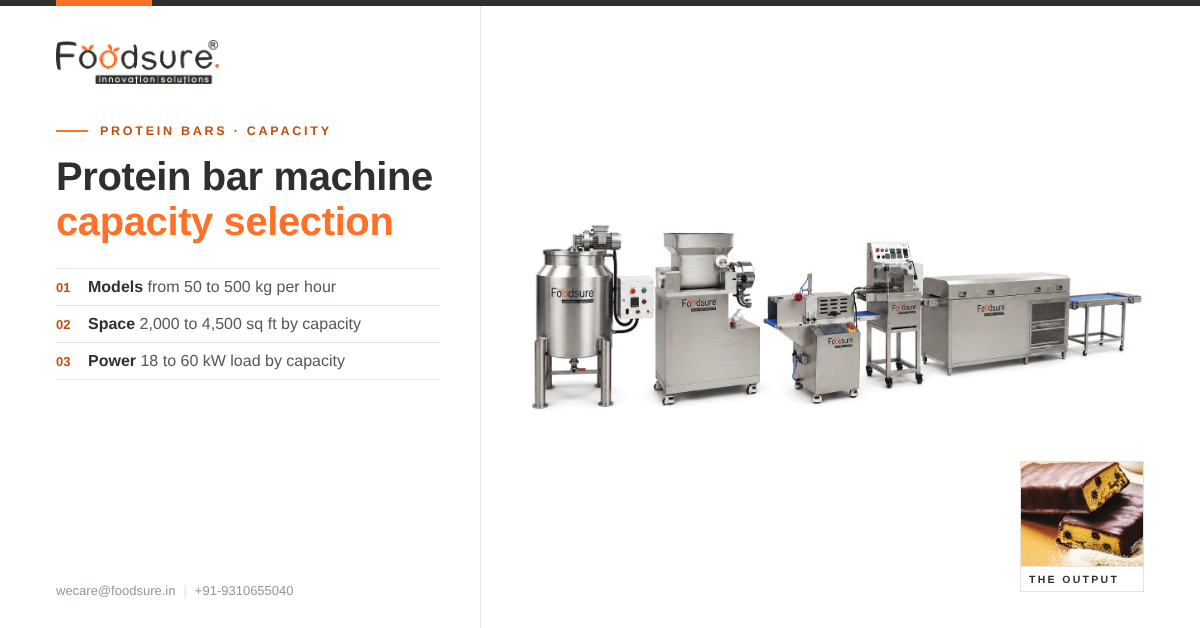
Proper equipment selection is a key consideration for a protein bar manufacturing company. Equipment capacity significantly affects output levels, process efficiency, manpower needs, and the ability to meet future demand. Using equipment that is either too small or too large can create problems.
Protein bar machine capacity selection must be based on actual production needs, product features, and capacity of the whole production line. If you are starting up a business or enlarging your existing one, knowledge of machine capacity, molding process, and automation will assist you in making a wiser investment.
Why Is Protein Bar Machine Capacity Selection Important?
Capacity planning helps manufacturers choose machinery that supports their production targets without creating unnecessary operational bottlenecks.
A right protein bar making machine is one that manages to produce the desired production levels and maintains bar dimensions and weights, not forgetting the quality of the products made. The machine should also have capacities that match other machines.
Before selecting machinery, businesses should consider:
- Expected production rate per hour and per shift
- Expected daily and monthly production rate
- Weight, size, and texture of bar
- Number of rows for production
- Hours of operation and need for changeover
- Labour available and factory floor space
- Existing demand and achievable future increase
- Capacity of cooling and packaging equipment
Considering these factors helps manufacturers select a machine that fits their production goals instead of relying only on advertised output figures.
What Does Protein Bar Machine Capacity Mean?
The capacity of a protein bar machine can be described as the amount of product that can be made within a period of time. The capacity of each machine varies, such as bars per minute, bars per hour, and kilograms per hour.
These measurements are not interchangeable. A machine may have the ability to make many small bars in one minute, but the total weight of the bars may be different due to bar size and density.
For accurate protein bar machine capacity selection, manufacturers should understand three important measurements.
1. Weight-Based Capacity
The capacity based on weight determines the number of kilograms that the machine is able to handle per hour.
This will be helpful in the comparison of production requirements for different bar sizes, assuming that the information is presented under equal conditions.
2. Piece-Based Capacity
Piece-based capacity measures the number of individual bars produced during a specified period.
This is particularly useful for businesses supplying packaged products in standard retail formats.
3. Finished-Line Capacity
The finished-line capacity is defined as the output of the entire manufacturing process that involves forming, cooling, cutting, and packaging if necessary.
In other words, the forming machine can produce bars at a higher speed compared to the wrapping process. In such cases, the bottleneck in the output becomes the packaging process despite the extra capacity of the forming machine.
How to Calculate Protein Bar Machine Capacity Per Hour
Understanding protein bar machine capacity per hour helps manufacturers determine whether a machine can meet their production targets.
The capacity calculations have to consider how many bars there will be, the weight of each bar, and the real productive time.
For instance, a machine that produces 100 bars in a minute and the weight of each bar is 40 grams will have a theoretical output of 240 kilograms in an hour.
However, this is a theoretical output. The real output can be less than the above calculation owing to other operating conditions such as cleaning.
When evaluating a machine, ask the supplier to clarify:
- Whether the rated capacity is theoretical or proven.
- The weight and size of the bar that was tested.
- The number of rows running at the same time.
- The product formulation used in the test.
- Whether the quoted capacity includes cooling and cutting.
- Whether the quoted capacity is for finished bars or just formed material.
- The efficiency of production under normal operating conditions.
These details make capacity comparisons more meaningful and help prevent unrealistic production planning.
Factors That Affect Protein Bar Machine Capacity Selection
The right machine capacity depends on more than the speed of the forming system. Several product and operational factors can influence actual output.
Product Type and Texture
There is variation in the texture of the protein bars. Some mixtures can be dense and sticky, while some mixtures have whole nuts, seeds, cereal bits, or other ingredients.
The dense and cohesive mixture will be appropriate for a protein bar extruder, but the particulate mixture may need slab forming to maintain the integrity of its ingredients.
The appropriate forming technology should be used in the manufacture of a particular product since inappropriate equipment can lead to various problems.
Bar Weight and Dimensions
The size of the bar is a determining factor in the piece output and the weight output as well.
Small-sized bars would permit the production of more bars during the same period of operation, while large-sized bars would need other conditions for shaping and cooling.
Before selecting a protein bar forming machine, you have to establish the desired weight, length, width, and thickness of the bar.
Number of Production Rows
Some machines produce multiple bars at once. Additional rows increase production as long as there is enough feed, forming, cooling, cutting, and packaging capacity.
But rows are only one factor that determines capacity for a machine. Size of the product, speed, and limitations downstream should also be taken into account.
Capacity of the Mixer
The forming machine needs to have a continuous stream of the prepared product. But if the mixer produces too little or too slowly, the forming unit can operate idle.
Thus, manufacturers should consider the batch size of the mixer, the time of mixing, discharge time, and speed of production at the forming unit.
Requirements for Cooling
Some protein bars require controlled cooling or stabilisation before the process of cutting, coating, and packaging.
If cooling takes more time or the cooling capacity is low, the formed products will build up before the next step. Thus, the cooling system should be designed with respect to the actual product and line speed.
Cutting and Packaging Speed
Cutting and packaging are common sources of production bottlenecks.
A high-speed protein bar machine with cutting and forming should be matched with suitable downstream equipment. Packaging speed should be assessed in finished bars per minute, taking account of the number of bars handled in each cycle.
Changeovers and Cleaning
Producers who make different tastes, sizes, or varieties will require some time to do cleaning and adjustments in between.
These take up time that could have been used in production, hence need to be considered in the calculation of daily output.
How to Choose a Protein Bar Machine: Step-by-Step
Understanding how to choose a protein bar machine requires a clear assessment of product requirements, production targets, and operating conditions.
Step 1: Define Your Product Line
Determine what type of protein bars you plan to produce, such as the ingredients used, texture, size, and packaging.
A line suitable for forming protein blends may be different from the line used for bars with bigger nuts, seeds, or cereals.
Step 2: Determine Production Requirements
Determine your production needs in terms of how many bars you need to produce each day or per hour.
Do not base the buying process on future sales figures that are yet to be determined.
Step 3: Select the Forming Technology
Select between extrusion, slab molding, or another forming system based on the nature of the product.
The protein bar extruder will work well for dense and cohesive products, while slab molding can be used for products that contain large inclusions.
Step 4: Match the Complete Production Line
Evaluate mixing, forming, cooling, cutting, coating, and packaging capacities together.
The objective is to create a balanced protein bar production line in which the different stages can operate at compatible rates.
Step 5: Evaluate Automation
Determine whether manual, semi-automatic, or fully automatic machinery is appropriate for the production goal and labor force.
Increased automation might lower the need for repetitive manual tasks, although it will require appropriate facilities, training, and maintenance.
Step 6: Verify Performance
Arrange a demonstration or trial of the product using a sample mix whenever possible.
Ensure that the output, size of the product, and other relevant details are determined before making the purchase decision.
Best Protein Bar Making Machine for Startups
The best protein bar making machine for startups is not necessarily the machine with the highest capacity or the most advanced automation. It is the equipment that meets the initial production requirement while allowing practical business expansion.
Startups should consider the following factors:
- Manageable capacity: Select a machine that is suitable for the actual requirement at the start.
- Compatibility with product: Ensure that the forming system is compatible with the ingredients and texture desired.
- Flexibility of operation: Think about whether the machine can work with various sizes of bars.
- Installation considerations: Consider factory space, power requirements, and other equipment.
- Maintenance considerations: Consider operator training, spares, and service.
- Expandability: See whether further equipment can be added as needs grow.
Modular arrangement may prove effective for organizations that would like to start out with basic machines and gradually introduce automation in terms of cooling, coating, cutting, or packaging as their production increases.
Nonetheless, even a small-scale arrangement should be created with the view to functioning as an integrated system; otherwise, the slower stage will affect efficiency.
Protein Bar Machine Capacity for Growing and Large-Scale Businesses
Manufacturing companies growing in size may require more throughput, increased automation, or the capability of producing various products. The capacity needs of such companies should be based on sales, operations, and production objectives.
Growing Businesses
The business that wishes to expand beyond the batch process should consider if its current mixer, formers, cooler, and packaging machines are able to handle the increased workload.
It is possible that upgrading one machine will not increase production if another part of the process is still a bottleneck.
Large-Scale Manufacturers
Integrated machines that have coordinated systems of material feeding, formation, cooling, cutting, and packaging will work well for large manufacturers.
However, even with more capable machinery that will produce more volume, the final system design must consider flexibility.
For both growing and established businesses, protein bar machine capacity selection should be based on the expected finished output of the complete line rather than the capacity of the fastest individual machine.
Protein Bar Machine Price in India: What Influences the Investment?
Businesses comparing the automatic protein bar machine price in India should evaluate the machine’s specifications and the complete production setup rather than considering automation alone.
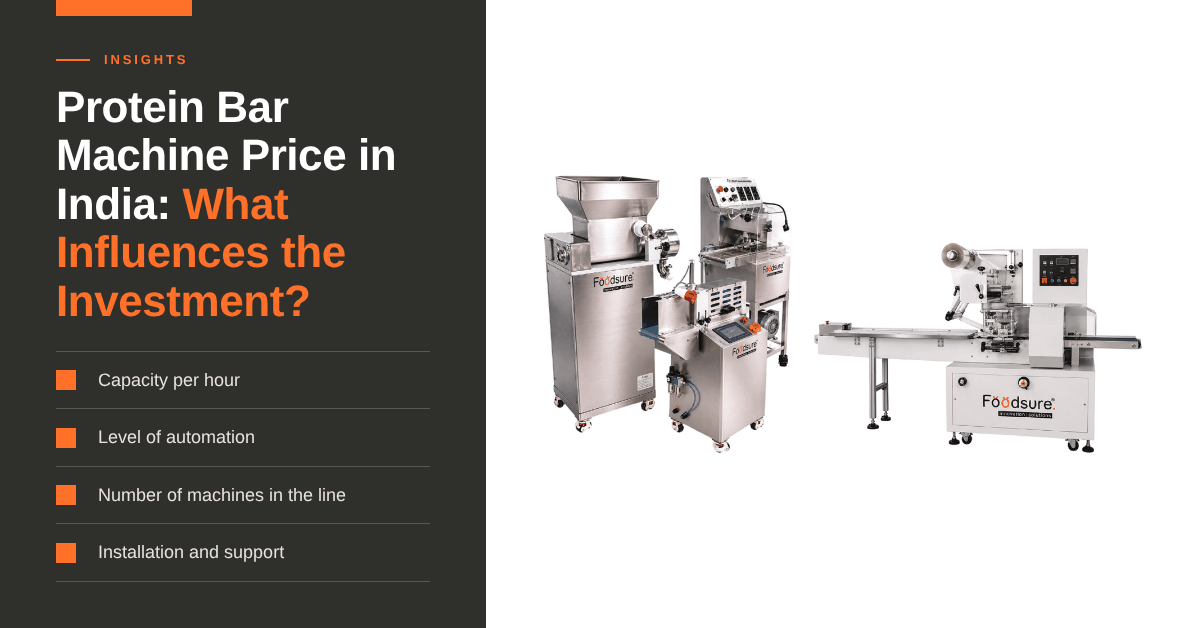
The overall investment can depend on:
- Production capacity
- Extrusion or slab-forming machinery
- No. of rows of machines for production
- Mixing and batching facilities
- Cooling and chopping facilities
- Coating system, optional
- Package form
- Degree of automation
- Installation and commissioning
- Maintenance and after-sales services
The scope of supply for a basic machine may be much different than that for an integrated assembly line machine. The scope of supply should be reviewed thoroughly.
Before requesting a protein bar machine quote, prepare the required capacity, product specifications, bar dimensions, ingredient characteristics, and preferred automation level. This information helps the supplier recommend a more suitable configuration.
How to Evaluate a Protein Bar Machine Manufacturer in India
Choosing the right supplier is as important as selecting the machine itself. A reliable protein bar machine manufacturer in India should understand the product requirements and explain how the proposed equipment will meet the intended production target.
Before deciding to buy protein bar machine equipment, evaluate the supplier based on the following points.
Technical Knowledge
The vendor needs to know the distinction between cohesive materials and those that have larger inclusions and suggest appropriate forming techniques.
Clear Specifications
Ask for specifications that include capacity, size of the product, operating conditions, construction materials, and full range of supply.
Machine Demonstration/Testing
Where feasible, ask for machine demonstration or sample testing. Make sure that the operating conditions for the specified output are known.
Installation and Training
Find out who will be responsible for installation, commissioning, and operator training.
After-sales Service
Consider the warranty period, availability of spare parts, maintenance, and technical support.
Complete Production Planning
A suitable protein bar machine supplier should help you consider the wider production workflow, including mixing, cooling, cutting, and packaging, rather than focusing exclusively on the forming machine.
Protein Bar Machine Capacity Selection Checklist
Use this checklist before finalising your machinery purchase.
| Evaluation Area | What to Confirm |
| Production target | Required hourly and daily finished output |
| Product type | Ingredients, texture, and inclusion size |
| Bar specifications | Weight, length, width, and thickness |
| Forming technology | Extrusion or slab forming |
| Machine capacity | Demonstrated output under defined conditions |
| Mixing | Sufficient prepared product supply |
| Cooling | Capacity suited to the product and line speed |
| Cutting | Compatible speed and required dimensions |
| Packaging | Ability to handle finished production output |
| Automation | Appropriate level for the business |
| Installation | Space, utilities, and layout |
| Maintenance | Cleaning, spare parts, and servicing |
| Supplier support | Testing, training, and warranty |
| Expansion | Scope for additional equipment or higher output |
This checklist helps manufacturers compare machinery more systematically and reduces the risk of selecting equipment based on incomplete capacity information.
Conclusion
It is important to properly choose the appropriate machine capacity to ensure that production will be carried out efficiently and allow the company to develop successfully. In order to select a protein bar machine capacity, it is necessary to take into consideration such aspects as output rate per hour, the size of bars, ingredients used, forming process, cooling, cutting, and packaging.
It is necessary to analyze the entire process of production and the capacity of the supplier in reality before deciding on which protein bar making machine to buy. This can assist businesses in making a more accurate decision.
If you either start a new company or are thinking of growing the existing one, collaboration with an experienced protein bar machine manufacturer can help to achieve this goal.
Frequently Asked Questions
1. What is protein bar machine capacity selection?
Protein bar machine capacity selection involves selecting the appropriate machinery based on the production capacity, product specifications, operating time, and total capacity of the production line.
2. How do I calculate protein bar machine capacity per hour?
Multiply the number of bars made per minute by the operating minutes in an hour and the weight of each bar to obtain theoretical output based on weight per hour. The actual output might be lower than this due to downtime, changeovers, cooling, and other operating conditions.
3. What is the best protein bar making machine for startups?
The best protein bar making machine for startups is the one that best fits the intended product, realistic production demands, available space, and budget while allowing future expansion.
4. What affects the automatic protein bar machine price in India?
The automatic protein bar machine price in India is affected by the production capacity, forming method, automation level, auxiliary machinery, cooling and cutting requirements, packaging system, and installation requirements.
5. Why should I choose a reliable protein bar machine manufacturer in India?
A reliable protein bar machine manufacturer in India can help identify suitable equipment, provide clear specifications, arrange testing, and support installation, training, and maintenance.




