
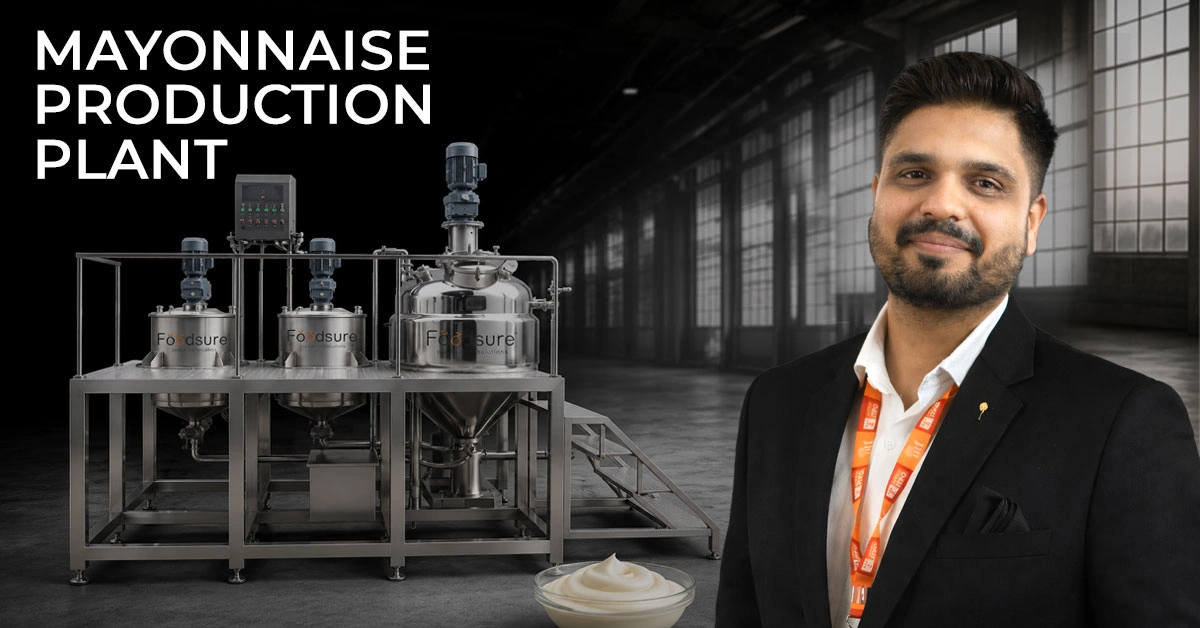
Here’s a strange little fact to start with: the mayonnaise sitting in your fridge can survive unrefrigerated for months without spoiling, even though it’s made almost entirely of raw egg and oil, two ingredients that, on their own, go bad embarrassingly fast. That’s not a packaging trick. It’s chemistry, and it’s the same chemistry that an entire industrial plant is built around getting right, batch after batch, at a scale most people never think about.
Being curious about this after talking to a few people setting up small food businesses who kept circling the same question: “How hard can it actually be to make mayonnaise at scale?”
The honest answer is harder than it looks, and easier than the equipment brochures make it sound. Somewhere between those two extremes is where most first-time manufacturers land, and that’s really what this piece is about: walking through what a mayonnaise production plant actually involves, from the science of why the emulsion holds together to what it realistically costs to set one up in India.
Mayonnaise Manufacturing Process: What Is It?
The mayo plant includes both technical solutions and processes required to create an emulsion from oil, egg yolk, vinegar, and spices. The essence of this procedure comes from the fact that a mayonnaise is an emulsion consisting of oil and water, with the ratio of oil in it varying depending on the variety, the concentration of oil in the emulsion will vary between 3% in light mayonnaise up to 80% in traditional varieties.
The reason for this process being interesting to manufacturing is because oil and water do not blend. Left to their own devices, they won’t combine in any way.
Going through the Mayonnaise Manufacturing Process
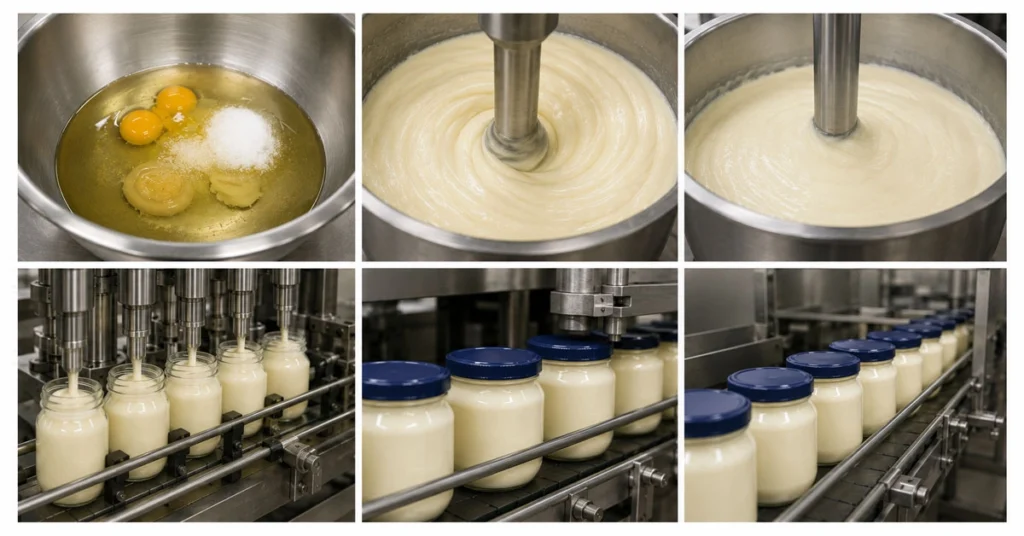
After understanding the science behind emulsion, the manufacturing process becomes much clearer because it’s simply taking advantage of that dual stage emulsification process.
Step 1: Preparation of Eggs
Separation of eggs takes place, followed by heating up of yolks up to temperatures of approximately 65-75 degrees Celsius to kill bacteria, but keep the lecithin in order to ensure that the emulsification takes place.
Step 2: Preparation of Oil
Neutral vegetable oil is required. Sunflower oil, rapeseed, or soybean oil need to be filtered. The quality of these oils requires that the acid value not exceed 0.5%, and moisture content should be kept at levels below 0.10%.
Step 3: Preparation of the Water Phase
An aqueous base containing egg yolk, vinegar, mustard, salt, and spices is prepared using a mixing vessel.
Step 4: Emulsification
Oil is gradually added to the water phase using high-shear equipment, often rotor-stator mixers operating under vacuum, to form a fine and stable emulsion. This pre-mix-then-emulsify approach is widely used across the industry.
Step 5: Pasteurization of Mixture
Emulsified mayonnaise is pasteurized at temperatures ranging from 68-72 degrees Celsius to minimize microbial risks, but keeping taste intact.
Step 6: Quality Control
Mayonnaise should be tested for acidity levels, pH (usually 3.6-4.0), viscosity, and taste among other parameters.
Step 7: Filling and Packaging
Automated systems fill the finished mayonnaise into jars or bottles, apply labels, and prepare the products for storage and distribution.
It’s a deceptively linear list on paper, but every one of these steps is where things can go quietly wrong if the equipment or sequencing isn’t right, which is really the whole argument for why plant design matters more than people initially budget for.
Mayonnaise Production Process Flow
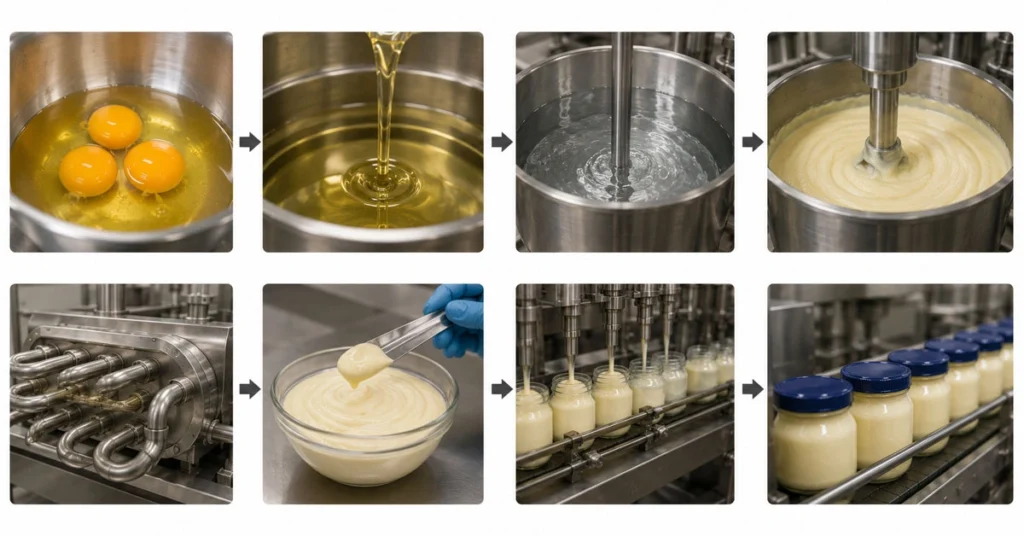
Understanding the process flow helps you visualize the complete equipment requirement:
The Equipment That Makes or Breaks the Batch
If there is one thing to learn about the plants through discussions with people that have experienced running them, it is that the emulsifying system is the one component in the whole process where you cannot afford to compromise.
Apart from the main component, the other aspects of an operating plant include various considerations that must be brought into the equation before settling for the perfect one according to your needs. Important aspects of Foodsure Mayonnaise Making Machine:
| Specification | Details |
|---|---|
| Key Selling Points | High Productivity |
| Control Type | Push Button |
| Heat Source | Steam |
| Feature | Large Capacity |
| Warranty | 1 Year |
| Dimension (L×W×H) | 7 × 4 × 6 ft (Approx.) |
| Material | Carbon Steel |
| Voltage | 415 V, 3 Phase, 50 Hz |
| Construction Material (MOC) | Food-Grade SS304 (Contact Parts), SS302 (Non-contact Parts) |
| Machine Type | Vacuumised (Egg Mayonnaise) / Non-vacuumised (Eggless Mayonnaise) |
| Finished Food | Mayonnaise |
| Application | Mayonnaise Production |
Plant Types: Matching the Setup to Where You Actually Are
Everyone envisions something utterly unique when thinking about their product and manufacturing unit. One of the most practical takeaways from this course is the relation of capacity levels to the stage of business:
- The 100 kg/hour model is well suited for pilot-scale production, product development, and small commercial operations. It requires approximately 500 sq. ft. of floor space, operates at 26–27 kW, and features a compact 63 × 8 ft footprint. Constructed entirely from SS 304 stainless steel, it provides food-grade durability and hygiene for consistent production.
- For manufacturers looking to increase output, the 200 kg/hour model offers a substantial capacity upgrade. Operating at 60 kW and requiring around 800–900 sq. ft. of installation space, this system features a 112.5 × 8 ft layout and is designed to support growing production volumes while maintaining process efficiency and product consistency.
- The 500 kg/hour model is designed for high-volume commercial manufacturing. With a power requirement of 75 kW and an installation area of approximately 1,200 sq. ft., the machine occupies a 100 × 12 ft footprint. Built using SS 304 stainless steel throughout, it is engineered for continuous operation, efficient processing, and large-scale mayonnaise production.
The bottom line is that the level of automation needs to correspond to your plans, not aspirations. Excessive investment in capacity will be wasted because of lack of demand; insufficient one will force an additional costly effort in the future.
What It Actually Costs to Set One Up in India
This is usually the question people actually came here for, so let’s be direct about it.
Machinery costs scale with the plant types a machinery setup with throughput of 80 – 100 kg/hour using 12-13 kW costs around 16,00,000. The Prices decreases and increases as per the requirements of the business.
But machinery is only one line item in a real business plan.
- Land or Plant Space: ₹5–10 lakh for approximately 300–500 sq. ft. suitable for a small-scale mayonnaise production setup.
- Licenses and Registrations: ₹50,000–1 lakh for FSSAI registration, GST registration, and local regulatory permits.
- Utilities and Infrastructure: ₹2–5 lakh for water supply, electricity connections, drainage systems, and basic facility setup.
- Packaging Materials: ₹1–3 lakh for bottles, jars, pouches, labels, cartons, and initial packaging inventory.
- Working Capital: ₹2–5 lakh reserved for raw materials, labor costs, transportation, and early-stage marketing activities.
Total cost of a new manufacturing facility to produce mayonnaise in India varies within the range of ₹20 lakhs to ₹1 crore-plus. It is impossible to determine the exact amount of money required as it depends purely on the intended growth rate and the associated risks.
Where the Market Actually Stands
Let’s be honest about something here rather than present false precision: market size figures for mayonnaise in India vary quite dramatically depending on which research firm you check.
IMARC places the Indian market at roughly USD 455.66 million for 2025, while Research and Markets/TechSci puts it closer to USD 746.52 million, and Expert Market Research lands at USD 521.95 million for the same year. Globally, the spread is similarly wide, anywhere from roughly USD 12.34 billion to USD 15.63 billion depending on the source.
Rather than pick one number and present it as settled fact, it’s more useful to note what these reports do agree on directionally, even when the magnitude differs:
- Growth Drivers: Demand from cloud kitchens and quick-service restaurants (QSRs) across Tier 1 and Tier 2 cities is a major factor fueling market growth.
- Rising Demand for Eggless Variants: Eggless mayonnaise continues to gain popularity, driven by vegetarian consumers and wider menu adoption.
- Increasing Preference for Flavoured Mayonnaise: Variants such as garlic, mint, peri-peri, and other specialty flavors are seeing strong consumer demand.
- Localization of Products: Manufacturers are developing Indian-inspired flavors rather than simply replicating traditional Western mayonnaise recipes
- Expansion Across Urban Markets: Growing foodservice and retail penetration in both metropolitan and emerging cities is creating new opportunities for mayonnaise brands.
Conclusion
If there’s one practical thread running through all of this, it’s that a mayonnaise production line isn’t really one decision, it’s a series of smaller ones that all need to line up.
Suppliers who understand this end-to-end, rather than just selling a machine and walking away, tend to make the difference between a plant that scales smoothly and one that gets stuck mid-growth.
If you’re at the stage of evaluating what fits your specific volume and budget, it’s worth looking at how a mayonnaise manufacturing plant is typically tiered by capacity, or going deeper into the mayonnaise production equipment itself to understand what separates a reliable emulsification setup from one that’ll give you inconsistent batches six months in.
Foodsure Machines has been working through these exact considerations with manufacturers across different scales, and if you’re trying to figure out whether a semi-automatic pilot line or a fully automatic setup makes more sense for where your business actually is, their team are a reasonable place to get specific answers rather than generic ones.
For anyone ready to talk specifics on capacity or budget, reaching out directly tends to save more time than trying to reverse-engineer the right setup from spec sheets alone.
Need Expert Assistance?
Get in touch with our experts for machine selection, production guidance, pricing, and project consultation.
Frequently Asked Questions
What is a mayonnaise production plant?
A mayonnaise production plant is the equipment and process setup used to convert oil, egg yolk, vinegar, and seasoning into a stable, shelf-ready emulsion at commercial scale. It typically includes mixing vessels, high-shear emulsifiers, pasteurization units, and automated filling lines.
How much does it cost to set up a mayonnaise manufacturing plant in India?
Total investment generally ranges from ₹20 lakh for a small semi-automatic pilot setup to over ₹1 crore for a fully automatic industrial plant, depending on machinery, space, licensing, and working capital requirements.
What is the ideal pH for mayonnaise during production?
The safe stability range for mayonnaise pH sits between 3.6 and 4.0. This range is part of what allows the product to remain shelf-stable without refrigeration once properly pasteurized and packaged.
Why is vinegar added late in the mayonnaise production process?
Acid reduces the emulsifying power of egg yolk, so adding vinegar too early can lead to a less stable emulsion. Manufacturers typically introduce it later in the sequence to protect the integrity of the emulsion.
Is FSSAI registration mandatory for a mayonnaise production plant in India?
Yes. FSSAI registration or licensing is mandatory for any food manufacturing facility in India, alongside other requirements like GST registration and a municipal trade license.
What’s the difference between HACCP and ISO 22000 for a food plant?
HACCP is legally mandated in many regions and focuses on identifying and controlling specific food safety hazards. ISO 22000 is voluntary, builds HACCP principles into a broader management framework, and is often a prerequisite for export-focused certifications like FSSC 22000.
What capacity should a first-time mayonnaise manufacturer choose?
Most first-time manufacturers start with a semi-automatic pilot plant producing 200–300 kg per day, which allows market testing with lower capital risk before scaling to medium or fully automatic setups.




