
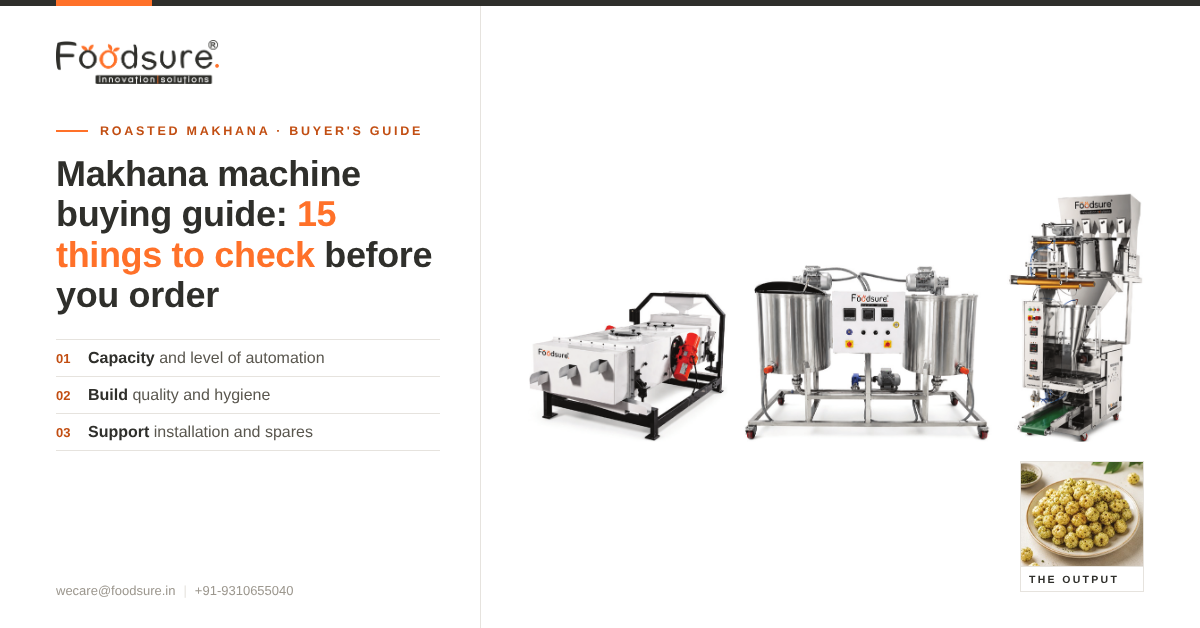
A good guide to buying makhana machines would be based on one golden rule: Buy for your raw seed, the product you want to get and the quantity you process, but never on the basis of price quotes only. You have to ensure popping consistency, heating process control, food grade material used, capacity, utilities requirement, and service support before paying any advance.
Makhana, which is commonly known as fox nuts or lotus seeds, is a difficult item to mechanize because of the variation in seed size, moisture content in different batches, and the popping process requires very strict control of heat and handling process. An equipment working perfectly well with one batch of seeds might give difficulties with another.
This list includes 15 checks, in the sequence that is most appropriate for the buyer’s need.
What Does a Makhana Machine Do?
The makhana machine automates one or more stages in the process of making makhana such as cleaning, sorting, roasting, popping, polishing and seasoning. Its purpose is to provide consistent popped makhana while reducing the need for labour-intensive hand processing.
The “makhana machine” could refer to a variety of things, so you have to be clear about what exactly you are asking when you inquire. Some people ask for just the popping and roasting section, while others want the whole processing line.
Most processing follows this sequence:
- Cleaning and washing the raw seed
- Grading seeds by size
- Drying or conditioning the seed
- Roasting and popping
- Polishing and removing shell fragments
- Grading the popped makhana
- Flavouring or coating, if required
- Packing
Your first decision is which of these stages you need machines for.
Makhana Machine Buying Checklist: Start With Your Product and Volume
The first three checks shape every later decision. Get them right and the rest becomes easier.
1. Define Which Stages You Want to Mechanise
List the stages you handle manually today and the ones causing the most delay, cost or inconsistency. Popping is usually the biggest bottleneck, because it relies on skill and is hard to scale by headcount alone.
Be clear on your end product, too. Plain popped makhana, roasted makhana and flavoured makhana snacks each need different downstream equipment.
2. Match Capacity to Your Seed Supply and Demand
Choose capacity from the raw seed you can source reliably and the finished product you can sell, not from the biggest figure on a brochure. Makhana supply is seasonal, so check how your sourcing pattern matches machine utilisation.
Ask the supplier how capacity is rated: per hour of raw seed input, or per hour of popped output? The two numbers differ a lot, because the popped product weighs far less than the seed you started with.
Ask for yield figures from your own seed, and check that your quote states the basis clearly.
Read our guide on Makhana Machine Capacity Selection.
3. Check Compatibility With Your Seed Size and Grade
Makhana seeds vary in size, and many machines work best within a defined size range. If you buy mixed-size seed, grade it first or confirm the machine tolerates the spread.
Bring samples of your typical seed lots to the supplier. Testing only on ideal seed hides problems you’ll meet in daily production.
Check Popping Performance and Machine Build
4. Ask for the Popping Percentage on Your Seed
Popping percentage is the share of seeds that pop fully. Ask for it from a trial on your own seed, and ask what the supplier does with seeds that don’t pop.
A higher popping rate means more saleable product from every kilogram of seed. It’s the single number that most directly affects your margin.
5. Understand the Heat Source and Temperature Control
Makhana pops when heated seeds are properly conditioned and handled, so heating stability matters. Ask what heat source the machine uses, how evenly it heats and how precisely you can control temperature.
Also check how quickly the machine reaches working temperature and what happens to energy use at partial loads.
- Electric heating needs strong power supply planning
- Gas-fired systems need safe fuel storage and ventilation
- Ask for operating-cost comparisons for your location
6. Look at Moisture Handling and Conditioning
Seed moisture affects popping quality and shelf life. Ask whether the machine or line includes drying or conditioning, and what moisture range it works with.
If your seed arrives with variable moisture, you’ll need a plan for it before the roaster, not after.
7. Verify the Material of Construction
All food-contact parts should be food-grade stainless steel, typically SS304. Ask the supplier to list which parts are SS304 and what the frame and other non-contact parts use.
Request material certificates and check welds and finishing. Pits and rough joints trap shell fragments and dust.
8. Check Hygiene Design and Cleaning Access
Makhana processing creates dust and shell fragments, and cross-contamination is a real concern with flavoured lines. Look for smooth surfaces, easy access and parts that clean without long dismantling.
Cleaning time directly reduces production time. Ask how long a full clean takes, and who does it.
Makhana Machine Buying Guide India: Labour, Utilities and Layout
9. Decide How Much Automation You Need
Manual popping depends on skilled workers who are hard to find and hard to keep consistent. Machines reduce that dependence, but the right level of automation depends on your volume and team.
| Factor | Manual processing | Machine processing |
|---|---|---|
| Output consistency | Varies by worker and shift | Held by machine settings |
| Labour skill needed | High, especially for popping | Lower, mainly loading and monitoring |
| Scalability | Limited by skilled headcount | Scales by choosing capacity |
| Hygiene | More hand contact | Less hand contact with product |
| Upfront investment | Low | Higher, with utilities to plan |
Choose the level of automation your team can run and maintain today.
10. Confirm Power and Utilities
Ask for the connected load in kW, the voltage and phase requirements, and any fuel, water or compressed-air needs. Have your electrician check the incoming supply and backup before you order.
Heat-intensive machines can need a stronger supply than buyers expect.
11. Measure Floor Space and Material Flow
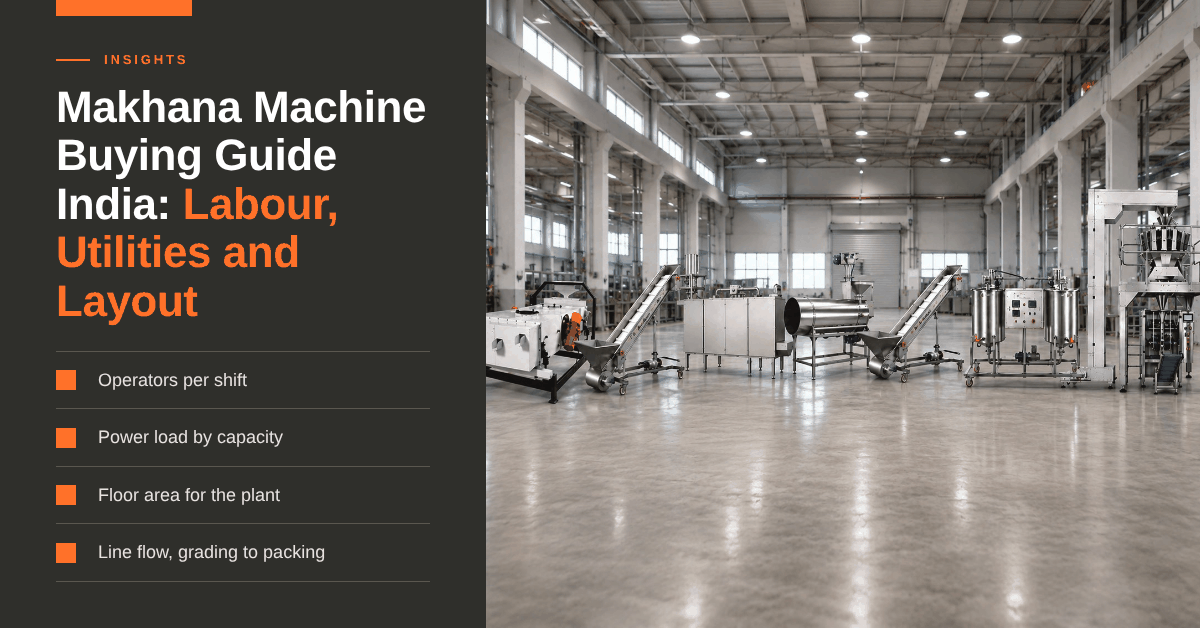
Plan for the full line, not just the machine. Raw seed storage, drying space, trolleys, finished-product staging and cleaning access all take room.
Ask the supplier for a layout drawing so you can check door widths, ceiling height and material flow before installation.
12. Check Line Integration and Changeover
A popping machine never works alone. It needs cleaning and grading upstream, and polishing, grading, flavouring and packing downstream. Check that capacities match, or the slowest stage will cap your output.
If you plan several products, such as plain, peri-peri and cheese-flavoured makhana, ask how long changeovers take.
Read our guide on Setting Up a Makhana Processing Plant.
Verify Compliance, Support and Total Cost
13. Confirm Compliance and Documentation
Food businesses in India need appropriate FSSAI registration or licensing, and your equipment records support that. Ask suppliers for material certificates, electrical safety details and drawings.
If you plan to export, check early what overseas buyers’ audits expect. Hygienic design and traceable materials make those audits smoother.
Read our guide on FSSAI Requirements for Makhana Manufacturers.
14. Get Installation, Training and After-Sales Terms in Writing
Ask what the warranty covers, how fast the supplier responds to breakdowns, and where spares come from. Heating elements, burners and moving parts wear, so spares availability matters.
Confirm in the quotation whether installation and operator training are included. A machine your team can’t run confidently saves you nothing.
15. Compare Total Cost, Delivery Time and Supplier Track Record
Makhana machine price depends on capacity, heat source, automation and configuration, so compare quotes like for like. Include freight, installation, utilities and spares in your calculation.
Ask for a delivery time in weeks and what could delay it. Then verify the supplier through references, a live machine demo or a factory visit.
Read our guide on Makhana Machine Maintenance Tips.
Questions to Ask Every Supplier
Use this table as a shortlist script. A confident supplier answers each point specifically.
| Ask this | A good answer sounds like |
|---|---|
| What’s your popping percentage on my seed? | A figure from a trial on your own seed lot |
| How is capacity rated? | Clear basis: raw seed input or popped output per hour |
| Which parts are SS304? | A list of contact parts, with certificates on request |
| What are the power and fuel needs? | Specific kW, voltage and fuel figures |
| What’s covered by the warranty? | A written scope and response time |
| Are installation and training included? | A yes or no in the quotation |
| What’s the delivery time? | A number of weeks, with stated assumptions |
Which Makhana Machines Does a Processing Line Use?
Knowing the machine types helps you ask better questions and avoid buying the wrong unit first.
| Machine type | What it does | Check before buying |
|---|---|---|
| Cleaning and washing unit | Removes dirt, debris and foreign matter from raw seed | Water use, drainage and cleaning access |
| Grading machine | Sorts seeds by size for even roasting and popping | Size ranges handled and sorting accuracy |
| Roasting and popping machine | Heats and pops the seeds | Popping percentage, heat control and capacity basis |
| Polishing machine | Smooths popped makhana and removes shell fragments | Breakage rate and dust handling |
| Flavouring drum | Coats makhana with seasoning or oil | Even coating and cleaning between flavours |
| Packing machine | Packs finished makhana in pouches | Pack sizes, speed and nitrogen flushing option |
Most first-time buyers begin with the roasting and popping unit, then add grading, polishing and flavouring as volume grows.
What to Measure During a Trial Run
A trial is only useful if you record the right results. Take these measurements and compare them across suppliers:
- Popping percentage from a fixed weight of your own seed
- Weight of popped makhana produced, compared with the seed fed in
- Share of broken or partly popped pieces
- Time taken to reach working temperature and to clean down
- Number of operators needed at each stage
Run the trial on more than one seed lot if you can. A machine that performs on a single hand-picked sample may not repeat that result on a regular working day.
What Affects Makhana Machine Price?
Makhana machine price changes with several factors, so two quotes are rarely directly comparable at first glance.
- Capacity: larger machines handle more seed per hour and cost more
- Heat source and controls: precise temperature control adds to the build
- Automation level: automated loading and discharge reduce labour but add cost
- Material and finish: SS304 contact parts and smooth welding affect price
- Scope: a single unit costs less than a connected line with grading, polishing and packing
Ask each supplier to break the quotation into these elements. That’s the fastest way to compare like for like.
When Is It Too Early to Buy a Makhana Machine?
Machines pay off when demand is steady. If you’re still testing your product or selling small volumes, manual processing or contract processing may be the smarter first step.
Hold off, too, if your seed supply isn’t secured. An idle machine in an off-season costs the same as one running at full capacity.
Common Mistakes Buyers Make
- Testing the machine only on ideal seed instead of their own lots
- Confusing input capacity with output capacity
- Ignoring seed size and moisture variation
- Skipping downstream equipment such as polishing and packing
- Ordering before checking power supply, fuel and floor space
- Accepting verbal promises on warranty or training
Red Flags to Watch For
- No questions about your seed or end product
- Unwillingness to run a trial on your seed
- Popping percentage quoted without any test basis
- Specifications that change between the call and the quotation
- Pressure to pay in full before utilities and layout are confirmed
A Simple Decision Framework
- Write down your seed source, size range and seasonal supply.
- Decide your end products: plain, roasted or flavoured.
- Estimate monthly volume and the capacity it needs.
- Shortlist two or three suppliers and send them the same specification.
- Run trials on your seed and compare popping percentage and consistency.
- Compare quotations like for like, including utilities, installation and training.
If two suppliers look equal on paper, choose the one that tested on your seed and put its terms in writing.
Key Takeaways
- Define which processing stages you want to mechanise and your end product before enquiring.
- Insist on a trial with your own seed and ask for the popping percentage.
- Check that capacity is stated clearly as raw seed input or popped output.
- Verify SS304 contact parts, hygienic design, power, fuel and floor space.
- Get warranty, installation, training and delivery time in writing.
Conclusion
A dependable makhana machine buying guide isn’t about finding the cheapest machine. It’s about confirming that the machine, the line and the supplier work with your seed, your product and your plans.
Work through the 15 checks, send suppliers the same specification, and ask for a trial on your own seed. When you’re ready to compare, request a free quotation from Foodsure Machines with your capacity and product details.
FAQs
What should I check before buying a makhana machine?
Check popping percentage, capacity basis, SS304 contact parts, heat control, utilities and after-sales support. The 15 points above cover each one.
Is there a makhana machine buying guide for makhana manufacturers in India?
Yes, this one is. It covers seed variability, FSSAI needs, utilities and service factors Indian processors face.
Does this makhana machine buying guide 2026 reflect current needs?
It reflects current industry practice. Confirm final specifications and pricing in your quotation.
What is popping percentage?
It’s the share of seeds that pop fully in a run. Ask for it from a trial on your own seed.
Should I buy a single machine or a full makhana line?
Start with the stage that limits your output, usually popping. Add other stages as volume grows.
Does a makhana machine need special power or fuel?
It depends on the heat source. Confirm kW, voltage and fuel needs with the supplier before ordering.
What should the quotation include?
Model, capacity basis, materials, utilities, warranty, delivery time and installation and training terms.




