
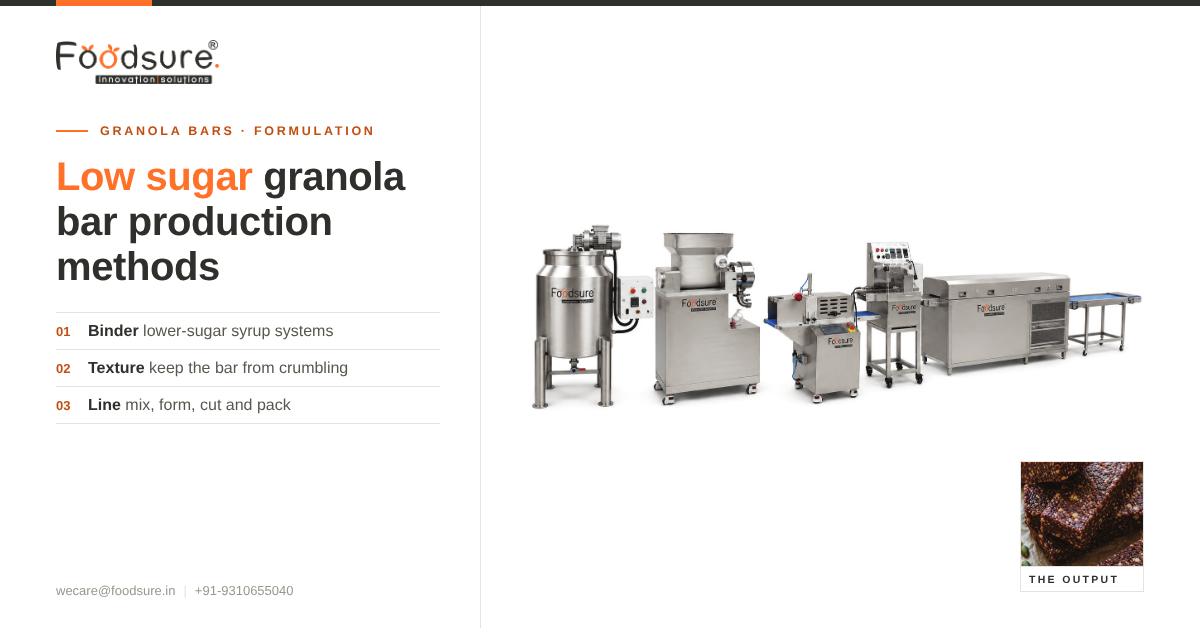
Granola bars are very common snacks that are produced using oats, nuts, seeds, dried fruits, and other components. As more and more customers are becoming interested in foods that contain less sugar, food companies have been considering ways of producing granola bars that will be tasty but not so sweet.
However, cutting sugar is not simply a matter of taking out syrup and honey in the ingredient list. Sugar adds more than sweetness and texture to baked goods. Therefore, successful low sugar granola bar production methods require careful ingredient selection, binder adjustment, processing control, and shelf-life testing.
Whether you are working on a recipe yourself or planning to produce it commercially, knowledge of these will aid you in formulating granola bars that have cohesion and offer consistency in terms of taste.
What Are Low Sugar Granola Bars?
Low sugar granola bars are snack bars produced with a lower sugar content in comparison to a relevant reference product or an existing recipe from the manufacturer. They can also have other binding agents and natural sweeteners to give the desired taste and texture.
It is not right to assume that a low-sugar product will contain zero sugar. For example, dried fruits, honey, and syrups all contain some sugars even though they might be used in smaller amounts or are seen as natural alternatives.
For manufacturers, the goal is to reduce added sugar while maintaining:
- An appropriate degree of sweetness
- Structure with adequate stability to hold its shape
- An appropriate ratio of crunchy and chewy textures
- Uniform weight and size of the bars
- Flavor and proper blending of ingredients
- Proper shelf-life and transportation stability
The final recipe should also be assessed for its nutritional composition and applicable food-labelling requirements.
Understanding Low Sugar Granola Bar Production Methods
The most suitable low sugar granola bar production methods depend on the ingredients, desired texture, and manufacturing process. The usual formula for making a granola bar involves sugar syrups in order to bind oats, nuts, and other components. In reducing the amount of these components, the producer must make up for their functionality.
Common production approaches include:
1. Alternative Binders
Alternative binders can help bind oats, nuts, and seeds together while decreasing the use of traditional sugar syrups. Based on the specific product, different producers might look into nut butters, fruit pastes, soluble fibers, and other alternatives.
Every binding agent works differently, which is why the amount of ingredients and the conditions of processing have to be tested.
2. Increase the Proportion of Whole Ingredients
Whole oats, nuts, seeds, and some dried fruits can provide flavor, structure, and texture to the bar. Proper balance will enable creating a satisfying product while not relying entirely on sweet taste.
However, the dried fruits have natural sugars in them; therefore, the contribution of those will need to be counted when determining the total sugar content.
3. Use of Baking or Non-Baked Processes
Some granola bars go through baking after being mixed and formed, while others go through non-baking procedures.
Baking can help dry out the mixture and give it a firmer texture.
4. Adjusting Moisture and Compression
Reducing sugar can change how ingredients bind together. Manufacturers may need to adjust the moisture content, mixing conditions, and compression pressure to achieve the required structure.
These adjustments are particularly important in commercial production, where every batch needs to deliver consistent results.
Granola Bar Ingredients: What Goes Into a Low Sugar Recipe?
The choice and proportion of granola bar ingredients directly affect sweetness, binding, texture, and product stability. Instead of treating each ingredient separately, manufacturers should consider how the complete ingredient combination behaves during mixing, forming, and storage.
| Ingredient Category | Examples | Role in the Granola Bar |
| Base ingredients | Rolled oats, puffed grains, cereal pieces | Provide bulk and structure |
| Nuts and seeds | Almonds, peanuts, pumpkin seeds, sunflower seeds | Add crunch, flavour and fat |
| Fruit ingredients | Dates, raisins, dried berries | Contribute flavour, sweetness and binding in some recipes |
| Alternative binders | Nut butter, fruit paste, soluble fibre systems | Help hold ingredients together |
| Sweetening ingredients | Suitable reduced-sugar sweetening systems | Provide the desired sweetness |
| Flavour ingredients | Cinnamon, cocoa, vanilla, salt | Improve the overall flavour profile |
| Functional additions | Selected fibres or protein ingredients | Adjust nutritional and structural properties |
The ingredients used must depend on the target product. The binder systems used for a chewy bar made from dates and oats can be different from those used for a crunchy bar that has whole nuts and seeds in it.
Consideration must also be given to moisture content, particle size, and fat content of the ingredients.
Choosing the Best Binder for Granola Bar Production
The main problem related to the reduction of sugar lies in retaining the structure of the bar. Traditional syrups normally act as binders for the dry elements, and when their amount is reduced, it becomes necessary to find another solution.
The best binder for granola bar production depends on the recipe, texture requirements, and processing method.
Nut Butters
Nut butters can assist with holding the ingredients together and adding flavor and fat. Peanut and almond butter are two examples of nut butters.
The use of nut butters depends on its consistency, fat levels, flavor, and amount used. High fat content can affect the firmness and handling characteristics of the end-product.
Date Paste and Fruit Pastes
Date paste and certain fruit pastes can assist with sweetness and binding in the mixture. This is useful in chewy bar formulas, but the presence of natural sugars needs to be taken into consideration during formulation.
Soluble Fiber Systems
Some types of soluble fiber can assist in providing bulk and modifying texture. The performance of some soluble fibers depends on the type of fiber, hydration levels and other ingredients in the formula.
Some soluble fiber systems can influence sweetness, chewiness, or moisture behavior.
Protein-Based Ingredients
Protein-based ingredients can add structure and nutrition but do not necessarily behave as good binding agents in certain formulations. This will render the bars dry and firm.
Combining Different Binders
In some cases, a blend of binders may give better results in terms of bonding, texture, and taste compared to using just one binding agent. Such a blend needs to be chosen on the basis of experiments rather than assumptions.
How to Improve Granola Bar Texture After Reducing Sugar
Sugar reduction can affect the granola bar texture in several ways. Bars may become crumbly, dry, excessively firm, or difficult to cut if the original recipe is not adjusted.
Manufacturers can evaluate the following factors:
Balance of Binder to Dry Ingredients
Enough binder should be used to bind dry ingredients together. Lack of binder makes the bar fragile, and it may break when cutting or handling the bar. Excessive binder may cause the bar to be sticky.
Level of Moisture in Ingredients
Moisture level will determine the chewiness and stickiness of the bar. Insufficient available moisture in a recipe will make the bar dry, whereas a high level of moisture will make the bar sticky.
Particle Size of Ingredients
The presence of large particles like nuts, seeds, and cereal will affect the evenness of binding of ingredients. Correct particle size distribution should be considered for better distribution of ingredients.
Mixing and Compression of the Bar
Mixing ensures proper distribution of binder among dry ingredients. Compression of the mix in the forming process is necessary to ensure uniformity of the slab without crushing the ingredients.
Conditions of Baking
In case of baking, timing and temperature will affect the moisture content and color of the bar. The conditions should be adjusted considering the bar thickness and ingredient content.
How to Make Granola Bar at Home Step by Step
The small-scale experiment at home could be used to illustrate the main concepts of making granola bars with less sugar. The next approach should be considered experimental rather than a tested one.
Step 1: Prepare the Ingredients
Put rolled oats, nuts, and seeds together in a mixing bowl. It is advisable to ensure that the pieces are relatively even, as it will aid in even distribution.
Step 2: Prepare the Binder
Pulverize the dates into a paste and blend it with some amount of nut butter. It should have the right thickness that can cover the dry ingredients.
Step 3: Combine the Ingredients
Gradually add the binder to the dry ingredients. Ensure that all ingredients are uniformly mixed and the mixture can stick together when pressed.
Step 4: Place on a Lined Pan
Place the mixture in a lined pan and press it down tightly.
Step 5: Bake or Refrigerate
If you decide to bake, ensure to use the appropriate baking method and keep an eye on it as you go. If you want to skip the baking step, then place the mixture in a fridge until it is hard enough to cut.
Step 6: Cut into Bars
Once your mixture has set, cut it into bars using a sharp knife.
Step 7: Store Properly
Keep the bars in a suitable airtight container. This home method does not establish a commercial shelf life; storage stability depends on the recipe, moisture level, hygiene, and packaging.
Granola Bar Formulation for Commercial Production
A commercial granola bar formulation needs to be developed around measurable product requirements rather than taste alone. The process of manufacturing should be determined after deciding on the required taste, texture, weight of the bar, and other factors.
A structured development process generally involves:
- Determine the target product properties: Determine if the product is going to be crispy, chewy, soft, or dense.
- Choose the raw materials: Select suitable types of oats, nuts, seeds, fruits, binders, and ingredients for sweetness.
- Determine the reduction goal: Define the desired amount of sugar and analyze the contribution of each ingredient.
- Create the binding system: Determine how well selected binders act with dry ingredients.
- Adjust the moisture content and texture: Analyze mixing, forming, baking, or cooling processes.
- Complete a pilot test run: Produce a pilot batch of product to determine its handling, cutting, flavor, and texture.
- Test the product: Conduct necessary nutrition, microbiology, and shelf-life tests
A granola bar recipe for machine production may need further adjustments compared with a home recipe. Commercial equipment introduces factors such as mixing intensity, feeding consistency, slab thickness, compression, cutting speed, and cooling time.
Commercial Production Process for Low Sugar Granola Bars
Once the recipe has been developed, the production line should be configured to handle the ingredient composition and required output.
A typical commercial process may follow:
Raw Material Inspection and Preparation
↓
Ingredient Weighing
↓
Dry Ingredient Mixing
↓
Binder Preparation and Addition
↓
Final Mixing
↓
Slab Forming or Extrusion
↓
Baking or Controlled Cooling
↓
Cutting
↓
Inspection
↓
Packaging
The exact sequence depends on whether the product is baked or no-bake and whether it is suitable for slab forming or extrusion.
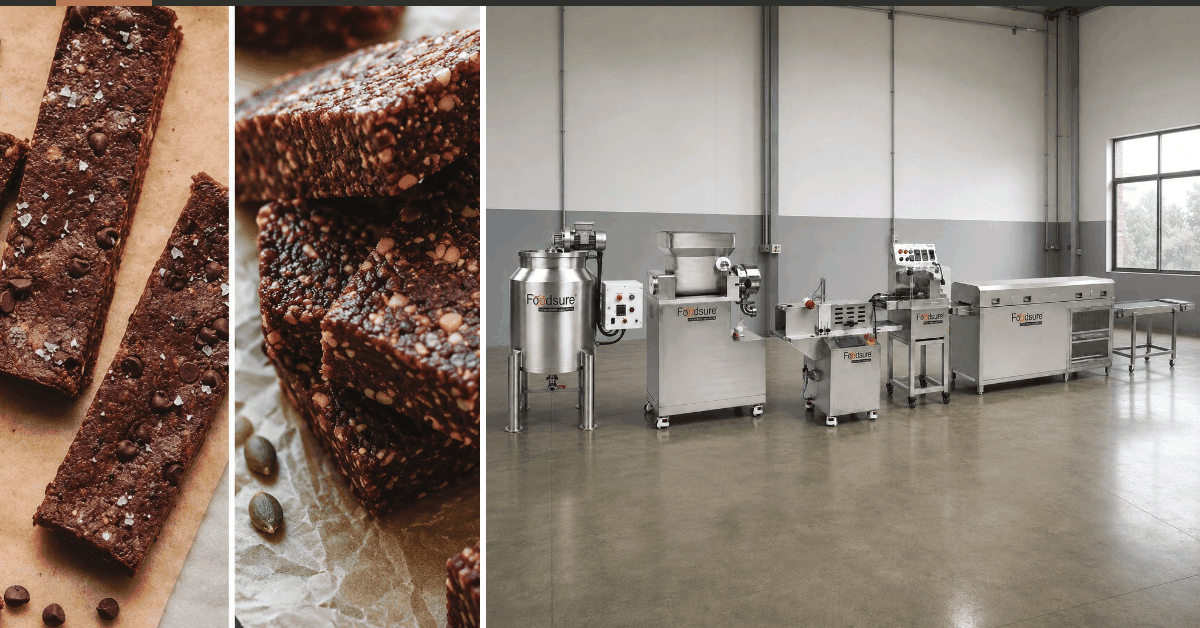
A granola bar manufacturing machine can integrate several of these stages. Slab-forming equipment is often considered for bars containing larger oats, nuts, and seeds, while extrusion may be suitable for more cohesive mixtures when the product consistency supports it.
How to Improve Granola Bar Shelf Life
Understanding how to improve granola bar shelf life is important when reducing sugar because changes to the recipe can affect moisture, texture, and product stability.
Manufacturers should evaluate:
Water Activity and Moisture
The moisture content and water activity measurements are two different yet connected tests. The former helps to show how much water can be used by microbes for their life activities.
Both should be evaluated during the development process. One shouldn’t assume that a recipe with less sugar will have the same stability compared to the original one.
Packaging Material
The packaging material should serve as an effective barrier to moisture and air. It depends on the moisture and fat sensitivity, storage conditions, and transportation needs of the product.
Control of Oxidation
Nuts and seeds have fat content that can go rancid during storage. Issues related to the quality of ingredients, processing, and oxidation need to be taken into consideration while assessing product stability.
Hygiene and Handling
Hygienic practices, cleanliness of equipment, and proper handling procedures will minimize contamination problems during production.
Shelf Life Testing
The shelf life of commercial products needs to be determined using appropriate tests carried out under specified storage conditions. Tests can be related to texture, sensory properties, moisture, water activity, microbiology, and other product characteristics.
Why Pilot Batches Matter Before Commercial Production
A granola bar pilot batch helps manufacturers evaluate a recipe and processing method before moving to full-scale production. It is especially useful when reducing sugar because small changes in binder quantity or moisture can affect the finished bar.
A pilot trial can help assess:
- Distribution and blending of ingredients
- Effectiveness of binders.
- Consistency and hardness of bars
- Formation and cutability of slabs
- Weight and size of products
- Necessity of baking/cooling
- Suitability for packaging
- Storage stability initially
The pilot batch results give valuable inputs for tweaking the formula and machinery settings. But it needs to be validated further prior to commercial release of the product.
When to Consider Granola Bar Product Development or Contract Manufacturing
For companies that lack a product development team in their business, a granola bar product development service may be used to test ingredients, the binding process, the manufacturing process, and the product’s features.
A development partner will help carry out tests, improve the formulation, and determine the suitability of the product for the manufacturing line.
Similarly, granola bar contract manufacturing may be an option for brands that want to launch a product without establishing their own complete manufacturing facility. Prior to making their choice of a partner, the firms need to have certain discussions about sources of ingredients, production capacity, quality testing, packaging needs, test ownership, and the final recipe.
A reliable granola bar raw material supplier is also important. Consistent quality of oats, nuts, seeds, dried fruits, and binder ingredients can help reduce variations between production batches.
Why Choose Foodsure for Granola Bar Production Planning?
Foodsure offers food processing machinery solutions to companies wishing to produce granola bars and similar snacks. The selection of appropriate machines demands knowledge regarding the structure of the ingredients used in the product, the binding mechanism, texture, capacity, and packaging needs.
For companies creating a reduced sugar product, it is critical to test the behavior of the product during the processes of mixing, molding, cutting and packaging. Foodsure can assist in assessing the machinery needs of the company and developing an efficient production line based on the company’s product.
Conclusion
Successful low sugar granola bar production methods involve more than reducing sweetening ingredients. The producers should ensure that there is the perfect blend of binders, oats, nuts, seeds, moisture, and production process to get a bar with uniform flavor and texture.
For commercial production, a well-developed granola bar formulation, suitable machinery, controlled processing, and proper shelf-life testing are essential. Pilot trials and assured sources of ingredients can help businesses improve their products before launching them into the market.
Frequently Asked Questions
1. What are some common low sugar granola bar manufacturing processes?
Some common processes are the use of alternative binding agents, changes in ingredient ratios, proper control of moisture levels, and choosing the right baked or no-bake process.
2. What is the best binding agent in producing granola bars?
There is no single binding agent that will fit all types of granola bars. Nut butter, date paste, fruit pastes, and certain soluble fiber systems will depend on the texture, sweetness, and processing requirements of the product.
3. Can granola bars be produced without the use of sugar?
It is possible to produce them without adding sugar; however, there are ingredients like dates and dried fruits that have natural sugar content.
4. What are some ways that granola bars may be textured better?
They can experiment with adjusting ratios between binders and dry ingredients, amount of moisture, size of particles, mixing, compression, and baking or cooling.
5. How do I formulate my own granola bar formulation to be produced using machinery?
Start by knowing what kind of texture is targeted and its ingredients. Follow this up by evaluating the performance of the binders, mixing, forming, cutting, and packaging.




