
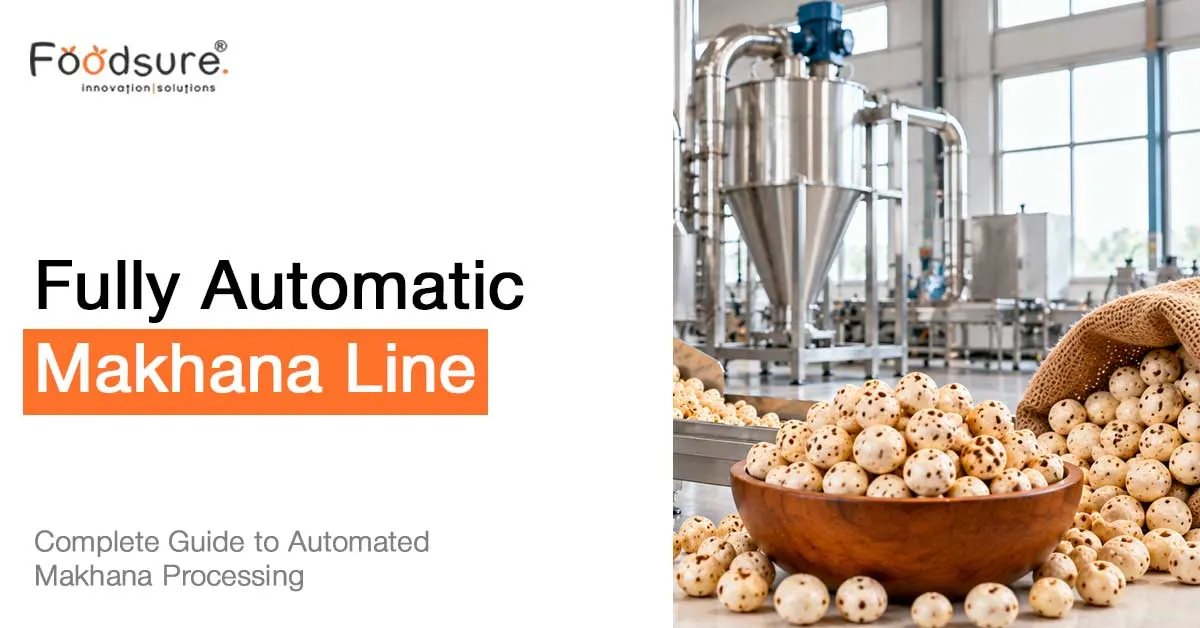
The increasing popularity of roasted and flavored packaging of makhana requires efficient processing facilities for commercial purposes. With increasing volumes of production, companies shift from using individual pieces of equipment and manual processing to combined processing techniques.
A fully automatic makhana line connects different stages of processing into one coherent manufacturing process. This could result in less human interference, improved process efficiency, and allow manufacturers to process greater amounts of makhana.
The arrangement of the automation line for tasks including cleaning, drying, grading, roasting, flavoring, and packing is flexible depending on the type of product and the capacity of automation desired.
What Is a Fully Automatic Makhana Line?
A fully automatic makhana line is an integrated food-processing system designed to carry out multiple stages of makhana processing with minimal manual intervention.
Rather than running each machine separately, the machines can be configured in an organized production process. The use of conveyor systems and automation will assist in conveying the product from one stage to another.
A typical processing flow may include:
The exact configuration depends on whether the business produces raw processed makhana, roasted products, flavoured snacks, or packaged retail products.
Why Choose an Automatic Makhana Processing Line?
Manual processing may be challenging to handle with increasing amounts of production. An automatic makhana processing line facilitates manufacturers in arranging numerous processes in a better way.
Key benefits include:
- Manual intervention reduced
- Consistency of processing increased
- Production capacity increased
- Material flow improved
- Repetitive labor decreased
- Process monitoring became easier
- Planning of production improved
- Scalability improved
Automation does not mean that operators are no longer required. Skilled personnel are still needed for monitoring, quality control, maintenance, and overall production management.
Main Stages of a Fully Automatic Makhana Processing Plant
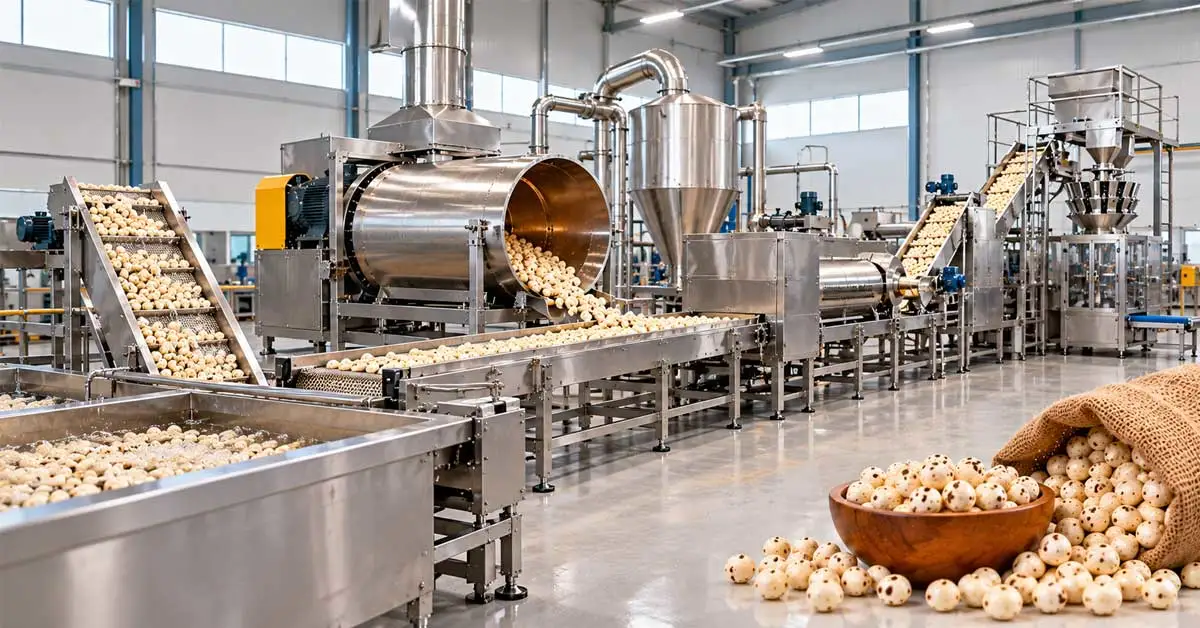
A fully automatic makhana processing plant can include several machines depending on the desired final product.
1. Raw Material Feeding
The production process starts with the introduction of raw makhana into the processing machine. Automated feeding will ensure that the material flow is kept steady during the first stage of processing.
2. Cleaning
Cleaning involves the removal of dust and any other impurities present in the raw material. This stage is important since mechanical cleaning will help minimize manual sorting.
3. Drying
Drying will help control the moisture content and prepare the material for subsequent processes. Controlled drying will enable consistency in the process, unlike full manual drying.
4. Grading
Grading separates makhana according to size or other physical characteristics. Consistent grading can help manufacturers organise raw material for different product requirements.
5. Roasting
Roasting is an essential process in making ready-to-consume makhana. The use of automatic roasters could help in getting uniform heating and movement of makhana.
6. Cooling
After roasting, the product may need controlled cooling before flavouring or packaging. A cooling stage can help bring the product to a suitable temperature for subsequent operations.
7. Flavouring
Flavouring equipment can apply seasoning to roasted makhana in a controlled manner. This stage is particularly useful for manufacturers producing multiple flavoured snack varieties.
8. Packaging
The final product can be transferred to an automated packaging system. Depending on the product and pack format, the system may include weighing, filling, sealing, and date coding.
Complete Makhana Production Line
A complete makhana production line could incorporate all the main processes needed to transform raw makhana into a fully developed commercial product.
The strength of an integrated process lies in the fact that the processes are designed as a single production system rather than individual machines.
For example:
Not every manufacturer needs all these stages. Businesses should configure the line according to their actual product range and production requirements.
Key Benefits of a Fully Automatic Makhana Line
1. Higher Production Efficiency
Automation allows multiple processing stages to work in a coordinated sequence, reducing unnecessary manual transfers between machines.
2. Reduced Labour Dependency
Conveyors and feeding and processing operations can be automated to minimize repetitive tasks by the operators. The operators may then concentrate on observation and quality control.
3. Consistent Processing
Controlled operating conditions can help maintain greater consistency between production batches.
4. Better Material Flow
An integrated line provides a defined movement path for the product, reducing unnecessary handling.
5. Easier Production Scaling
Businesses with growing demand can use an automated setup to handle larger production volumes more systematically.
6. Improved Process Monitoring
Centralised controls can make it easier to monitor different stages and identify operational issues.
Fully Automatic vs Semi-Automatic Processing
The choice between automation levels depends on production volume, investment capacity, labour availability, and plans.
| Factor | Semi-Automatic Setup | Fully Automatic Setup |
|---|---|---|
| Manual intervention | Higher | Lower |
| Production flow | Partly integrated | Highly integrated |
| Labour requirement | Higher | Lower |
| Process consistency | Good | Higher control |
| Initial investment | Generally lower | Generally higher |
| Scalability | Moderate | Better for larger operations |
| Process monitoring | More operator dependent | More systematic |
Businesses should select automation based on actual requirements rather than assuming that maximum automation is always the best option.
Small Scale vs Fully Automatic Makhana Machines
Businesses often need to decide whether to begin with individual machines or invest in an integrated system. The small scale vs fully automatic makhana machines comparison should consider production volume, available investment, labour costs, space, and future expansion.
A smaller setup can be employed if the company wishes to test the market or produce products in smaller amounts. A fully automated set-up becomes more feasible when the demand for production is high and consistent, and the company needs a smooth production process.
Therefore, this decision should be based on the future business plan.
How to Choose the Right Automatic Makhana Line
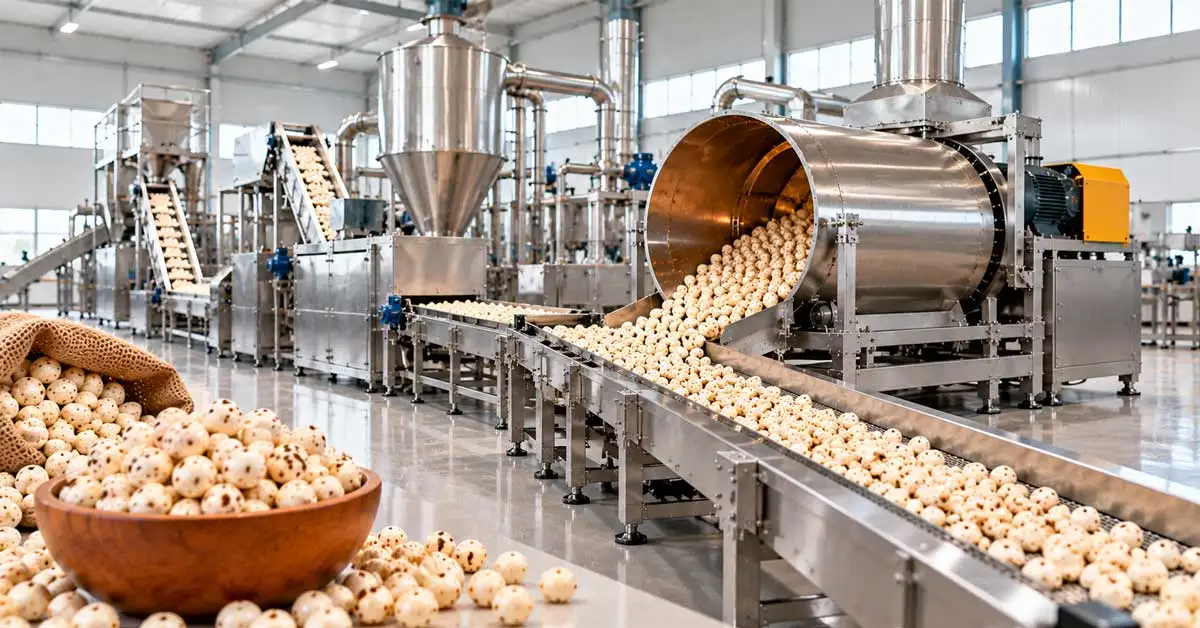
Several factors should be evaluated before purchasing an automated processing system.
Production Capacity
Establish the output requirement per hour and future demand projection. The line must be set up based on practical production requirements.
Product Type
Plain roasted makhana, flavoured snacks, bulk products, and retail-packed products may require different equipment configurations.
Automation Level
Determine which processes need full automation and where manual intervention may still be practical.
Available Space
The complete line requires space not only for machines but also for material movement, operator access, maintenance, and storage.
Material Handling
Conveyors and transfer systems should maintain a logical flow between processing stages while minimising unnecessary handling.
Cleaning and Maintenance
The equipment should be available for routine maintenance, inspection, and cleaning.
Supplier Support
Installation, operator training, spare parts, technical support, and after-sales services should be taken into account together with machine specifications.
Cost Considerations
The factors determining the amount of investment required to automate the processing of makhana are the processing capacity, number of machines to be installed, extent of automation, material for construction, control systems, and packaging.
It is important to keep in mind the total cost of the entire project rather than just the cost of one machine. Some of the other investments are utilities, installation, conveyors, storage, packaging, and maintenance.
Researching the makhana processing machine price can help businesses compare different equipment configurations and understand how automation level and production capacity affect investment.
Maintenance and Hygiene
A line that operates automatically requires maintenance and cleaning as well. Accumulation of residues, dust, and seasonings may occur in the processing and conveyors unless proper cleaning is done.
Important practices include:
- Regular cleaning of machinery
- Inspection of movable parts
- Inspection of electrical connections
- Unusual noise/vibration inspection
- Inspection of conveyors and transfer points
- Preventive maintenance programs
- Proper operator hygiene
Who Should Invest in a Fully Automatic Makhana Line?
A fully automated system may be suitable for:
- Big makhana processors
- Snack food manufacturers
- Makhana Roasted makers
- Flavored makhana products
- Food processing industry
- Companies that supply retail chains
- Manufacturers that intend mass production
The small-scale firms may choose from either automated or semi-automated machines when they start. When the process grows, automation may be considered.
Conclusion
The fully automatic makhana line offers an integrated method for makhana production by linking several processes like cleaning, drying, grading, roasting, flavoring, cooling, and packaging.
An automatic makhana processing line has the ability to minimize repetitive labor, enhance the flow of materials, and ensure consistency in production. In cases where the volume of business is greater, a fully automatic makhana processing plant can provide a sound base for scaling up production.
Nevertheless, automation must always correspond to real business needs. Factors such as capacity, product category, space, investment, labor, maintenance, and future expansion must be considered before selecting a complete makhana production line.
Have a Question? Let’s Connect
Need expert guidance on food processing machines, production setup, or process optimization? Our team is ready to help you choose the right solution for your business.
Frequently Asked Questions
What is a fully automatic makhana line?
An automatic makhana line refers to the processing system wherein the entire production of makhana is undertaken, and minimal human effort is required.
What machines are included in an automatic makhana processing line?
Depending on the configuration, it may involve equipment for cleaning, drying, grading, roasting, cooling, flavoring, conveying, weighing, and packaging.
Is a fully automatic processing plant suitable for small businesses?
It can be, but the investment should match the expected production volume. Small businesses may initially benefit from individual or semi-automatic machines.
What are the main advantages of a fully automatic makhana processing plant?
Some of the major benefits include decreased manual labor, increased production uniformity, enhanced material handling, greater productivity, and scalability.
How much does a complete makhana production line cost?
It is dependent upon the capacity of production, arrangement of machinery, automation level, installation, and packaging. Companies need to think about the overall setup rather than the single machine cost only.




