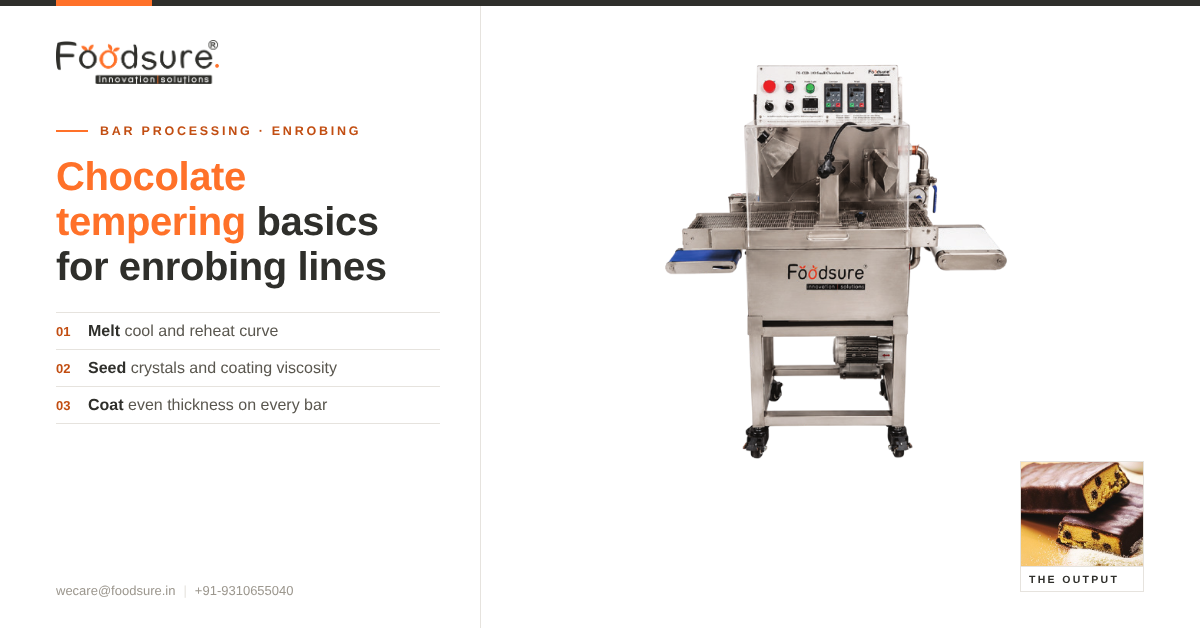
A chocolate enrober is used to cover various confectionery items such as biscuits, wafers, cookies, bars, nuts, and others with a chocolate covering. But for good coverage, the proper temperature, viscosity, and crystal formation are essential.
Understanding chocolate tempering basics enables manufacturers to develop a shiny surface, a clean snap, a smooth coating, and consistent quality. Chocolate tempering involves controlling the crystallization of cocoa butter.
In the commercial production process, having the right chocolate enrober machine, the proper tempering machine, and the right cooling machines will help in ensuring that there is uniformity in the coating process. Poor tempering results in dullness, fat blooming, and uneven coating.
This blog provides information on the chocolate enrobing line tempering process, possible problems, and equipment needs. It also details how process control can help achieve consistent results in the production process.
What Is Chocolate Tempering?
Tempering chocolate is a technique whereby controlled heating and cooling cause the cocoa butter to form a crystalline structure that will ensure stability. The cocoa butter could crystallize in various ways, but chocolate tempering ensures that only stable crystals form.
Chocolate will otherwise have a rough texture and finish when not tempered during the melting process. It will harden with an inconsistent structure and an undesired surface finish. Tempering helps to ensure proper crystal formation for the coating process.
A typical tempering process involves three main stages:
- Melting: Existing cocoa butter crystals are melted by heating the chocolate.
- Cooling: The chocolate is cooled under controlled conditions to encourage crystal formation.
- Reheating to working temperature: The chocolate is gently warmed to reduce the number of less desirable crystals while retaining the stable crystal structure needed for coating.
The temperature curve will vary depending on the type of chocolate used. Dark, milk, and white chocolate all have different tempering requirements since they all have different formulations. The manufacturer must always follow the suppliers’ guidelines and validate the process according to the type of chocolate that is used.
Tempering becomes important when it comes to real chocolate that contains cocoa butter. This is because compound coatings use vegetable fat and do not need tempering.
Why Is Chocolate Tempering Important for Enrobing Lines?
An enrobing line applies a controlled layer of chocolate over a product as it travels through the coating system. For consistent results, the chocolate must remain within its suitable working range throughout production.
Tempering affects the quality of the coating and the stability of the manufacturing process.
1. Glossy Surface Finish
Well-tempered chocolate is capable of forming a glossy surface once it sets. Such a quality becomes necessary for products to be put up in retail packs, since the surface finish plays a big part in influencing the consumer.
Failure to temper could result in a rough surface.
2. Firm Texture and Snap
Firm cocoa butter crystals allow the chocolate coating to set. Based on what kind of item it is, it will give the right snap when the item is broken.
Poor chocolate tempering can make the coating softer than it should be.
3. Controlled Setting
A well-tempered coating will be more inclined to set appropriately under the right cooling conditions.
But tempering is not the only factor that determines the set time. There are other factors that affect this process, and they include coating thickness, product temperature, chocolate formula, among others.
4. Reduced Fat Bloom Risk
Fat Bloom is a whitish surface film that develops on the surface of chocolate. This could result from poor fat crystallisation, temperature changes, and fat migration from the interior of the food. Proper tempering reduces the incidence of bloom arising from cocoa butter, although it cannot prevent all forms of bloom.
5. More Consistent Production
A consistent tempering procedure ensures that the same characteristics of the coating are maintained during the entire process. It also decreases the requirement for constant adjustment due to the varying behaviour of the chocolate.
In case of large-scale producers, a consistent tempering process can help achieve effective quality control and planning.
How Chocolate Tempering Works Before Enrobing
Tempering is normally completed before the chocolate enters the coating stage. The chocolate must then remain within an appropriate working range while being transferred to the enrober.
A simplified commercial workflow is:
Stage 1: Melting the Chocolate
Chocolate is heated sufficiently to melt existing cocoa butter crystals. The required temperature depends on the chocolate type and the supplier’s processing recommendations.
Heating must be controlled to avoid scorching, moisture contamination, and unnecessary thermal exposure.
Stage 2: Controlled Cooling
The cooled liquid chocolate helps to form the required cocoa butter crystals. Poor control of the cooling process can lead to formation of undesired crystals.
This will affect the performance of the chocolate as a coating material.
Stage 3: Crystal Development
Crystal growth begins as the cooling stage is reached in relation to cocoa butter. The aim is to have enough stable crystals for the required behaviour while not having the chocolate too thick.
The industrial equipment used to temper chocolate controls this process.
Stage 4: Reheating to Working Temperature
The chocolate is then heated to its appropriate working temperature. This allows for the removal of the excess unstable crystals while retaining the stable crystalline structure required for coating.
Overheating at this stage results in the destruction of tempering, which calls for proper monitoring.
Stage 5: Maintaining Temper During Enrobing
However, once the chocolate is ready for the enrobing phase, it is important to ensure that it stays within the ideal operating range. Chocolate can then continue being heated, stirred, and its temperature monitored.
The temperature range varies according to the type of formula used.
How Tempering Affects Chocolate Coating Quality
The tempering process directly influences how chocolate behaves during coating and after the product leaves the cooling tunnel.
Coating Thickness
Viscosity of the chocolate will determine how much coating will be left on the product after excess chocolate is stripped from it. Tempered chocolate should flow enough to cover the product with the coating.
Too viscous chocolate will result in a heavy coating and/or an uneven distribution of it. Too fluid chocolate might yield less coating on the product.
Surface Appearance
Stable tempering helps produce a smoother surface and a more uniform finish. Poorly controlled tempering may contribute to streaking, dullness, uneven setting, or visible surface defects.
Edge Definition
Products with defined shapes may require controlled chocolate flow to preserve their edges and avoid excessive pooling. The chocolate’s working condition, enrober settings, and product temperature all influence the result.
Setting and Release
The coating needs to have dried adequately before the product is touched or packed. Tempering will allow for easy crystallisation, whereas the cooling process allows for removal of excess heat and the coating to harden.
A coating that is wrongly tempered will be soft, difficult to strip from some surfaces, or will not dry properly.
The Role of a Chocolate Enrober Machine
The chocolate enrober machine is used to coat products with chocolate either in a continuous process or in batches. In a continuous process, the products move through the enrobing section while chocolate is applied on top, sides, and sometimes underneath the product.
A commercial enrobing system may include:
- Product conveyor
- Chocolate curtain or coating machine
- Bottom or undersurface coating unit, if needed
- Air blowers or vibrator units for removal of excess chocolate
- Recovery and recycling system
- Temperature-controlled chocolate supply system
- Cooling tunnel downstream
The configuration depends on the product, coating thickness, production capacity, and required level of automation.
Consistent Chocolate Flow
The chocolate supplied to the enrober must maintain suitable flow characteristics. Tempering conditions, viscosity, and temperature all influence how evenly the coating is distributed.
Coating Weight Control
Adjustments to the coating process should be possible in the enrober based on the needs of the product. Some of the factors that could influence the coating weight include curtain flow, product speed, air flow, and excess chocolate elimination.
Continuous Production
With an integrated tempering and enrobing system, a more consistent availability of chocolate can be achieved throughout the process. It is also advisable that the machines be set in such a way as to avoid unnecessary fluctuations in temperature.
Why a Cooling Tunnel Is Essential After Enrobing
The cooling tunnel dissipates the heat from the coated item and facilitates the formation of the chocolate coating. The effectiveness of the tunnel is important for surface finish, hardness of the coating, handling of the items, and efficiency of the entire line.
Cooling should not be done at the lowest temperature but rather needs to be regulated.
Controlled Cooling Temperature
The cooling process needs to be appropriate for the type of chocolate being used, the thickness of the coating, the size of the product, and the speed of production. Aggressive cooling can cause temperature variations within the coating or the product itself.
Airflow Distribution
Uneven airflow can cause products to cool at different rates. A well-designed tunnel should provide suitable air distribution throughout the product path.
Residence Time
Residence time depends on tunnel length and conveyor speed. If products leave the tunnel before the coating has set sufficiently, they may be difficult to handle or package.
Condensation Prevention
When cold products encounter humid air, condensation can form on the surface. Moisture can damage chocolate appearance and may contribute to sugar bloom after drying.
Manufacturers should manage the cooling environment and allow products to reach suitable handling conditions before exposure to humid areas.
Common Chocolate Tempering Problems and Their Causes
Tempering troubles may take the form of problems with coating, flow consistency, and set behavior. But just because a problem exists does not necessarily mean that tempering is to blame. Other variables such as the formula of the chocolate, temperature, and cooling are also important factors.
| Problem | Possible Cause | What to Check |
| Dull chocolate coating | Incorrect temper, unsuitable cooling, or formulation-related issues | Tempering profile, cooling conditions, and chocolate specifications |
| White or grey surface marks | Fat bloom, sugar bloom, or temperature-related changes | Temper, storage conditions, humidity, and formulation |
| Chocolate too thick | Low working temperature, excessive crystallisation, or formulation characteristics | Chocolate temperature, temper condition, and viscosity |
| Uneven coating | Inconsistent flow, product movement, or unsuitable enrober settings | Chocolate supply, curtain flow, conveyor speed, and product alignment |
| Soft coating after cooling | Inadequate temper, insufficient cooling, or unsuitable formulation | Temper test, cooling profile, coating thickness, and product temperature |
| Excessive chocolate buildup | High viscosity, incorrect machine settings, or excess coating flow | Working temperature, blower settings, and coating system |
| Poor coating release | Tempering, surface condition, or cooling-related issues | Product surface, coating formulation, temper, and setting conditions |
| Inconsistent results between batches | Temperature fluctuations or variation in raw materials | Sensor calibration, tempering records, chocolate batch specifications, and operating procedures |
Troubleshooting should begin with observations and measurements rather than changing several settings simultaneously. This makes it easier to identify the source of the problem.
How to Maintain Consistent Tempering on an Enrobing Line
Commercial manufacturers need repeatable operating procedures to maintain coating quality during both short and extended production runs.
1. Follow Chocolate Supplier Specifications
Begin with the recommended temperature for melting, cooling, and tempering the particular type of chocolate being used. Don’t presume that all dark, milk, white, and compound chocolate coatings have the same requirements.
2. Monitor Temperature Continuously
Where possible, monitor temperature in the tempering machine and chocolate going into the enrobing machine. Look out for any temperature changes at start-up, product changeovers, and continuous running.
3. Validate Temper Before Production
Use an appropriate temper test or validated measurement method to confirm that the chocolate is ready for enrobing. Visual appearance alone may not reliably indicate the quality of the temper.
4. Maintain Suitable Agitation
The agitation and movement of chocolate ensure uniformity in the holding and distribution system. Ensure that you follow the machine manufacturers’ instructions in order to prevent factors that may affect the temper or add too much air.
5. Control Production Interruptions
Long interruptions may affect the temperature of the chocolate and the formation of crystals. Set up a method of restarting the process after an interruption and checking the chocolate.
6. Standardise Cooling Conditions
Use consistent cooling tunnel settings and verify that products are adequately set before handling. Changes in line speed or coating thickness may require adjustments to the cooling process.
7. Record Process Parameters
Keep a record of temperature settings, temper test results, line speed, coating weight, cooling conditions, and defects in the products. These records will aid in identifying trends in the process.
Chocolate Tempering for Different Enrobing Applications
The ideal tempering and coating conditions depend partly on the product being enrobed. Different products have different surface characteristics, shapes, and thermal properties.
Biscuits and Cookies
Biscuits and cookies generally require an even coating without excessive pooling. Their surface temperature and moisture condition can affect chocolate setting and adhesion.
Wafer Products
Wafer is delicate and can even need to be carefully handled for it not to break. The thickness of the coating and the cooling process should be well controlled.
Protein and Cereal Bars
Bars may have irregular surfaces or contain inclusions such as nuts, cereals, and dried fruits. These features can affect coating coverage and chocolate consumption.
Nuts and Small Confectionery Products
Special attention may be required for products that have curvy or irregular surfaces. Product handling and removal of excess chocolate are especially significant.
Compound-Coated Products
Compound coating formulations frequently make use of plant oils in place of cocoa butter as the primary fat system. The behavior of compound coatings is different from that of true chocolate.
The compound chocolate machine could hence be adapted to a process that does not need tempering of cocoa butter. It is essential to verify the coating and adhere to the manufacturer’s directions.
Chocolate Enrober Machine Price and Chocolate Coating Machine Cost
The costs involved in setting up the commercial chocolate coating plant are dependent on the machinery setup and coating needs, among other things.
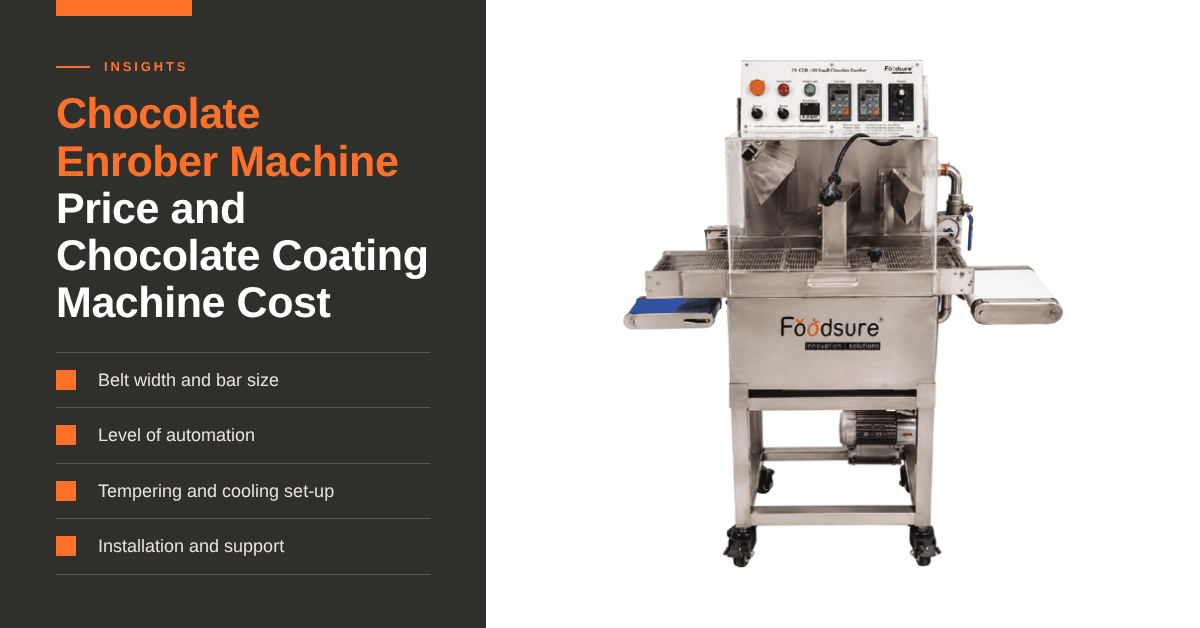
The chocolate enrober machine price may vary according to working width, conveyor speed, chocolate curtain design, bottom-coating options, temperature control, and the features included in the supply.
The overall chocolate coating machine cost may also include supporting equipment such as a chocolate melter, tempering unit, holding tank, transfer pumps, cooling tunnel, conveyors, and packaging equipment.
Before comparing quotations, manufacturers should evaluate:
- The required production capacity
- Product size and coating thickness
- Chocolate or compound-coating formulae
- Chocolate tempering conditions
- Enrober size and conveyor belt speeds
- Cooling tunnel size and cooling control
- Chocolate collection and recycling equipment
- Materials to be used and cleaning
- Installation and training of operators
A complete line should be evaluated according to the required output and product quality, rather than only the price of the enrobing machine.
While choosing the best chocolate machine manufacturer India, one needs to ascertain if the quotation is inclusive of the tempering system, cooling tunnel, and chocolate handling machines. This will make it easy to compare various quotations.
Businesses planning to buy chocolate enrober equipment should provide the supplier with product dimensions, target coating weight, chocolate type, production capacity, and available factory space.
The search phrases chocolate tempering basics price, chocolate tempering basics manufacturer, and buy chocolate tempering basics refer to an informational topic rather than a standard machine category. Buyers searching for commercial equipment should clarify whether they need a tempering machine, an enrober, a cooling tunnel, or an integrated chocolate coating line.
Conclusion
Learning the chocolate tempering basics is key to ensuring that there is proper consistency in the enrobing quality of the chocolate. Temperatures help ensure an even finish, firm texture, and setting of the chocolate.
But successful enrobing also involves coating formulation, temperature of the product, machine parameters, cooling tunnel efficiency, and storage. It is important for manufacturers to validate the whole process and not just focus on the tempering stage.
Choosing a suitable chocolate enrober machine, tempering system, and cooling tunnel can help create a more reliable and efficient production line. By combining appropriate equipment with controlled processing and routine quality checks, manufacturers can improve coating consistency and support dependable commercial chocolate production.
Frequently Asked Questions
1. What are chocolate tempering basics?
Tempering of chocolate is done by carefully melting, cooling, and reheating to form a stable cocoa butter crystal structure. The correct tempering ensures that there is a smooth shine and solid texture.
2. Does every chocolate coating need tempering?
No. Real chocolate with cocoa butter usually needs to be tempered properly to achieve good results. Compound coatings often have different fats and therefore different melting and cooling processes.
3. What happens if chocolate is not tempered correctly?
Improper tempering can cause dullness, improper setting, inconsistency in texture, or even fat bloom. The effect will vary depending on the type of chocolate and other factors.
4. What is the difference between a chocolate enrober and a tempering machine?
A tempering machine is used to temper chocolate by controlling the temperature and the crystalline structure of the chocolate. A chocolate enrober is used to coat the products with the tempered chocolate.
5. Why is a cooling tunnel needed after enrobing?
A cooling tunnel is used to remove the heat from the coated items, making the chocolate hard before being packaged. It should have temperatures, airflow, and holding time depending on the nature of the items and coatings.