In India, premium chocolate-coated products are getting highly popular day by day. Brands are more eager to get the chocolate coating machine suppliers installed on their end products, be it biscuits, wafers, protein bars, cookies, dry fruits, confections, etc. But how to get a perfect estimate on the chocolate coating machine price in India can be quite a difficult process. These machines’ prices vary with different parameters, including capacity, automation level, cooling tunnel size, conveyor width, stainless steel quality, and applicability to various products. However, a startup-scale, small-sized machine can start from a few lakhs, and it can even be more if it comes under the industrial-sized chocolate coating machine type.
Here is a complete price guide of all those elements that affect the machine prices, the machine capacities, the types, and the additional prices while purchasing a pro chocolate enrober machine.
Read More :- chocolate coating bar machine
Chocolate Coating Machine Price in India
| Machine Type | Capacity | Automation Level | Estimated Price |
|---|---|---|---|
| Small-Scale Chocolate Coating Machine | 20–50 kg/hour | Semi-Automatic | ₹2.5 – ₹6 lakh |
| Automatic Chocolate Coating Machine | 50–150 kg/hour | Fully Automatic | ₹6 – ₹15 lakh |
| Industrial Chocolate Coating Machine | 200–500 kg/hour | PLC-Based Automation | ₹15 – ₹40 lakh+ |
The final cost is subject to the configuration of the machine, conveyor belt width, inclusion of a cooling tunnel and a chocolate circulating system, and overall needs.
Production Capacity and Its Impact on Chocolate Coating Machine Price

Capacity is the most significant cost driver when purchasing a chocolate coating machine. As demands go from the smaller craftsman-style machines for speciality batches to those running large, industrial-speed production lines, the level of engineering sophistication increases, thereby raising the overall price point.
Why Capacity Drives Price
The need for machines that will withstand larger volumes means these units need to stand up to more mechanical stress while also maintaining a tighter and more consistent temperature control. This can be seen in their internal construction, which typically demands the following:
- Increased motor power: As conveyors become larger and move more product, larger and stronger motors are required to compensate for both length and weight load.
- Increased tank size: Higher production rates necessitate larger jacketed tanks for consistent chocolate tempering and supply.
- Heavily engineered conveyors: These must maintain integrity and accuracy even when travelling at high speeds through the production line.
- Advanced heating and circulation loops: These systems allow for an evenly coated product while processing at increased rates.
Price Tier Overview
| Capacity | Estimated Price Range |
|---|---|
| 20–30 kg/hr | ₹2.5 – ₹4 lakh |
| 50–100 kg/hr | ₹5 – ₹12 lakh |
| 200–500 kg/hr | ₹15 – ₹40 lakh+ |
Semi-Automatic vs Fully Automatic Chocolate Coating Machine Price
The automation level will influence the capital required for chocolate coating lines, depending on the production capacity, available workforce, and precision.
Semi-Automatic System
This option is best suited for startups and custom shops and caters to the requirements of small-batch production, cost and space efficiency being of prime importance.
- Operating method: Manual loading of products that helps maintain flexibility when processing non-uniform items.
- Simple technology: Equipped with a conventional motor and basic temperature controls.
- Cost of investment: 2.5-6 Lakh.
Fully Automatic System
This option is suitable for industrial-scale production and eliminates the dependency on labour and human error for coating purposes.
- Accurate control system: Includes a PLC-based control system that automatically synchronises conveyor speed, chocolate circulation, and coating thickness.
- Continuous process: The line can be directly integrated with a cooling tunnel for a “raw-to-retail” solution.
- Cost of investment: Starts from 6 Lakh and can go above 15 Lakh depending on smart sensors and conveyance width.
Key Selection Factors
- Labour Cost: Automating the system reduces the number of operators per shift.
- Consistency: A uniform coating is achieved with automation, helping you build a reliable brand standard.
- Future growth: Though the cost for the semi-automatic system is low for startups, it can be beneficial to consider full automation for higher volumes due to good return on investment.
Why Cooling Tunnel Length and Conveyor Width Increase Machine Cost
The cooling tunnel is a necessary part of any commercial chocolate coating system, providing precise controlled cooling that determines the snap, gloss, and shelf life of the finished product. The addition of the cooling tunnel is often one of the greatest initial investments in a system such as these are highly customised to be commensurate with the flow of the coater.
Cooling tunnel investment:
A cooling tunnel will be priced in line with the length and the cooling power. The system must be scaled to the speed of your line:
- Small Unit (1-3 lakh): For low-volume production, this unit provides all of the basic temperature control needs of a boutique operation.
- Medium Unit (3-6 lakh): This provides the most balance between cooling power and length for a production environment that is ready to grow.
- Industrial Unit (6-15 lakh+): High-performance units will be used in a large production environment and will employ sophisticated climate control to keep temperatures steady throughout the length of the cooling tunnel.
Conveyor width and structure:
The width of the conveyor belt becomes the main characteristic determining physical space and the type of frame required for a system.
- Small Unit (200-300 mm): These small, efficient units have a relatively lower price point and are most suitable for niche, lower-volume production.
- Medium Unit (400-600mm): Wider conveyor belt widths offer more production flexibility, allowing for a greater number of different products to be coated at once.
- Industrial Unit (800 mm+): This size requires a heavier, reinforced frame, a more robust drive system, and much more significant refrigeration capacity to maintain a uniform temperature throughout the width of the belt.
When making this investment, be sure to emphasise the cooling capacity; an undersized tunnel can make a larger conveyor width redundant.
Stainless Steel Quality and Hygiene Standards
The material construction of a chocolate coating machine significantly affects not only its price but also your ability to comply with food safety legislation in the future. The use of non-approved materials may also not last very long in terms of usage, and it has potential issues with contaminants.
The Importance of SS304 Food-Grade Steel
Commercial equipment utilises food-grade SS304 (stainless steel) that adheres to all regulations for the food industry. It offers a unique level of protection and usability:
- Corrosion Resistance: Ch ocolate can be acidic, cleaning agents can contain acids, and cleaning procedures may use high humidity. SS304 prevents damage from corrosion and other chemical agents.
- Hygienic Properties: All welds and polishing should allow for a very smooth finish so that there is minimal build-up of food material. SS304 achieves high hygiene standards, enabling compliance with things like the ISO 22000 standards.
- Strength: A robust frame ensures that the structure is firm during high-speed operations and will not vibrate to cause further damage.
Risks of Low-Cost Alternatives
To bring the cost low, companies will use lower-thickness steel with inferior polishing standards. While this is cheaper in the initial purchase cost, it inevitably leads to:
- Higher repair rates: Frequent need to replace corroded or damaged parts or rebuild the entire frame.
- Safety hazards: Failure to pass a hygiene audit leading to potential recall or certification problems for your products.
Investing in higher-quality stainless steel construction reduces the total lifetime cost.
Chocolate Circulation System Cost in Chocolate Enrobing Machine
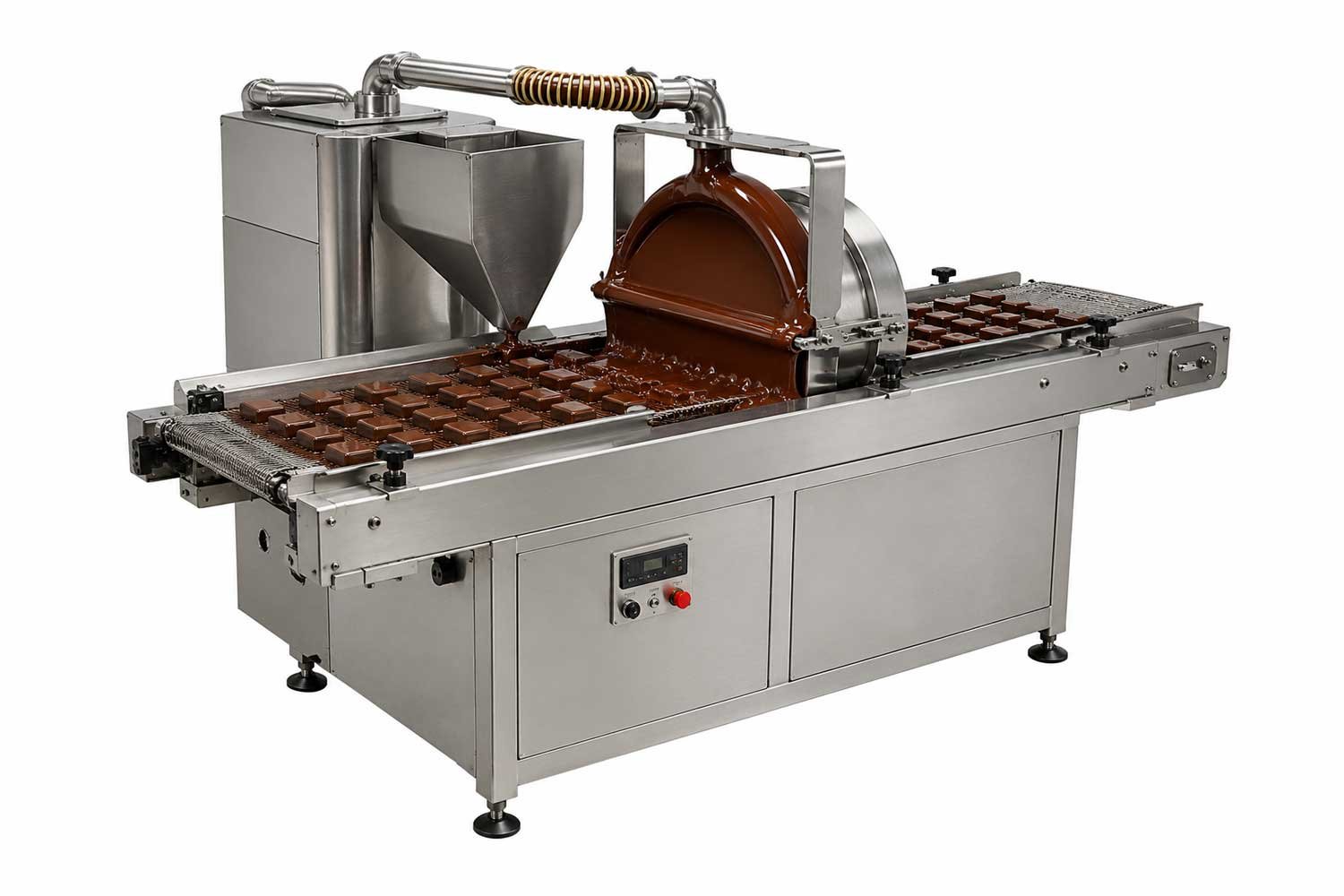
A crucial aspect of a chocolate enrober machine is its circulation system; this is what guarantees a uniform, continuous sheet of chocolate, which determines the overall quality of the product. While the better quality systems are more expensive upfront, they ensure a smooth operation, crucial for commercial-sized production.
Critical elements of the advanced circulation systems are the following:
- Heated Jacketed Tanks: To keep chocolate at a consistent, workable temperature and stop it from solidifying too early.
- Precision Pumping: Automating flow, which delivers a steady curtain, for a smooth, even coating on every piece.
- Chocolate recovery systems: To filter and reuse any drips so that no waste is generated and hygiene is maintained.
- Automatic viscosity control: Sensors will detect when the chocolate is becoming too thick and heat/agitate it automatically to maintain a consistent consistency.
Why Investment Matters
The benefits that these systems can provide can hugely reduce your waste and labour. If you’re in commercial food production and you require a “raw-to-retail” method that’s stable, consistent and can increase your product’s gloss level, you will want a proper system to handle your chocolate circulation.
Installation and Factory Setup Cost for Chocolate Coating Equipment
The expense of buying a chocolate coating line does not stop at the purchase price of the machine itself. These “soft costs” are crucial to take into consideration; otherwise, your budget will run over and setup time will increase. “Setup” refers to integrating your machinery into your factory’s utility infrastructure and ensuring food safety compliance is met.
Critical Infrastructure and Setup Costs
- Utility Infrastructure: Industrial enclosures are usually equipped with 3-phase power; the costs of additional and specific electrical panels and possibly a voltage stabiliser, are sensitive, as PLC circuits can get damaged by surges.
- Climate control: Chocolate is extremely sensitive to fluctuations in humidity and temperature. Investing in a professional HVAC installation is imperative, as humidity will cause bloom, and insufficient cooling will result in an unattractive high-gloss finish.
- Cooling system: A dedicated chiller system or even a simple, professional, stand-alone refrigeration system will be needed for your cooling tunnels. Take plumbing, glycol, circulation and adequate ventilation to release heat from your cooling systems into account.
- Structural alignment: It goes without saying that a solid floor structure will be required for such large, moving machinery. You should also factor in the costs of precise levelling and support of the conveyors to avoid vibration, which will contribute to an uneven coating and accelerated wear and tear.
- Training and commissioning: Set aside budget for the on-site training by specialists who can ensure your operators master calibration, proper maintenance, and safety procedures; this will avoid costly downtime later.
Strategic Planning for Setup
- Factory readiness: Before your machine arrives, the facility itself must be considered. Make sure you can accommodate the “raw-to-retail” flow, defining clear zones for assembly, raw materials, staging area and finished goods storage.
- Compliance costs: The local certifications will need to be obtained before you can run at full capacity in India, these may include the FSSAI license, fire N.O.C., factory licensing, etc. Do account for their respective fees.
- Spare parts and logistics: An initial investment in a few critical spare parts should not be neglected, nor should costs of shipping, insurance, and handling be overlooked (especially if the machine is sourced overseas).
Hidden Costs Most Buyers Ignore in Chocolate Coating Machine Investment
When a manufacturer purchases a chocolate coating line, there is much more to consider than the initial cost of the equipment. A common mistake among new manufacturers is the underestimation of the Total Cost of Ownership (TCO). The primary focus on the price of the initial machine often leaves a shortfall in the operational budget and can eventually bring the entire project to an end.
Critical Hidden Financial Factors
- Maintenance: They are precision instruments; industrial equipment systems need to be regularly maintained. Motors, pumps, and chillers all need regular service in order to assure constant coating quality and to eliminate unexpected breakdowns in the middle of the shift.
- Utility Bills: Electricity bills will skyrocket for machines that have to run on a continuous basis, particularly those equipped with long cooling tunnels. To address this problem, one must purchase efficient refrigerators and install power stabilisers.
- Cost/Durability of imported parts: If your machine incorporates sensitive, imported electrical parts, then the costs of replacement parts will be exorbitant, and their lead times extremely long, to the extent that they may render your entire line nonoperational for days or weeks.
- Planning for future expansion: If the system is not bought modularly, the later stages may require a complete overhaul, which can be tremendously costly. Investing in extra conveyor length and automation will drastically minimise the long-term costs.
The bottom line for your investment-3-year TCO (which will take into account electrical costs, future maintenance, and critically, the investment in spare stock) will make your “raw to retail” line a success.
Conclusion
A chocolate coating machine price in India would primarily be based on factors such as the production capacity of the system, the degree of automation it contains, the integration of a cooling tunnel along with it, belt width, grade of stainless steel, and the need for product customisation and specification. Entry-level confectionery setups and start-ups are better suited to the compact systems, whereas highly automated industrial chocolate coating machine setups would benefit from the large-scale continuous production process.
At Foodsure Machines, we strive to deliver technologically sound and user-friendly chocolate coating machine solutions that deliver longevity, high efficiency, a safe production environment, sustainable production, and easy scaling of your production setup, be it for a small confectionery unit or for an industrial food factory.
Chocolate coating machine price 🚀
Chocolate coating machine price setup support in India.
FAQ
What is the starting price of a chocolate coating machine in India?
Prices for the chocolate coating machine in India begin from 2.5 Lakh, in the case of small-scale machinery.
How much does an automatic chocolate coating machine price for small business?
The automatic chocolate coating machine price for small businesses generally falls between 6 Lakh and 15 Lakh.
What capacity is available in a small-scale Chocolate coating machine?
Small-scale chocolate coating machine prices and capacity usually vary from 20 to 50 kg/hr production.
Which factors affect the price of chocolate coating equipment?
Chocolate coating equipment prices are influenced by parameters such as production capacity, degree of automation, size of the cooling tunnel, and width of the conveyor.
Why do large manufacturers prefer industrial chocolate coating machines?
Industrial chocolate coating machinery allows for continuous processing, with increased output and the achievement of even coating.