Chocolate-covered protein bars have the benefits of the nutritional value of a bar with a chocolate coating. The ideal way to ensure that the bars have an even coating and an attractive look is through the right equipment for coating them.
The chocolate coating bar machine can apply a controlled layer of chocolate or a similar coating onto the bars as they pass through the coating process. Depending on the product and manufacturing needs, the system could be equipped with a chocolate melter, temperer, enrober, cooling tunnel, and conveying and packaging equipment.
Protein bars, cereals bars, energy bars and other coated products have their own equipment that could help improve the process of coating and reduce manual labor in the protein bar production line.
What Is a Chocolate Coating Bar Machine?
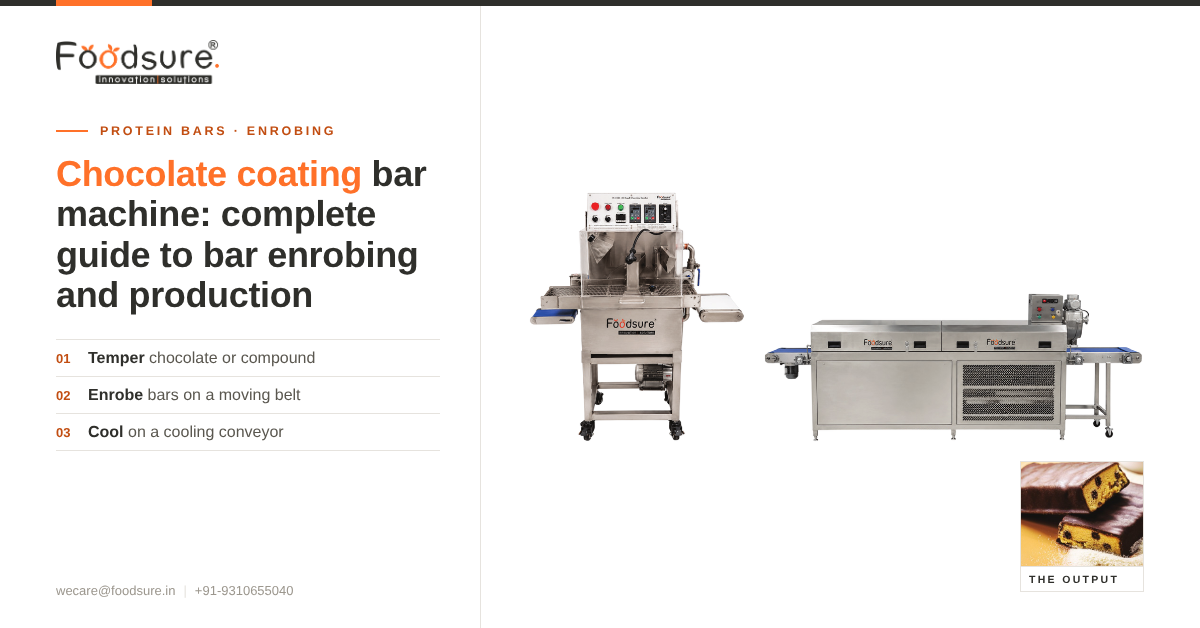
A chocolate coating bar machine is food processing machinery for coating the surfaces of individual bars with chocolate or other coating compound. The coating system applies the coating to the product and strips off excess material.
The machine is sometimes known as a chocolate enrober in commercial applications. It can function as a stand-alone machine or can be integrated with forming, cutting, cooling, and packaging equipment.
A typical coating setup may include:
- Equipment for the melting of chocolate
- A tempering machine, depending on the type of chocolate and process
- A coater to apply the coating
- A wire mesh conveyor to move the products
- An air blower or another appropriate system to control any extra coating
- A cooling tunnel to set the coating
- Conveyors for transferring between processes
- Optional decorating or bottom coating systems
The exact configuration depends on bar dimensions, coating thickness, product temperature, chocolate characteristics, and required production capacity.
Why Is Chocolate Coating Important in Protein Bar Manufacturing?
Chocolate coating can improve the appearance, flavour and eating experience of a protein bar. However, commercial coating requires control over chocolate flow, product handling, coating thickness, and cooling conditions.
A suitable chocolate coating bar machine helps manufacturers achieve more consistent results across production batches.
Uniform Coating Distribution
Controlled application of the coating can lead to a more uniform chocolate coating. The coating requirements can differ according to whether full enrobing, bottom coating, or coating of some part of the product is needed.
Enhanced Product Quality
A uniform coating will result in better aesthetics of the bars. Temperature control and cooling also improve the surface quality of the bars.
Increased Production Efficiency
The use of conveyor belts and a continuous coating system allows the production of many bars in an efficient way by doing away with repeated manual coating.
Decreased Product Handling
Combining the coating process with forming and cooling operations can help decrease handling, which could cause damage to delicate products.
Facilitates Product Diversity
An appropriate coating system will be able to cater to varying coating requirements, provided that machine setup and product specifications allow that.
How Does a Chocolate Coating Bar Machine Work?
The coating process depends on the chocolate type, product structure and equipment configuration. A typical commercial process follows this sequence:
1. Preparing the Bars
The bars are first formed and cut into the required dimensions. A protein bar forming machine can create a continuous slab or shaped product, depending on the forming technology.
A protein bar extruder may be suitable for dense and cohesive mixtures, while slab-forming systems can be useful for products containing whole nuts, seeds, cereals, or other larger inclusions.
2. Processing the Chocolate
Chocolate or compound coating is first processed at the right processing conditions prior to its introduction into the enrobing station.
Where the use of real chocolate is considered, then tempering would be required to provide the right glossiness, texture, and setting characteristics of the product. The compound coating can have other requirements for processing, and thus the right machinery should accommodate that type of coating.
3. Application of the Coating
The product moves on to the enrobing station wherein the chocolate coating or compound coating is applied to the product. There are cases where complete or partial coating or even bottom coating is considered.
4. Removing Excess Coating
Excess coating is next removed or relocated using the coating control mechanism of the machine itself.
This ensures that there is only the required coating thickness and not excess.
The coating control setting varies depending on the coating’s viscosity and the product configuration.
5. Cooling and Setting
Next, the coated bars enter the cooling chamber for setting.
The cooling is determined by factors such as the type of coating, product temperature, coating thickness, and the speed of the conveyor belt system.
6. Inspection and Packaging
After cooling, the coated bars can be inspected for appearance and coating consistency before moving to packaging. The packaging equipment should be compatible with the finished product and its handling requirements.
Key Equipment Used in a Chocolate Coating Line
A commercial coating setup may contain several connected components. Each component should be selected according to the product and expected output.
| Equipment | Main Function |
| Chocolate melting unit | Melts the coating material under suitable conditions |
| Tempering machine | Controls chocolate crystallisation where required |
| Chocolate enrober | Applies coating to the bars |
| Wire-mesh conveyor | Transfers products through the coating section |
| Coating-control system | Helps manage excess coating and coverage |
| Cooling tunnel | Sets the coating under controlled conditions |
| Transfer conveyor | Connects coating with upstream and downstream equipment |
| Inspection arrangement | Supports checks for visible coating or handling defects |
Not every production line requires all these components. The final configuration depends on the coating material, product requirements, level of automation, and existing machinery.
Chocolate Enrobing Machine vs Chocolate Coating Bar Machine
The terms chocolate coating bar machine and chocolate enrobing machine are often used to describe related equipment, although the exact scope can differ between suppliers.
A chocolate enrober usually describes the machine used for applying a curtain or flow of chocolate on the products that are conveyed by a conveyor belt. A larger system could also consist of equipment for preparing, tempering, cooling, and transferring chocolate.
The most important issue for a manufacturer will be whether the proposed system provides adequate coating and integrates with the entire manufacturing process.
It is essential to ensure that the quoted system consists of melting/tempering equipment, enrober, cooling tunnel, conveyors, and other accessory components before placing an order.
How to Choose the Right Chocolate Coating Bar Machine
Selecting the right chocolate coating bar machine requires an assessment of the product, coating material, production volume, and factory infrastructure.
Product Type & Structure
The protein bars, cereal bars, energy bars, or nut bars may differ in structure, consistency, and resistance. The coating process shall be performed with minimal deformations and product fractures.
Type of Coating
Specify what kind of coating material you want to use: true chocolate, compound, or other suitable material. The required coating equipment and temperature regime may vary.
Coating Coverage
Specify if you need full coating, bottom coating, partial coating or decorative coating of the bar. This shall affect the required setup of the machine.
Coating Thickness
The required coating thickness affects the coating material consumption, appearance of the product, and process parameters. The coating process shall allow for achieving the required thickness control.
Production Capacity
Evaluate the required hourly capacity and make sure that both the enrobing machine and the cooling tunnel will be able to perform the same production flow.
Cleaning & Maintenance
The machine shall have easy access to all parts that are in contact with the coating material for proper cleaning and maintenance.
Integration with Existing Equipment
If you already operate a protein bar production line, confirm that the coating system can integrate with the forming, cutting, cooling, and packaging stages.
Protein Bar Machine Capacity per Hour: What to Evaluate
The protein bar machine capacity per hour depends on the equipment configuration, bar dimensions, number of lanes, conveyor speed, and coating requirements.
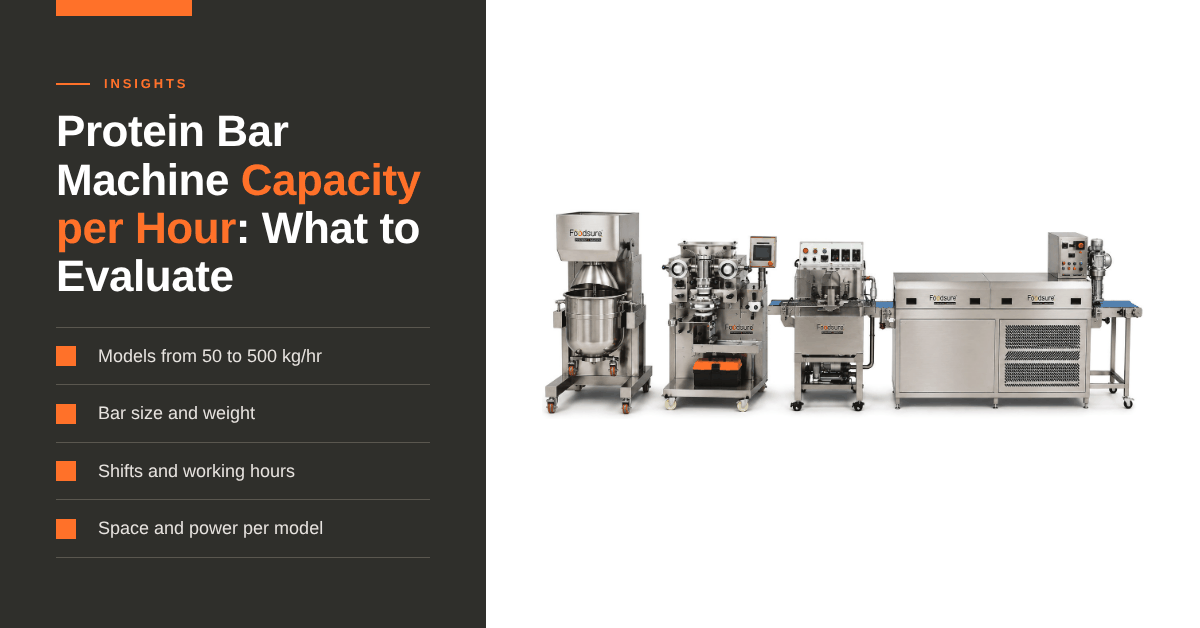
For the coating process line, factors other than the speed of the enrober affect the finished output. The time taken for cooling, thickness of the coating, spacing between products, and the capacity of the forming and cutting equipment are also factors.
Before finalising a machine, evaluate:
- Required production rate in bars or finished product per hour
- Weight and dimension of bar
- Number of rows/lanes
- Required coating area and thickness
- Capacity for chocolate preparation and supply
- Length of cooling tunnel and conditions
- Package line capacity
- Changeover and cleaning time required
Ask the supplier to distinguish between theoretical machine speed and expected finished output under the intended operating conditions.
Automatic Protein Bar Machine Price in India: What Affects the Investment?
The automatic protein bar machine price in India depends on the equipment configuration, production capacity, automation, and the number of integrated processing stages.
When comparing the protein bar machine price, businesses should evaluate the complete technical specification rather than focusing only on the initial purchase cost.
Important considerations include:
- Coating capacity and conveyor configuration
- Chocolate melting and tempering needs
- Design of cooling tunnel
- Automation and control systems
- Coating coverage needed and product sizes
- Integrating with forming, cutting, and packaging equipment
- Installation and commissioning needs
- Maintenance, spare parts, and after-sales service
An enrober alone may have different specifications compared to a full coating system that comes with chocolate making, cooling, and product transfer. Manufacturers should ask for the specification first before comparing any available systems.
Best Protein Bar Making Machine for Startups
Choosing the best protein bar making machine for startups requires planning the complete manufacturing workflow rather than selecting coating equipment in isolation.
For instance, the startup manufacturing a small number of coated bars could start off with an appropriate forming system, cutters, and a coating system that corresponds to its planned production volume. Those intending to produce more may need more comprehensive equipment.
Before investing, consider:
- Type and texture of the bar
- Whether the coating process needs to be complete or partial
- Production demands
- Space availability
- Requirements for chocolate processing and cooling
- Packaging needs
- Training and maintenance considerations
- Prospects for growth in the future
A modular setup can allow businesses to expand production gradually while ensuring that each stage remains compatible with the rest of the line.
How to Buy a Protein Bar Machine for Commercial Production
Before you buy protein bar machine equipment, prepare a clear specification describing your product and production requirements.
Include information on bar size, product consistency, type of coating, coverage needed, desired output, and packaging form. Such information is helpful to the supplier in determining the equipment that is needed to produce the bar coating.
When evaluating a protein bar machine supplier, ask for:
- Technical specifications in detail.
- Compatibility check between product and coating
- Estimated production capacity under the mentioned conditions
- List of equipment along with optional accessories
- Installation and commissioning services
- Cleaning and maintenance guidelines
- Availability of spares and warranty terms
- Support for integration of the entire production line
A reliable supplier should explain how the equipment fits into the intended process rather than recommending machinery solely on advertised capacity.
Why Choose Foodsure for Chocolate Coating Bar Solutions?
Foodsure supplies food processing machines to food producers who wish to start or grow their existing commercial protein bars production.
When selecting a chocolate coating bar machine, the firm needs to consider how well the coating machine will integrate with the forming, cutting, cooling, and packaging process. This is dependent on the product structure, coating specification, production rate, and automation.
Foodsure can assist companies in evaluating their production needs and appropriate equipment setups that will help in streamlining the manufacturing process.
Companies seeking a protein bar machine manufacturer in India should consider discussing technical specifications, coating requirements, installation, maintenance, and future production plans.
Conclusion
A chocolate coating bar machine allows manufacturers to put a chocolate or compound coating on their protein bars and snacks. The choice of the right system will make sure that there is a better uniformity of the coating and appearance and efficiency of the overall manufacturing process.
Before you begin manufacturing, assess the product structure, coating type, coverage requirements, manufacturing capabilities, cooling conditions, and maintenance requirements. With the right machinery and process planned out, manufacturers will be able to create an efficient protein bar production line for commercial coated bar manufacturing.
Frequently Asked Questions
1. What is a chocolate coating bar machine used for?
The chocolate coating bar machine is used to coat bars such as protein bars, energy bars, cereal bars, and nut bars using chocolate or similar compound coatings. Depending on its design, it may give full coating, bottom coating, or partial coating.
2. Does a chocolate coating bar machine require a tempering unit?
Not all coating materials will have the same process of preparation. Real chocolate may need to be tempered in order to achieve the right gloss and setting properties. Compound coatings may have other needs. The machinery used will need to suit the coating material chosen.
3. How do I choose the right protein bar machine capacity per hour?
Consider the needed output in relation to bar sizes, coating thicknesses, conveyor speeds, cooling needs, and packaging capacity. The whole line must be balanced to avoid any bottlenecks.
4. What affects the automatic protein bar machine price in India?
The investment depends on the manufacturing capacity, coating technologies, melting and tempering equipment, cooling needs, automation, installation, and integration with other machines.
5. How can I get a protein bar machine quote?
Give the supplier the product specifications, bar size, the coating material to be used, and also the expected production volume. This will enable the supplier to suggest an ideal configuration and even give you a quotation.