
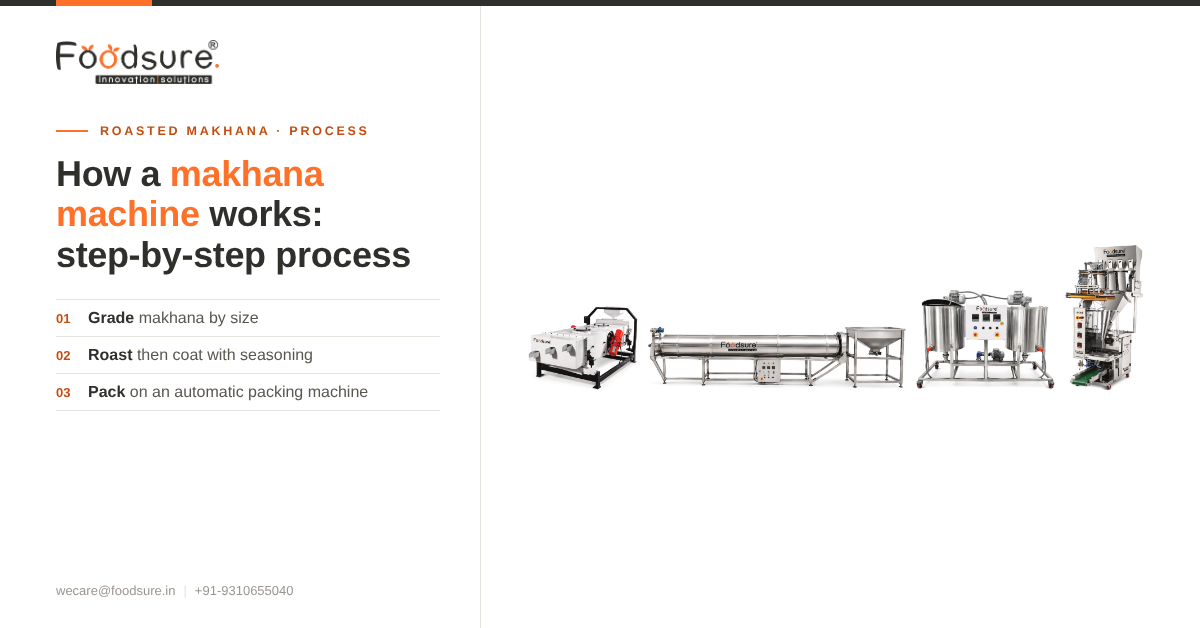
Makhana processing goes through several steps to convert seeds to popped kernels or edible treats. For manufacturers, machines can aid the entire process in getting organised to ease tedious manual labour and standardise processes.
It becomes necessary to understand how makhana machine works when choosing a machine for use in a new processing plant or in case of upgrading the existing production plant. But then, each machine does something differently. The popping machine helps to pop the right kind of seeds to get the popped makhana, while the roasting machine roasts the popped makhana.
This guide explains the makhana machine working principle, the step-by-step processing sequence, and the equipment considerations relevant to commercial production in India.
What Is a Makhana Machine?
A makhana machine is a piece of machinery used in the processing of makhana to perform a specific task. The machine can either be used to roast, pop, grade, season, or package the product depending on its kind.
The processing system may involve many machines in a sequence, but it all depends on whether the producer uses raw makhana seeds or popped makhana for roasting and packaging.
Common equipment includes:
- Machines for cleaning and grading raw makhana
- Drying and roasting machines for the seeds
- Popping machine
- Machines for grading popped makhana
- Roasting and seasoning machines
- Conveyors
The process flow published by ICAR and food-processing agencies identifies operations such as cleaning, grading, drying, roasting, tempering, popping, and final grading as important parts of makhana processing.
Step-by-Step Process: How a Makhana Popping Machine Works
Raw makhana seeds should be suitably prepared prior to popping for proper processing and quality. The cleaning, grading, and preparation of seeds for moisture ensures that they are properly prepared for the process of heating and popping.
1. Preparation of Raw Seed
The first stage begins with using appropriate raw makhana seeds. The quality of the raw material will have an impact on further treatment steps; hence, manufacturers must consider such aspects as the quality of seeds, the moisture condition, and the presence of undesirable matter.
Depending on the raw material and process type, preparation may involve cleaning, washing, drying, and grading.
Appropriate preparation provides a better initial position for the popping procedure.
2. Cleaning and Grading
Cleaning is carried out to eliminate the presence of undesirable matter. Meanwhile, grading serves to separate raw material based on seed size or other parameters.
Manufacturers can take advantage of grading in organizing the raw material into lots that have similar features. It is essential since seed size will have an impact on heating behavior.
Special machinery for this purpose may be used in industrial processing lines.
3. Drying and Moisture Preparation
The moisture state of the seeds is one of the critical processing parameters. Drying and moisture preparation are used to prepare the raw material for the next heating and popping phases.
Conditions vary depending on the particular seed type, its storage conditions, and the processing machine. Processors need to follow validated operating conditions rather than using one set of drying conditions for all processes.
4. Pre-Roasting
Pre-roasting or pre-heating of the seeds takes place in traditional and some mechanized processing operations.
This step is done to prepare seeds for the tempering and popping phases. Temperature and heating time will vary based on processing and machine design.
Controlled heating can help commercial processors to achieve consistency in processing as long as the machine is used properly.
5. Tempering
The tempering process entails leaving the preheated seeds for a specified period of time prior to proceeding to the next phase of processing. This is the case for both conventional processing of makhana and any related mechanized processing procedure.
It is aimed at conditioning the seeds prior to roasting and popping. The necessary time and storage conditions will depend on the type of processing and raw materials.
It is important to check if the chosen machinery requires a separate tempering process or another way of processing.
6. Final Roasting and Popping
This is where the right seeds are heated and popped to get the expanded white kernel called makhana.
A makhana popping machine is meant to help mechanize this process through the use of an effective heating and popping setup. This will vary depending on the design of the machine, which could involve the use of a heated barrel, screw-conveyor mechanism, and so forth.
The process needs to fit the design of the machine and the seed condition.
7. Grading of Popped Makhana
Once popped, the product can be graded based on its size, appearance, and quality standards.
Grading assists manufacturers in organizing the different categories of their products in order to sort the right batches for further processing or selling.
Grading of the product can be done using a grading machine depending on the quantity produced.
8. Collection and Further Processing
Once graded, popped makhana can be collected for storage, roasting, seasoning, or packaging, depending on the business model.
Manufacturers producing plain makhana may move directly towards suitable quality checks and packaging. Businesses producing ready-to-eat snacks may add a separate roasting or flavouring stage.
The complete workflow should be planned to avoid unnecessary handling and delays between operations.
Makhana Machine Working Principle: Main Components
The makhana machine working principle depends on the specific equipment, but several components are commonly used in mechanised roasting and popping systems.
Heating System
The heating system provides the energy required for the desired process. The heating system design is determined by the machine design, utilities available, and required operating conditions.
Feeding Arrangement
A hopper, feeder, or other feeding device feeds the material into the process chamber. Stable feeding allows the machine to work under more stable conditions.
Process Chamber
The chamber, barrel, pan or other working chamber exposes the material to the necessary heat or mechanical treatment. The design of the process chamber differs from the design of popping and roasting machines.
Drive System
Motors, gearboxes, shafts, or screws may drive the material movement, rotation or feeding, depending on the machine design.
Control System
Controls allow operators to regulate operating parameters according to the equipment design. Some machines have timers and other monitoring systems.
Discharge System
The discharge system enables the product to be discharged from the machine to proceed further. A proper discharge system may facilitate handling and make the process more organized.
Not all machines include all of the above systems. Machine manufacturers need to consider the technical specifications of the particular machine before purchase.
How a Makhana Roasting Machine Works
A makhana roasting machine is generally used to roast popped makhana rather than perform the initial seed-popping operation.
The exact working method varies by design, but a typical process involves loading the popped product, applying controlled heat, moving the product to promote more even exposure, and discharging it once the required roasting conditions are achieved.
Loading of Popped Makhana
The operator loads a proper amount of popped makhana for roasting in the roasting machine. The batch size must stay within the limit set by the capacity of the machine.
Heating Under Control
The heating is done through the machine with respect to the operating parameters chosen. The texture, colour, and crispness are greatly affected by temperature and processing time.
Movement of Product
As per the design of the machine, either a rotating drum, agitation system, or other methods are used for the movement of the product during the process of roasting.
Discharging and Cooling
Once roasting is done, discharging takes place, and then the product cools down under suitable hygiene conditions prior to the process of seasoning or packing.
Seasoning can take place using a separate machine or a combined method of roasting and seasoning.
Difference Between a Makhana Popping Machine and a Makhana Roasting Machine
Understanding the difference between these machines is essential when planning a commercial processing unit.
| Feature | Makhana Popping Machine | Makhana Roasting Machine |
| Main purpose | Processes suitable raw seeds into popped makhana | Roasts already-popped makhana |
| Input material | Raw seeds prepared for popping | Popped makhana |
| Primary operation | Controlled heating and popping | Controlled roasting |
| Typical output | Popped makhana kernels | Roasted makhana |
| Downstream stages | Grading, further processing, or storage | Cooling, seasoning, quality checks, and packaging |
| Selection priority | Seed condition, popping process, and required output | Batch capacity, heating control, and desired texture |
A business that purchases already-popped makhana may only require roasting, seasoning, and packaging equipment. A business starting with raw seeds may need a more extensive processing arrangement.
How Makhana Machine Works for Commercial Manufacturers in India
Understanding how makhana machine works india is particularly useful for businesses planning commercial production. The appropriate equipment depends on the starting material, product range, required capacity, and level of automation.
Small Scale Manufacturers
Small companies might start with single machines for the processing steps they want to automate. A company that buys popped makhana might want to consider roasting and packaging but not a popped seed line for raw seeds.
Medium Scale Manufacturers
Companies that are growing might require specialized grading, roasting, seasoning, and material handling equipment to efficiently handle their production requirements.
It is critical at this point that the capacity of each machine matches that of the other machines. A large roaster won’t increase production capacity if the bottlenecks lie in packaging.
Large Scale Manufacturers
Large-scale processing might require specialized equipment, automation of material handling, and control of production steps.
The ultimate design should be based on projected output, number of operating hours, infrastructure, and product mix.
How to Choose the Right Makhana Machine
Before investing in equipment, manufacturers should evaluate their processing requirements rather than choosing a machine based on general descriptions alone.
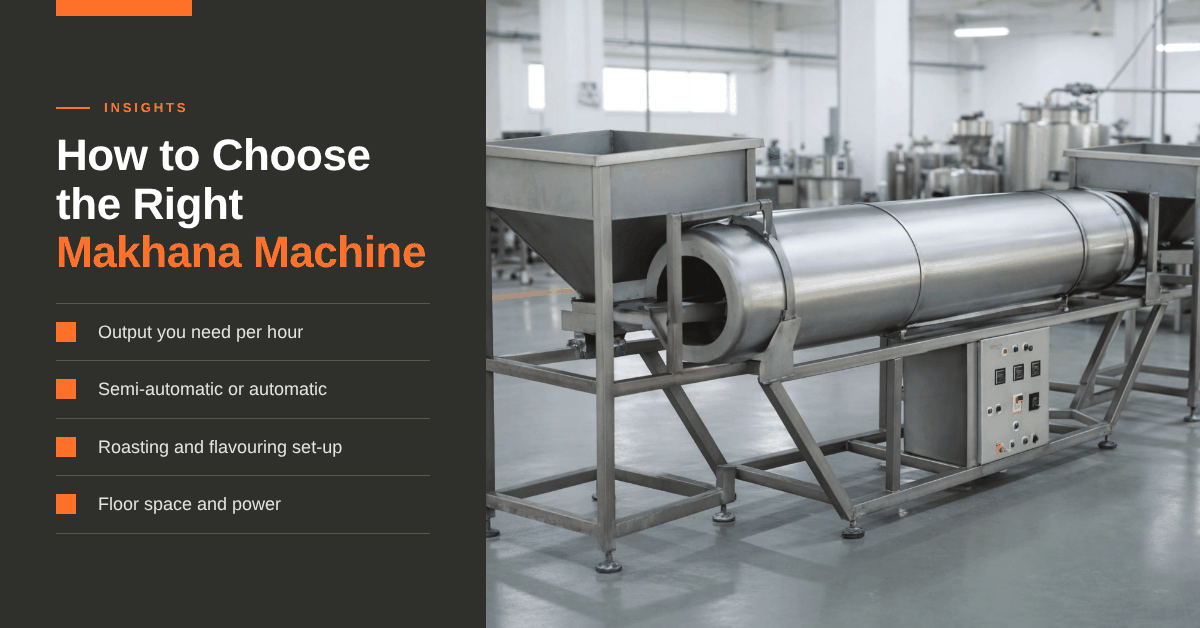
Processing Stage Required
Evaluate whether the business will require seed popping, roasting, grading, flavoring, packaging, or any other of the processing stages.
Production Capacity
Evaluate the capacity needed for processing in relation to what will be achieved in terms of outputs. These can vary depending on the nature of the process involved.
Heating/Operating Controls
Evaluate the manner in which heating, control of temperature, feeding and operation settings on the machine.
Product Quality
Evaluate what qualities are desired as regards product quality with the supplier.
Hygiene & Clean-up
Examine product contact materials, hygiene considerations including ease of clean-up and inspection and maintenance.
Utilization & Space
Evaluate electricity or heat requirements, space considerations, operator access, and compatibility with existing equipment.
Technical Support
Evaluate installation and operator training needs, service, and spare parts.
Makhana Machine Price and Quotation Considerations
The makhana machine price depends on the machine type, processing capacity, heating arrangement, automation, construction, and additional equipment included in the setup.
Comparison of popping machine and roasting machine is irrelevant since both do not accomplish the same task. Likewise, the quote for a single machine is quite different from that of an entire process line.
Before requesting a makhana machine quotation, manufacturers should specify:
- Raw material and final product desired
- Hourly or batch capacity required
- Processes to be automated
- Degree of automation required
- Utilities available and space for installation
- Supporting equipment required
- Installation requirements, training, warranty, and after-sales support
An exact quote must include a listing of the machine specification details, parts, and separate items provided. This will help businesses make comparisons based on their relevance and completeness apart from the quoted price.
Why Choose Foodsure for Makhana Processing Machinery?
Choice of the right machinery company will help companies to plan their production in a much better and organized manner. Foodsure offers machinery solutions for food processing which can be assessed based on the product to be produced, process, production volume, and facility needs.
For companies that want to purchase either a makhana popping machine or a makhana roasting machine, it is advisable to know which process they need to carry out before making the decision.
Foodsure will be able to assist the manufacturers in discussing their processing needs and deciding on an appropriate equipment setup. Prior to placing an order, companies need to ascertain the machine specification, capacity, installation, operational requirements, and post-sale support.
Conclusion
Knowledge of the working of a makhana machine will enable manufacturers to select machines that suit their production process. Each step of preparing the raw seeds, grading, heating, popping, roasting, and handling serves its own purposes.
The working principle of a makhana machine depends on the machine selected. While the makhana popping machine converts the raw seeds into popped makhana, the makhana roasting machine ensures that the popped makhana is ready for further processing or use.
Before making an inquiry about a makhana machine price quote, manufacturers must consider capacity, processing needs, controls, hygiene, installation, and future expansion. By selecting machines according to these considerations, one can develop a well-organized makhana processing business.
Frequently Asked Questions
1. How does a makhana machine work?
The functioning of a makhana machine varies depending on the purpose of the machine. The popping machine pops the processed raw makhana seeds through heating, whereas the roasting machine heats the popped makhana.
2. What is the makhana machine working principle?
The makhana machine working principle varies by equipment type. Popping machinery combines a suitable heating process with a configured popping mechanism, while roasting machinery applies controlled heat to popped makhana.
3. Is a makhana popping machine the same as a makhana roasting machine?
No. A makhana popping machine is designed for the seed-popping stage, whereas a makhana roasting machine is generally used to roast popped makhana. Businesses should select equipment according to the stage they need to automate.
4. Can one machine handle the complete makhana processing process?
While some mechanical systems integrate certain processes, a full system might need different machines for cleaning, sorting, drying, tempering, popping, roasting, seasoning, and packaging. The exact arrangement will depend on the machine type and requirements.
5. What should I check before requesting a makhana machine quotation?
Before requesting a makhana machine quotation, identify the required processing stage, production capacity, starting material, finished product, automation level, utility requirements, installation space, and after-sales support needs.




