
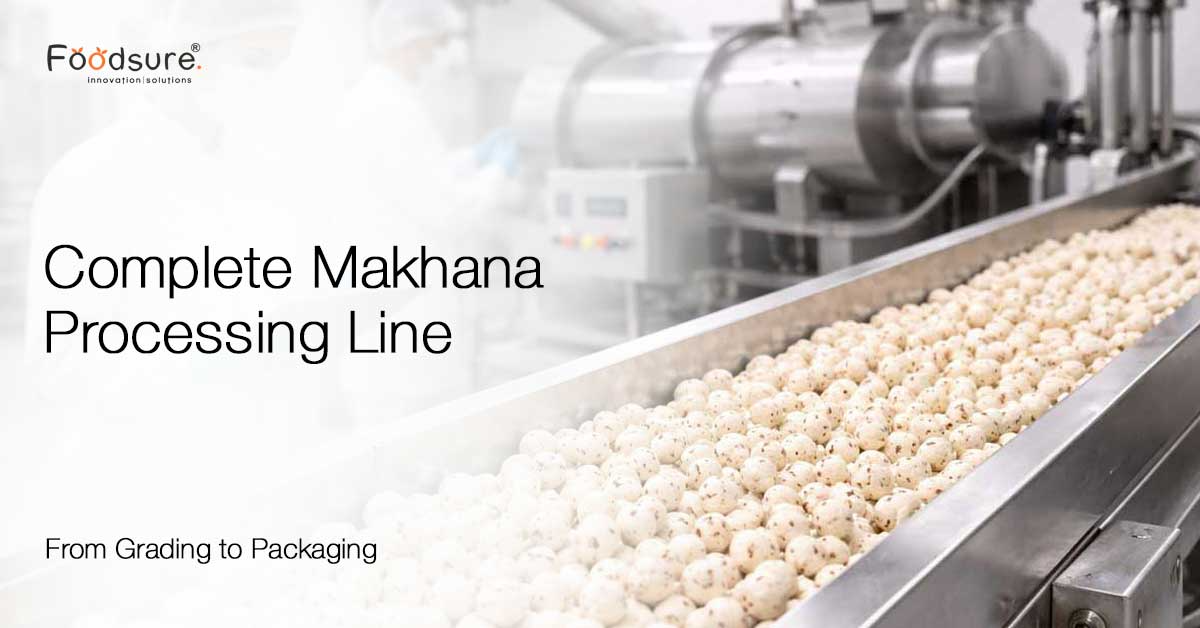
Makhana has evolved from being a traditional food item to become a rapidly growing category of packaged snacks. With the rising demand for roasted and flavored makhana in ready-to-eat form, manufacturers cannot depend on individual machines for ensuring continuous production of such products.
Having a Complete makhana processing line can be very helpful for manufacturers in ensuring consistency in production while lowering manual interventions and increasing production depending on market demands.
This guide explains how a Complete makhana processing line works, the machinery involved at each stage, and the key factors manufacturers should consider when planning a commercial makhana processing setup.
Why Invest in a Complete Makhana Processing Line?
There are various stages involved in the commercial processing of makhana, and performing each stage manually could complicate matters where maintaining quality and production rate is concerned.
The right design of a makhana production line makes sure that makhana goes through its entire process of processing, right from the raw material stage to packaging.
Key benefits include:
- Consistent processing: Each phase can be monitored in relation to the requirements of the product.
- Lower manual handling: Automation in machinery reduces labour-intensive activities.
- Greater efficiency in manufacturing: Connected machinery assists in maintaining a smooth flow of work.
- Enhanced quality of products: Controllable processes such as roasting and flavouring can lead to consistent results.
- Increased capacity of production: Machinery can be designed to accommodate larger-scale production.
- Future scalability: Machinery can be chosen as per present requirements but with future scope in mind.
Understanding the Makhana Processing Process
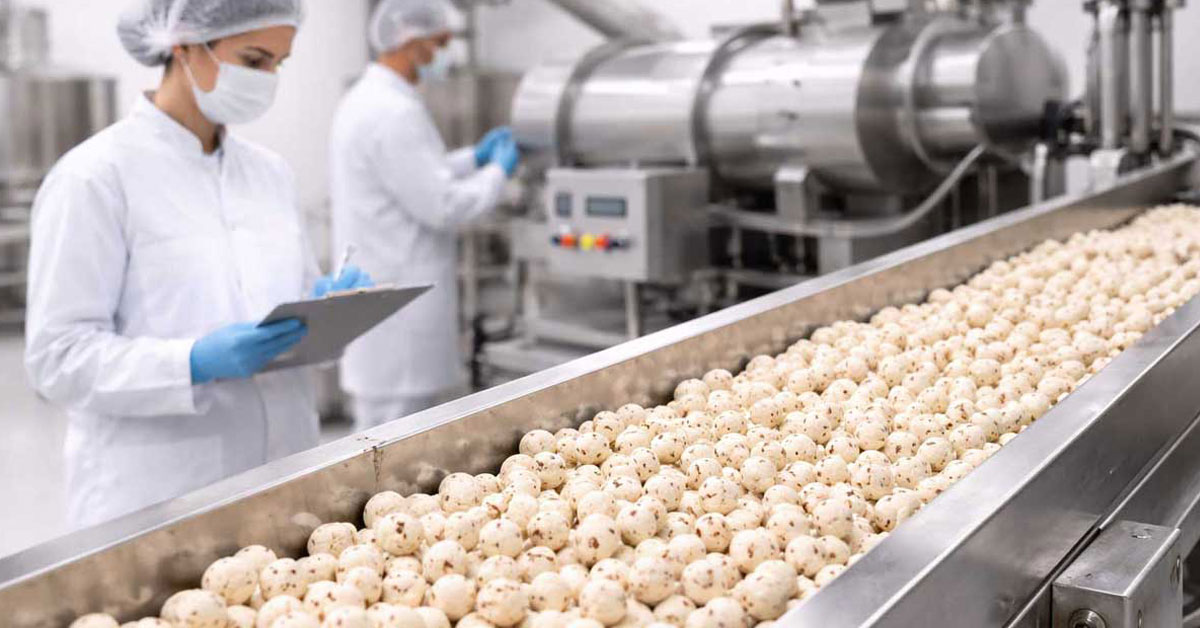
Makhana processing starts with raw makhana and involves multiple preparation and value-addition stages before the finished product reaches packaging. The exact process depends on whether the manufacturer is producing plain roasted makhana, flavoured makhana, or other value-added products.
Grading: The First Important Processing Stage
Grading helps separate makhana according to size and quality. Since raw makhana can contain pieces of different sizes, proper grading creates a more uniform product for subsequent processing.
Uniform sizing can help improve roasting consistency because pieces of similar size are more likely to respond similarly to the same processing conditions.
A grading system can help manufacturers:
- Separate different size grades
- Remove unsuitable pieces
- Improve batch uniformity
- Prepare makhana for consistent roasting
- Create different product grades for different markets
For a commercial Complete makhana processing line, grading should therefore be considered an important initial stage rather than an optional addition.
Cleaning and Raw Material Preparation
Makhana has to undergo adequate preparation before it can be processed through the roasting process. The cleaning process will help eliminate unwanted materials from the incoming raw material.It is important that the cleaning process is appropriate for the nature of makhana in order to prevent unnecessary breakage during the process.
Raw-material preparation gives clean and more uniform material to be used in the roasting process.
Roasting: Developing the Desired Product Quality
Roasting is considered one of the most significant operations in makhana production. This process affects the texture, crunchiness, and quality of consumption of the final product. It is important to ensure that roasting technology provides uniform heating.
Poorly controlled roasting can result in:
- Underroasted products
- Overroasted products
- Texture inconsistency
- Discoloration of products
- Higher breakability
Considering that manufacturers are purchasing makhana processing machinery, the roasting machine will have to be analyzed depending on production capability, heating needs, product attributes, and automation.
Cooling After Roasting
After roasting, there comes the need to bring down the temperature of the makhana to a desired level before proceeding with further processing steps like seasoning and packing.
The process of controlled cooling makes sure that overheating does not affect the seasoning or packing of the product.
Moreover, the right cooling system may prove to be helpful in maintaining the continuity in production.
Flavouring and Coating
Plain roasted makhana can also be prepared into seasoned forms using the appropriate seasonings and coatings.
The seasoning process should provide for uniform distribution of seasonings while treating the product with gentleness. This is due to the fact that too much movement of the product will lead to breakage.
As per the need for the product and type of coating required, an appropriate Coating Pan Machine may be used.
The exact equipment configuration depends on the type of seasoning, coating material, product characteristics, and desired production capacity.
Importance of Controlled Product Handling
Makhana is lightweight and fragile, so careful handling is important throughout the makhana production line. Suitable conveyors and controlled transfers can help reduce breakage and maintain product quality.
Careful handling could contribute to:
- Improved product appearance
- Decreased breakage
- Uniform product quality
- Minimized material wastage
- Streamlined production process
Makhana Processing Machinery for Commercial Production
The machinery required for a makhana processing plant depends on production capacity, product type, automation level, and packaging requirements.
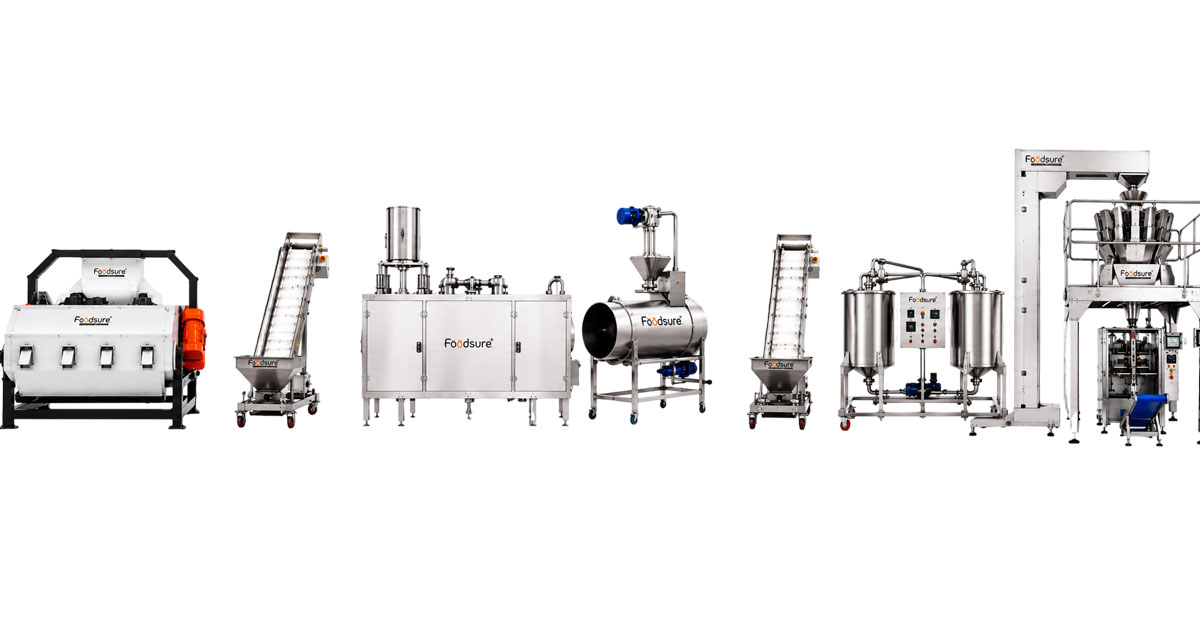
A commercial system can comprise:
Grading Equipment
To segregate makhana based on size and produce an even raw-material flow.
Cleaning Machine
To help eliminate impurities from the product before the processing starts.
Roasting Equipment
For providing controlled heat to develop the required qualities.
Cooling Equipment
To cool the product after roasting before the process of flavouring and packing begins.
Flavouring or Coating Equipment
For applying the flavouring or coating evenly depending on the end product.
Conveyors
To transport the makhana from one processing station to another.
Weighing and Packaging Equipment
Handles the final filling and packing stage according to the selected pack format.
The machinery should be selected as an integrated system rather than purchasing each machine independently.
Choosing the Right Production Capacity
Capacity planning is one of the most important parts of setting up a Complete makhana processing line.
The capacity of roasting, flavoring, conveying, and packaging operations should be well balanced, taking into consideration both current production needs as well as future production needs.
Key considerations include:
- Projected daily production
- Batch size
- Number of shifts worked
- Range of products
- Packaging rate
- Future expansion plans
In capacity planning, a mismatch between different machines’ capacity may cause bottlenecks. For example, if the roasting operation produces much more product than the packaging operation can handle, a pileup of finished products will occur between operations.
Automation Level in Makhana Processing
The degree of automation will need to be determined by the level of production.
A small manufacturer could have a semi-automated system whereby operators will carry out some activities manually. A larger industrial manufacturer could opt for an automatic makhana processing line that would integrate conveying, processing, flavoring, and packing.
Automation is expected to make production easy through reducing manual activities and increasing production consistency.
It is not the aim to have a fully automated process but rather to have the ideal degree of automation based on production requirements.
Packaging in a Complete Makhana Processing Line
Packaging prepares processed makhana for retail and distribution, with the system selected according to product type, pack size, packaging material, and output.
A good packaging system can assist producers to obtain:
- Correct filling
- Uniform pack sizes
- Effective sealing
- Reduced human involvement
- Improved efficiency of production
Packaging capacity should also match the output of the rest of the Complete makhana processing line to avoid bottlenecks.
Factors Affecting Makhana Processing Line Cost
The makhana processing line cost depends on several factors rather than a single fixed machine price.
The total investment can be affected by the following factors:
- Production capacity
- Processing steps
- Automation level
- Type and number of machines
- Roasting method
- Flavoring requirements
- Packaging type
- Conveyor/material handling needs
- Facilities layout/installation needs
It is imperative that manufacturers determine their production needs first and then make comparisons of different machine designs based on the entire process.
Common Mistakes When Setting Up a Makhana Processing Plant
Unnecessary production problems may arise for businesses in the selection of machines if the overall production process is not taken into account.
Examples of problems include:
- Equipment selection based solely on the capacity of individual machines
- Neglecting breakage while handling products
- Underestimation of packaging needs
- Automation without proper consideration of production needs
- Provision of insufficient space for future expansion
- Disregard of roasting, flavoring, and packaging capacities
A correctly planned makhana processing plant should be based on the entire production requirement and not the purchase of individual equipment.
Foodsure Machines for Makhana Processing
Foodsure Machines offers process and packaging machines for manufacturing units intending to set up and increase their production of makhana products.
This arrangement may be tailored based on the production capacity, nature of product, degree of automation needed, flavoring, and packaging.
Businesses interested in setting up a complete makhana processing line may seek assistance from Foodsure regarding equipment and line setup for grading, processing, roasting, flavoring, conveying, and packaging of products.
Conclusion
The Complete makhana processing line will enable manufacturers to link grading, cleaning, roasting, cooling, flavouring, handling, and packaging into one coordinated manufacturing process.Machinery that suits the manufacture of makhana should be chosen based on the attributes of the product, production capacity, degree of automation, and long-term development strategies. Correct integration will assist in minimizing manual operations, enhancing consistency, and ensuring smooth production flow.For companies intending to set up a commercial makhana processing factory, having a production line in place can lay a good platform for producing plain and flavored makhana commercially.
Have a Question? Let’s Connect
Need expert guidance on food processing machines, production setup, or process optimization? Our team is ready to help you choose the right solution for your business.
Frequently Asked Questions
Which machines are needed for a complete makhana processing line?
Typical machines used in such a line include cleaning, grading, roasting, cooling, flavouring or coating, conveying, weighing, and packaging equipment. The exact equipment will depend on production needs.
Why is grading important in makhana processing?
This step enables separation of makhana by its size and quality and ensures that a more homogeneous raw material stream is created for further processing.
Is it possible to have flavoured makhana produced in the makhana processing line?
Yes. With the right flavouring or Coating Pan Machine, makhana can be flavoured.
What factors determine the cost of a makhana processing line?
Capacity, degree of automation, machine layout, roasting and flavouring needs, packaging format, conveyors, and plant specifications can affect the total cost of a makhana processing line.
Can the makhana processing line be customized?
Yes. Makhana processing lines can be customized depending on production capacity, product range, level of automation, flavoring needs, and packaging requirements.




