
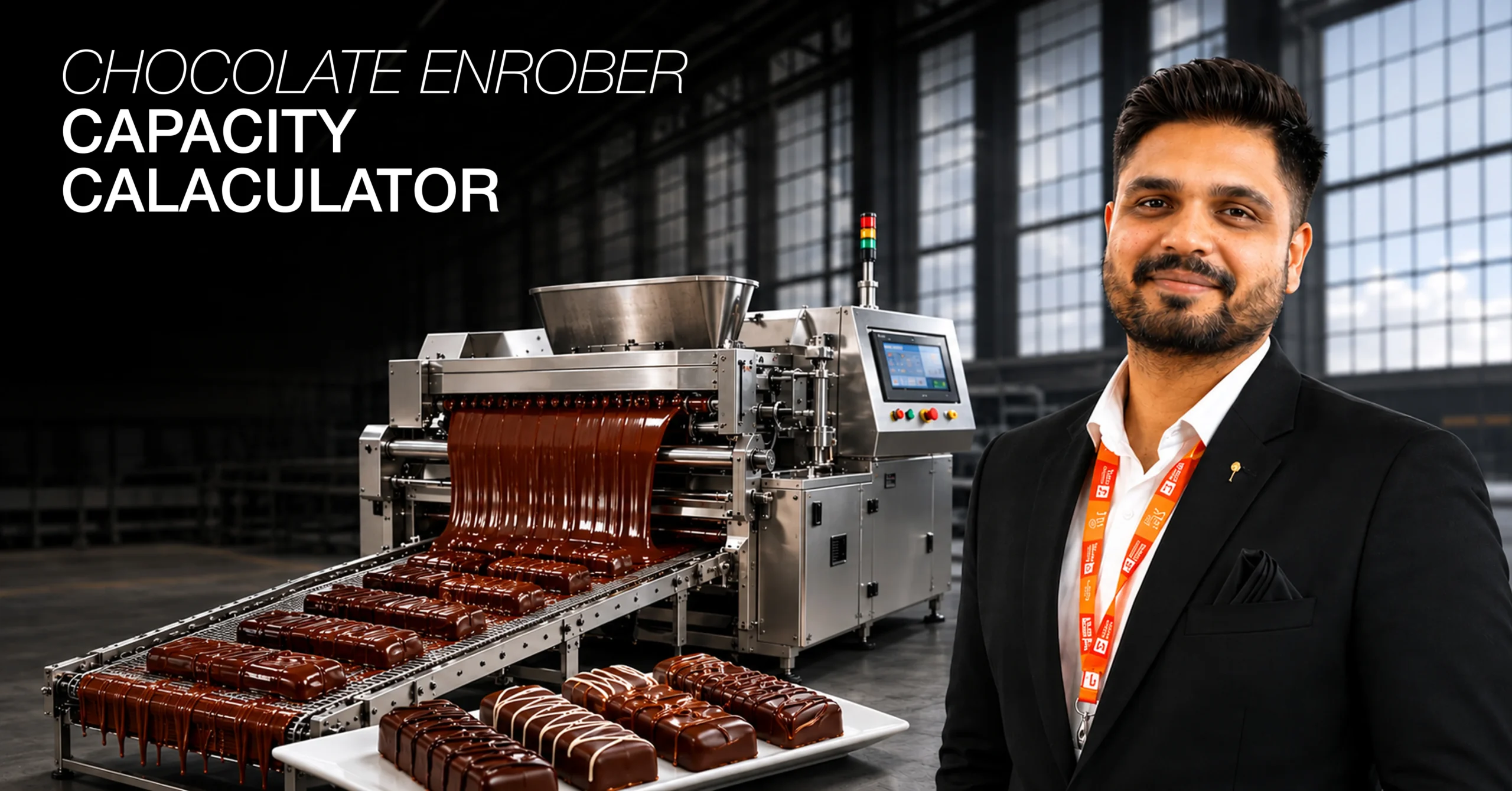
The selection of the right chocolate enrober will have the biggest impact on your overall chocolate coating production. If you are planning on producing chocolate bars, protein bars, biscuits, wafers, cookies, confections and any other products to be enrobed in chocolate, the enrober needs to have the right production capacity to suit your needs while also maintaining coating quality.
Most of the manufacturers today only consider the price of the machine or the width of the belt as important factors, but a machine’s actual production capabilities are defined by its capacity. Too little capacity will make the enrober a bottle neck, and too much will add extra costs and investment that are not necessary. The Chocolate Enrober Capacity Calculator can be very useful here.
The purpose of a Chocolate Enrober Capacity Calculator is to estimate the throughput of a chocolate enrober given; the products’ dimensions, the products’ weight, the conveyor speed and the belt width. By estimating the production output in kilograms per hour (kg/hr), it is possible to make sure that you select the correct size machine, effectively manage production scheduling and integrate your equipment together with other production stages, such as chocolate melter/storage, tempering machines, cooling tunnels and packing systems. A Chocolate Enrober Capacity Calculator helps manufacturers select the correct machine size for their production requirements.
This guide will discuss the way to calculate the chocolate enrober capacity and the factors which affect this production output.
What is a Chocolate Enrober Capacity Calculator?
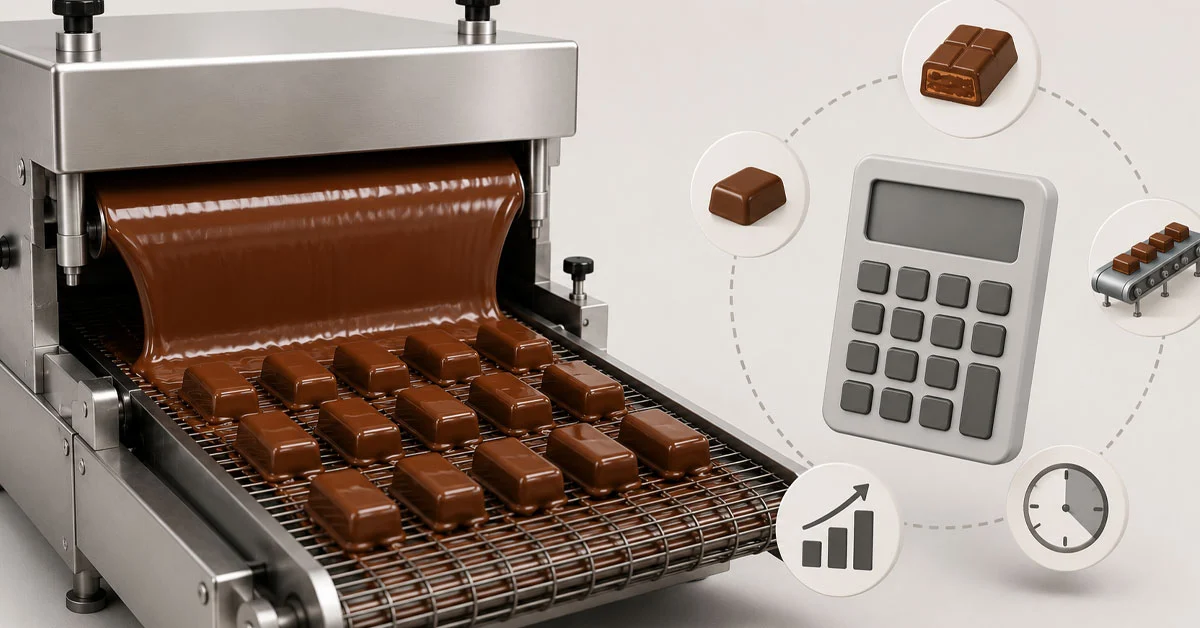
The purpose of this Chocolate Enrober Capacity Calculator is to help producers figure out how many products the chocolate enrober machine can handle per hour. This calculation would be most useful when producers choose chocolate enrober for chocolates, protein bars, biscuits, wafers, cookies, and confectionery products.
By accurately calculating capacity, it will help avoid the following issues:
- production blockage
- spending more on the over-specified machines
- wasted products
- inconsistent chocolates coating
- production line balancing
Why Is It Important To Calculate Capacity?
Understanding Chocolate Enrobing Machine Capacity is essential before purchasing a new production line.
Before buying a chocolate enrober, producers need to know about the following items:
- expected output rate (production volume)
- product dimensions
- conveyor width
- machine speed
- percentage of chocolate coating
By precisely estimating the capacity of a machine, a smooth production could be maintained. Besides, it will guarantee a good return on investment as well.
What Factors Influence The Capacity of A Chocolate Enrober?
Several operating parameters directly affect Chocolate Coating Production Capacity.
- Size of product
Larger size of product will occupy a larger belt area.
E.g:
- Protein bars
- Chocolate bars
- Cookies
- Wafers
- Biscuits
Usually, small size products can be processed more than large ones.
- Conveyor Belt Width
Wider belts can accommodate more products.
| Belt Width | Typical Application |
|---|---|
| 400 mm | Small-scale production |
| 600 mm | Medium-scale production |
| 800 mm | High-capacity production |
| 1000 mm+ | Industrial production |
- Conveyor Speed
Higher conveyor speeds increase capacity.
| Belt Speed | Production Output |
|---|---|
| 1–2 m/min | Low |
| 3–5 m/min | Medium |
| 6–10 m/min | High |
- Spacing of products
It is important to space products in a way to provide total coating.
The following will effect spacing:
- Shape of product
- Height of product
- Thickness of coating
- Cooling necessity.
With insufficient spacing, actual capacity will be lower.
- Chocolate Enrober Capacity Formula
Using a Chocolate Enrober Capacity Calculator can improve production planning and equipment utilization.
A simplified calculation method is:
Capacity (kg/hr) = Products per Minute × Product Weight × 60
Example
Assume:
- Product Weight = 50 grams
- Products per Minute = 200
Calculation:
200 × 50 × 60
= 600,000 grams/hour
= 600 kg/hour
Estimated Capacity = 600 kg/hr
Capacity Calculation Flow Chart
Typical Chocolate Enrober Capacities
The required Chocolate Enrobing Machine Capacity depends on product dimensions and production speed.
| Machine Type | Capacity Range |
|---|---|
| Small Enrober | 50–150 kg/hr |
| Medium Enrober | 150–500 kg/hr |
| Large Enrober | 500–1000 kg/hr |
| Industrial Enrober | 1000+ kg/hr |
The final capacity depends on product size and production speed.
Machines Associated With A Chocolate Enrober:
A fully automated chocolate enrober line is usually complete with:
| Machine | Function |
|---|---|
| Chocolate Melting Tank | Chocolate melting |
| Chocolate Storage Tank | Chocolate holding |
| Chocolate Tempering Machine | Chocolate conditioning |
| Chocolate Enrober | Chocolate coating |
| Cooling Tunnel | Chocolate setting |
| Metal Detector | Quality inspection |
| Flow Wrap Machine | Packaging |
| Cartoning Machine | Secondary packing |
Sample Calculation of The Capacity of Protein Bars
| Parameter | Value |
|---|---|
| Product Weight | 60 g |
| Products Per Minute | 250 |
| Operating Time | 60 min |
Calculation
250 × 60 × 60
= 900,000 grams/hour
= 900 kg/hr
Capacity needed in enrober: 900 kg/hr
A medium to large system would be required for this.
Common Mistakes to avoid when calculating capacity
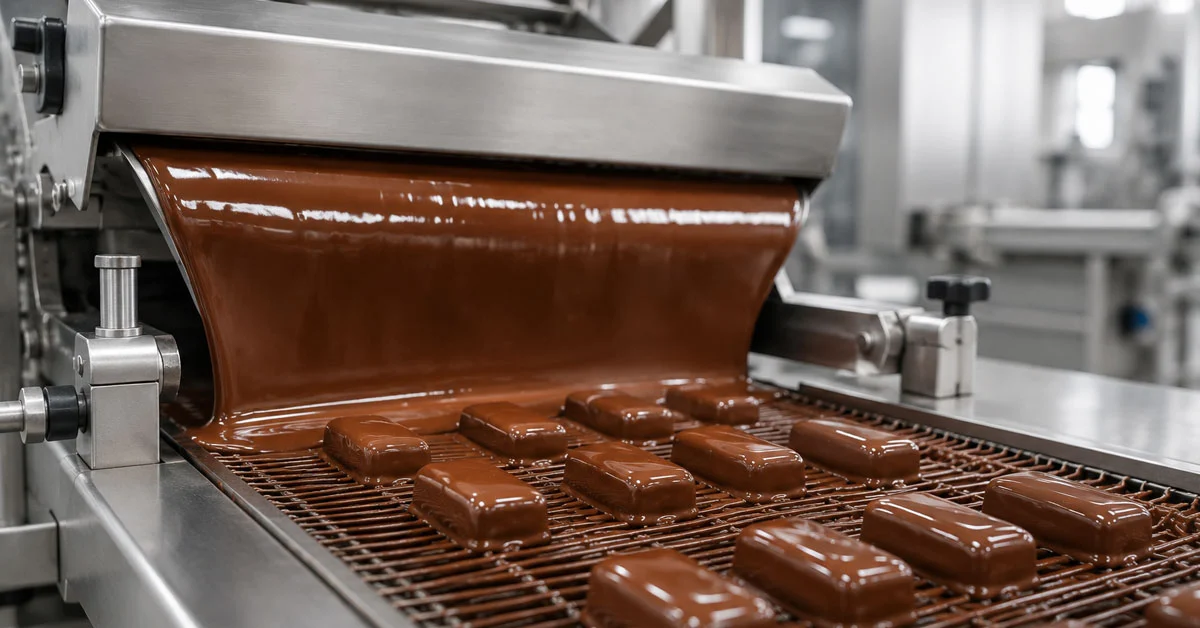
- Forgetting about product spacing
- Only accounting for maximum machine speed
- Not taking into account down-time
- Not taking into account the weight of chocolate coating
- Over-sizing the equipment
- Not taking into account for future expansion
Always maintain 15-20% additional capacity for future expansion.
Correct Enrober Capacity sizing
- Small manufacturers- 50-150 kg/hr (400-600mm)
- Medium manufacturers- 150-500 kg/hr (600-800mm)
- Large manufacturers- 500-1000 kg/hr (800-1200mm)
- Industrial manufacturers- 1000+ kg/hr (custom-made)
Benefits of using correct capacity
Optimizing Chocolate Coating Production Capacity can improve profitability and reduce operating costs.
- Reduced production cost
- Optimal machine utilization
- Reduced downtime
- Higher coating quality
- Simpler line expansion
- Increased profitability
Foodsure Machines provides complete chocolate coating & enrobing solutions to the food manufacturing sector in India.
Foodsure provide:
- Capacity calculation support
- Machine sizing & selection
- Chocolate enrober supply
- Production line designing
- Installation and commission
- Cooling tunnel integration
- Training of operator
- After sales support
The Foodsure Machines experts will guide customers on selecting the appropriate enrober capacity based on their products. Foodsure Machines assists manufacturers in determining the ideal Chocolate Enrobing Machine Capacity for their application
Conclusion
Chocolate Enrober Capacity Calculation is an effective way of knowing what machine size should be taken and avoid production wastage. By considering the size of product, the belt width and conveyor speed as well as the product weight, businesses can better understand their output to correctly size their equipment to ensure adequate production volumes are met to meet demand without being inefficient in machine size. A properly used Chocolate Enrober Capacity Calculator helps avoid bottlenecks and unnecessary investment costs.
Frequently Asked Questions(FAQ)
1. How is capacity calculated in a chocolate enrober?
Multiply product per min x product weight x operating hours to get the approximate hourly output.
2. What influences chocolate enrober capacity?
Product size, conveyor belt width, conveyor speed, product spacing, and chocolate coating weight/thickness are the main influencers.
3. What is the optimum width for a chocolate enrober belt?
The appropriate belt width depends on production volume and can vary from 400mm to 1200mm.
4. Can the same enrober be used to enrobe protein bars and biscuits?
Yes, most modern enrober machines are capable of handling more than one type of product depending on the configuration settings.
5. How much capacity buffer should be held in reserve for the future?
The optimum is generally accepted to be around 15-20% for most manufacturers.




