
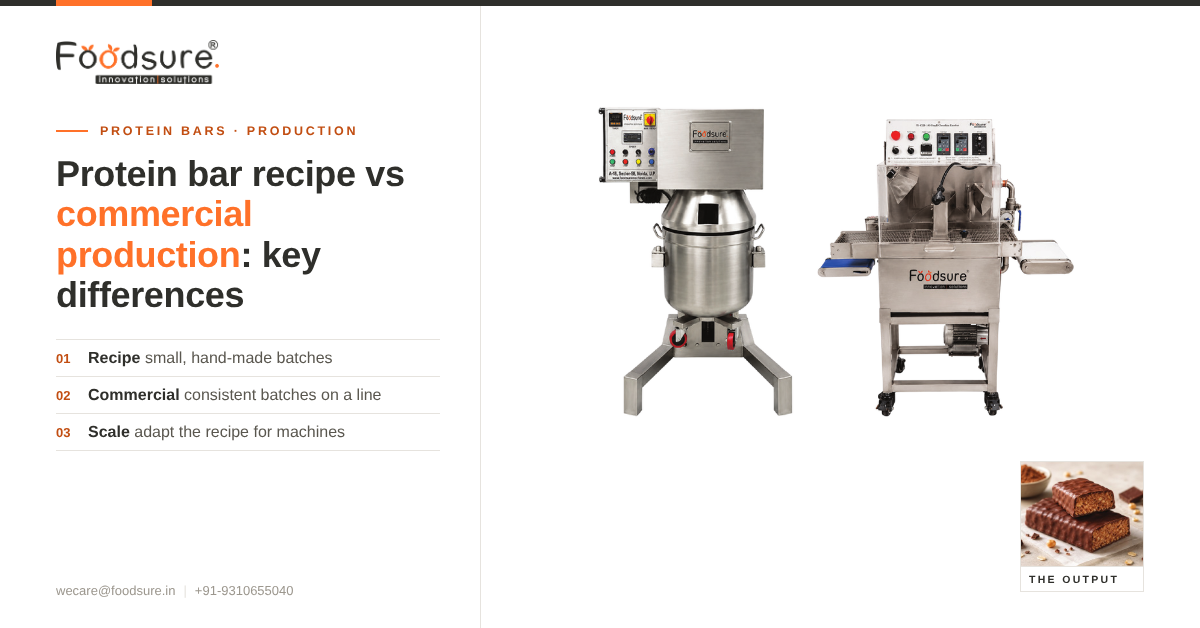
The use of protein bars is no longer restricted to the baggy of the athlete. Increased awareness of health issues, the fitness craze, rapid life styles and the instant requirement of nutrition keeps the demand for protein bars increasing. However, the problem is that the bar which has great taste in the kitchen is not always the same in the factory.
Knowledge of the protein bar recipe versus the commercial manufacturing of protein bars allows the founder of any company to make a good plan of equipment and quality control prior to scaling up the production process. Normally, people choose their production equipment according to their production requirements.
Why Are Businesses Investing in Commercial Protein Bar Production?
A home recipe can test demand, but only structured production can serve retail and online customers reliably.
Consistency in quality, bar after bar
Consistency in weight, form, and the texture of your protein bars is what your customers want. This kind of consistency is guaranteed in commercial production facilities by industrial weighing, mixing, and molding which cannot be achieved manually.
Higher capacity
The capacity of home-made batches is limited. With an automatic line, you are capable of producing thousands of bars per hour, thereby enabling mass production and marketing across various channels including chains, e-commerce and direct to consumers.
Better process control
Factors such as moisture content, mixing time, and cooling affect the final product. This process can be controlled and recorded in commercial setups so that it is not reliant on the person mixing the batch.
Less dependence on manual labor
Manual cutting, shaping and wrapping become slower and more expensive with increased volumes. The machines take care of the repetitive tasks leaving employees to do quality control.
Scaling in the long run
An automatically scalable line allows adding capacity, coating or packaging without needing to build from scratch again. This is important as most start-ups scale faster than planned.
Key Features to Look for in a Protein Bar Making Machine
Machine choice shapes your cost, quality and growth, so judge it on capability, not only price.
Precision dough handling
The dough in a protein bar is dense and sticky, and requires precise moisture content control. Ensure you choose a machine that processes the binder and ingredients mix without adhering, tearing, or over-working the dough.
Consistent forming and cutting
It forms the dough in predetermined dimensions and cuts it automatically to ensure weight, shape, and appearance uniformity to protect your brand identity.
Capacity sufficient for your demands
Purchase a machine that will handle your needs in the upcoming years rather than the current volume. It will lead to underproduction or overproduction of bars, which is costly to your business.
Hygienic construction and material quality
The components making contact with the food materials should be food grade stainless steel with smooth surfaces in adherence to food safety standards.
Ease of operation
Easy to operate means fewer training sessions and reduced human error. Make sure your staff can use the machine after a short training period.
Machine scalability and after-sale services
Make sure your equipment is scalable and check on the availability of the spares and after-sale services from the supplier.
How Does Protein Bar Production Work?
The exact process varies by formulation and machine model, but the core stages stay similar. At home, the steps are simple: mix dry ingredients, add peanut butter and honey, press the mixture into a lined tray, refrigerate for two to three hours and cut into bars. Commercial production turns each of those steps into a controlled stage.
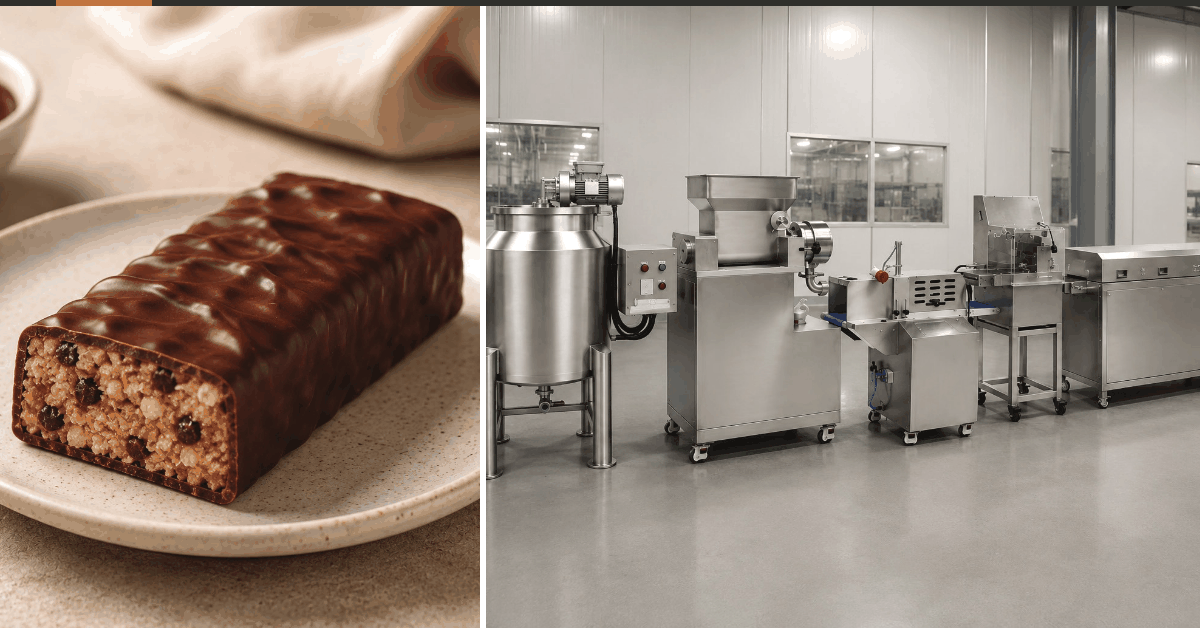
Ingredient Weighing
Protein bars’ protein, oats, syrups, and nut butters’ industrial weighing systems will be accurate. Measuring cups and spoons cannot provide repeatability required for a batch manufacturing process.
Mixing and Dough Preparation
Industrial mixing machinery will combine protein bar ingredients into homogeneous dough. The amount of moisture in the dough should be carefully controlled since it determines the properties of the dough formation and shelf life of the bar.
Forming
The dough will be introduced into the machine that forms a protein bar according to the predetermined dimensions. This is an alternative to the manual forming method that defines the weight and form of each bar.
Cooling
It makes the structure of the bar stable enough for cutting and packing. Otherwise, the bar might be too soft, poorly formed, or sticky.
Cutting and Coating
If your product requires coating with yogurt, chocolate, or fruit mixture, an automatic cutter will cut the bars according to the required size.
Packaging and Inspection
Automatic packaging machinery will wrap bars; the final products will be inspected for weight and appearance. The combination of all these procedures guarantees the shelf life that commercial bars have.
Which Production Scale Suits Your Protein Bar Business?
Choosing the right scale matters because each stage has different equipment, compliance and cost needs. Demand, available space, budget and growth plans should guide the decision.
| Production Scale | Suitable For | Key Consideration |
|---|---|---|
| Homemade batch | Testing taste and gauging market demand | Shelf life of a few days, minimal quality control, no regulatory compliance required |
| Pilot production | Startups validating formulation and texture at larger volumes | Binder and moisture behave differently at scale, so run shelf-life tests and refine with food technologists |
| Commercial production line | Brands supplying retail, online and distribution channels | Strict quality standards, automated packaging, mandatory compliance and machines matched to demand |
Biggest Challenges and Solutions When Moving From Recipe to Commercial Production
Most startups hit the same few problems when they scale, and each one has a practical fix.
Increasing the quantity of the recipe without compromising the texture
When scaling up a protein bar recipe, the end product does not become the same. Ingredients work differently when in large quantities resulting in texture issues and inconsistent products.
Solutions
Pilot test to understand how the formulation will perform on a larger scale with the help of a food technologist to optimize the protein bar formulation for the machinery.
Poor shelf life and selection of binder
The homemade protein bars normally last a few days but commercial bars are supposed to last many months. It is difficult for a simple peanut butter and honey protein bar binder to achieve such shelf life.
Solutions
Utilize a commercial ingredient system that uses glycerin to retain moisture and fiber syrups that increase consistency of the product. Confirm through shelf-life testing since the best binder will depend on your proteins.
Wrong choice of machine
Commercial companies often opt to purchase machines based on the cost of acquisition alone. This choice may be very expensive as well as result in inefficient machines.
Solutions
Always buy based on the projected capacity and service. Always test your dough on the machine before purchasing.
Inconsistent bar formation
Bar formation inconsistencies, including different weights, shapes, and appearances, negatively affect your business and make customers lodge more complaints. It’s one of the most ignored quality concerns in commercial manufacturing.
Solution-
Equip yourself with a quality protein bar forming machine and clearly define your weight and size specifications.
Benefits of Using an Automated Protein Bar Production Line
A connected line brings mixing, forming, cooling, cutting and packaging into one system.
- Consistent Output: All bars produced match your desired weight, dimensions and shape.
- Increased Production: The automation of the process allows you to manufacture thousands of bars an hour.
- Reduced Labor: Less labor is required to produce the product because there are fewer people handling the product.
- Quality Assurance: Uniform settings and batches allow for better quality assurance.
- Easier Scalability: Increased production capacity can be achieved simply through adding units.
How to Choose the Right Protein Bar Machine?
The best machine isn’t the biggest or the most expensive. It’s the one that fits your product, volume and growth plan.
- Expected daily and monthly volume
- Bar size and weight range
- Formulation and dough type
- Level of automation needed
- Forming and cutting accuracy
- Food-grade construction and easy cleaning
- Cooling and coating options
- Floor space and utility needs
- Spare parts and after-sales service
- Budget and future expansion
Why Choose Foodsure for Protein Bar Machines?
Foodsure Machines provides assistance in developing new food products as well as existing brands right from conception to the market-ready product stage. Having worked for over 13+ years in growing companies with advanced food processing machines, we provide assistance in recipe development, food consultancy, contract manufacturing and compliance to FSSAI guidelines and commercialization.
In other words, we give you advice about the formula for the protein bar, the machines and the production process all at once, not separately for each one.
Start Your Protein Bar Production Journey with Foodsure — Enquire now!
FAQs
How to prepare a protein bar at home in steps?
Combine oats, protein powder, peanut butter, honey, almonds, chia, and cocoa, press the mixture onto a lined tray, put in the refrigerator for 2-3 hours and then cut bars.
What protein bar formula should be used for mass production?
It includes proper balancing of protein, binders, fibers and stabilizers to ensure proper texture, shelf life and processability.
What is the best binder for protein bars production?
There is no best binder; usually nut butters, glycerin and fiber syrups are used, and depending on your requirements you can choose the most suitable combination.
How to extend shelf life of protein bars?
Control moisture content using proper ingredients, conduct shelf life testing, proper packaging and comply with food safety regulations.
How do I modify protein bar recipes for mass production on machines?
Adjust dough rheology, binder and moisture content according to your requirements, then test your formula on small pilot batches.
What determines the texture of protein bars during mass production?
Protein type, binder, fiber syrup, moisture content, forming and cooling all affect the final texture of protein bars.




