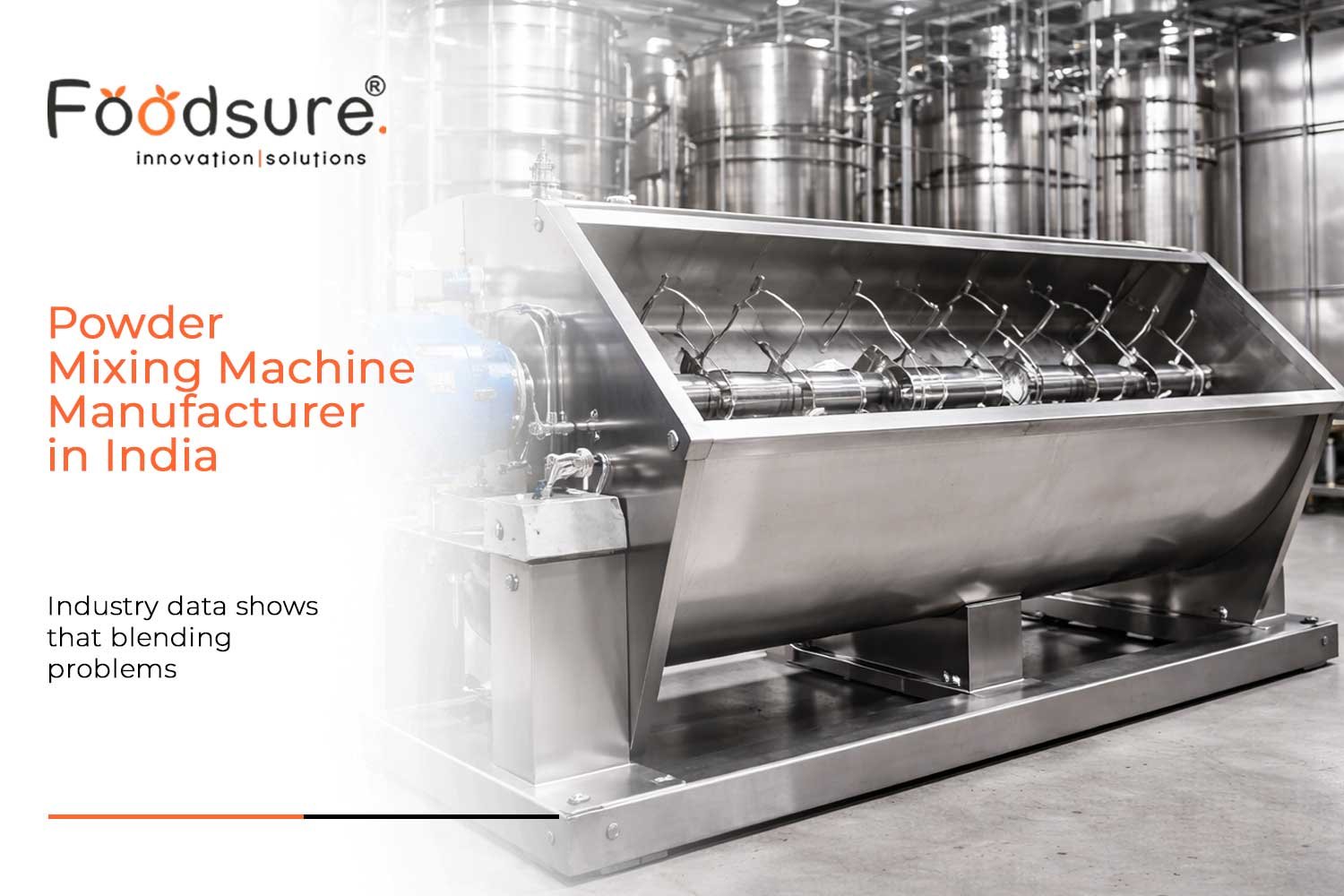
Industry data shows that blending problems in pharmaceutical, nutraceutical, and chemical manufacturing arise from equipment mismatches and manufacturing quality issues, rather than formulation issues. The process of selecting a Powder Mixing Machine Manufacturer in India in 2026 requires organizations to conduct detailed technical assessments that go beyond basic price evaluations.
This blog framework serves plant heads, procurement managers, and business owners who need to understand their capital allocation requirements. The industrial powder mixer combines technical audit parameters, procurement best practices, and ROI evaluation metrics into a single practical framework, enabling manufacturers to select a powder mixer supplier through informed decisions that protect against potential risks in their manufacturing facilities.
Advanced 7-Pillar Audit System for Powder Mixing Machine Manufacturer in India Selection
The process of finding the best Powder Mixing Machine Manufacturer in India requires assessment of their 7-Pillar framework engineering accuracy instead of evaluating their costs. A trustworthy industrial mixer manufacturer creates products through engineering processes that achieve both Batch Consistency and Regulatory Compliance.
The 7-Pillar Technical Audit (Core Evaluation Layer)
- Pillar 1: MOC – Demand SS 316L for contact parts to resist corrosive ingredients and SS 304 for frames. This ensures longevity and hygiene.
- Pillar 2: Surface Finish – Aim for Ra < 0.4 µm. Mirror-polished, crevice-free welds prevent dead zones where powder harbors bacteria.
- Pillar 3: Mechanism – A quality vendor provides data on mixing time vs. homogeneity. The Ribbon Blender achieves 95% uniformity within a 10-minute period.
- Pillar 4: Drive System – Ensure IE3/IE4 motors with VFDs. The powder mixing machine achieves energy cost reductions between 15 and 25 % while providing soft-start protection.
- Pillar 5: Seals – Use air-purged seals to stop fine powders from migrating into bearings, which leads to early mechanical breakdown.
- Pillar 6: Discharge – Opt for pneumatic butterfly valves to achieve ≥99% discharge, which results in material losses of up to 8%.
- Pillar 7: Safety – Look for limit switches and GMP-ready designs that align with FSSAI and ISO 22000 standards.
How to Verify Manufacturing Strength of a Powder Mixing Machine Manufacturer in India
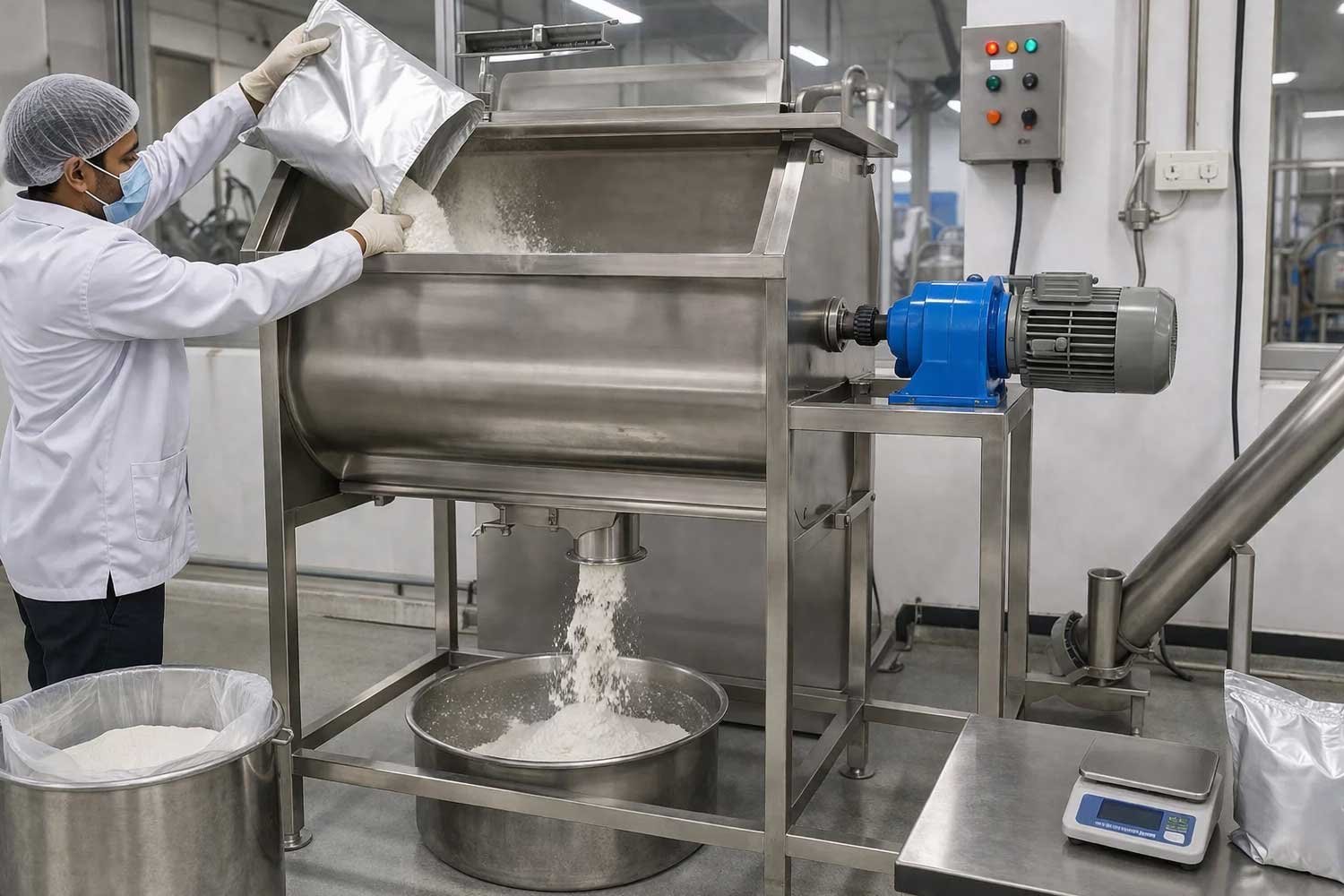
The Indian powder mixing machine manufacturer must show extensive facilities because their product range does not establish their trustworthiness.
What to Verify:
- CNC Machining Capability: This method provides precision tolerances that specify exact measurements for shaft-to-seal connections.
- In-house Fabrication: This process enables complete supervision of both metallurgical properties and welding standards.
- Trial Testing Facility: The organization conducts research and development activities together with material testing procedures before customers make their purchasing decisions.
- Quality Inspection: The process verifies the Ra values together with the results of non-destructive testing (NDT).
Factory Audit Checklist:
- Weld Quality: Examine the seams that require continuous TIG welding to create mirror-polished connections instead of using tack welds, which create porous connections.
- Shaft Alignment: The dial indicators check run-out because any misalignment directly damages seals.
- Noise Levels: The system generates excessive decibels, which reveal that the gear meshing process and the bearings used are of inferior quality.
Deep Insight: The Under Load Reality
The actual assessment of a manufacturer occurs when they conduct a Factory Acceptance Test (FAT) using complete operational capacity. The majority of vendors conduct empty machine testing, which hides both structural flexing and motor stalling issues. A high-tier manufacturer uses laser alignment tools and vibration analysis to ensure the drive train handles the high torque required for dense powders without shearing pins or overheating.
Why Trial Runs Are Critical When Choosing a Powder Mixing Machine Manufacturer in India
Top-tier manufacturers offer material testing before purchase. The current process develops an actual production performance assessment, which measures theoretical specifications against their manufacturing requirements.
Ask for a Batch Trial Report:
- Mixing Homogeneity: The testing procedure confirms mixing uniformity at 95-98% through multi-point sampling and coefficient of variation measurement.
- Temperature Rise: Friction-generated heat causes damage to delicate enzymes and leads to the melting of fats present in nutraceutical products.
- Cleaning Time: The evaluation process includes testing dead zones, together with evaluating how easy it is to access areas designated for manual and CIP cleaning.
- Residue Percentage: The process measures the heel residue left behind in the vessel for determining actual yield loss.
Benchmark:
- Homogeneity: The standard batches reach homogeneity within 5-10 min, while extended cycles indicate inefficient blade design and insufficient drive power.
Deep Insight: The Science of Homogeneity
Trial validation requires more than a visual demonstration because it tests Scalability Physics. The testing process needs to measure the Froude Number (Fr) because it shows the relationship between centrifugal force and gravitational force. A successful trial must prove that the mixer can move particles in a three-dimensional fluidized state without causing demixing or particle shear. In the nutraceutical sector, a temperature rise of even 5°C can be a deal-breaker for probiotics or vitamins. Real-world validation ensures that the tip speed of the ribbon or paddle is set at the proper speed for mixing your expensive raw materials.
Audit-Ready Documentation from a Powder Mixing Machine Manufacturer in India
The manufacturer of professional powder mixing machines based in India will deliver a complete powder mixing equipment qualification package. The documentation shows that your protein powder blending machine meets the specifications that you requested at the time of purchase.
Mandatory Documents:
- MOC Certificates: Mill Test Certificates (MTC), which confirm the specific heat and chemical composition of steel.
- FAT Report: The Factory Acceptance Test report contains a complete record of the test, which shows system performance throughout different operational loads.
- Electrical Diagrams: These diagrams serve as essential resources for both maintenance activities and the detection of PLC/VFD control system pathways.
- Operation & Warranty: The document provides specific directions for PM (Preventive Maintenance), which will help organizations achieve their long-term return on investment goals.
For Regulated Industries:
- IQ/OQ/PQ: The three qualifications, which include installation assessment and operational evaluation, and performance testing, fulfill FDA/GMP inspection requirements.
- Surface Finish Reports: The profilometer readings validate that the contact surfaces achieve Ra values that the document specifies.
- Traceability Records: The automatic protein powder mixing machine tracks all components, starting from gaskets and ending with lubricants, to their initial manufacturing origin.
The Validation Lifecycle & Component Integrity
The machine in high-stakes manufacturing depends on its documentation for operational efficiency. Traceability is the most overlooked factor; if a seal fails and contaminates a batch, you must be able to trace that gasket’s batch number and food-grade certification. This includes BSE/TSE-free certificates for polymers and USP Class VI compliance for elastomers used in high-purity applications.
The IQ/OQ/PQ protocols function as more than documentation because they operate as an effective system to minimize risks. Operational Qualification (OQ) should include worst-case scenario testing, which needs to assess power-loss recovery during a full-load mix and E-stop functionality verification under maximum torque conditions.
Cost Breakdown Analysis for Powder Mixing Machine Manufacturer in India
The Indian manufacturing industry uses low-cost quotes, which lead to hidden expenses that companies must pay for their equipment use. Reliable quotations provide detailed cost estimates that extend beyond total prices to show all important cost elements.
What a Reliable Quotation Includes:
- Machine Cost: Base price for the fabricated vessel and frame.
- Motor & Gearbox Brand: The system requires all torqueproofing components to be specified through their ABB, Siemens, or Bonfiglioli brand names.
- Logistics: The complete transportation cost, unloading expense, and on-site installation fee will be disclosed.
- Automation: The costs for Schneider and Delta PLCs and VFDs will be described through their specific itemized costs for speed modulation.
- Taxation: The document must show 18% GST and all additional packing and insurance costs.
Warning Signs:
- Lump-sum Pricing: The pricing method conceals its actual usage of low-quality and secondhand motors.
- Undefined Timelines: Production processes remain unorganized, which leads to outsourcing activities that follow a process of trading.
The Hidden Lifecycle Cost Analysis
To counter operational obsolescence, your first line of defense is to provide a transparent quote. In 2026, energy will comprise approximately 60-70% of a mixer’s life cycle costs, so when a quote does not include spec details for an IE3/IE4 motor, it becomes a precursory invitation for a utility bill that will be excessive. Your operation should provide complete visibility into its Wear & Tear (OPEX) projections because it will become reliant upon proprietary spare parts.
After-Sales Infrastructure of a Powder Mixing Machine Manufacturer in India: The Real Differentiator
The majority of product failures happen after customers complete their installation process instead of occurring during the purchasing phase. The profitability of a machine depends on its operational time because manufacturers need their service network to function as their most essential asset, instead of their initial marketing demonstrations.
Evaluate:
- Spare Parts Availability: The company provides a dispatch window between 24 and 48 hours for silicon gaskets, teflon bushes, and drive belts, which are categorized as consumable items.
- Service Engineer Network: The company provides access to local technicians who work in industrial centers located in Ahmedabad, Noida, and Chennai to decrease travel time.
- Annual Maintenance Contracts (AMC): The program includes scheduled maintenance sessions, which assess shaft alignment and gearbox lubrication condition.
- Remote Troubleshooting: The system uses IoT technology to enable PLC access for immediate software adjustments and VFD error correction.
Ideal Response Time:
- Critical Breakdown: Companies require <48 hours to resolve critical breakdowns because this time limit helps them avoid production delays and material damage.
ROI & Total Cost of Ownership Analysis for Powder Mixing Machine Manufacturer in India
The least expensive equipment option in food or pharmaceutical production turns out to be their highest financial expense. The actual expense of a mixer extends beyond its purchase cost because the business must pay for every kilogram of produced goods during its three to five years of operation.
3-Year Impact Analysis:
- Hidden Loss: Factors include all material waste that occurs without planning and all operational interruptions that happen when workers are not fully active because of extended work periods.
- ROI Drivers: Include both the increased operational speed and the 99% discharge efficiency, and the 15-20% energy savings.
Cheap Machine vs. High-Performance Machine
| Parameter | Low-Cost Vendor | Reliable Manufacturer | Financial Impact |
|---|---|---|---|
| Mixing Time | 12–15 min | 5–7 min | 2× Throughput |
| Material Loss | 5–8% | <1% | High Yield Recovery |
| Maintenance | Reactive (Breakdown) | Preventive (Scheduled) | Low Downtime Cost |
| Energy Use | Standard (IE1/IE2) | Premium (IE3/IE4) | 15–20% Power Saving |
| Batch Quality | 80–85% Homogeneity | 98–99%+ Homogeneity | Zero Rejection Risk |
| Service Life | 3–5 Years | 12–15 Years | Lower Depreciation |
How to Identify an Unreliable Powder Mixing Machine Manufacturer in India (Red Flags)
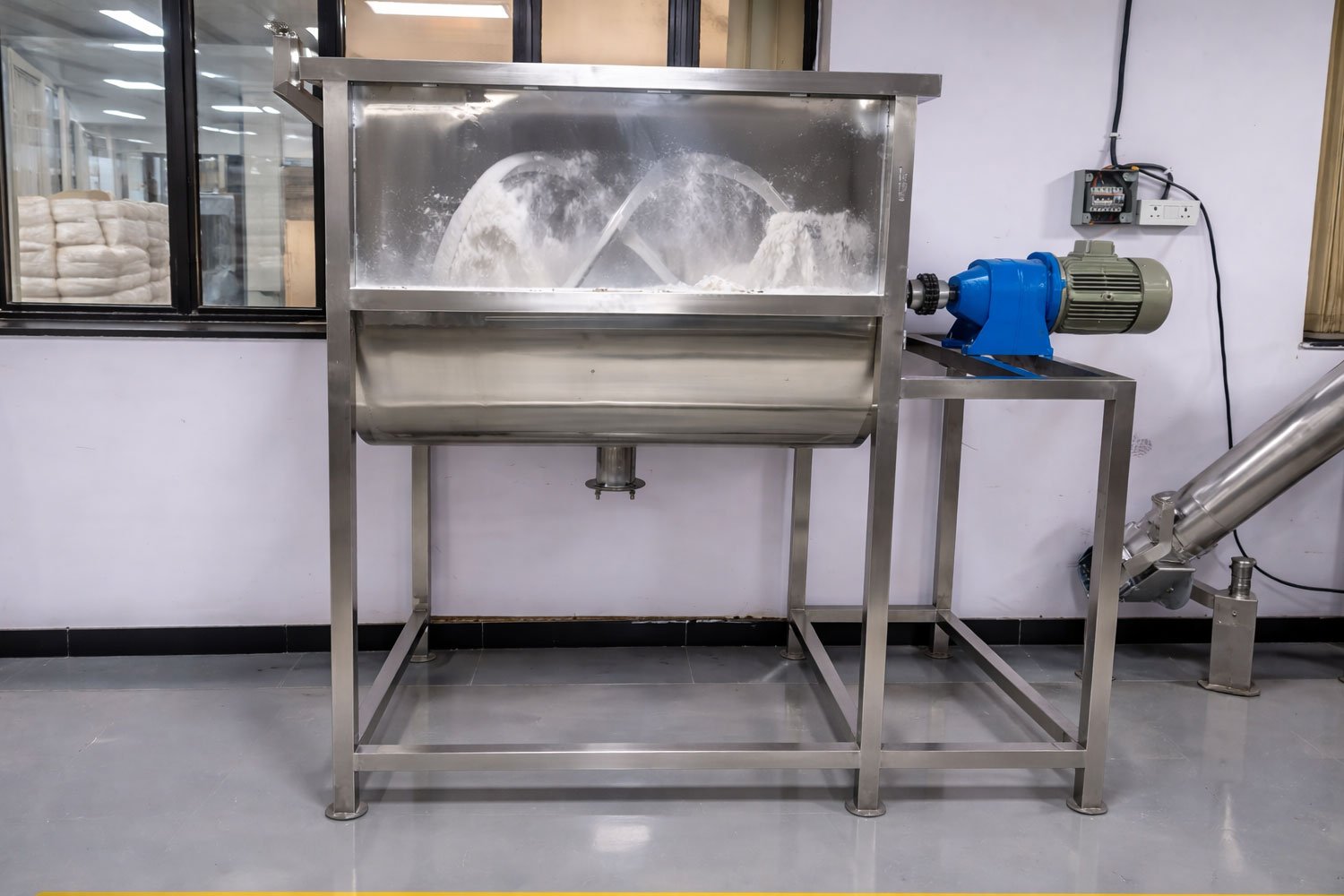
A common problem in the Indian machinery market occurs when low-priced products hide essential engineering faults. The detection of these red flags during the initial phases of a project enables organizations to avoid permanent operational breakdowns and financial setbacks.
Disqualification Pointers:
- One Machine Fits All: Describes how professional manufacturers develop customized ribbon and paddle designs that depend on Bulk Density and Flowability properties, while universal mixers create operational dead zones.
- No Trial/Testing: The design remains unproven until they can show Homogeneity at a level of 95% or higher with your specific powder.
- No Brand Disclosure: Vendors should not be approached when they offer in-house or unbranded motors and bearings because these products do not meet IE3 and IE4 efficiency standards and lack nearby maintenance services.
- Weak Service Network: The production process will stop for weeks because engineers to handle seal failures do not exist in Noida, Ahmedabad, and Bengaluru, essential industrial centers.
Expert Buyer Insights for Powder Mixing Machine Manufacturer in India Selection
The experienced buyers in the food, pharma, and chemical industries utilize their procurement capacity to achieve Risk Mitigation. The buyers know that the total cost of ownership for a machine exceeds its purchase price by 70-80%.
Key Strategic Pointers:
- Prioritize Process Validation: Top buyers demand 98%+ Homogeneity and Ra < 0.4um surface finishes over 5% price cuts. The equipment operators understand that the expenses from one batch failure exceed the cost of the equipment premium.
- Conduct Pre-PO Factory Audits: The team conducts in-person inspections to evaluate CNC machining and TIG welding quality. A manufacturer that does not have internal polishing and testing laboratories will face immediate disqualification.
- Treat Manufacturers as Partners: The company uses Annual Maintenance Contracts (AMC) and standard spare parts to achieve an uptime rate above 99%.
Conclusion
Execution differentiates a regular supplier from an experienced Powder Mixing Machine Manufacturer in India, not ideas. The things we value most are performance quality, documentation quality, and service responsiveness. At Foodsure Machines, we design machines that produce consistent results, meet regulatory standards, and reduce operational risk. We are committed to providing you with the support you need for your production process at all levels, including installation, training, and long-term maintenance, so you can run your business successfully without interruptions.
CHOOSE THE RIGHT MANUFACTURER
Looking for a Reliable Powder Mixing Machine Manufacturer in India?
Get expert guidance on machine types, capacity, quality standards, and pricing to choose the right manufacturer for your business.
FAQ
How to choose the best powder mixing machine manufacturer in India?
Choose a manufacturer of powder mixing machines in India that offers proven machine trials, supports good manufacturing practice (GMP), and provides quality after-sales assistance.
Who is a reliable industrial powder mixer supplier in India?
A trustworthy supplier of industrial powder mixing machines, like Foodsure Machines provides stainless steel 316 machines at a set price with a network of service providers throughout India.
What is the difference between a powder mixer supplier and a mixing machine manufacturer in India?
An industrial mixer machine manufacturer creates their own equipment, while an industrial powder mixing machine distributor may only sell or distribute the equipment it represents.
Which industries require an industrial mixer manufacturer in India?
Food and pharmaceutical industries, chemical and nutraceutical manufacturers rely on a trusted manufacturer of industrial mixing machines to produce reliable, consistent mixed products.
Why is choosing the right powder mixing machine manufacturer in India important?
A credible manufacturer of powder mixing machines in India provides uniform mixing, adheres to Good Manufacturing Practice, and provides significantly reduced operational costs.