
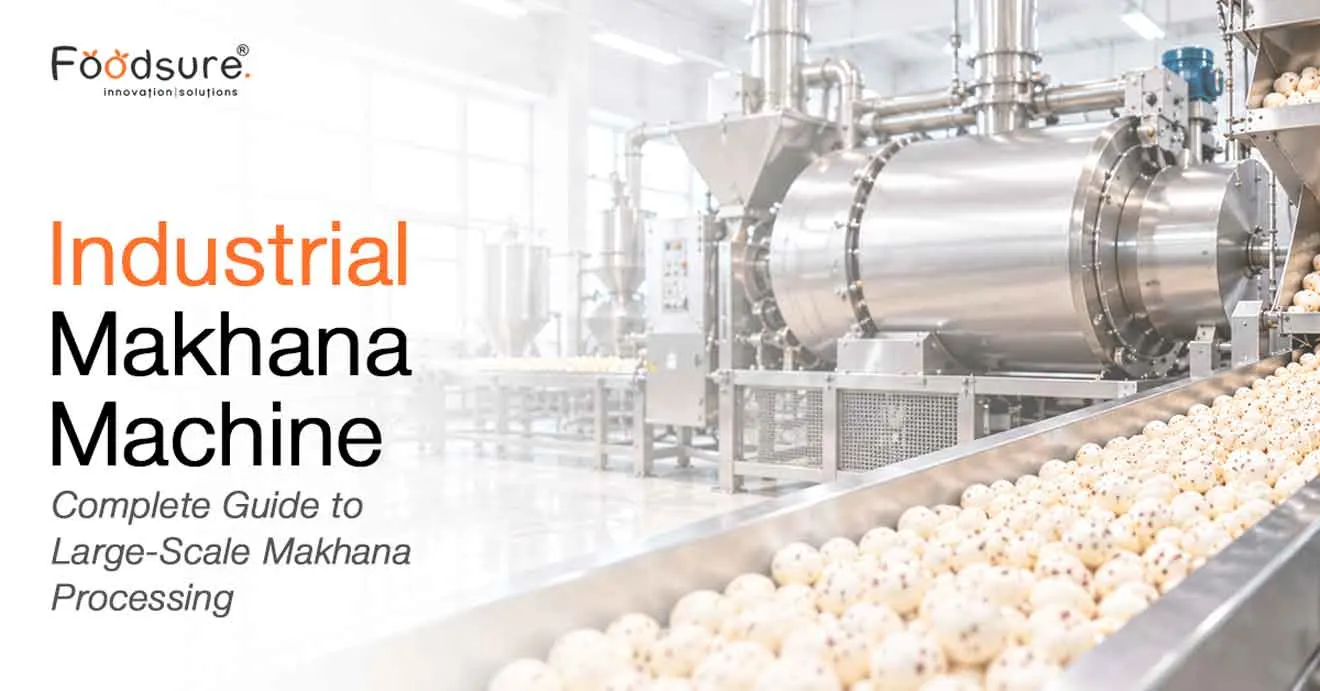
Makhana has emerged as a significant product within the snack and food processing industry. The increasing need for roasted and flavored makhana has motivated food manufacturers to shift from conventional methods of food processing to a more systematic approach.
An industrial makhana machine can help manufacturers handle larger production volumes while improving process consistency, hygiene, and operational efficiency. Instead of depending heavily on manual processing at every stage, businesses can use specialised machinery for cleaning, grading, roasting, flavouring, and packaging.
Those companies looking to establish themselves in the field of makhana processing or improve their facilities need to know about the whole process before purchasing the machines.
What Is an Industrial Makhana Machine?
An industrial makhana machine refers to commercial-scale machinery designed to perform one or more stages of makhana processing. Depending on the production setup, individual machines can be used for specific operations, or several machines can be integrated into a complete processing line.
Industrial equipment may be used for:
- Cleaning raw makhana
- Grading and sorting
- Roasting
- Cooling
- Flavouring and seasoning
- Coating
- Conveying
- Weighing
- Packaging
The layout is determined by the nature of makhana product to be produced, production capacity required, extent of automation, and the space available for future expansion.
Unlike smaller machines that are either hand-operated or partially mechanized, industrial machines are created taking into account business production demands. They can assist in minimizing the need for repetitive manual labor.
Why Invest in Industrial Makhana Processing Equipment?
Traditional processing methods may be suitable for small production volumes, but they can become difficult to manage as demand increases. An industrial makhana machine can offer several operational advantages:
Higher Production Capacity
There is more capacity for handling large amounts of materials through industrial machines than in manually operated systems.
Better Process Consistency
Controlled machinery can help standardise operations such as roasting, seasoning, and packaging, reducing variation between batches.
Reduced Manual Labour
Mechanised processing can reduce repetitive handling and allow workers to focus on monitoring, quality control, and other production activities.
Improved Hygiene
Food-grade construction and organised processing areas can make it easier to maintain appropriate hygiene practices.
Easier Production Scaling
A properly designed processing line can be expanded or upgraded as production requirements increase.
Industrial Makhana Making Machine: How Does It Work?
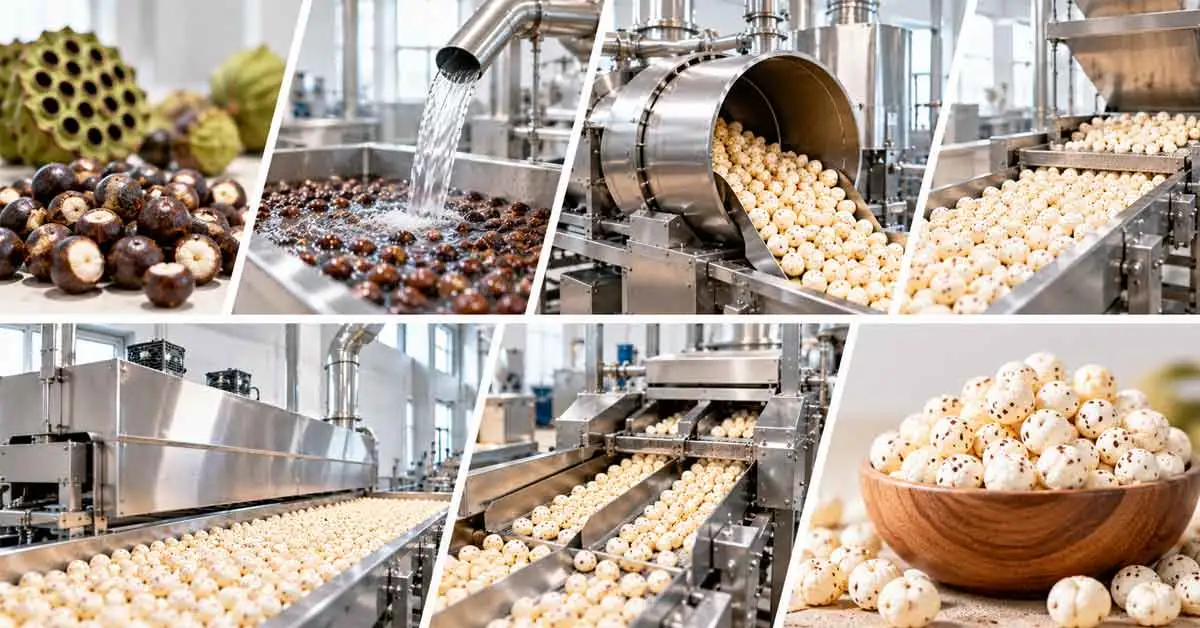
An industrial makhana making machine does not necessarily refer to one machine performing the entire production process. In commercial processing, different machines are generally used for different stages.
A typical production flow can include:
The exact process varies according to whether the facility handles raw seeds from the initial processing stage or purchases already-popped makhana for further processing.
Complete Makhana Processing Plant
A complete makhana processing plant is a coordinated production setup containing the machinery and supporting systems required for multiple stages of makhana processing.
A commercial plant may include:
Cleaning and Sorting Section
Raw material is cleaned to remove unwanted particles and impurities. Sorting and grading can then separate material according to size or quality.
Popping Section
Prepared seeds are processed under controlled heating conditions to produce puffed makhana. This stage requires careful control because raw material characteristics and processing conditions can influence the final result.
Roasting Section
Roasted makhana can be prepared to give it the desired texture and flavor by roasting it. This can be done using industrial machinery for roasting rather than through hand roasting.
Cooling Section
After roasting, the product may need to be cooled before further handling. Cooling can help prepare the product for flavouring and packaging.
Flavouring and Coating Section
Flavoured products require the use of a system that will coat the makhana with the flavours. Various types of systems may be chosen based on whether the products require dry seasonings or oil-based flavouring.
Packaging Section
The final product can be weighed, filled, sealed, and packed using suitable packaging equipment.
The complete line should be designed so that the capacity of one stage does not create a bottleneck for the following stage.
Large-Scale Makhana Processing Equipment
Large-scale makhana processing equipment is designed for manufacturers handling substantial production volumes. At this scale, machine capacity is only one part of the purchasing decision.
Businesses should also evaluate:
- Production flow
- Degree of automation
- Handling of the product
- Machine build-up
- Energy consumption
- Cleanability
- Maintenance access
- Floor space availability
- Handling of material
- Packaging specifications
A high-capacity roasting machine, for example, will not improve overall production if the downstream flavouring or packaging equipment cannot handle the same output.
Capacity matching is therefore essential when designing a large-scale processing facility.
Key Machines Used in an Industrial Makhana Plant
Processing of makhana using industrial methods needs a combination of machines to be used at various stages, depending on the efficient processing of the product. Some of the machinery involved in an industrial facility is chosen based on the production capability of the industry.
Makhana Cleaning Machine
Cleaning equipment helps remove dirt, dust, and unwanted material before further processing.
Grading Machine
Grading equipment separates makhana according to size or other defined characteristics. Uniform grading can help improve consistency in subsequent processing.
Roasting Machine
Roasting equipment exposes makhana to controlled heat while maintaining suitable product movement. It is particularly important for commercial roasted makhana production.
Flavouring Machine
The flavouring machine can assist in applying seasoning to the surface of roasted makhana. Both semi-automatic and automatic types are possible.
Conveyors
Material can be conveyed from one stage to another during the process without any human intervention.
Packaging Machine
Packaging equipment can automate weighing, filling, sealing, and other final packing operations according to the selected packaging format.
Manual vs Industrial Makhana Processing
| Factor | Manual Processing | Industrial Processing |
|---|---|---|
| Production volume | Limited | High |
| Labour requirement | High | Lower |
| Process consistency | Operator-dependent | More controlled |
| Production speed | Lower | Higher |
| Batch handling | Manual | Mechanised |
| Quality monitoring | Mostly manual | More systematic |
| Scalability | Limited | Better |
| Integration | Difficult | Easier |
Manual processing can continue to be used for small organizations and limited production. But companies manufacturing goods for large retail or export markets would require better processing methods.
Benefits of an Industrial Makhana Making Setup
Investing in industrial processing can provide advantages beyond increased production capacity.
Improved Production Efficiency
Mechanised processing can reduce the time and labour required for repetitive operations.
Better Batch Consistency
Consistent production may be attained through controlled equipment among other things.
Reduced Material Handling
Conveyors and integrated machinery can reduce unnecessary movement of product between processing stages.
Better Quality Control
A structured production line makes it easier to define and monitor individual processing stages.
Easier Expansion
A modular production setup can make it easier to introduce additional equipment as demand increases.
Improved Commercial Readiness
Businesses supplying packaged products to larger markets can benefit from a more systematic production environment.
How to Choose an Industrial Makhana Machine?
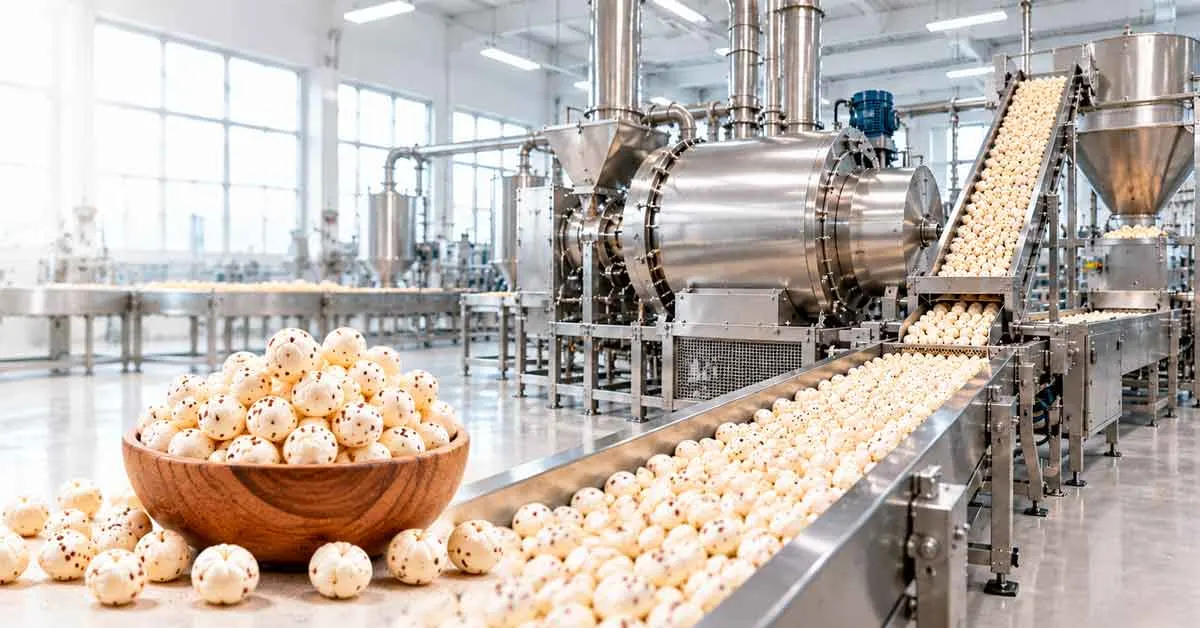
Selecting equipment requires an assessment of both present and future production requirements.
Determine Production Capacity
Determine the expected hourly production as well as daily production. Include operating hours, batch cycle time, cleaning time, and changeover time.
Evaluate Product Requirements
The machine should be compatible with the type of makhana being processed and the desired finished product.
Check Machine Construction
Contact surfaces must be made of appropriate food-grade material. Stainless steel is usually considered in commercial food processing operations.
Consider Automation
Determine whether manual, semi-automatic, or automatic processing is appropriate for the business.
Review Space Requirements
Machine dimensions, operator access, maintenance clearance, and material flow should be considered before installation.
Evaluate Maintenance
The equipment should provide practical access to components that require cleaning, inspection, and servicing.
Consider Future Expansion
Where increased production is anticipated, the business should determine whether the chosen machinery can be adapted for integration with other machinery.
Automation in Industrial Makhana Processing
Automation can be implemented gradually based on the scale of production. A manufacturer that is growing in size can begin with separate machinery, followed by implementing conveyors, feeders, flavoring, weighing, and packaging systems.
A more automated setup can help with:
- Consistent process control
- Reduced manual intervention
- Improved material flow
- Repeatable production cycles
- Better monitoring
- Higher production efficiency
However, automation should be based on actual operational requirements. Over-automating a small facility may increase investment without providing proportional benefits.
Maintenance and Hygiene
Regular cleaning and maintenance are essential for industrial food-processing equipment.
Manufacturers should establish procedures for:
- Surfaces that come into contact with products
- Movement of parts
- Bearing and drive mechanisms
- Electrical wiring connections
- Seal inspection
- Residue removal
- Conveyor check
- Maintenance of equipment per manufacturer’s recommendation
Hygiene procedures should also be integrated into daily production routines rather than being treated as an occasional activity.
Makhana Udyog and Industrial Processing
The growth of the makhana udyog has created opportunities for businesses across processing, roasting, flavouring, packaging, and distribution.
However, to enter the industry, buying a machine is not enough. A business needs to first determine its product type, production quantity, supply of raw materials, process, packaging, and method of distribution.
Machinery should now be chosen in light of these specifications. This method ensures that one does not purchase machinery that will be inadequate for manufacturing or will be too big for the work intended.
Working With a Makhana Machine Supplier
The supplier plays an important role in designing and implementing a commercial processing setup. A reliable makhana machine supplier India can help manufacturers evaluate machine configurations based on capacity, product requirements, available space, and desired automation.
Before finalising equipment, businesses should discuss:
- Production capacity
- Machine specifications
- Construction material
- Automation options
- Installation requirements
- Maintenance
- Spare parts
- Technical support
- Warranty
- Future expansion
A supplier should ideally understand how the individual machines will work together rather than treating each piece of equipment as an isolated installation.
Cost Considerations
The cost of an industrial makhana processing setup depends on the scale and configuration of the plant.
Factors that can influence investment include:
- Number of machines
- Processing capability
- Automation level
- Construction of machines
- Roasting machine
- Flavoring machine
- Conveyor
- Packaging machine
- Installation
- Electrical requirement
- Facility changes
Businesses should evaluate the complete project investment instead of comparing the price of one machine in isolation.
Operating expenses should also be considered, including electricity, labour, maintenance, cleaning, and spare parts.
Conclusion
The industrial makhana machine may aid in shifting from a manual to an organized processing method. Through the use of appropriate machines such as those that are required to clean, sort, pop, roast, flavor, convey, and package, a processing plant can be set up based on production needs.
An industrial makhana making machine or integrated processing line should be selected based on capacity, product characteristics, automation, hygiene, maintenance, available space, and future expansion plans. For larger manufacturers, large scale makhana processing equipment can support higher production volumes while improving process consistency and operational efficiency.
Whether building a new complete makhana processing plant or improving an existing one, it all boils down to developing the processing sequence as a whole system. Proper equipment choice and good technical assistance could allow the producers to develop a system that would be able to meet commercial market demands.
Have a Question? Let’s Connect
Need expert guidance on food processing machines, production setup, or process optimization? Our team is ready to help you choose the right solution for your business.
Frequently Asked Questions
What is an industrial makhana machine?
An industrial makhana machine is commercial food-processing equipment used for one or more stages of makhana production, such as cleaning, grading, roasting, flavouring, or packaging.
What machines are required for a complete makhana processing plant?
The machinery used depends on the manufacturing process and can include cleaning, grading, popping, roasting, cooling, flavoring, conveying, weighing, and packaging machinery.
Is industrial makhana processing suitable for large-scale production?
Yes. Industrial machinery is built to accommodate larger quantities through controlled processes and less human interference as compared to conventional methods of processing.
How do I choose the right industrial makhana machine?
Think about the need for capacity, product nature, design of the machine, degree of automation, available space, cleaning needs, maintenance, and future plans for production.
Can a makhana processing plant be automated?
Yes. Various phases can be automated independently or as part of an entire automated manufacturing system based on the capacity requirement and level of investment.




