
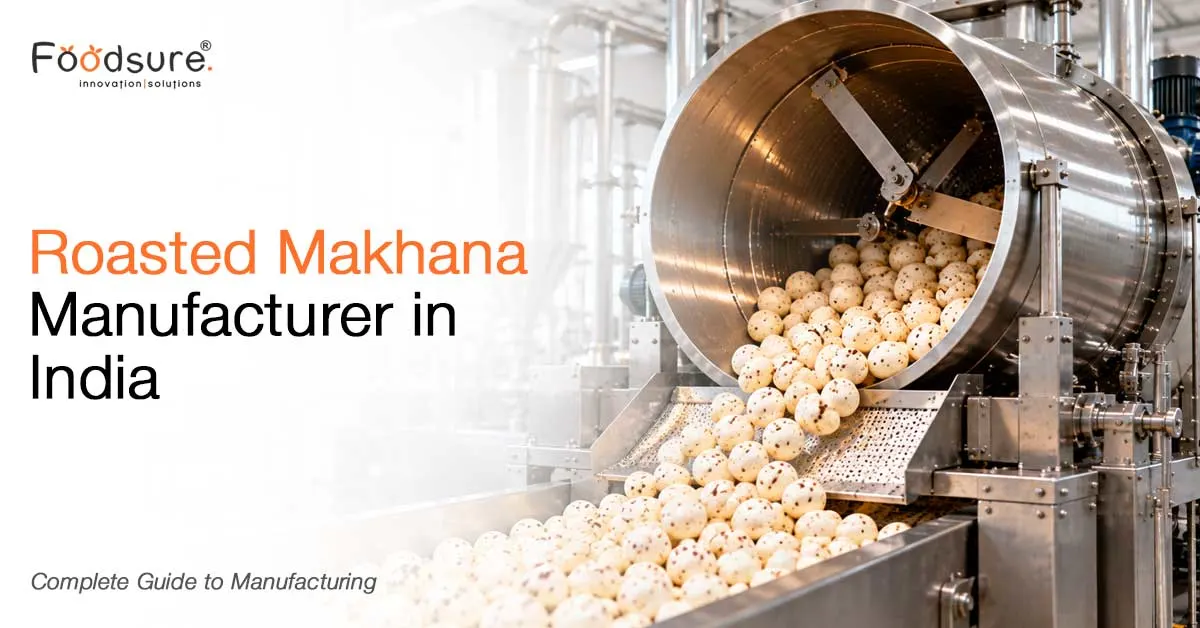
Roasted makhana has emerged as an important product line in the market for packed snacks where the producers need to pay attention to roasting, flavoring, cleanliness, and effective manufacturing processes. As businesses transition from manual processing to manufacturing processes, the selection of equipment and production processes becomes crucial.
A roasted makhana manufacturer in India typically focuses on converting processed makhana into a ready-to-eat roasted product through controlled heating and handling. Depending on the final product, the manufacturing setup may also include cleaning, grading, cooling, seasoning, and packaging equipment.
What Is Roasted Makhana Manufacturing?
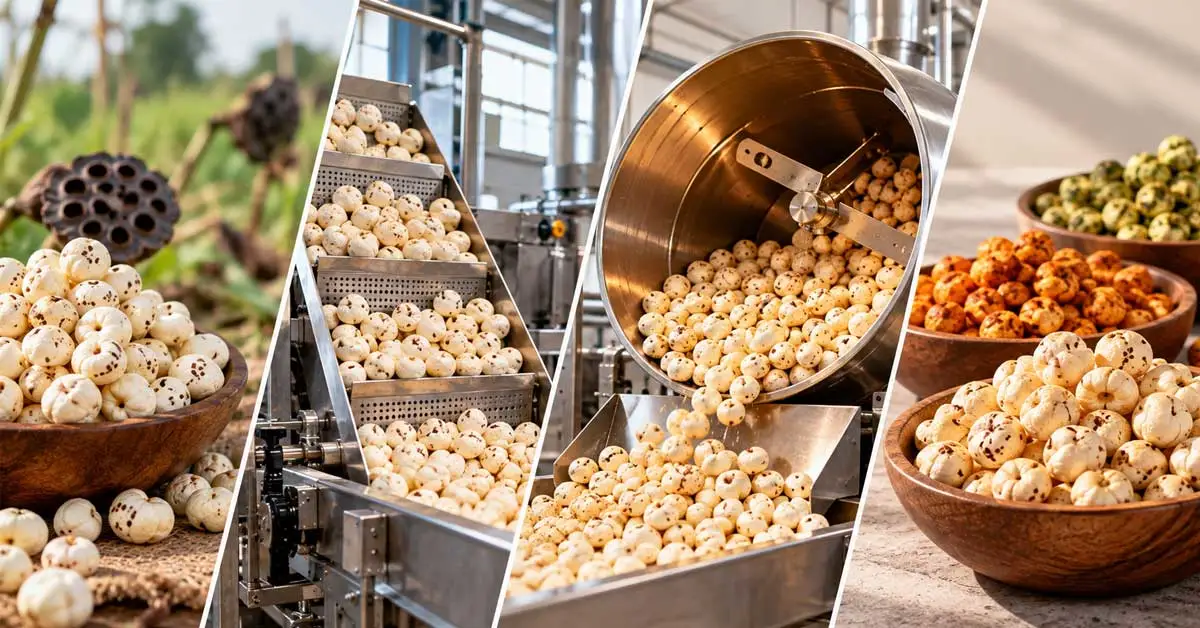
Roasted makhana manufacturing involves processing makhana through controlled roasting to achieve the desired texture, crispness, colour, and quality. The process can range from relatively simple roasting operations to integrated automated production lines.
A commercial workflow may include:
The exact process depends on the raw material, product specifications, production capacity, and level of automation.
Why Is Roasting Important in Makhana Manufacturing?
Roasting is an important process because it will affect the features of the product directly. Uncontrolled heat distribution may lead to variation in texture, color, and crispiness.
In order to achieve consistency in the commercial process, it becomes hard to control the roasting process manually as the production volume increases.
A suitable roasting system can provide:
- Controlled heating
- More consistent roasting
- Reduced manual handling
- Better production efficiency
- Improved process control
- Easier integration with downstream equipment
Roasted Makhana Making Machine
A roasted makhana Making Machine is designed to support the roasting stage of commercial makhana production. Depending on the equipment configuration, it may include a heating system, roasting chamber or drum, product movement mechanism, temperature controls, feeding arrangement, and discharge system.
The equipment subjects the makhana to controlled heat treatment while ensuring proper movement of the products. It is useful for producers who wish to get more consistent roasting than when using manual methods of heat and product handling.
What equipment should be used depends on the following factors:
How Does Roasted Makhana Manufacturing Work?
A commercial roasting process typically starts with well-prepared makhana. The initial stage might involve cleaning and sorting to ensure that the material is free from any undesirable materials.
After this, makhana is introduced to the roasting process. It is subjected to controlled heating as it passes through the roasting chamber.
Once the process of roasting reaches a desired level, the makhana is ejected and cooled. Unflavored makhana is packaged, while flavored products are first seasoned or coated before packaging.
This process may vary depending on the product being made.
Key Machines Used in Roasted Makhana Production
A commercial plant may use multiple machines rather than relying on one piece of equipment.
Cleaning Machine
Cleaning equipment helps remove dust, foreign particles, and unwanted material before further processing.
Grading and Sorting Equipment
Grading helps separate makhana according to size or quality requirements. Consistent sizing can also support more uniform downstream processing.
Roasting Machine
The roasting machine provides controlled heating and product movement to achieve the desired roasting result.
Cooling System
After roasting, controlled cooling can help bring the product to a suitable temperature before flavouring or packaging.
Flavouring Equipment
For seasoned products, flavouring equipment can help distribute seasoning more consistently across the roasted makhana.
Packaging Machine
The packaging machinery plays an important role in weighing, filling, sealing, and packaging of the end product in accordance with the selected packaging style.
The selection of the machinery would depend upon the scale of production and the roasted makhana produced.
Benefits of Commercial Roasted Makhana Manufacturing
Quality must remain consistent in order to ensure that there are uniform texture and appearance when making roasted makhana. This will be possible if the roasting conditions are maintained.
1. Consistent Product Quality
Controlled roasting conditions can help manufacturers maintain similar texture, crispness, and appearance across production batches.
2. Higher Production Capacity
Commercial machinery can handle larger quantities than many traditional manual methods, allowing businesses to increase production.
3. Reduced Manual Intervention
Automation can reduce repetitive handling and allow operators to focus on monitoring the production process.
4. Better Process Control
Temperature, product movement, and roasting duration can be controlled more systematically with suitable equipment.
5. Scalable Production
A properly planned production line can be expanded or upgraded as the business grows and production requirements change.
6. Improved Hygiene
Enclosed and controlled processing systems can reduce unnecessary exposure to external contaminants compared with open processing environments.
What Makes a Good Roasted Fox Nuts Manufacturer?
A roasted fox nuts manufacturer needs more than roasting equipment to establish consistent commercial production. Raw-material quality, process control, hygiene practices, equipment maintenance, and packaging all contribute to the final product.
The manufacturers should determine proper parameters based on their product requirements and validate the roasting process using production trials.
Important considerations include:
- Raw-material quality
- Moisture characteristics
- Roasting temperature
- Roasting duration
- Product loading
- Cooling conditions
- Seasoning requirements
- Packaging conditions
Consistent monitoring throughout production can help identify variations before they affect larger quantities of finished product.
How to Choose Machinery for Roasted Makhana Production?
Selecting machinery should begin with an assessment of actual production requirements.
Production Capacity
Determine the quantity of makhana required per batch or per hour. The equipment should be sized appropriately for the expected production volume.
Automation Level
Businesses can choose between manual, semi-automatic, and automatic systems depending on production requirements and available workforce.
Heating Control
The roasting system should provide suitable temperature control and consistent heat distribution.
Construction Material
Food contact surfaces must use appropriate food grade material. Stainless steel is widely used in commercial food processing equipment due to its hygienic nature.
Maintenance
Machines should provide practical access to components requiring routine inspection, cleaning, and servicing.
Plant Layout
The dimensions, feeding system, discharge arrangement, and connection with other machines should be considered before installation.
Working With Makhana Machines Companies in India
There are different makhana machines companies in India offering equipment for individual processing stages as well as complete production setups.
In assessing the suppliers, the manufacturers need not only to compare the quotation but should look at the technical specifications, machine capacity, construction, level of automation, service, installation needs, and maintenance among other things.
The suppliers should be able to tell how the suggested equipment can be incorporated into the production process.
Finally, companies need to ascertain whether the machinery is offered individually or as part of a complete processing line.
Makhana Machine Price in India
The makhana machine price in India can vary depending on capacity, machine configuration, automation, construction material, heating system, and additional features.
Therefore, there cannot be one cost for every process involved in production. A small-scale processing system and a large-scale manufacturing facility will have different requirements in terms of the machines needed and the amount of capital investment.
The cost of the machine that has been used should not be the only thing that the manufacturer looks at; he/she needs to look at the entire value of the equipment used.
Quality Control in Roasted Makhana Manufacturing
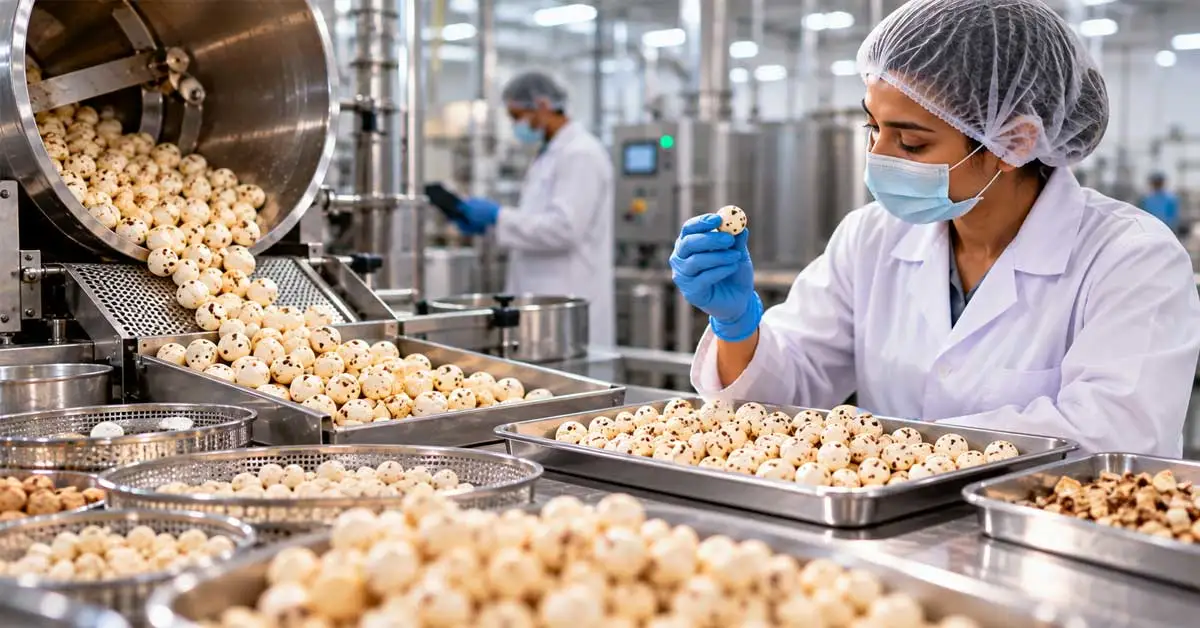
The quality control process needs to be included throughout the manufacturing process, and not just in the final manufactured product.
Inspection needs to be conducted on the raw materials prior to any processing, and roasting conditions need to be controlled during the production stage. Once the product is roasted, it needs to be tested for parameters like colour, crunchiness, and uniformity.
In the case of flavoured products, seasoning uniformity also needs to be controlled. Packaging should give enough protection from the environment.
Maintenance and Hygiene
Maintenance is necessary for ensuring the reliability of the machines used for roasting and processing.
The heating elements, motor parts, bearings, sensors, electrical contacts, and moving parts must be checked as per the manufacturer’s specifications.
The equipment must be cleaned periodically, especially the areas where the products come in contact with the machines.
The accumulation of Makhana debris, seasonings, and dust in the equipment must be prevented.
Building a Commercial Roasted Makhana Production Line
A commercial production line can be configured according to the manufacturer’s product range and required output.
A typical setup may follow:
In cases where companies manufacture several types of roasted makhana, the production line can be configured with appropriate machinery and changeover facilities for different products.
The extent of automation needs to be decided based on actual production needs rather than just opting for the highest degree of automation possible.
Conclusion
Working with a reliable roasted makhana manufacturer in India requires attention to machinery, raw-material preparation, roasting control, hygiene, quality management, and packaging. Commercial roasted makhana manufacturing becomes more efficient when the different processing stages are properly coordinated.
An ideal Roasted Makhana Making Machine could help producers maintain consistent roasting while minimizing manual effort and increasing production. However, before making any investment, some factors need to be considered, such as capacity, automation, construction, maintenance, cost of operation, and integration with other machinery.
With a properly planned processing line and suitable operating practices, manufacturers can build a scalable system for producing consistent roasted makhana for commercial markets.
Have a Question? Let’s Connect
Need expert guidance on food processing machines, production setup, or process optimization? Our team is ready to help you choose the right solution for your business.
Frequently Asked Questions
What is roasted makhana manufacturing?
The process of making roasted makhana commercially includes the activities of cleaning, processing, roasting, cooling, seasonings, and packaging the makhana as a finished food item.
What is a roasted makhana Making Machine?
A roasted makhana Making Machine is processing equipment used to support controlled roasting and handling of makhana for commercial production.
What machines are required for roasted makhana production?
Depending on the production setup, manufacturers may require cleaning, sorting, grading, roasting, cooling, flavouring, and packaging equipment.
What affects the makhana machine price in India?
Capacity, automation, construction material, heating system, machine configuration, and additional features can influence the overall equipment price.
How should a manufacturer choose makhana processing machinery?
These include production capacity, needs of the product, automation, machine design, energy consumption, maintenance, space availability, and compatibility with other machinery in the processing plant.




