
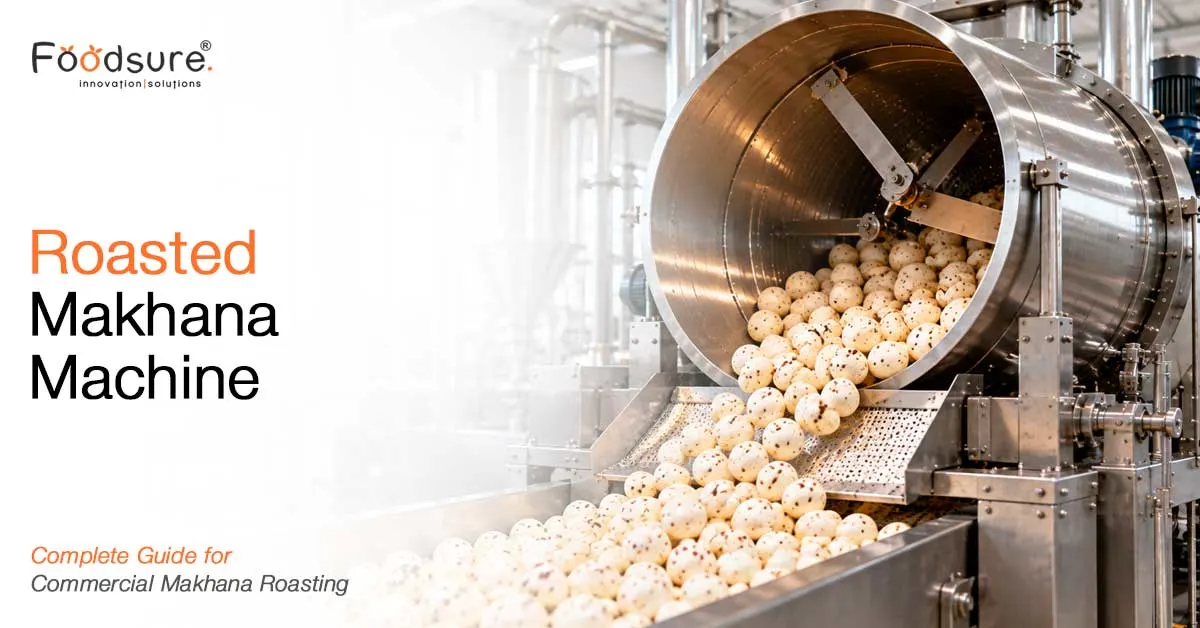
Roasting is an essential process in makhana production on an industrial scale. Correct roasting plays an important role in obtaining the required properties of the final product, including its crispness, texture, color, and eating qualities. Although traditional methods of roasting may be suitable for small-scale production, they do not ensure sufficient control in large-scale operations.
A roasted makhana machine is designed to make the roasting process more controlled and efficient. It can help manufacturers process larger quantities with consistent heating while reducing manual intervention. The right machine can also be integrated with other equipment to create a more organised commercial makhana production line.
What Is a Roasted Makhana Machine?
A roasted makhana machine is food-processing equipment used to roast makhana or fox nuts under controlled heating conditions. Depending on the machine design, it may use a rotating drum, heating chamber, conveyor system, or another mechanism to expose the product evenly to heat.
The machine is normally made to ensure proper control over essential factors of the process including temperature, time spent roasting, and movement of the material. This helps to minimize differences that might arise when roasting manually.
Commercial firms can use the equipment by choosing one based on capacity, type of heat, level of automation, space, and nature of the product to be made.
Why Is Makhana Roasting Important?
However, makhana should be roasted properly to get the right texture without over-roasting the food product. Some portions may end up being under-roasted while others may end up over-roasted.
Proper roasting becomes even more significant when packaging makhana for commercial purposes. Consumers have a tendency of expecting the same texture and quality regardless of the pack they buy.
A properly designed roasting system can help manufacturers achieve:
- More consistent roasting
- Better control over heating conditions
- Reduced manual handling
- Improved production efficiency
- More predictable processing time
- Better integration with downstream equipment
How Does a Roasted Makhana Machine Work?
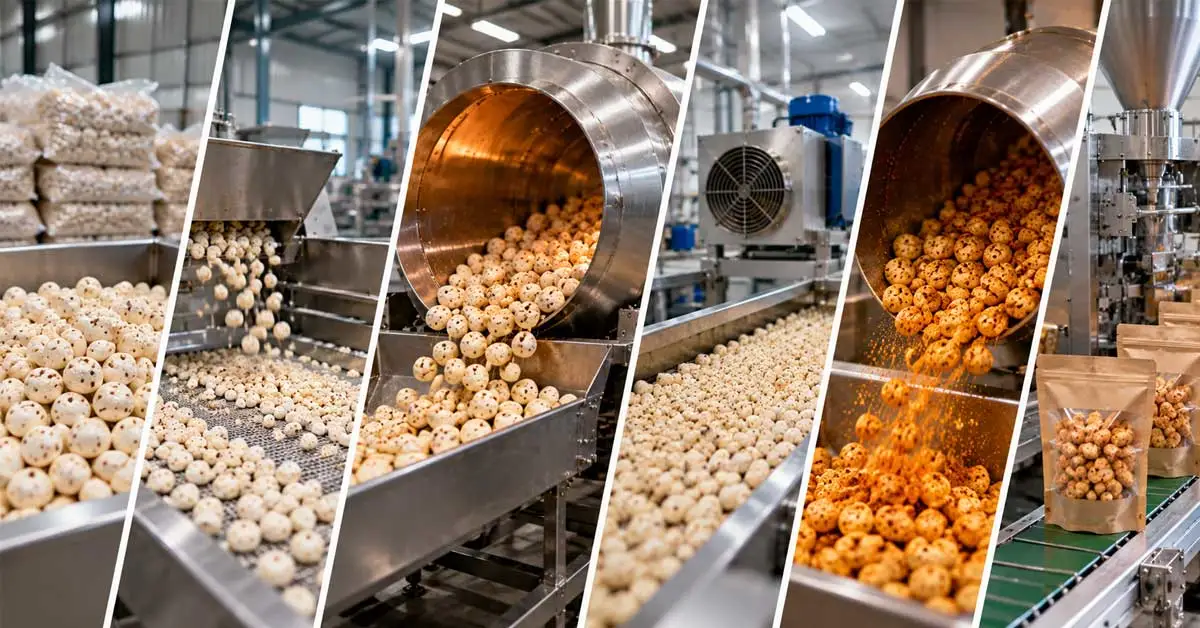
The exact working process depends on the machine configuration, but commercial roasting generally involves controlled heat combined with continuous or batch-wise product movement.
A typical process can be represented as:
The makhana goes into the drum or roasting chamber where it is subjected to controlled heating. The movement of the product aids in ensuring uniform heating, while temperature control ensures that the operators keep the required conditions in check.
Following the roasting process, the product can now be moved to the next step depending on the production system.
Key Features of a Commercial Makhana Roaster
A commercial makhana roaster may include several features designed to improve process control and production efficiency.
Controlled Heating
Heating that is stable is essential in ensuring uniformity in roasting. The heating system should provide sufficient heat coverage to the product contact area.
Temperature Control
Temperature monitoring and control can help operators maintain suitable roasting conditions and reduce the risk of excessive heating.
Uniform Product Movement
Proper movement of makhana through the roasting area helps expose the product to heat more consistently.
Automated Feeding and Discharge
Depending on the automation level, feeding and discharge can be automated or semi-automated, reducing repetitive manual handling.
Food-Grade Construction
Food contact parts should be made from suitable food-grade material. Stainless steel is a common choice for food processing equipment as it facilitates hygiene and cleaning.
Easy Maintenance
Access to heating components, moving parts, and product-contact areas is important for routine inspection, cleaning, and maintenance.
Industrial Makhana Roasting Equipment
For larger production facilities, industrial makhana roasting equipment can form an important part of a complete processing line.
The choice of industrial equipment is based on production capacity and process requirement of the producer. Industrial equipment can be interfaced with the upstream equipment such as cleaning and sorting equipment, and also with downstream equipment like flavoring and packing machines.
A commercial production line may include:
The exact configuration can vary depending on whether the manufacturer produces plain roasted makhana, flavoured snacks, or other value-added products.
Automatic Roasted Makhana Machine
An automatic roasted makhana machine is designed to reduce manual involvement in the roasting process. Automation can cover functions such as product feeding, temperature monitoring, product movement, roasting control, and discharge, depending on the equipment configuration.
In cases where there is higher volume in production, there will be the need to have better workflow through automation, which helps to minimize reliance on constant human monitoring.
It should, however, be noted that the correct amount of automation will depend on the production volume, labor, plant setup, and financial resources.
Benefits of Using a Roasted Makhana Machine
Uniformity in roasting is important to ensure uniformity in texture and color across all batches. Carefully controlled heating and handling will minimize the variations that occur with manual methods of roasting.
1. Consistent Roasting
Controlled heating and product movement can help produce more uniform roasting results across production cycles.
2. Higher Production Efficiency
Machines are able to roast large amounts than the manual processes, making it easier for companies to increase productivity.
3. Reduced Manual Labour
Automated or semi-automated operations can reduce repetitive handling and allow operators to focus on monitoring and managing the production process.
4. Better Process Control
Temperature and roasting time can be monitored more systematically, helping manufacturers maintain consistent operating conditions.
5. Easier Integration
Roasting machine can be integrated in a larger process chain so that the roasted makhana can be sent straight to the cooling, seasoning, and packing stage.
6. Improved Production Planning
Controlled machine operations will make the roasting process easier to predict, hence improving the coordination among other production processes.
Roasting Quality Factors
The final quality of roasted makhana depends on more than the machine itself. Manufacturers should also consider raw-material quality and process conditions.
Important factors include:
- Raw makhana quality
- Moisture level
- Loading quantity
- Heating conditions
- Roasting duration
- Product movement
- Cooling conditions
- Machine maintenance
Since different raw materials can react differently to the same operating conditions, manufacturers need to determine appropriate parameters by conducting production trials.
How to Choose the Right Roasted Makhana Machine?
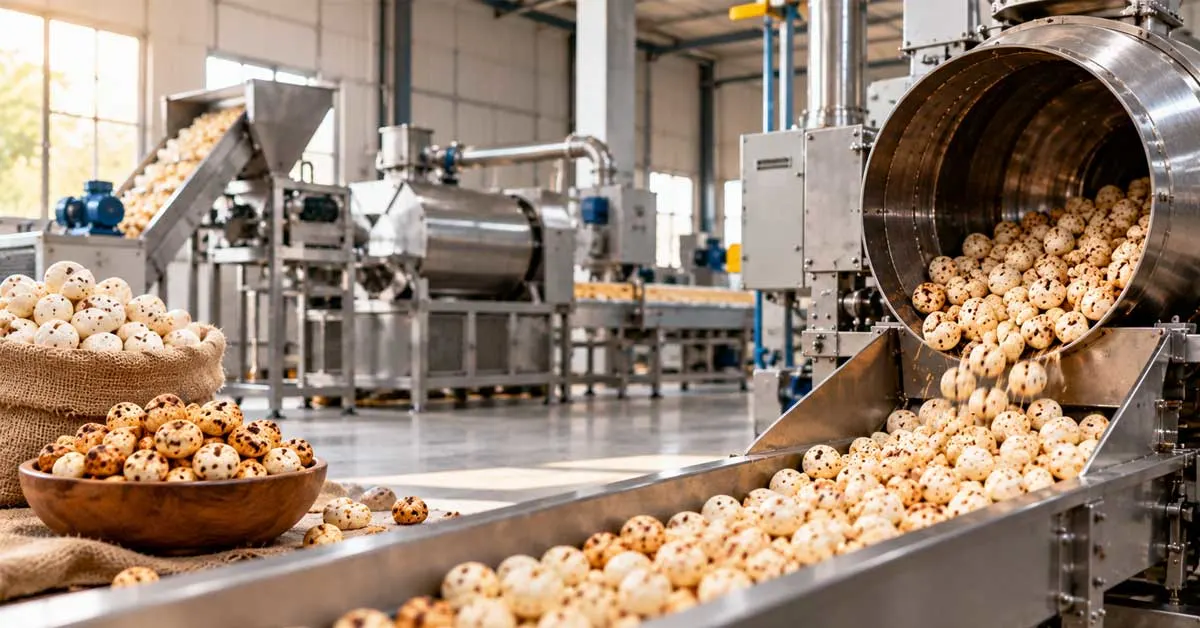
Selecting the right equipment requires an understanding of the production requirements rather than simply comparing machine prices.
Production Capacity
Find out the quantity of makhana that has to be roasted at a time or hourly. The machine should be selected according to the requirement.
Heating Method
Evaluate the heating system and how effectively heat is distributed throughout the roasting area. Consistent heat distribution is important for uniform roasting.
Automation Level
Consider whether manual, semi-automatic, or fully automatic operation is suitable for the business.
Construction
The contact surfaces for food must use appropriate material for food-processing equipment. The preference for stainless steel arises from its hygiene and durability features.
Cleaning Requirements
The machine should provide practical access to product-contact areas and components requiring regular cleaning.
Plant Layout
Check the machine’s dimensions, feeding arrangement, discharge position, and compatibility with surrounding equipment before installation.
Roasted Makhana Machine Price in India
The makhana machine price in India can vary considerably depending on machine capacity, heating system, construction, automation level, configuration, and additional features.
Manufacturers should not judge the machines based on their initial cost but rather the total cost of owning the equipment. Various things like electricity consumption, labor needed to operate, maintenance costs, and capacity of the equipment itself may affect the costs of owning it.
It is recommended that businesses get technical specifications about the machines and production capabilities of each one.
Maintenance and Hygiene
Maintenance is key to ensuring consistent performance of the roasting machine. Inspection of heating elements, motor, bearings, thermometers, electrical wiring, and moving parts is required following the manufacture’s guidelines.
Maintenance of the roasting chamber and other areas that come into contact with the product is also required. Residues of makhana and other residues may build up when roasting continuously, so maintenance ensures hygienic operations.
In addition, maintenance will prevent any problems that may cause downtime.
Integrating Roasting Into an Industrial Processing Setup
When a business intends to manufacture more products, roasting could be integrated into the production process along with other machines to make a coordinated production system.
The industrial makhana machine process would involve cleaning, sorting, grading, roasting, cooling, flavouring, and packing. The coordination of the manufacturing process would lead to better movement of materials without any wastage.
The whole process would depend on the specifications of the manufacturer.
.Conclusion
A roasted makhana machine offers a regulated and efficient approach to companies dealing with the commercial roasting of makhana. Through regulation of temperature, handling of the makhana, and the roasting process in general, the machine can assist companies in producing uniform products.
When selecting industrial makhana roasting equipment, businesses should evaluate capacity, heating technology, automation, construction, cleaning requirements, maintenance, and plant integration. The initial equipment cost should also be considered alongside long-term operating expenses.
For businesses planning to scale production, selecting a suitable commercial makhana roaster can support a more consistent and organised roasting process while allowing the equipment to become part of a broader commercial processing setup.
Have a Question? Let’s Connect
Need expert guidance on food processing machines, production setup, or process optimization? Our team is ready to help you choose the right solution for your business.
Frequently Asked Questions
What is a roasted makhana machine?
A roasted makhana machine is food-processing equipment designed to roast makhana under controlled heating and product movement conditions.
What is a commercial makhana roaster used for?
Makhana Roasting Machine is a device that is used for roasting large amounts of makhana as compared to other means of roasting that are done manually.
Is an automatic roasted makhana machine suitable for large-scale production?
An automatic roasted makhana machine can be suitable for larger production requirements where businesses need reduced manual intervention and more controlled processing.
What factors affect the cost of a makhana roasting machine?
Capacity, heating technology, automation level, construction material, machine configuration, and additional features can all affect equipment cost.
How should a business select industrial makhana roasting equipment?
Businesses should consider production capacity, heating efficiency, automation, hygiene, maintenance, available space, operating costs, and compatibility with other processing equipment.




