
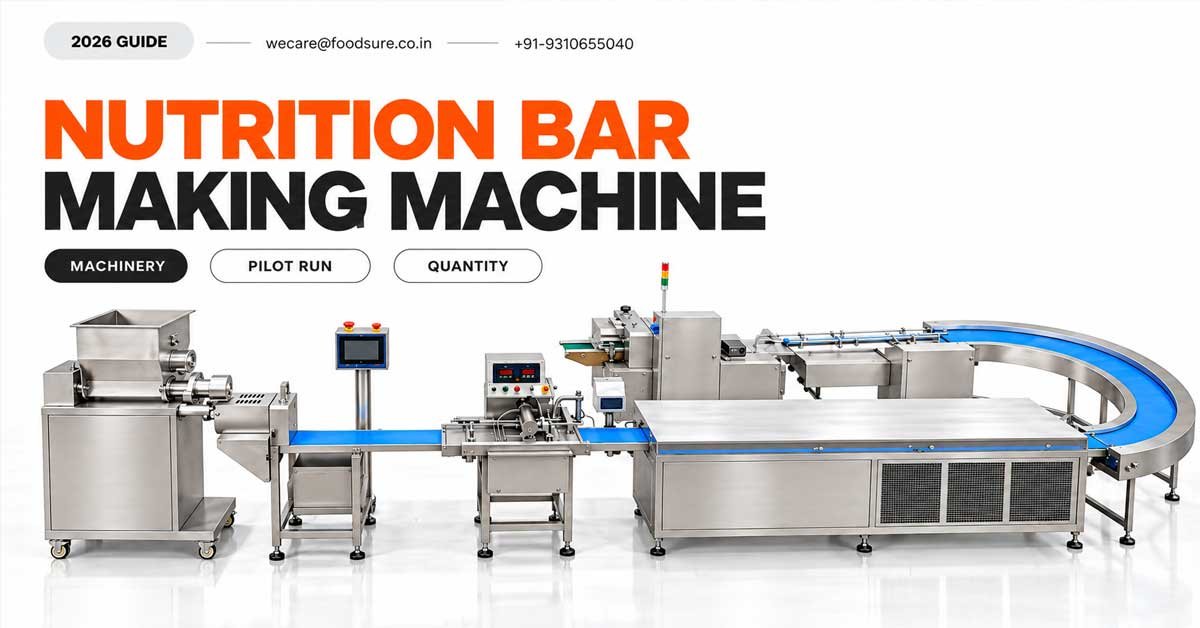
Nutrition bars have gained much popularity among consumers searching for snacks, sources of protein, and energy-boosting foods. From cereal and granola bars to date-based and functional nutrition bars, there is an increased demand for machines to ensure the production of uniform products.
A nutrition bar making machine helps automate important production stages, including mixing, forming, cutting, and product handling. Depending on the recipe and production requirements, the setup may also include cooling, coating, and packaging equipment.
Businesses that are looking to enter into the nutrition bar market or increase production by extending their existing plant must be aware of the different machines, capacities, levels of automation, and supplier support.
What Is a Nutrition Bar Making Machine?
A nutrition bar making machine is food-processing equipment designed to transform prepared ingredients into uniformly shaped bars. Depending on the configuration, it may operate as a standalone forming machine or as part of an integrated production line.
A commercial system can include:
- Preparation of ingredients and feeding equipment
- Mixer for mixing ingredients and binder
- Extrusion machine or slabs forming machine
- Cooling conveyor or tunnel
- Bar slicing machines
- Coating machine (optional)
- Conveyor and handling system
- Packaging equipment
The appropriate configuration depends on the recipe, ingredient structure, bar dimensions, production capacity, and desired level of automation.
Types of Nutrition Bar Making Machines
Different nutrition bar formulations require different forming technologies. Selecting the right system helps maintain product consistency and improve manufacturing efficiency.
Extrusion-Based Nutrition Bar Machine
A nutrition bar extruder forms an already prepared mixture by forcing it through an appropriate die.
The extruded material can then be stabilized and cut into individual bars.
Extrusion may be ideal for dense, cohesive, or sticky materials, such as some bars made from dates, and those that contain binders or nut pastes.
The machine setup should fit the consistency of the mixture and the size of the desired product.
Slab-Forming Nutrition Bar Machine
The slab forming process rolls or presses a formed material into a sheet, which is later cut into bars.
It may be used for making nutritional bars that contain oats, cereals, nuts, seeds, granola, and other solid components. It enables one to keep a uniform slab thickness while keeping large pieces in their original form.
Automatic Nutrition Bar Production Line
An integrated nutrition bar production line connects multiple processing stages into a coordinated workflow. Depending on the product, it may include mixing, forming, cooling, cutting, coating, conveying, and packaging.
Automation will help avoid repetitive manual transfers and facilitate a steady production process. Nevertheless, it is essential that the equipment is chosen taking into account real production needs and not only the automation degree.
How Does a Nutrition Bar Making Machine Work?
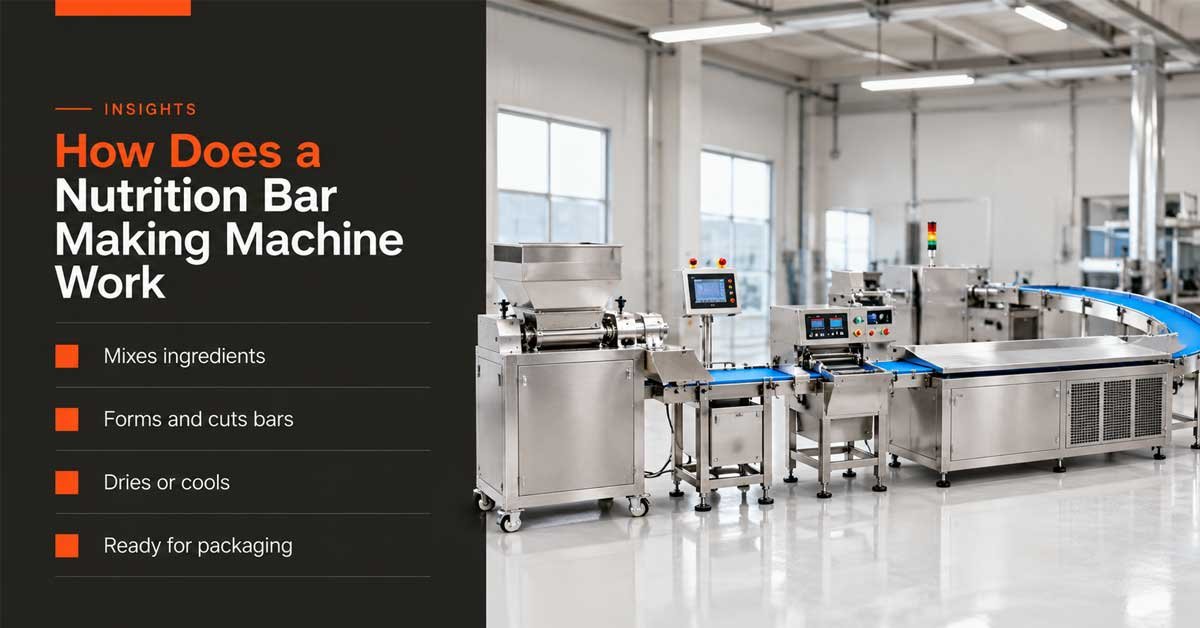
The working process depends on the product formulation and machine configuration. A typical manufacturing workflow follows this sequence:
Ingredient Preparation
The ingredients like cereals, protein powder, nuts, seeds, dried fruits, and binding agents are processed as per the recipe. The process of cleaning, roasting, or sizing, if needed, takes place prior to mixing.
Mixing
Prepared materials are mixed in order to attain the desired consistency and distribution. The choice of mixer is influenced by the nature of the materials to be mixed.
Forming
The mixture is shaped using an extrusion-based or slab-forming system. The choice depends on whether the mixture is cohesive and sticky or contains larger solid inclusions.
Cooling and Cutting
The formed product may require cooling or stabilisation before cutting. The cutting system divides the product into individual bars according to the required dimensions.
Coating and Packaging
There are some nutrition bars that require chocolate coating. After any needed cooling process, the bars are transferred to the packing stage, where they get ready for shipment.
Key Features to Look for in a Nutrition Bar Forming Machine
A suitable nutrition bar forming machine should match the product formulation and provide consistent output under the intended operating conditions.
Suitable Forming Technology
The machine must be capable of supporting the desired consistency of the mixture. Dense and cohesive products are best for extrusion, but inclusion-filled mixtures might do better with slabbing.
Consistent Bar Dimensions
The forming and cutting systems should accommodate the required bar weight, width, thickness, and length. Ask the supplier about achievable tolerances for your specific recipe.
Controlled Feeding
A consistent supply of mixture helps maintain stable forming and reduces interruptions during production.
Cutting and Forming Integration
A nutrition bar machine with cutting and forming can streamline the transition from continuous product formation to individual bars. This can reduce manual handling and help maintain uniform dimensions.
Hygienic Construction
Food-contact components must use appropriate food-grade materials and facilitate easy cleaning. Accessible components may make maintenance and product changeovers easier.
Production-Line Compatibility
The machine should work effectively with the mixer, cooling system, conveyors, and packaging equipment. An imbalance between production stages can create bottlenecks.
Nutrition Bar Machine Capacity per Hour
The nutrition bar machine capacity per hour depends on several factors rather than machine speed alone.
Important considerations include:
- Formulation and consistency of the product
- Weight and size per bar
- Stability of feed
- Speed of forming
- Number of lines of production
- Speed of cutting
- Cooling requirement
- Cleaning time and product changeover time
A machine that produces bigger bars will produce fewer units per hour than a machine that produces smaller bars. Likewise, a fast-forming machine might fail to meet the required production levels due to lack of sufficient cooling and packing capacities.
In comparing the different machines, find out whether the capacity quoted is based on the mixture, formed products, or cut bars. Determine the expected performance by using the intended recipe and product sizes.
How to Choose a Nutrition Bar Machine
Understanding how to choose a nutrition bar machine requires evaluating the complete production process, not simply comparing individual machine features.
Define Your Product Range
Decide what kind of bar you are going to make, such as cereal bars, granola bars, protein-rich nutrition bars, date bars, nut bars, etc. Different formulations can be processed differently.
Evaluate the Recipe
The composition of ingredients, moisture content, properties of binders, and inclusion size will have an effect on the mixing/forming processes to be used. This information should be passed to the manufacturer before deciding on the equipment to use.
Determine Production Requirements
Estimate the expected output per hour and consider realistic future demand. The capacity should meet production targets without creating unnecessary underutilisation.
Confirm Bar Dimensions
Specify the required weight, width, thickness, and length. Check whether the forming and cutting systems can consistently produce the desired format.
Assess Cooling and Packaging
Determine whether the product needs cooling before cutting, coating, or packaging. The downstream equipment should be compatible with the expected production output.
Review Maintenance and Support
Confirm cleaning procedures, spare-parts availability, operator training, installation, and after-sales assistance before purchasing.
Best Nutrition Bar Making Machine for Startups
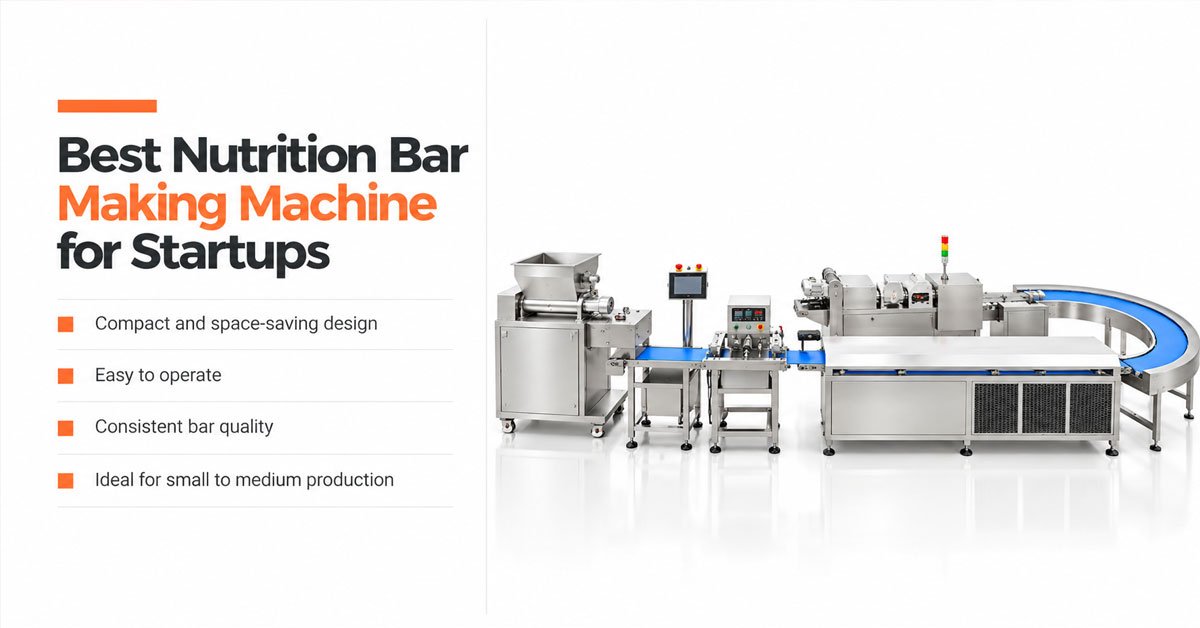
The best nutrition bar making machine for startups would be one that would work well with the intended product, existing demand, and infrastructure.
A compact or modular plant design that includes basic processes such as mixing, forming, and cutting may be helpful for startups. Cooling, coating, or packaging machinery may be added as per the product and manufacturing needs.
Before choosing a machine, evaluate:
- Compatibility with the intended recipe
- Forming process technology
- Ease of operation and cleaning
- Production capability
- Available factory space and utilities
- Packaging needs
- Installation and training assistance
- Future growth potential
A startup producing sticky, cohesive bars may need an extrusion-based system, whereas a business producing bars with large cereal or nut inclusions may need to assess slab forming.
Understanding Nutrition Bar Machine Price and Investment Factors
The nutrition bar machine price depends on the machine configuration, production capacity, automation level, and supporting equipment required.
Organizations evaluating the cost of an automatic nutrition bar machine in India must compare the total specifications rather than considering only the major forming machine individually.
Factors affecting the overall investment include:
| Factor | What to Evaluate |
| Machine configuration | Standalone forming equipment or integrated production line |
| Production capacity | Required throughput and finished output |
| Forming technology | Extrusion or slab forming |
| Cutting equipment | Required dimensions and cutting arrangement |
| Cooling system | Product-specific cooling requirements |
| Automation | Manual, semi-automatic or integrated operation |
| Packaging integration | Compatibility with the intended packaging format |
| Installation | Commissioning, utilities and layout requirements |
| Technical support | Training, maintenance and spare-parts availability |
A full installation might also call for mixers, conveyors, coating facilities, and packaging equipment. Companies should determine their whole production process before asking for an estimate.
How to Evaluate a Nutrition Bar Machine Manufacturer in India
Choosing a reliable nutrition bar machine manufacturer in India is important for establishing consistent commercial production.
Before selecting a supplier, assess:
- Experience with food processing machines
- Knowledge of nutrition bar formulas and forming requirements
- Design and specifications of the machine
- Suitability for your formula and bar size
- Installation and commissioning plan
- Operator training and maintenance service
- Availability of spare parts
- Compatibility with existing or future equipment
A suitable nutrition bar machine supplier should understand your production requirements and explain the capabilities and limitations of the proposed system.
Before you buy nutrition bar machine equipment, share your recipe, target output, bar dimensions, packaging needs, and factory requirements. This helps the supplier recommend a suitable configuration.
Why Choose Foodsure for Nutrition Bar Processing Equipment?
Foodsure manufactures machinery that can be used in the commercial production of bars. The choice of equipment depends on the formulation, method of formation, production volume, and further processing requirements.
When requesting a nutrition bar machine quote, provide details about your recipe, target production capacity, bar dimensions, forming method, and packaging format. Also confirm installation, training, warranty coverage, maintenance support, and spare-parts availability.
Conclusion
The use of a nutrition bar making machine aids in shaping the bars efficiently while reducing forming, cutting, and handling operations. It is important to consider various factors such as the formula used, the nature of the ingredients, among others, in selecting the proper equipment.
Before choosing any nutrition bar extruder or nutrition bar production line, factors such as forming technology, cutting accuracy, cooling, hygiene, packaging compatibility, and supplier support should be considered. Comparing all machines can enable businesses to set up a successful nutrition bar manufacturing business.
Frequently Asked Questions
1. What is a nutrition bar making machine used for?
A nutrition bar making machine is used to form prepared ingredients into bars. Depending on the configuration, the production system can include mixing, forming, cooling, cutting, coating, and packaging equipment.
2. What is the difference between a nutrition bar extruder and a slab-forming machine?
A nutrition bar extruder pushes a cohesive mixture through a forming die, while a slab-forming machine spreads or compresses the mixture into a sheet before cutting. The right method depends on the recipe and ingredient structure.
3. What determines nutrition bar machine capacity per hour?
Production capacity will depend on recipe consistency, size of the bars, feeding, forming rate, cutting rate, cooling, and downstream process needs. The true capacity needs to be validated for the desired product.
4. What affects the automatic nutrition bar machine price in India?
The investment depends on capacity, automation, forming technology, cutting and cooling equipment, packaging integration, installation, and technical support.
5. What should I check before requesting a nutrition bar machine quote?
Give information about the recipe details, bar size, production output, automation, packaging and plant construction and setup requirements. Verify warranty, training, maintenance, and after-sales service.




