
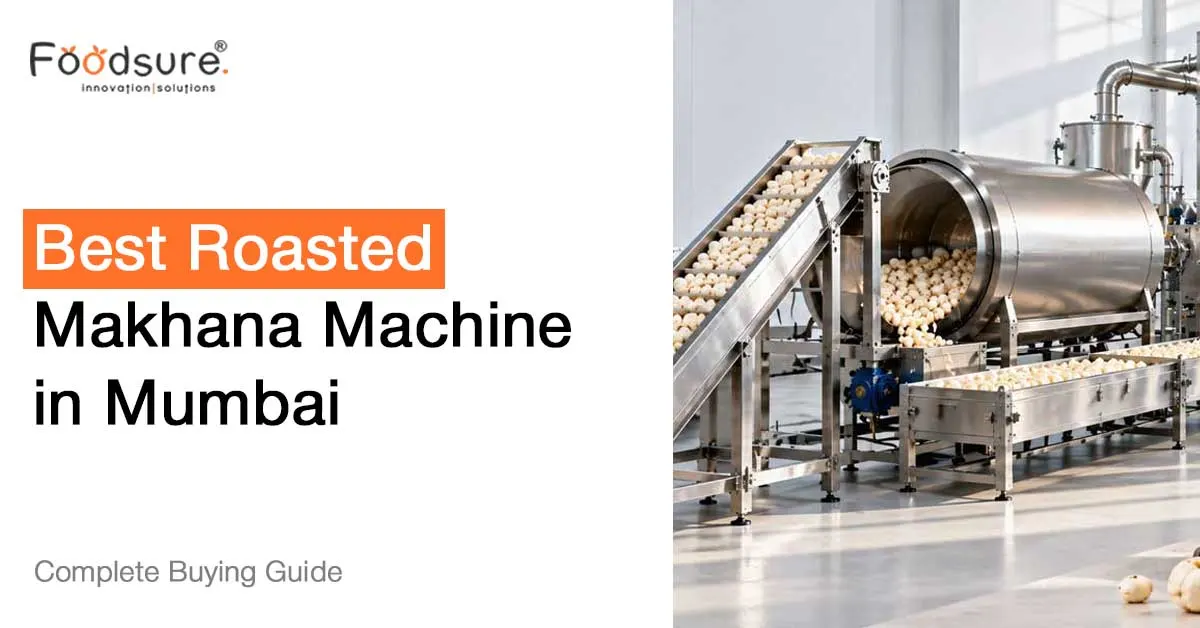
Makhana has become a popular packaged snack in India, creating new business opportunities for food processors and snack producers in Mumbai. Roasted makhana is especially promising because it can be sold as a ready-to-eat snack, part of a flavored snacks range, or even in bulk to other food companies.
For manufacturers planning commercial production, choosing the best roasted makhana machine in Mumbai can help improve roasting consistency, production efficiency, and overall process control. The right machine should match the required production capacity, available space, product requirements, and future expansion plans.
What Is a Roasted Makhana Machine?
The roasted makhana machine is a food processing machine used for roasting makhana through controlled heating. This machine assists manufacturers in shifting from manual roasting to a more consistent process.
The machine incorporates both controlled heating and proper movement of the product to allow the makhana to be heated uniformly.
A typical roasting process includes:
The exact configuration depends on the machine design, production capacity, and final product requirements.
Why Use a Commercial Roasted Makhana Machine?
However, manual roasting may work well for extremely small amounts, but it is hard to maintain consistency of production when larger amounts are involved. The commercial roasted makhana machine offers an organized solution to this problem.
Key advantages include:
- Uniform roasting in all batches
- Greater control of the heating process
- Less need for human interference
- Increased production efficiency
- Enhanced production process
- Easier coordination with other processing stages
- More suitable for commercial snack production
For businesses supplying retail markets, consistency becomes particularly important because variations in roasting can affect texture, appearance, and customer experience.
How Does a Makhana Roaster Machine Work?
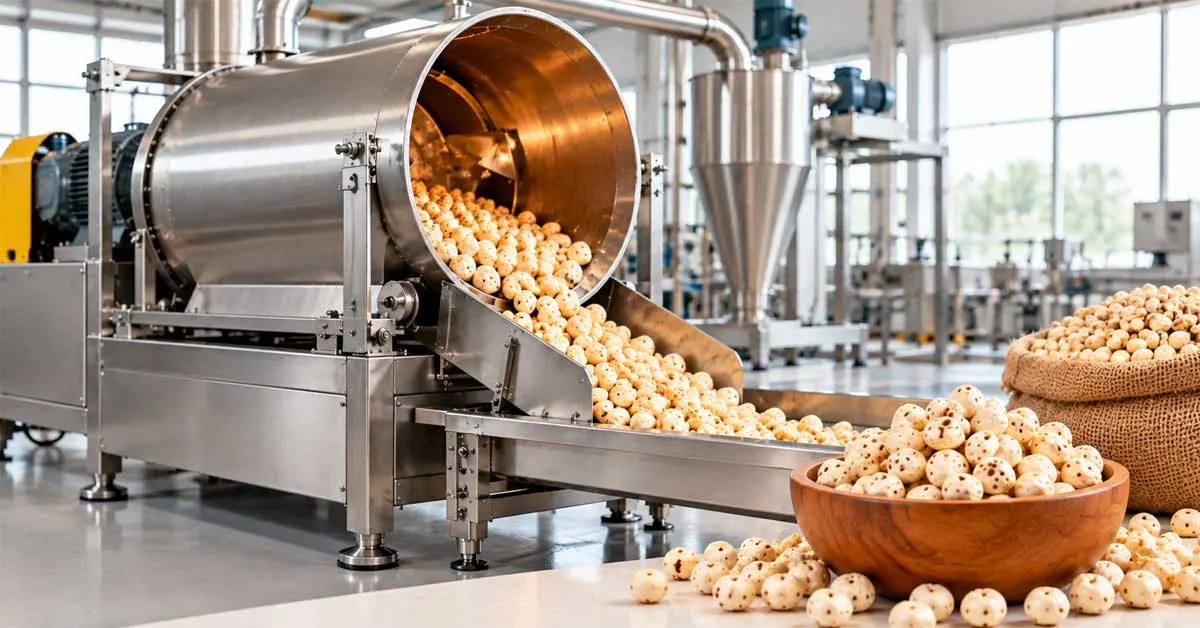
A makhana roaster heats the product while maintaining controlled movement. The raw makhana enters the roasting chamber, where heat is applied according to the operating requirements.
Movement of the product allows different parts of it to be exposed to heat, thereby promoting better roasting.
After the process of roasting is completed, the product can then be moved to another place for cooling prior to flavouring, grading, or packing.
Features to Look for in a Roasting Machine
When looking for the best roasted makhana machine in Mumbai, businesses should evaluate the complete machine configuration rather than focusing only on purchase price.
Controlled Heating
Applying heat uniformly is necessary for successful roasting. It is therefore important to have an appropriate heating system depending on the intended production process.
Uniform Product Movement
The roasting chamber should provide effective product movement so that makhana receives reasonably consistent heat exposure.
Hygienic Construction
Food-processing equipment should be constructed using suitable materials and surfaces that can be cleaned and maintained properly.
Appropriate Capacity
The machine capacity needs to be related to the projected production by the business. Overly small machines will lead to bottlenecks in production, while overly large machines will mean unnecessary expenses.
Easy Operation
Operators should be able to monitor and control the roasting process without unnecessary complexity.
Maintenance Access
Important components should be accessible for inspection, cleaning, and routine maintenance.
Industrial Makhana Roasting Equipment
Businesses handling larger production volumes may require industrial makhana roasting equipment capable of supporting continuous or high-capacity operations.
The industrial systems used for roasting can be incorporated into an extensive system that includes cleaning, drying, grading, flavoring, cooling, and packaging.
A larger setup may follow this sequence:
Not every manufacturer needs a complete line. Equipment should be selected according to the actual product and production model.
Choosing a Makhana Roaster Machine Supplier in Mumbai
Choosing the right supplier is an important part of machinery investment. A reliable makhana roaster machine supplier Mumbai should be able to understand the manufacturer’s production requirements and recommend an appropriate machine configuration.
Before finalising a supplier, businesses should consider:
- Machine capacity
- Build quality
- Heating system
- Degree of automation
- Installation demands
- Maintenance
- Availability of spare parts
- Technical assistance
- Compatibility with existing equipment
It is also useful to communicate expected production volume, available installation space, desired automation, and the type of makhana products being manufactured.
Manual Roasting vs Machine Roasting
| Factor | Manual Roasting | Machine Roasting |
|---|---|---|
| Labour requirement | High | Lower |
| Roasting consistency | Operator dependent | More controlled |
| Production capacity | Limited | Higher |
| Process control | Variable | Better controlled |
| Scalability | Limited | Better suited to commercial production |
| Integration | Difficult | Easier |
For businesses that are starting small, manual processing may initially be practical. However, mechanised roasting becomes increasingly valuable as production volumes grow.
How to Select the Best Roasted Makhana Machine
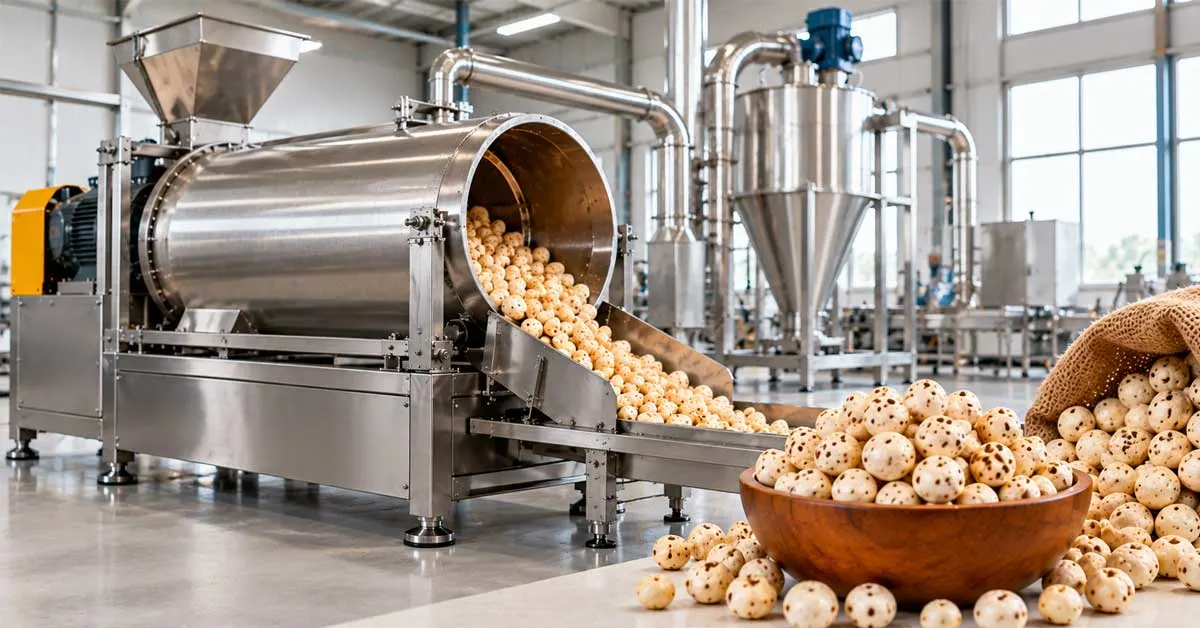
The term “best” depends on the requirements of the business. There is no single machine configuration suitable for every manufacturer.
1. Determine Required Capacity
Determine current production needs and realistic future demands. The machine must be able to cope with the anticipated work load without providing any unnecessary excess capacity.
2. Evaluate Heating Performance
Consistent heating is essential for maintaining product quality. Businesses should understand how the machine distributes and controls heat.
3. Consider Automation
The appropriate automation level depends on production volume, available labour, and desired process control.
4. Check Space Requirements
The installation area should include sufficient room for feeding, discharge, operation, cleaning, and maintenance.
5. Consider Future Expansion
If the business plans to introduce flavoured or packaged makhana products, the roasting machine should ideally fit into the planned future processing line.
Makhana Roasting and Product Quality
The roasting process itself affects the ultimate texture of the makhana. Inconsistencies in heat can lead to variations between individual pieces or batches.
Roasting machines can assist in creating more controlled processing conditions. The operation of the machine, quality of raw materials, load conditions, and maintenance affect the final output as well.
For this reason, manufacturers need to create consistent operation processes and check on the roasting results periodically.
Maintenance and Hygiene
The equipment used to roast the products needs proper maintenance. It is because particles of the product may accumulate inside and outside the equipment.
Basic maintenance practices include:
- Cleaning after production
- Removing product residues
- Inspecting heating components
- Checking moving parts
- Monitoring unusual noise or vibration
- Inspecting electrical connections
- Following the recommended maintenance schedule
Preventive maintenance can help identify wear or operating problems before they lead to unexpected downtime.
Roasted Makhana Machines in Mumbai: What Businesses Should Consider
The food processing business in Mumbai consists of firms ranging in size from small snack makers to commercial processors. Thus, there is a huge variation in machinery needs.
Firms need to compare the machine according to its capacity, construction, automation, maintenance needs, supplier support, and compatibility with the process.
Those evaluating roasted makhana machines in mumbai should also consider how the roasting machine will fit into their overall production setup rather than purchasing it as an isolated piece of equipment.
Understanding Machine Investment
The total cost for purchasing the coffee roasting machinery is dependent upon various aspects, including capacity of machines, automation, structure, type of heating, customization, and support equipment.
The complete installation requirement of the company needs to be taken into account while deciding the cost rather than just taking into account the cost of the basic machine itself.
For businesses researching machinery investment, understanding the makhana machine price in India can provide a starting point for comparing different equipment configurations and production scales.
Conclusion
Selecting the best roasted makhana machine in Mumbai involves having an in-depth knowledge of production capacity, roasting needs, automation, machine structure, space, maintenance, and further expansion.
A suitable commercial roasted makhana machine can help manufacturers improve roasting consistency, reduce repetitive manual work, and create a more organised production process. Larger manufacturers may benefit from industrial makhana roasting equipment that can be integrated with other stages of a complete processing line.
Instead of picking out a machine only by its cost, companies need to consider how well the machine would work for their material type, output level, products, and future processes.
Have a Question? Let’s Connect
Need expert guidance on food processing machines, production setup, or process optimization? Our team is ready to help you choose the right solution for your business.
Frequently Asked Questions
What is the best roasted makhana machine for commercial production?
The best machine depends on production capacity, heating requirements, automation level, available space, and the manufacturer’s product requirements.
Is a commercial roasted makhana machine suitable for small businesses?
Yes, but only if the capacity of the machine is equal to the real production needs of the business. Smaller firms should not invest in extra capacity.
What should I check before choosing a makhana roaster machine supplier in Mumbai?
Consider machine construction, capacity, heating system, automation, installation support, maintenance, spare parts, and after-sales technical assistance.
Can industrial makhana roasting equipment be integrated with other machines?
Yes. Roasting equipment can be incorporated into processing lines containing cleaning, drying, grading, cooling, flavouring, and packaging systems.
How can I maintain a makhana roasting machine?
Routine cleaning, checking of heating and moving parts, cleaning of product residues, and preventive maintenance in accordance with the manufacturer’s guidelines may ensure reliable functioning of the machine.




