
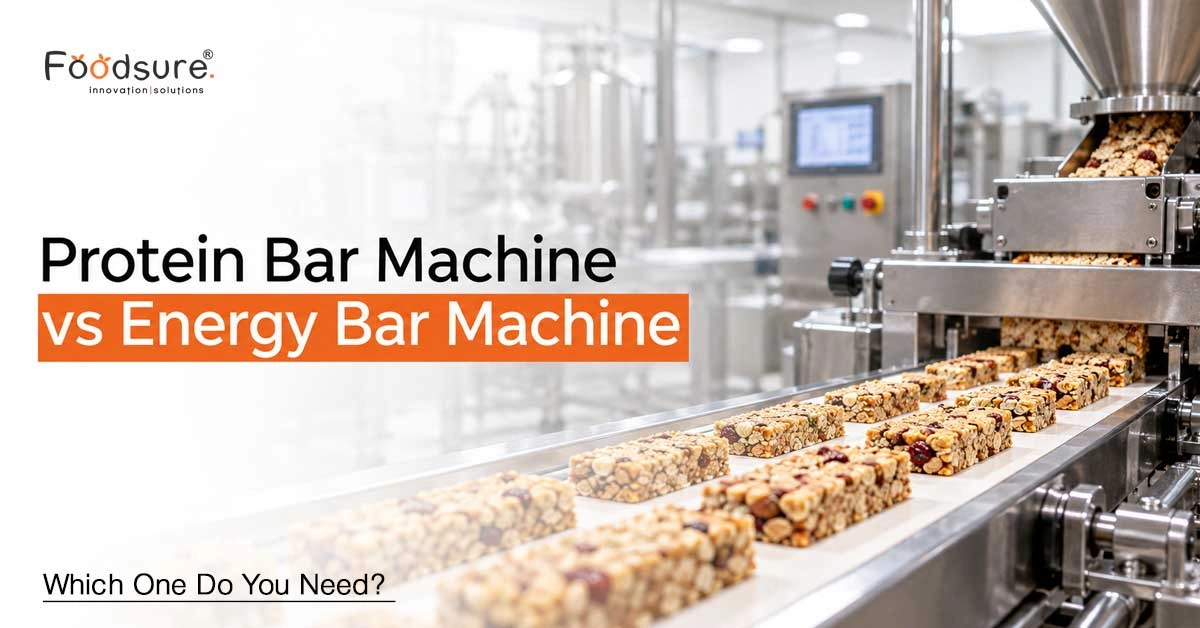
Every entrepreneur working in the food sector has had one moment when the idea is already formed in their mind, market research is complete, the gaps are clear, and suddenly there comes only one question: what machine do I choose? It is very much like standing at the forks in the desert. Both forks look similar at first sight, and both forks lead somewhere good. Pick the wrong one, and you will be faced with considerable consequences of that choice. In the GCC food manufacturing industry, where demand for functional snacks outpaces most manufacturers’ abilities to cater to it, such forks are frequent. And usually, they come in the following form: Protein Bar Machine vs Energy Bar Machine.
They might seem alike. And in a way, they are. But differences between those two in formulation capabilities, engineering design, compliance issues, and other important aspects are significant enough to affect the success of an entire line of products.
This guide was made to help you make the right choice.
What Is a Protein Bar Machine?
Protein bars, from a formulation point of view, are a challenging product. These contain large amounts of whey protein concentrate, casein, pea protein, or soy isolate, which are heavy, often hygroscopic, and notoriously sticky when heated. A Protein Bar Machine is designed to handle precisely this sort of challenge.
The manufacturing process usually starts with a high-shear mixing step, wherein protein powders are mixed with binding agents, syrups, oils, and humectants at a certain temperature. The material is then sent to the forming unit to make the bar of uniform size, either through extrusion or a compression process. Post-forming, bars go through a cooling tunnel before coating, slicing, and packaging.
There is a certain tolerance level at each step in the process. Excessive heat will cause denaturation of proteins. Insufficient mixing will cause the bar to break up. It is imperative to maintain these parameters at all times throughout the production process.
Key Features of a Protein Bar Production Line
A well-configured Protein Bar Manufacturing Line includes:
- High-torque ribbon or planetary mixers capable of handling thick, viscous doughs
- Temperature-controlled forming heads or extrusion dies
- Integrated cooling tunnels (often multi-zone)
- Enrobing units for chocolate or compound coating
- High-speed wire or ultrasonic cutters for clean bar separation
- CIP (Clean-in-Place) compatibility for hygienic changeovers
Types of Protein Bars This Machine Handles
- A Soft Dough Protein Bar Machine is especially suited for chewy, moist bar formats.
- A Protein Bar Extrusion Machine handles denser, slab-formed bars.
The same line, when configured correctly, can manage whey-based, plant-based, keto, and collagen bar formats, each with its own temperature and pressure profile.
What Is an Energy Bar Machine?
Energy Bars are made from a different set of raw materials. The formulation of these energy bars incorporates the use of oats, dates, nuts, seeds, honey, dried fruits, and rice crisps, which are bulkier and irregular in texture and moisture compared to protein concentrate. An Energy Bar Machine should take this into consideration and process the material accordingly without excessively processing these ingredients.
The processing usually involves mixing more gently than the protein bar process and involves the use of paddle or sigma mixers to avoid breaking down these ingredients. Afterward, the mixture will be spread and pressed into a slab form, followed by guillotine or rotary cutting. In some processes, there will be an additional process of coating or drizzling.
Key Features of an Energy Bar Production Line
An Energy Bar Production Line is characterised by:
- Gentle, low-shear mixing systems
- Slab-forming or moulding conveyors with adjustable thickness
- Rotary or guillotine cutters with precise portion control
- Optional enrobing or drizzle finish
- Compact footprint relative to output capacity
Types of Energy Bars This Machine Produces
From Medjool date bars deeply familiar across the GCC to oat-and-nut clusters, granola slabs, and seed-based snack bars, an Energy Bar Machine covers a wide range of products that sit comfortably in Middle East retail, hospitality, and health-food markets.
Protein Bar Machine vs Energy Bar Machine: Core Differences
This is the question at the centre of everything. Here is how the two stack up across the parameters that matter most to a buyer:
How to Choose the Right Bar Manufacturing Machine for Your Business

Start With Your Product Type and Target Consumer
Before any machine discussion, one must ask oneself the following:
“What type of bar am I producing and who is consuming it?”
A whey protein bar with a focus on gym consumers in Dubai represents a totally different product, thus totally different machine requirements, compared to a date and nut bar designed to be sold via supermarkets in Riyadh.
Budget, ROI, and Total Cost of Ownership
Protein bar machine pricing for the GCC market depends on prices, location, customizations as per the requirements, and much more. The capacities include 100kg/hr production line, with additional options of 50kg/hr and 200kg/hr protein bar manufacturing machines.
Energy bar lines, however, have the same pricing as a protein bar line of the same capacity.
Can One Machine Handle Both Product Types?
Sometimes it may be possible; but then again, changeovers take time, as well as effort to clean up. In all honesty, it may be more relevant for companies to ask themselves a different question: what product has more of a market justification at the moment? Think about it and expand in the future.
Why Middle East Food Manufacturers Are Investing in Bar Production Lines
1. Growing Demand for Functional Snacks in the GCC
GCC’s market for functional food is experiencing steady growth due to increasing health consciousness, Saudi Arabia Vision 2030 lifestyle programs, and changing preferences from traditional candy to other kinds of food. Protein and energy bars hold a unique spot; they are easily accessible, portable, and gaining more and more acceptance as a meal replacement.
2. Private Label and Contract Manufacturing Opportunities
Retailers such as Carrefour and Lulu Hypermarket are making their own lines of functional food and nutrition products. This makes it possible to enter the market through contract manufacturing of nutrition products for these retailers’ specifications. Another high-profit business idea is to make contracts with regional companies that are not quite ready to manufacture their products on their own yet.
3. Import Substitution and Local Production Trends
Saudi Arabia, the UAE, and Kuwait are all incentivising local food production as part of broader economic diversification strategies. Importing protein and energy bars from Europe or North America carries cost, shelf-life, and supply-chain risks that local production eliminates. For food entrepreneurs with access to the right machinery, this policy environment is a genuine commercial tailwind.
At Foodsure Machines, these conversations happen every week with buyers ranging from first-time food entrepreneurs to established FMCG groups expanding into functional nutrition. The questions are always the same. The answers depend on one thing: knowing your product before you specify your machine.
Why GCC Investors Should Import Machines From India
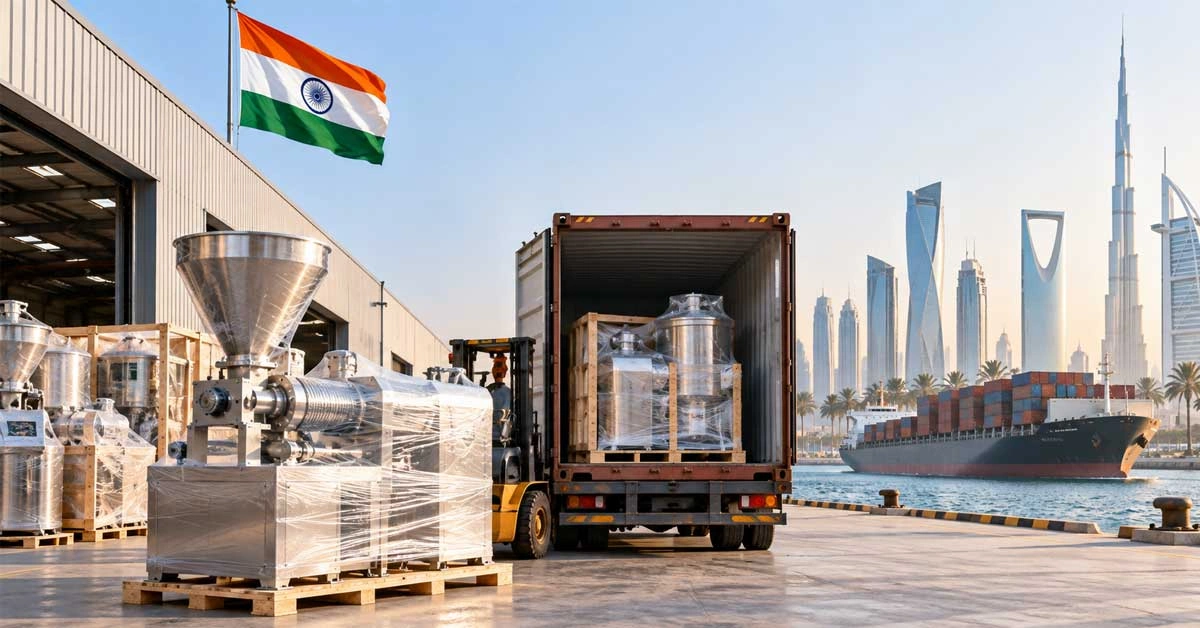
For GCC and Middle Eastern food manufacturers, choosing the right machinery supplier is not only about the machine price. The supplier’s ability to customise the line, provide technical support, meet required standards, and deliver a commercially viable solution also matters. India has become an increasingly relevant sourcing market for food processing and industrial machinery, with machinery and mechanical equipment already accounting for a significant share of India’s exports to the GCC.
Competitive Equipment Costs
Indian machinery manufacturers can offer competitive pricing across semi-automatic, automatic, and industrial production lines. For a food business entering the protein or energy bar market, this can make it easier to match the machine investment with the planned production capacity instead of overinvesting from the beginning.
Customisation for Different Formulations
Bar manufacturing is rarely a one-size-fits-all process. Protein bars may require high-torque mixing, controlled extrusion, cooling, and precise cutting, while date, nut, cereal, and energy bars require gentler processing. Indian manufacturers can configure machines around the formulation, capacity, automation level, and product format required by the buyer.
Strong Manufacturing and Engineering Capability
India has an established food processing machinery manufacturing base. Government data has recorded substantial exports of food processing machinery under HS code 8438, covering machinery used across several food manufacturing applications. This gives GCC buyers access to a wider manufacturing ecosystem rather than relying only on imported machinery from Europe or East Asia.
Easier Access to the GCC Market
India already has strong trade connections with the Gulf region. India and the UAE have also operated under the India-UAE CEPA since May 2022, with the agreement providing a framework for more predictable and simplified customs procedures. For UAE-based buyers, this established trade relationship can make India a practical sourcing market for industrial equipment.
Better Scope for Scalable Production
A growing food brand may not need a 200 kg/hr or industrial-scale line on day one. Indian suppliers can offer different capacity configurations, allowing manufacturers to start with a suitable production capacity and expand as demand increases. For protein and energy bar businesses, this could mean selecting a 50 kg/hr, 100 kg/hr, or 200 kg/hr line based on current production requirements.
Technical Support and Spare Parts
The purchase does not end when the machine reaches the factory. Installation, commissioning, operator training, troubleshooting, replacement parts, and future upgrades can affect the long-term value of the equipment. GCC buyers should therefore evaluate the supplier’s after-sales support and spare-parts availability alongside the initial machine quotation.
Why GCC Investors Choose Foodsure Machines?
When looking for a food processing machine supplier that can match your product formulation, production capacity, automation requirements, and future expansion plans, Foodsure Machines is the right place to start.
Foodsure Machines offers 50 kg/hr, 100 kg/hr, and 200 kg/hr protein and energy bar production configurations, allowing GCC manufacturers to choose a line based on their current requirements without overinvesting in unnecessary capacity. Each setup can be configured around factors such as bar dimensions, formulation, forming method, automation level, cooling requirements, and finishing process.
The machines are designed for commercial and industrial food production, with food-grade stainless-steel construction and configurable production systems. From mixing and forming to cooling, cutting, and optional coating, the line can be planned around the specific product you intend to manufacture.
More importantly, Foodsure Machines works with buyers during the machine selection and production-line configuration process, helping them identify the equipment specifications suited to their formulation and expected output.
So, if you’re a GCC investor looking to source cost-effective, configurable, and scalable food processing machinery from India, Foodsure Machines can be your manufacturing partner from machine selection to production-line setup.
Have a Question? Let’s Connect
Need expert guidance on food processing machines, production setup, or process optimization? Our team is ready to help you choose the right solution for your business.
Frequently Asked Questions
What is the difference between a protein bar machine and an energy bar machine?
The protein bar manufacturing equipment can be used for dense, high-protein formulations which require high shear mixing, extrusion or compression forming, and multiple zone cooling. The energy bar manufacturing equipment uses whole-ingredient and carbohydrate-rich formulations with lower mixing and slab forming systems. It comes down to formulation compatibility and engineering configurations rather than types of products.
Can I use the same machine to make both protein and energy bars?
Some multi-format lines support both product types through interchangeable tooling and adjustable settings. For low to mid-volume operations, this works well. At industrial scale, dedicated lines for each product type deliver better efficiency and cleaner changeovers.
How much does a bar manufacturing machine cost in the Middle East?
At Foodsure Machines, we offer protein and energy bar production lines in 50 kg/hr, 100 kg/hr, and 200 kg/hr capacities to suit different production requirements. Our 100 kg/hr fully automatic production line starts at approximately AED 107,000, while pricing for 50 kg/hr and 200 kg/hr configurations varies based on the level of automation, machine customization, and optional equipment.
What certifications should a bar machine have for GCC export?
Look for CE-certified machines built from food-grade stainless steel that support halal-compliant production environments. Suppliers should provide documentation that supports SFDA (Saudi Arabia) and ESMA (UAE) audits. Ask your supplier explicitly whether their machines have been installed in GCC-compliant facilities.
What is the production capacity of a bar making machine?
Capacity varies significantly by machine type. Semi-automatic machines produce roughly 50 kg/hour. Industrial automated lines can handle 200 kg/hour. For Middle East manufacturers targeting retail or private labels at scale, a mid-range line with 100 kg/hour output is typically the practical starting point.
Get the Right Machine for Your Bar Production Line
The protein bar and energy bar markets in the Middle East are not competing; they are growing in parallel, serving different consumers, different occasions, and different retail channels. The machine you choose should reflect not just what you want to produce today, but where your brand is going in three to five years.
If you are still working through the decision, the clearest next step is a conversation with someone who has configured lines for both product types across the GCC. That is exactly what the team at Foodsure Machines does without the sales pressure, and with the kind of specificity that actually helps you move forward.




