Starting a protein bar manufacturing business in Sri Lanka requires more than buying a protein bar machine and finding a factory space.You will have to know about the food regulations locally, register the manufacturing facility, develop a formulation which is compatible with locally sourced and imported ingredients, determine the production capacity, and decide on how the final product will be distributed to gyms, retailers, and online consumers.
The opportunity deserves consideration because protein bars in Sri Lanka are developing in tandem with the increased interest in convenient nutrition and sports foods. According to 6Wresearch, protein bar imports witnessed substantial growth from 2023 to 2024. As per Mordor Intelligence, the global market size for protein bars will stand at USD 10.69 billion by 2026, with Asia-Pacific being the fastest-growing region.
This guide highlights the market opportunity, food licensing, protein bar machinery, investment considerations, raw material sourcing, distribution and the risks a new manufacturer needs to plan for.
Is Protein Bar Manufacturing a Good Business in Sri Lanka?
There are many reasons to focus on the category.
The economy of Sri Lanka is on a path of recovery after the major disruption experienced in 2022. According to the Central Bank of Sri Lanka, economic activity was resilient during 2025 due to macroeconomic stabilization and structural reforms.
Recovery is important for the category because it is a convenience and nutrition product. However, recovery should not be confused with evidence that customers will pay premiums.
A new brand still needs to get three things right:
- Product quality
- Price
- Distribution
The local protein bar market also has a useful signal on the supply side. 6Wresearch reports that Sri Lankan protein bar imports increased by 153.33% between 2023 and 2024, with the market tracked across supermarkets, convenience stores, specialty stores and online channels.
That tells us something important: there is already an established route for protein bars to reach Sri Lankan consumers.
The opportunity for a local manufacturer is to determine whether part of that demand can be served through locally produced products with suitable pricing, flavours and positioning.
The Global Protein Bar Market Is Moving Toward Asia
The wider market gives Sri Lankan manufacturers another reason to pay attention.
According to Mordor Intelligence, the global protein bar market is estimated at USD 10.69 billion in 2026 and is forecast to reach USD 17.17 billion by 2031, representing a CAGR of 9.92%. Asia-Pacific is identified as the fastest-growing regional market, with a projected CAGR of 9.05% during 2026–2031.
Mordor also notes that protein bars are increasingly being consumed beyond traditional bodybuilding audiences, including as workplace snacks, travel food and convenient meal substitutes.
That matters for Sri Lanka.
A protein bar brand does not necessarily have to position itself only as a bodybuilding product. There is room to develop products for:
- Gym and fitness consumers
- Outdoor and trekking customers
- Students
- Working professionals
- Travellers
- Consumers looking for convenient higher-protein snacks
The Asia-Pacific snack bar market shows a similar shift. Mordor Intelligence reports that protein bars accounted for 63.43% of Asia-Pacific snack bar revenue in 2025 and that online retail is one of the faster-growing distribution channels.
Sri Lanka’s Protein Bar Market Is Still Developing
The strongest local evidence is not a claim that Sri Lanka has no competition.
Instead, the available data shows a market where imports are an important part of supply and where the category is still developing.
6Wresearch’s Sri Lanka protein bar study tracks imports, distribution channels, competitive activity and market forecasts through 2032. Its import analysis reports a 153.33% increase in protein bar imports between 2023 and 2024.
This gives a new manufacturer a clear question to investigate:
Can a locally manufactured bar compete with imported products on price, freshness, local flavour preferences and distribution?
That is a much more useful question than simply calling the market untapped.
What Licenses Do You Need to Start a Protein Bar Business in Sri Lanka?
The regulatory structure involves several different areas, so it is better to think of the process as a compliance stack rather than a single licence.
Depending on the business model, you may need to address:
- Company registration
- Food premises registration
- Food manufacturing and hygiene requirements
- GMP certification
- Product certification where applicable
- Food labelling requirements
- Tax registrations
- Export-related approvals if selling overseas
- Additional certifications required by a particular export market
The exact requirements should be confirmed with the relevant Sri Lankan authorities before construction or commercial production begins.
Food Premises Registration
This is one of the clearest requirements.
Sri Lanka’s Ministry of Health states that all food establishments need to be registered with the food authority of the relevant area under the Food Act No. 26 of 1980 and the Food Registration of Premises Regulations.
The Ministry’s food-control information also describes inspection, documentation and other steps associated with food establishment registration.
For a protein bar manufacturing unit, this means the factory should be planned around food hygiene from the beginning.
That includes:
- Factory layout
- Raw material storage
- Production areas
- Cleaning and sanitation
- Personnel hygiene
- Pest control
- Packaging
- Finished product storage
- Waste handling
Trying to retrofit these requirements after installing machinery can create unnecessary delays.
SLSI GMP Certification
The Sri Lanka Standards Institution operates a Good Manufacturing Practices certification scheme covering food and beverage manufacturing.
SLSI describes GMP as a system covering areas such as facility design, raw material handling, process control, cleaning and sanitation, personal hygiene, transportation, training, pest control, waste management, packaging and labelling.
SLSI’s current GMP material also references SLS 143:2022 as part of its food GMP requirements.
GMP is therefore highly relevant when setting up a commercial protein bar manufacturing facility, particularly if you plan to supply established retailers or export markets.
Is the SLS Mark Mandatory for Protein Bars?
This point needs to be handled carefully.
The SLSI states that SLS Mark product certification is generally voluntary, although certain products have been made subject to compulsory SLS certification through government directions.
So it would be inaccurate to state that every protein bar manufacturer in Sri Lanka automatically needs an SLS Mark.
Instead, check whether the specific protein bar product falls under a compulsory standard or whether voluntary SLS Mark certification is commercially useful for your target market.
SLSI’s product certification process includes application review, assessment, testing and surveillance for certified products.
Company Registration
The manufacturing company also needs to be legally established under Sri Lankan company law.
The exact registration structure depends on whether the business is being established as a private company, partnership or another legal form.
For an investor planning a dedicated food manufacturing unit, company registration should be completed alongside tax, premises and industry planning rather than treated as a separate final step.
Export Compliance
If the business eventually sells protein bars outside Sri Lanka, additional documentation will apply.
The Ministry of Health’s Food Control Administration Unit has a separate food establishment export-registration process, including manufacturer and exporter information and documentation.
Export markets can also impose their own requirements for:
- Food safety systems
- Product testing
- Labelling
- Halal certification
- Certificates of origin
- Ingredient documentation
- Allergen declarations
So if GCC or Maldives exports are part of the long-term plan, it is better to design the manufacturing and documentation system with export requirements in mind.
Protein Bar Machinery and Manufacturing Setup
Once the compliance structure is understood, machinery becomes the next major decision.
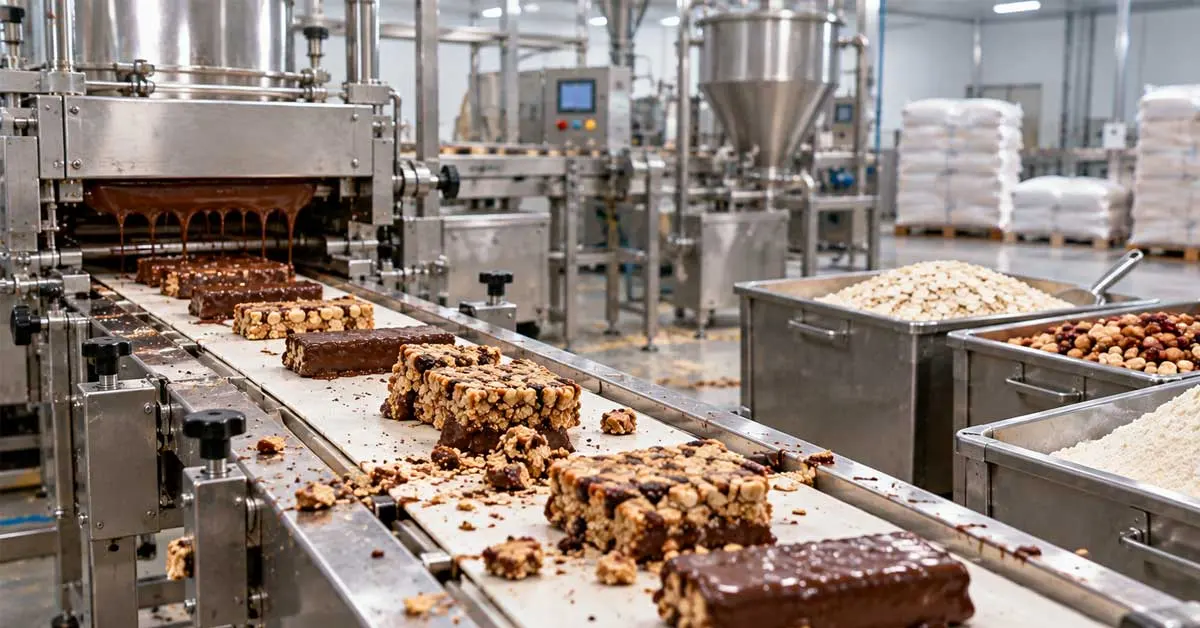
A typical protein bar production line follows a sequence such as:
The exact line depends on the formulation.
Mixing Machine
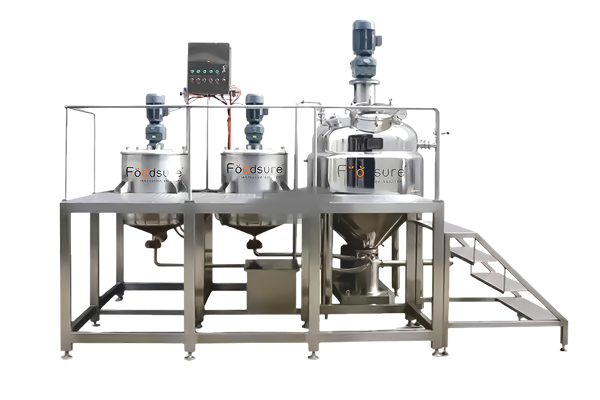
The mixer combines protein powder, binders, sweeteners, nuts, grains, flavours and other ingredients into a consistent mass.
Protein-heavy formulations can behave differently from conventional cereal or bakery mixtures, so the mixer needs to be selected around the actual formulation rather than only the required batch size.
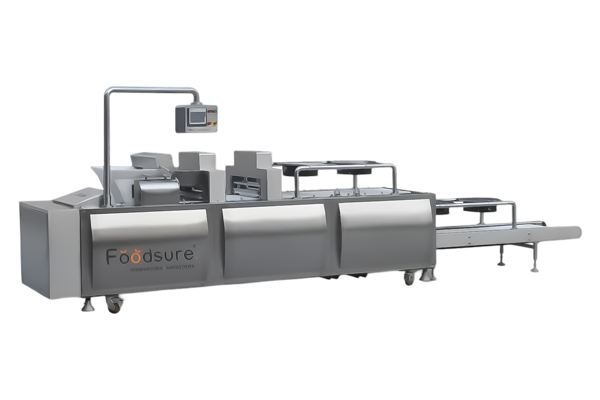
Protein Bar Forming or Extrusion Machine
A forming or extrusion system converts the mixed mass into a continuous slab or bar shape.
A soft dough protein bar machine is particularly useful for formulations where the mixture has a dense or sticky consistency.
The forming stage also determines the consistency of bar dimensions, which later affects cutting and packaging.
Cutting Machine
After forming, the slab is divided into individual bars.
Accurate cutting helps control piece weight and reduces unnecessary variation between bars.
That matters because the finished product’s weight needs to remain consistent with the declared net quantity and nutritional information.
Cooling System
Some formulations need controlled cooling or setting before cutting and packaging.
The exact cooling requirement depends on the formulation, fat system, binder and whether the product is coated.
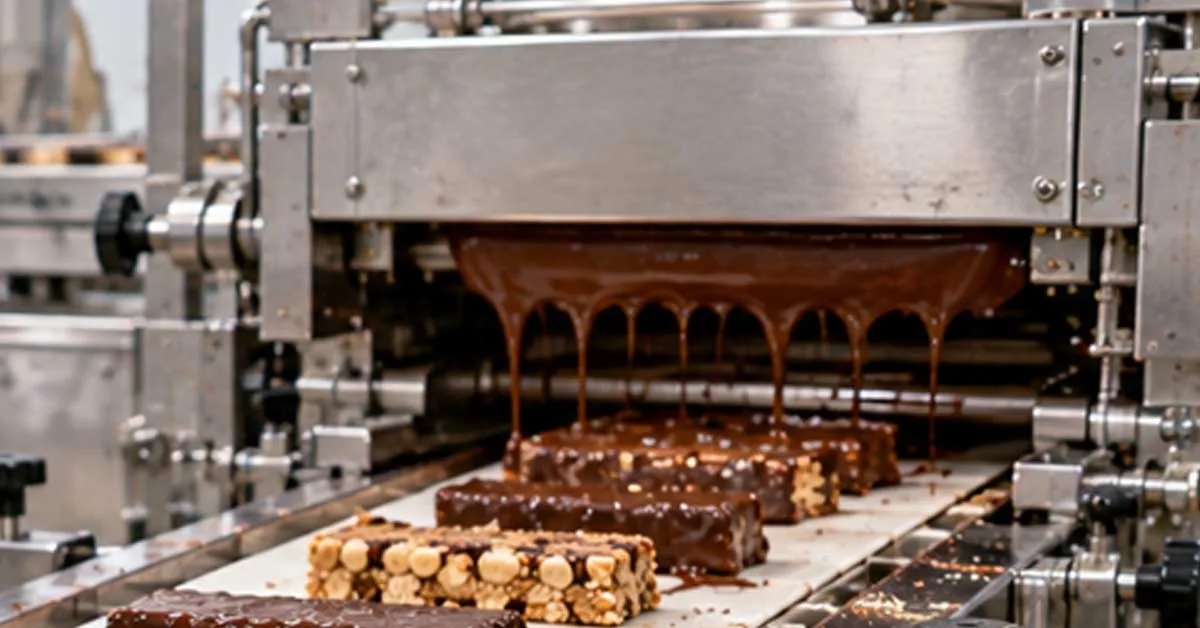
Coating System
A coating machine is optional.
It becomes relevant if the product uses:
- Chocolate coating
- Compound coating
- Yogurt-style coating
- Protein glaze
- Multi-layer coating
A business launching a simple uncoated protein bar does not necessarily need this equipment at the beginning.
Packaging Machine
Individual flow wrapping is common for bar products.
The packaging system needs to provide appropriate protection against moisture, oxygen and physical damage, while also allowing the required product information and batch coding to be included.
Choosing the Right Protein Bar Production Line
Capacity should be selected from expected sales rather than from the maximum amount of product the factory could theoretically produce.
A small brand may need a lower-capacity semi-automatic setup for testing a few SKUs.
An established brand supplying multiple retail chains may need a higher-capacity automated line.
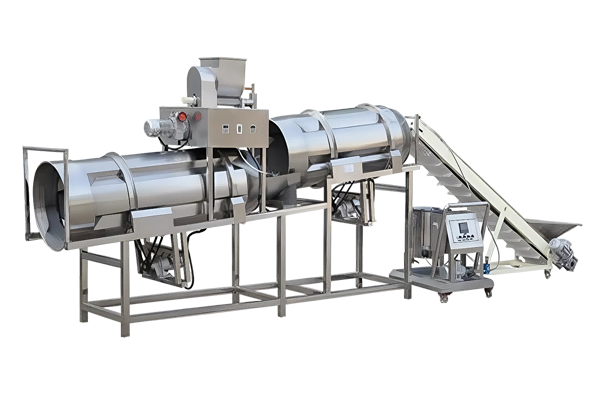
Foodsure Machines publishes different bar-processing configurations for different production capacities. For example, its published functional bar manufacturing systems include configurations around 50 kg/hour, 100 kg/hour and 200 kg/hour, with different power and space requirements.
The important point is that these are specific supplier configurations, not universal industry standards.
A machinery quotation should therefore specify:
- Hourly capacity
- Batch capacity
- Power requirement
- Floor-space requirement
- Contact material
- Automation level
- Cooling requirements
- Cutting system
- Packaging integration
- Installation
- Training
- Warranty
- Spare parts
- After-sales service
Small-Batch vs Semi-Automatic vs Fully Automatic
A useful way to think about the three models is:
The mistake is buying a fully automatic protein bar manufacturing plant before the business knows what it can sell.
At the other extreme, a business with confirmed supermarket or export orders can quickly outgrow a small setup.
Capacity planning should therefore consider the next stage of growth without paying for a line that will remain underused.
How Much Investment Is Needed to Start a Protein Bar Manufacturing Unit in Sri Lanka?
There is no single reliable investment figure for every Sri Lankan protein bar business.
The total project cost depends on:
- Machinery capacity
- Automation
- Factory size
- Number of SKUs
- Formulation
- Packaging format
- Imported ingredients
- Utilities
- Quality-control equipment
- Installation
- Working capital
- Import duties and taxes
This is why a generic statement such as a protein bar plant will always cost ₹8 lakh or ₹45 lakh should be treated carefully.
Supplier quotations provide a better starting point.
Foodsure Machines, for example, publishes multiple bar manufacturing configurations rather than one standard machine price. The published specifications vary according to capacity and application.
For a Sri Lankan project, the Indian machinery quotation should be converted into a landed project cost, not treated as the final amount.
The landed calculation should include:
Sri Lanka Customs publishes the current 2026 tariff by HS code, so the exact import treatment needs to be calculated against the classification of the specific machinery or ingredient being imported.
Raw Material Sourcing for Protein Bars in Sri Lanka
Sri Lanka can potentially support a mixed sourcing strategy.
The formulation can combine locally available ingredients with imported protein ingredients where local supply is insufficient.
Possible local inputs include:
- Coconut
- Cashew
- Finger millet or kurakkan
- Peanuts
- Sesame
- Selected fruits
- Natural sweeteners
- Spices and flavour ingredients
The exact combination depends on the product.
Coconut
Coconut is one of the strongest local ingredients that can be considered for a Sri Lankan protein bar.
It can be used in forms such as:
- Desiccated coconut
- Coconut flour
- Coconut oil
- Coconut-based flavour systems
A coconut-based bar also gives the brand a clear local identity.
However, ingredient availability and prices can change, so formulations should not depend on one agricultural commodity without a backup sourcing plan.
Cashew
Cashew can work well in premium protein bars because of its taste and texture.
It can be used in:
- Nut-based bars
- Cashew butter
- Crunch inclusions
- Coated bars
But manufacturers should verify seasonal availability and pricing before making a formulation dependent on cashew as the primary nut ingredient.
Kurakkan or Finger Millet
Kurakkan can give a protein bar a more distinctly Sri Lankan positioning.
It can contribute:
- Fibre
- Grain texture
- Local identity
- A different flavour profile from conventional oat-based bars
It can also be combined with nuts, coconut, dates and protein powder.
The final formulation still needs nutritional testing and sensory validation before making specific health or nutrition claims.
Imported Protein Ingredients
Protein isolates and concentrates may need to be imported depending on the required ingredient specification.
Possible options include:
- Whey protein concentrate
- Whey protein isolate
- Soy protein isolate
- Pea protein
- Other plant proteins
The purchasing decision should not be based only on price per kilogram.
Check:
- Protein percentage
- Solubility
- Flavour
- Microbiological specifications
- Heavy metals where applicable
- Allergen information
- Certificate of analysis
- Shelf life
- Batch consistency
- Supplier reliability
For a protein bar manufacturing business, consistency in the protein ingredient can have a direct effect on texture and processing.
Why a Blended Sourcing Model Can Work
A local-plus-import sourcing strategy can give a manufacturer more flexibility.
For example:
Sri Lankan ingredients: coconut, selected nuts, grains and flavour ingredients.
Imported ingredients: specialised protein isolates, selected functional ingredients and ingredients that are not consistently available locally.
This approach can also create a more recognisable local product identity without forcing the business into a 100% local sourcing claim that may be difficult to maintain.
For imported inputs, always calculate the current customs treatment using the applicable HS code. Sri Lanka Customs publishes a 2026 import tariff and notes that applicable rates are determined by classification and the relevant tariff provisions.
Distribution and Market Entry Strategy
Making the protein bar is only half of the business.
The launch strategy should be built around channels where consumers already purchase health, fitness and convenient food products.
Supermarkets and Modern Retail
Supermarkets can provide volume and visibility, but they also introduce listing requirements, distributor margins, promotional costs and payment cycles.
A startup should therefore avoid assuming that national retail distribution is the first step.
A better approach can be:
D2C → gyms/specialty stores → selected supermarkets → wider retail
The exact sequence depends on the brand and available distribution network.
6Wresearch’s Sri Lanka protein bar research identifies supermarkets, hypermarkets, convenience stores, specialty stores and online stores among the relevant distribution channels.
Gyms and Fitness Stores
Gyms are useful because the consumer already understands the connection between protein and fitness.
Potential outlets include:
- Gyms
- Fitness studios
- Supplement stores
- Sports nutrition retailers
- Personal training facilities
But the product still needs to compete on taste and price. A high protein number alone does not guarantee repeat purchases.
E-commerce and D2C
Online selling gives a new manufacturer an easier way to test demand.
A brand can start with:
- Its own website
- Marketplaces
- Fitness communities
- Influencer partnerships
The benefit is not only sales.
Online feedback can show which flavours, pack sizes and claims consumers respond to before a large retail investment is made.
Export Potential From Sri Lanka
Sri Lanka’s location also makes export planning relevant.
The Port of Colombo handled 8,291,178 TEUs in 2025, its highest annual container throughput on record, according to the Sri Lanka Ports Authority.
That does not automatically make a protein bar exporter successful, but it does mean the country already has substantial container-handling infrastructure.
Potential future markets can include:
- Maldives
- GCC markets
- Selected South Asian markets
- Tourism-focused export channels
If exports are part of the plan, the factory should be designed around documentation, traceability, ingredient records, product testing and packaging compliance from the start.
Challenges of Starting a Protein Bar Business in Sri Lanka
There are real risks, and they should be included in the business plan rather than ignored.
Currency and Import Cost Risk
A manufacturer importing whey, plant proteins, dates or specialised ingredients will have some exposure to international prices and exchange-rate movements.
That makes local ingredients useful not only from a marketing perspective but also as part of supply-chain planning.
However, a local sourcing strategy does not remove currency risk completely.
Sri Lanka Customs also applies different import duties, levies and taxes according to product classification. The current tariff should therefore be checked whenever you calculate imported ingredient or machinery costs.
Competing With Imported Brands
Imported protein bars already have an advantage in brand recognition and established distribution.
A local brand therefore needs a clear reason for consumers to switch.
That could be:
- Better price
- Local flavours
- Local ingredients
- Higher freshness
- Smaller affordable pack sizes
- Cleaner formulation
- Stronger local distribution
- Better availability in gyms and supermarkets
Trying to compete only by copying an imported product is unlikely to create a strong reason to choose the local option.
Getting the Formulation Right
Protein bars are technically more complicated than they appear.
A formulation can taste good in a kitchen trial and still fail during commercial production.
Common issues include:
- Hard texture
- Excessive stickiness
- Protein powder clumping
- Cracking
- Poor binding
- Oil separation
- Moisture migration
- Poor cutting
- Packaging leakage
- Short shelf life
This is why formulation trials should be performed on the actual production equipment before the final commercial recipe is locked.
Choosing the Wrong Machine Capacity
A startup may be tempted to purchase a large automatic line because the higher capacity looks more profitable.
But unused capacity still costs money.
At the same time, buying equipment that is too small can create production bottlenecks when orders increase.
The machine should therefore be selected after estimating:
Expected monthly sales × average bar weight × production days × expected production efficiency
That gives a much more useful capacity requirement than choosing a machine based only on its maximum kg/hour number.
Conclusion
Starting a protein bar manufacturing business in Sri Lanka is not simply an exercise in buying a machine.
The market already has evidence of demand. 6Wresearch reports significant growth in Sri Lankan protein bar imports between 2023 and 2024, while the wider global protein bar market is continuing to expand and Asia-Pacific remains the fastest-growing regional market according to Mordor Intelligence.
At the same time, the local opportunity should not be overstated.
The market is developing, imported products already have established distribution, and Sri Lankan consumers remain price-sensitive. A successful local manufacturer therefore needs to bring together the right formulation, sensible pricing, reliable food-safety practices and a production system that matches actual demand.
The first step is not necessarily a large protein bar manufacturing plant.
It is understanding the product you want to make and then selecting the protein bar production line around that product.
For a startup, that may mean beginning with a smaller or semi-automatic setup and expanding once sales become consistent. For an established food company with confirmed retail or export demand, a higher-capacity automatic line may make more sense.
Foodsure Machines offers protein and energy bar processing systems in different configurations, allowing machinery to be considered according to the required production capacity and product format.
If you’re planning a protein bar manufacturing business in Sri Lanka, evaluate the formulation, capacity, factory layout, packaging and after-sales support together before committing to a machine supplier.
Have a Question? Let’s Connect
Need expert guidance on food processing machines, production setup, or process optimization? Our team is ready to help you choose the right solution for your business.
Frequently Asked Questions
What licenses are required to manufacture protein bars in Sri Lanka?
A protein bar manufacturer needs to address company registration, food premises registration and applicable food safety requirements. Sri Lanka’s Ministry of Health requires food establishments to be registered with the relevant food authority. GMP certification through SLSI can also form part of the food manufacturing compliance system.
Is SLS certification mandatory for protein bars in Sri Lanka?
Not automatically. SLSI states that SLS Mark product certification is generally voluntary, although the government has made it compulsory for certain specified products. A protein bar manufacturer should verify whether the specific product falls under a compulsory certification requirement.
How much does it cost to start a protein bar manufacturing unit in Sri Lanka?
The investment depends on production capacity, automation, factory setup, packaging, utilities, formulation and working capital. Machinery should be priced from a supplier based on the required capacity rather than relying on a generic industry figure.
Where can I source protein bar machines for a Sri Lankan factory?
Protein bar machine Sri Lanka can be sourced from manufacturers in India and other equipment-producing markets. When comparing suppliers, look beyond the machine price and compare installation, training, warranty, spare parts, technical support and the manufacturer’s experience with your formulation.
What machinery is required for protein bar production?
A typical line includes a mixer, forming or extrusion system, cooling or setting system, cutting machine and packaging equipment. Coating machines, metal detectors, checkweighers and other equipment can be added depending on the product and production scale.
How long does SLSI GMP certification take?
SLSI’s GMP certification process includes application and documentation followed by an initial audit. The exact timeline depends on documentation, facility readiness and audit scheduling, so a fixed number of days should not be assumed.
Can Sri Lankan ingredients be used in protein bars?
Yes. Ingredients such as coconut, selected nuts, kurakkan and other locally available ingredients can be incorporated depending on the formulation. Specialised protein ingredients may still need to be imported depending on local availability and the required specification.
Can a Sri Lankan protein bar brand export to the GCC?
Yes, export is possible subject to the requirements of the destination market. The manufacturer needs to plan for food safety, product documentation, labelling and any market-specific certifications required by the importing country.