
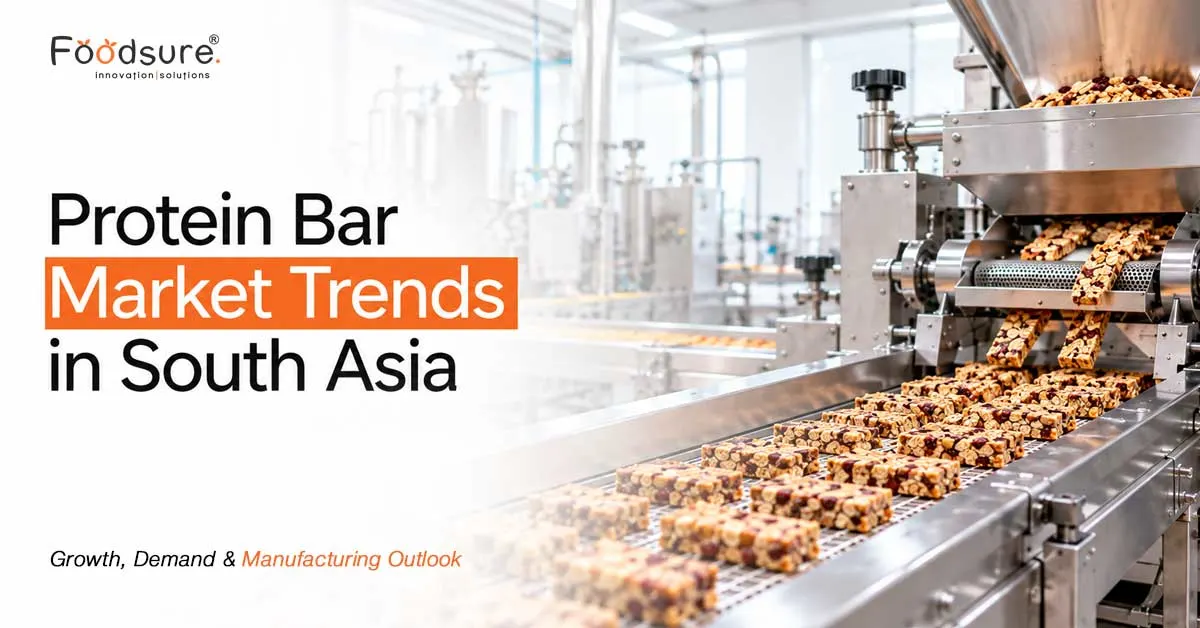
Protein bars will soon be found outside the conventional sports nutrition aisle. The increasing demand in South Asia for nutritional convenience, functional food, fitness, and high protein content has created space for a wider protein snacking category.
What makes this opportunity even more exciting is the fact that South Asia is no single market. India already has a large commercial protein bar segment, while Nepal, Bangladesh, Pakistan and Sri Lanka have differing levels of product availability, production and retail infrastructure.
For the manufacturers, that difference will make all the difference.
An organization entering the Indian market will face competition through product formulation, price, brand and distribution. An organization entering Nepal may be trying to solve a different problem, such as formulating a local product for a market that is still importing nutrition products. Bangladesh will be an opportunity through retail consumers and institutions, while Sri Lanka will provide a different combination of tourists, health and local demand.
This guide focuses on the South Asian Protein Bar Market from a manufacturer’s point of view. It covers market growth, consumer demand, country-level differences, formulation, machinery, production capacity, packaging, regulation, investment considerations and the manufacturing outlook through 2028.
How This Market Analysis Was Built
Nevertheless, country-level protein bar data is still rather limited in some regions of South Asia. This is why it is critical to differentiate between published market data and other indicators explaining demand for a particular product.
To estimate regional and country-level markets, this article considers published market research when there is a similar protein bar category. For instance, according to Grand View Research, the outlook for Asia-Pacific region in 2026 predicts that the market will be worth approximately US3.36 billion in 2024 and grow up to about US 4.90 billion by 2030, with a 6.5% CAGR in the forecast period. The Indian market is estimated at about US$864 million in 2024 and will reach approximately the same level by 2030 at 6.6% CAGR.
Such numbers cannot be considered as direct measurements of the whole South Asian market since market research organizations use different category definitions, geographic scope and methodology.
The demographic and economic situation will be explained through World Bank and UN databases. Information on regulation is taken from national authorities such as Nepalese Department of Food Technology and Quality Control, FSSAI of India, Pakistan PSQCA, Bangladesh’s BSTI and Sri Lanka SLSI.
Where country-specific protein bar data is unavailable, the article does not substitute an unsupported number. Instead, it uses relevant indicators such as urbanisation, manufacturing activity, nutrition programmes, retail development and trade conditions.
That distinction is important when evaluating an emerging category.
The South Asian Protein Bar Market Is Moving Into a Broader Snacking Phase

Protein bars were once closely associated with bodybuilding, sports supplements and specialist nutrition stores. The product category has expanded since then.
Today’s protein bar can be positioned as a post-workout snack, breakfast alternative, office snack, travel food, functional snack or convenient source of protein.
This broader positioning is particularly relevant to South Asia because urban consumers are increasingly exposed to packaged convenience foods while food brands are experimenting with products that combine familiar ingredients with functional nutrition.
The World Bank’s 2026 South Asia Economic Update highlights the region’s continuing urbanisation and notes that around 40% of South Asians currently live in cities. It also estimates that more than 500 million additional people could move into South Asian cities by 2050.
That does not automatically translate into protein bar purchases. It does, however, create the kind of urban consumer environment in which portable, packaged and convenient foods can expand.
The more important change for manufacturers is that protein bars no longer have to be marketed exclusively to athletes.
A brand can develop separate products for:
- Fitness and sports nutrition
- Everyday protein consumption
- Breakfast and meal replacement
- Kids and family snacking, where permitted and appropriately formulated
- Plant-based consumers
- Low-sugar and reduced-sugar positioning
- Functional nutrition
- Travel and on-the-go consumption
- Corporate and institutional nutrition programmes
The result is a much wider product-development landscape.
Protein Bar Market Outlook for South Asia Through 2028
The most reliable published market data is available at the Asia-Pacific and individual-country level rather than for South Asia as a standalone protein bar market.
Grand View Research’s March 2026 outlook estimates that Asia-Pacific protein bar revenue was about US 3.36 billion in 2024 and project sit to reach about US.90 billion by 2030. The same source identifies sports nutritional bars as the largest type segment in 2024 and meal replacement bars as the fastest-growing type segment in its forecast.
India has a particularly important role in the regional market. Grand View Research estimates the Indian protein bar market at about US 864 million in 2024 and projects it to reach approximately US 1.27 billion by 2030.
These numbers provide a useful regional benchmark, but they should not be used to claim that every South Asian country is growing at the same rate.
A more useful manufacturing outlook looks like this:
| Market | Current Market Signal | Manufacturing Outlook Through 2028 |
|---|---|---|
| India | Established and expanding protein bar category | Greater product differentiation, automation and capacity expansion |
| Nepal | Smaller and less-developed local category | Opportunity for local production and imported-product substitution |
| Bangladesh | Large manufacturing base and institutional nutrition potential | Scope for consumer and B2B applications |
| Pakistan | Large consumer market with standards and supply-chain considerations | Opportunity for locally produced alternatives where economics work |
| Sri Lanka | Smaller domestic market with tourism and wellness channels | Potential for premium and hospitality-oriented products |
The important point is that South Asia should not be viewed as a single protein bar market.
It is better understood as several connected markets at different stages of category development.
Country-by-Country Protein Bar Market Snapshot
Nepal: An Early-Stage Market With a Manufacturing Question
Nepal is one of the most interesting markets to examine precisely because reliable public data on domestic protein bar manufacturing is limited.
That limitation should not be converted into a claim that there are absolutely no local manufacturers. Publicly available evidence does not provide enough information to make that absolute statement confidently.
What can be said is that Nepal’s protein bar category appears considerably less developed than India’s, and imported nutrition products have an established route to consumers through supplement retailers, fitness businesses and online commerce.
The country’s urban consumer base also matters. World Bank data shows that Nepal’s urban population share was about 67% in 2025, using the World Bank’s country data series.
Nepal’s wider economic environment should also be considered before making a manufacturing investment. The World Bank’s April 2026 Nepal Development Update projects real GDP growth of 2.3% in FY26, followed by stronger growth in FY27 and FY28. The report also notes the importance of remittances to household incomes and identifies private-sector development and infrastructure as continuing structural issues.
For a protein bar manufacturer, the practical opportunity is therefore not simply:
“Nobody makes protein bars here.”
It is:
“Can a locally produced product compete with imported products on price, taste, freshness, availability and formulation?”
That is a much more useful business question.
India: The Regional Manufacturing Benchmark
India is currently the most developed protein bar manufacturing and consumption market among the countries covered here.
Grand View Research estimates India’s protein bar market at US$863.9 million in 2024, with a projected CAGR of 6.6% from 2025 to 2030. Sports nutritional bars represented the largest segment in its 2024 assessment.
India’s importance goes beyond consumer demand.
It has an established food-processing machinery ecosystem, a large ingredient supply base, domestic packaging suppliers, food testing infrastructure and an increasingly sophisticated D2C and organised-retail environment.
That makes India useful as a benchmark for manufacturers elsewhere in South Asia.
A Nepalese or Bangladeshi entrepreneur does not necessarily need to reproduce the entire Indian market. Instead, India provides a reference point for:
- Product formats
- Bar sizes
- Packaging
- Machinery configurations
- Ingredient sourcing
- Product positioning
- Retail pricing strategy
- Automation levels
The market is also becoming more competitive, which means simply launching another generic chocolate-flavoured protein bar may not be enough.
Formulation, texture, protein source, ingredient transparency, price and brand positioning increasingly become important differentiators.
Pakistan: Local Production and Product Trust
Pakistan represents another market where the opportunity cannot be measured only through protein bar market reports.
The country’s large population, developing fitness culture and broader packaged-food sector create potential demand, but manufacturers also need to consider food standards, imported ingredients, purchasing power, supply-chain conditions and regulatory requirements.
The Pakistan Standards and Quality Control Authority is responsible for developing and administering Pakistan Standards across sectors including agriculture and food. PSQCA also operates a Certification Marks Scheme covering products that fall under applicable compulsory standards.
For a protein bar manufacturer, this means compliance should be built into product development rather than treated as a final packaging exercise.
A Pakistan-focused product strategy could include:
- Affordable protein bars
- Date and nut-based bars
- Plant-protein formulations
- Sports nutrition products
- Functional snack formats
- Locally adapted flavours
The strongest opportunity will depend on the product, target consumer and route to market rather than on a single nationwide market-growth number.
Bangladesh: Consumer and Institutional Opportunities
Bangladesh has an unusually large food-manufacturing and garment-sector ecosystem.
The World Bank reports that Bangladesh’s ready-made garment sector employed around 4.2 million workers in 2024 and generated US$38.48 billion in export earnings.
Nutrition programmes targeting workers are not theoretical in Bangladesh either. GAIN has documented workplace nutrition initiatives involving garment factories and female workers, demonstrating that institutional food and nutrition programmes already exist as a potential channel.
That does not mean protein bars will automatically become a major factory-canteen product.
It does suggest that Bangladesh offers a potential B2B route alongside conventional retail.
A manufacturer could therefore consider two separate product strategies:
Consumer channel
Protein bars for fitness, convenience, urban snacking and D2C sales.
Institutional channel
Nutritionally designed bars for workplace programmes, NGOs, institutional buyers and other organised nutrition initiatives, subject to the relevant procurement and regulatory requirements.
Bangladesh’s regulatory environment also needs to be checked product by product. BSTI maintains a list of mandatory products and a certification process for products falling within compulsory standards. Its current published list was updated in 2026.
Sri Lanka: Wellness, Hospitality and Premium Positioning
Sri Lanka presents a different commercial model.
Instead of relying entirely on mass-market retail, a manufacturer can examine channels such as:
- Hotels
- Resorts
- Wellness centres
- Fitness businesses
- Travel retail
- Supermarkets
- Export-oriented specialty foods
The Sri Lanka Standards Institution provides product certification and maintains information on compulsory SLS-mark categories. Its current guidance makes clear that SLS certification is voluntary unless a product has been specifically made compulsory through the relevant authorities.
This is important because regulatory requirements should be assessed according to the actual product category rather than assuming that every packaged food requires the same certification.
What Consumers Are Looking For in South Asian Protein Bars
A protein bar does not succeed simply because it contains protein.
Consumers still evaluate it as food.
Taste, texture, sweetness, price, convenience, ingredients and packaging can determine whether someone buys the product again.
For South Asian brands, several product directions are particularly relevant.
Familiar Ingredients
Dates, peanuts, almonds, cashews, oats, seeds and chocolate are easier for consumers to understand than highly technical ingredient systems.
That does not make traditional ingredients automatically better. It simply reduces the amount of consumer education required.
Plant-Based Protein
Plant proteins provide another formulation route for brands that want to reduce dependence on dairy-based ingredients or target vegetarian and vegan consumers.
Soy, pea, rice and blended plant proteins can be incorporated depending on the required nutritional profile and texture.
The formulation challenge is important here.
Protein source affects flavour, mouthfeel, binding, processing behaviour and final product texture. A machine cannot compensate for a formulation that has not been developed for the intended production process.
Lower-Sugar and Functional Positioning
Brands are also experimenting with bars positioned around lower sugar, higher fibre, plant protein and other functional attributes.
However, these claims must be supported by the applicable food regulations.
For example, India’s FSSAI maintains separate regulations covering advertising and claims as well as labelling and display requirements. The Labelling and Display Regulations have also been amended, including an amendment published in March 2026.
The practical lesson is simple: formulate first, test the product, then determine which claims the finished product can legally support.
Protein Bar, Energy Bar, Functional Bar or Meal Replacement?
These products can look similar but they are not necessarily manufactured or positioned in the same way.
| Product Type | Typical Positioning | Common Ingredient Direction | Manufacturing Consideration |
|---|---|---|---|
| Protein Bar | Higher-protein snack | Whey, milk, soy, pea, nuts | Mixing, forming/extrusion, cutting and packaging |
| Energy Bar | Convenient energy | Dates, oats, nuts, cereals | Binding and forming become especially important |
| Functional Bar | Specific nutritional positioning | Protein, fibre, botanicals or micronutrients | Formulation and claim substantiation are critical |
| Meal Replacement Bar | Convenient nutritional meal substitute | Protein, carbohydrate, fat, fibre and micronutrients | More complex formulation and nutritional balancing |
This distinction becomes important when selecting machinery.
A manufacturer should not purchase a machine simply because it is marketed as a protein bar machine.
The equipment should be selected around the actual recipe, bar dimensions, throughput, forming method, coating requirements and packaging format.
How Protein Bars Are Manufactured
The manufacturing process varies according to the recipe, but a typical production sequence is:
Raw material preparation → Mixing → Binding → Forming or extrusion → Slab formation → Cutting → Cooling → Coating, if required → Packaging → Quality control
Each stage affects the final product.
Raw Material Preparation
Protein powders, cereals, nuts, seeds, dry fruits, binders and other ingredients need to be weighed and prepared according to the formulation.
Mixing
The mixer needs to distribute ingredients consistently without damaging sensitive inclusions.
Binding
The binder determines much of the bar’s structure.
Date paste, nut butter, syrups and other systems behave differently during processing.
Forming or Extrusion
Depending on the formulation, the mixture may be formed into a continuous slab or processed through an extrusion/forming system.
Cutting
The continuous product is divided into individual bars according to the required dimensions.
Cooling
Cooling can be important when the product contains fats, chocolate or ingredients that need controlled setting before packaging.
Coating
Chocolate or other coatings may be added depending on the product concept.
Packaging
Individual flow wrapping protects the finished product during distribution and provides the packaging platform for labelling information.
Quality Control
Finished bars should be checked against the product specification for parameters such as weight, texture, moisture, water activity where applicable, microbiological safety, nutritional composition and packaging integrity.
What Machinery Is Required for Protein Bar Manufacturing?
A commercial protein bar line can include different equipment depending on the product.
A typical line may contain:
- Ingredient preparation equipment
- Roaster where required
- Industrial mixer
- Protein bar extruder or forming machine
- Slab forming system
- Bar cutting machine
- Conveyors
- Cooling system
- Chocolate enrober where required
- Flow wrapping machine
- Inspection and quality-control equipment
Foodsure’s own published protein bar machinery information illustrates this modular approach, with equipment covering mixing, extrusion or forming, cutting, coating, cooling and wrapping depending on the line configuration.
The important point is that not every manufacturer needs every machine.
A date-and-nut bar may require a different configuration from a high-protein soft bar. A coated product introduces cooling and enrobing requirements that may not be necessary for an uncoated product.
How to Choose the Right Protein Bar Production Capacity
Capacity should be based on expected sales rather than simply selecting the largest machine available.
An indicative planning framework can look like this:
| Business Stage | Indicative Production Capacity | Suitable Use |
|---|---|---|
| Product Validation | 50–100 kg/hr | New brand and regional testing |
| Small Commercial Production | 100–200 kg/hr | Growing D2C and regional distribution |
| Expansion Stage | 200–500 kg/hr | Multiple retail and distribution channels |
| Large Commercial Production | 500 kg/hr and above | High-volume domestic or export production |
These are planning ranges, not universal industry standards. Actual output depends on recipe, bar weight, machine configuration, operating hours, changeovers, operator efficiency and packaging speed.
For a new manufacturer, it is often more useful to calculate:
Required daily production = expected daily sales ÷ expected production utilisation
rather than selecting equipment purely from maximum machine capacity.
A line rated for a certain hourly capacity will not necessarily deliver that number continuously during an entire working day. Cleaning, changeovers, maintenance, recipe variation and packaging interruptions all affect practical output.
Protein Bar Machine Cost in South Asia
Machine prices vary substantially according to capacity, automation, construction, accessories and packaging integration.
Public marketplace listings demonstrate that even individual protein bar machines can have widely different prices. For example, one current Indian listing for a 300 kg/hr protein bar manufacturing machine shows a listed price of ₹59 lakh including GST.
That should not be interpreted as a universal market price.
A complete production line can include several machines, installation, electrical work, conveyors, packaging equipment, commissioning, testing and other plant requirements.
For this reason, manufacturers should request a project-specific quotation rather than relying on a generic online machine price.
A useful cost structure includes:
| Cost Area | What It Covers |
|---|---|
| Processing Machinery | Mixing, forming/extrusion, cutting |
| Cooling and Coating | Cooling conveyors, tunnels, enrobing where required |
| Packaging | Flow wrapping and related systems |
| Utilities | Electrical installation, compressed air and other requirements |
| Factory Preparation | Flooring, drainage, hygiene and layout |
| Quality Control | Testing and laboratory requirements |
| Installation | Assembly, commissioning and trials |
| Training | Operator and maintenance training |
| Working Capital | Ingredients, packaging, labour and distribution |
This gives a much more realistic picture of the investment than quoting a machine price alone.
Raw Materials for Protein Bar Manufacturing
The formulation determines the raw-material system.
Protein Sources
Depending on the target product, manufacturers may work with:
- Whey protein
- Milk protein
- Soy protein
- Pea protein
- Rice protein
- Other plant-protein ingredients
- Protein blends
Binding Ingredients
Common options include:
- Dates
- Nut butters
- Syrups
- Fruit-based binders
- Other functional binding systems
Texture and Inclusion Ingredients
These can include:
- Oats
- Nuts
- Seeds
- Cereals
- Protein crisps
- Cocoa
- Dried fruit
Functional Ingredients
Depending on the formulation:
- Dietary fibre
- Vitamins and minerals
- Electrolytes
- Botanical ingredients
- Other permitted functional ingredients
The choice of raw material affects more than nutrition.
It changes viscosity, moisture, texture, processing behaviour, shelf life, taste and machine settings.
That is why a protein bar formulation should be developed alongside production feasibility rather than treating formulation and machinery as two unrelated decisions.
Shelf Life and Packaging Considerations
Protein bars are generally designed to be convenient, shelf-stable products, but shelf stability should never be assumed from the ingredient list alone.
A manufacturer needs to evaluate:
- Moisture migration
- Water activity
- Fat oxidation
- Ingredient stability
- Texture changes
- Chocolate coating stability
- Packaging barrier properties
- Storage temperature
- Transportation conditions
- Seal integrity
Packaging therefore becomes part of product development.
A bar that has excellent texture immediately after production may become hard, soft, sticky or oily during storage if the formulation and packaging system are not properly matched.
Shelf-life testing should be carried out on the final product in its intended packaging rather than relying only on theoretical calculations.
Quality Control in Protein Bar Manufacturing
A commercial production line should have defined quality parameters before production begins.
Important checks may include:
- Product weight
- Protein content
- Moisture
- Water activity where relevant
- Texture
- Microbiological safety
- Allergen control
- Oxidative stability
- Ingredient identity
- Packaging seal quality
- Batch traceability
- Label accuracy
The exact testing plan depends on the product formulation, ingredients, claims and target market.
For an export-oriented manufacturer, buyer specifications may add another layer of testing and documentation.
Regulatory and Labelling Landscape
Regulation is one of the areas where manufacturers should avoid generalising across South Asia.
Each country has its own licensing, standards, labelling and product requirements.
Nepal
Nepal’s Department of Food Technology and Quality Control operates the Nepal Food and Feed Industry Licensing System, or NeFFILS.
The government system describes NeFFILS as an online mechanism designed to facilitate the recommendation and licensing process for food and feed industries before production and market placement.
DFTQC also publishes Nepal’s applicable food laws, regulations and food standards through its official website.
For a Nepalese protein bar manufacturer, the practical sequence should therefore include facility approval, applicable product requirements, labelling, testing and market permissions rather than treating product registration as the only compliance step.
India
India’s FSSAI framework includes regulations covering food safety, advertising and claims, packaging and labelling.
The FSSAI website currently lists the Advertising and Claims Regulations, Packaging Regulations and Labelling and Display Regulations among its regulatory framework.
The Labelling and Display Regulations specifically prescribe requirements for pre-packaged food, while amendments continue to be issued as the regulatory framework develops.
For protein bars, this becomes particularly relevant when brands use claims such as high protein, source of protein, low sugar, no added sugar or other nutritional and functional statements.
Pakistan
Pakistan’s PSQCA develops Pakistan Standards and operates conformity-assessment and certification systems for products falling under relevant requirements. Its agriculture and food division covers standards related to food products and associated categories.
Manufacturers should therefore verify the applicable standard and certification requirements for their specific product before commercial production.
Bangladesh
BSTI maintains lists of mandatory products and operates a CM licensing process for products covered by compulsory standards. Its published guidance also addresses factory information, process flow, equipment and product labelling requirements.
Whether a particular protein bar falls within a mandatory product category should be checked directly with BSTI rather than assumed from the product name.
Sri Lanka
Sri Lanka’s SLSI operates product certification and maintains information on compulsory SLS-mark categories. Its official guidance distinguishes voluntary SLS certification from products for which the SLS mark has been made compulsory.
The applicable food labelling and advertising requirements should also be reviewed for the final product.
Protein Claims Need More Than a Formulation Sheet
This is particularly important for protein bars.
A manufacturer may calculate the protein contribution of whey, soy, pea protein, nuts and other ingredients during formulation. That does not automatically mean every marketing claim can be printed on the pack.
The finished product should be assessed against the relevant country’s requirements.
For India, FSSAI maintains dedicated Advertising and Claims Regulations and Labelling and Display Regulations.
For a regional brand, this means the same protein bar may need different packaging, claims or documentation when sold in different countries.
Cross-Border Manufacturing and South Asian Trade
South Asia has a large potential consumer base, but regional trade remains relatively underdeveloped.
The World Bank reports that intraregional trade accounts for only about 5% of South Asia’s total trade, compared with around 25% in ASEAN. It estimates current intraregional trade at about US23billionversusapotentialofatleastUS67 billion. The same source highlights transport, tariff, non-tariff and trust-related barriers as constraints.
This matters for protein bar manufacturers because regional expansion involves more than simply transporting finished products across a border.
A manufacturer also needs to consider:
- Rules of origin
- Customs procedures
- Product registration
- Labelling
- Import requirements
- Shelf life
- Packaging
- Testing
- Buyer specifications
- Transport conditions
Trade agreements can help, but they do not remove the need to meet the importing country’s food regulations.
Building a Protein Bar Plant for Regional Exports
An export-ready factory should be designed differently from a small local production unit.
The initial product may only need one flavour and one bar size.
An export-oriented operation may eventually need:
- Multiple recipes
- Multiple bar sizes
- Different packaging formats
- Longer shelf-life validation
- Batch traceability
- More formal quality systems
- Export documentation
- Consistent production records
- Greater automation
- Flexible changeover capability
This is why plant planning should consider future products even if the first production line is relatively simple.
Investment and Unit Economics
Protein bar manufacturing profitability cannot be established from machine capacity alone.
A proper business model needs to consider:
Revenue
Selling price × number of bars sold
Variable cost
Protein ingredients + other ingredients + packaging + direct labour + production utilities + wastage
Fixed cost
Rent + salaries + maintenance + administration + depreciation + compliance
Commercial cost
Distribution + trade margins + marketing + commissions + logistics
A useful illustrative model might look like this:
| Parameter | Example |
|---|---|
| Selling Price | ₹80 per bar |
| Total Manufacturing and Packaging Cost | ₹35 per bar |
| Contribution Before Fixed and Commercial Costs | ₹45 per bar |
| Production Sold | 1,000 bars/day |
| Illustrative Daily Contribution | ₹45,000 |
This is only a mathematical example, not an industry benchmark or guaranteed margin.
Actual profitability can be very different depending on the formulation, ingredient prices, packaging, wastage, production utilisation, selling price, distributor margins and marketing expenditure.
The same principle applies to payback periods.
A manufacturer should not promise that a protein bar plant will recover its investment within a particular number of months unless the calculation is based on a verified project-specific financial model.
How to Set Up a Protein Bar Manufacturing Unit in Nepal
For an entrepreneur evaluating Nepal, the practical process can be broken into stages.
Step 1: Define the Product
Decide whether the first product will be:
- Protein bar
- Energy bar
- Date-and-nut bar
- Plant-protein bar
- Functional bar
- Meal replacement bar
Step 2: Develop the Formula
Determine:
- Protein source
- Protein target
- Sweetener/binder system
- Texture
- Bar weight
- Flavour
- Shelf-life objective
- Nutritional claims
Step 3: Conduct Product Trials
The formulation should be tested at laboratory and pilot scale before finalising commercial machinery.
Step 4: Determine Production Capacity
Use actual sales projections rather than selecting capacity based only on machine specifications.
Step 5: Select the Production Line
Equipment should be matched to:
- Recipe
- Bar dimensions
- Capacity
- Automation level
- Coating requirements
- Packaging format
- Future expansion plans
Step 6: Prepare the Facility
Consider:
- Production area
- Raw-material storage
- Finished-goods storage
- Hygiene zoning
- Utilities
- Drainage
- Personnel movement
- Material movement
- Packaging area
- Quality-control space
Step 7: Complete Regulatory Requirements
Use the relevant DFTQC processes and verify applicable food standards, labelling and licensing requirements.
Nepal’s official NeFFILS platform is the appropriate starting point for understanding the food-industry licensing process.
Step 8: Install and Commission the Machinery
A commercial line should be tested with the actual formulation wherever possible.
Step 9: Validate Packaging and Shelf Life
The final bar should be evaluated in the packaging that will actually be used commercially.
Step 10: Start With a Controlled Product Range
Launching one or two well-tested SKUs can make production and inventory management easier than beginning with a large portfolio.
Step 11: Build Distribution
Possible channels include:
- Gyms
- Nutrition stores
- Supermarkets
- D2C websites
- Marketplaces
- Corporate sales
- Hotels
- Cafes
- Institutional buyers
Step 12: Scale According to Demand
Once the initial products demonstrate repeat demand, the manufacturer can add flavours, increase capacity or automate additional stages.
Capacity and Automation: When Should a Manufacturer Scale?
Automation should solve a real production problem.
For a startup, semi-automatic equipment may provide flexibility while recipes and demand are still being validated.
As production grows, automation becomes more useful for:
- Consistent bar weight
- Consistent dimensions
- Faster cutting
- Reduced manual handling
- Packaging speed
- Repeatable production
- Batch traceability
- Labour efficiency
The decision should therefore be based on production requirements rather than the idea that fully automatic equipment is always necessary.
A sensible expansion path can be:
This allows the manufacturing system to grow alongside the brand.
Protein Bar Manufacturing Challenges in South Asia
Price Sensitivity
Protein ingredients can be expensive compared with conventional snack ingredients.
That creates a fundamental challenge.
A product containing a high level of premium protein may have excellent nutritional positioning but still struggle if the target consumer cannot afford the final retail price.
Manufacturers therefore need to balance:
Protein content + taste + texture + ingredient cost + packaging cost + retail price
Ingredient Availability
Protein ingredients, nuts, cocoa, dates, sweeteners and speciality functional ingredients can be affected by international supply conditions.
A formulation that relies entirely on one expensive imported ingredient may therefore be more exposed to price volatility.
Ingredient diversification can provide more flexibility.
Taste and Texture
This may be one of the biggest barriers to repeat purchase.
Consumers may try a protein bar because of its nutritional positioning but reject it if it is:
- Too dry
- Too hard
- Too sweet
- Too chalky
- Too sticky
- Difficult to chew
This is why formulation development and production trials should happen together.
Distribution
Protein bars are not dependent on conventional cold-chain distribution in the same way as chilled foods, but they still need packaging and logistics systems suited to the product.
Heat, humidity, rough handling and long transport routes can affect texture, coating and packaging integrity.
Regulatory Differences
A recipe developed for one country may not be ready for sale in another.
Ingredient permissions, claims, labelling, product standards and registration requirements can differ.
Regional expansion therefore requires regulatory review before export.
The Role of Local Ingredients in South Asian Protein Bars
South Asia already has a strong food culture around nuts, seeds, dates, cereals and pulses.
That creates opportunities for manufacturers to develop products that feel familiar rather than simply copying imported protein bars.
Examples include:
- Date and almond bars
- Peanut protein bars
- Chocolate and peanut bars
- Oat and seed bars
- Plant-protein snack bars
- Fruit and nut bars
- Millet-based functional bars
The goal is not to replace protein-rich ingredients with traditional ingredients just for the sake of localisation.
Instead, local ingredients can be combined with modern protein systems to create products that balance nutritional positioning with familiar taste.
Product Categories to Watch Through 2028
The next phase of South Asian protein bar development is unlikely to be limited to conventional whey-based bars.
Several categories deserve attention.
Plant-Protein Bars
Plant-based formulations can serve vegetarian, vegan and dairy-sensitive consumers while giving manufacturers another route to manage protein sourcing.
The challenge is achieving a good balance of protein content, flavour and texture.
Date-Based Bars
Dates work naturally as a binding ingredient and pair well with nuts, seeds and cereals.
This makes date-based products particularly relevant to South Asian and Middle Eastern-influenced markets.
Functional Bars
Brands can build products around specific nutritional attributes such as fibre or other permitted functional ingredients.
However, the formulation and regulatory requirements become more important as the product moves from simple nutrition to specific health-related positioning.
Meal Replacement Bars
Grand View Research identifies meal replacement bars as the fastest-growing type segment within its Asia-Pacific protein bar market outlook.
This is relevant because it expands the category beyond sports nutrition into convenience-oriented food consumption.
2026–2028 Manufacturing Outlook
The protein bar opportunity in South Asia is not about one universal growth rate.
It is about different markets reaching different stages of category development.
India already has a measurable protein bar market and a mature food-processing ecosystem.
Nepal offers a smaller market where the main question is whether local manufacturers can build products that compete effectively with imported alternatives.
Bangladesh combines a large manufacturing economy with potential institutional nutrition channels.
Pakistan has potential for locally adapted products but requires careful attention to standards, pricing and supply chains.
Sri Lanka provides opportunities to explore premium, hospitality and wellness-oriented channels alongside domestic retail.
The wider regional environment is also relevant. The World Bank’s current South Asia work highlights urbanisation, a large and growing workforce and the potential for stronger regional manufacturing and trade.
For protein bar manufacturers, this creates an important shift in thinking.
The opportunity is not simply to manufacture another imported-style bar.
It is to build products around South Asian consumers, South Asian price points, locally relevant flavours and commercially realistic production systems.
What a Future-Ready Protein Bar Plant Should Consider
A manufacturing plant designed for the next several years should ideally allow room for product variation.
That means considering:
- Multiple protein sources
- Different bar weights
- Different formulations
- Adjustable forming systems
- Flexible cutting
- Optional coating
- Cooling capacity
- Automated packaging
- Hygienic food-contact construction
- Easy cleaning
- Recipe changeovers
- Future capacity expansion
- Quality-control integration
This approach is more useful than selecting a machine based only on today’s product.
A brand that begins with one protein bar may eventually add energy bars, date bars, nutrition bars or functional snack products.
A flexible line can make that transition easier.
How to Choose a Protein Bar Manufacturing Machine

Before purchasing equipment, manufacturers should evaluate:
- What type of bar will be produced?
- What is the target bar weight?
- What dimensions are required?
- What is the required hourly production capacity?
- Is the product soft, dense, sticky or extrusion-friendly?
- Will chocolate coating be required?
- What cooling system is needed?
- What packaging format will be used?
- How many recipes will be produced?
- How frequently will the product change?
- What level of automation is appropriate?
- What food-contact materials are being used?
- Does the supplier provide installation and training?
- Are spare parts and technical support available?
- Can the line be expanded later?
For an entrepreneur setting up a new plant, machine selection should happen after product and capacity decisions, not before them.
Final Takeaway
The South Asian protein bar market is developing, but it is not developing at the same speed everywhere.
India provides the strongest publicly documented market benchmark. Nepal represents a less-developed category where local manufacturing can be evaluated against imported supply. Bangladesh offers both consumer and institutional possibilities. Pakistan requires careful attention to standards and economics, while Sri Lanka provides an interesting combination of domestic, hospitality and wellness-oriented channels.
The most important decision for a manufacturer is therefore not simply whether protein bars are growing.
It is which consumer to serve, which formulation to develop, which capacity to install and which distribution model can support repeat demand.
For a new protein bar plant, the right sequence is straightforward:
Validate the product → develop the formulation → test shelf life → determine capacity → select machinery → complete regulatory requirements → install and trial the line → launch commercially → scale with demand.
That approach keeps the market opportunity grounded in something more important than a forecast: whether the finished product can actually be made consistently, sold at the right price and bought again.
Frequently Asked Questions
What is the protein bar market size in South Asia?
There is no single widely accepted public market-size figure for South Asia as a standalone protein bar market. Published research is more commonly available for Asia-Pacific and individual countries. Grand View Research estimates the Asia-Pacific protein bar market at approximately US$3.36 billion in 2024, with a projected 6.5% CAGR through 2030.
What is the protein bar market size in India?
Grand View Research estimates India’s protein bar market at approximately US863.9millionin2024andprojectsittoreachaboutUS1.27 billion by 2030, representing a 6.6% CAGR from 2025 to 2030.
Which South Asian country has the largest documented protein bar market?
India has the clearest country-level published protein bar market data among the South Asian markets discussed in this article. It also has a more developed food-processing and sports-nutrition ecosystem than several neighbouring markets.
Is there a protein bar manufacturing opportunity in Nepal?
Nepal’s protein bar category is less documented than India’s, and public sources do not provide enough evidence to quantify the domestic manufacturing base reliably. This makes detailed market validation particularly important for an entrepreneur considering local production.
What machinery is required to manufacture protein bars?
A typical production line can include a mixer, forming or extrusion system, cutting equipment, conveyors, cooling equipment, optional chocolate enrobing equipment and flow-wrap packaging. The exact configuration depends on the formulation, capacity and packaging format.
What is the protein bar manufacturing process?
The typical process involves raw-material preparation, mixing, binding, forming or extrusion, cutting, cooling, optional coating and individual packaging, followed by quality control. The exact sequence varies according to the recipe.
How much does a protein bar manufacturing machine cost?
There is no single reliable price because machinery varies considerably by capacity and configuration. Current Indian marketplace listings show substantial variation even for individual machines. A complete plant quotation can also include processing equipment, packaging, installation, commissioning and other services.
What capacity protein bar machine should a startup choose?
A startup should choose capacity according to realistic sales projections, expected operating hours, recipe changeovers and packaging requirements. Starting with a smaller commercial line can make sense when demand is still being validated, while established brands may require higher-capacity and more automated systems.
Can protein bars be made without whey protein?
Yes. Protein bars can be formulated using plant proteins such as soy, pea and rice protein, as well as other permitted protein sources. The choice affects taste, texture, nutrition, cost and processing behaviour.
What raw materials are used in protein bars?
Common ingredients include protein powders, nuts, seeds, oats, cereals, dates, nut butters, cocoa, sweeteners, fibre and other functional ingredients. The final ingredient system depends on the product’s nutritional target and texture.
How important is packaging for protein bars?
Packaging is critical because it protects the product from environmental exposure and supports shelf-life stability. The appropriate packaging depends on the bar’s moisture, fat, coating and storage characteristics.
Are protein bar claims regulated?
Yes. Nutritional and other food claims are regulated and vary by country. In India, FSSAI maintains dedicated regulations covering advertising and claims as well as labelling and display. Other South Asian markets have their own standards and requirements.
Can one production line make protein bars and energy bars?
In many cases, the same broader production system can be configured for multiple bar products, but compatibility depends on the formulation, consistency, dimensions, forming method and cleaning/changeover requirements. Machinery should therefore be selected around the full intended product range.
How long does it take to set up a protein bar manufacturing plant?
The timeline depends on machinery configuration, facility readiness, regulatory approvals, utilities, installation, product trials and packaging. A reliable project timeline should be developed after the product, capacity and facility requirements are defined.
Can protein bars manufactured in South Asia be exported?
Yes, but exportability depends on the destination country’s food regulations, labelling, product standards, shelf-life requirements, customs procedures and buyer specifications. Regional trade opportunities exist, but the World Bank notes that South Asian trade continues to face transport and non-tariff barriers.




