
There’s a particular kind of morning in Dubai, the one where the sun is already too bright by 7 a.m., the metro is packed with people carrying gym bags to work, and every second hand reaching into a fridge at a convenience store pulls out something wrapped in foil, not a plate. A decade ago, that same hand might have reached for a croissant, or nothing at all. Today, portable nutrition products are increasingly filling that gap, with protein bars moving beyond their traditional sports-nutrition positioning.
This pattern, occurring in all of the important GCC countries, is aiding in the creation of a bigger snack category based on protein, convenience, and wellness. However, this opportunity does not only include traditional whey-based bars anymore. Regional flavors, plant proteins, functional foods, e-commerce, and other factors have opened new avenues for manufacturers and investors.
This article analyzes how the Middle East Protein Bar Market is evolving, who the consumers are, what trends exist in this market, what challenges the market faces, and how to produce protein bars in the Gulf region. For any brand that wants to study Protein Bar Trends in Middle East, this information can be highly helpful.
Understanding the Middle East Protein Bar Market
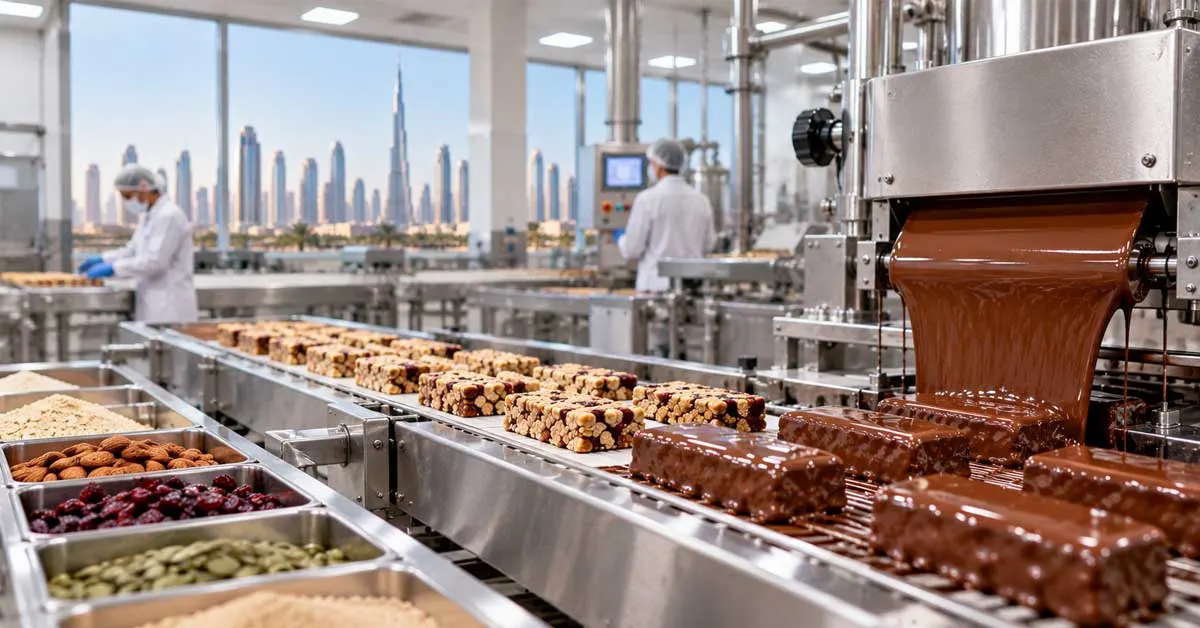
The broader Middle East snack bar market was valued at approximately USD 305.60 million in 2025 and is projected to reach USD 432.22 million by 2031, representing a 5.95% CAGR from 2026 to 2031. Within this category, protein bars are forecast to grow at a faster 7.70% CAGR through 2031.
Saudi Arabia accounted for 24.10% of the Middle East snack bar market in 2025, while the UAE is projected to record the highest country-level CAGR in the region at 7.64% through 2031.
The wider Middle East and Africa protein bar market also shows several important segment-level shifts. Animal protein formulations held 64.23% of the market in 2024, but plant-based protein is projected to grow at an 11.22% CAGR through 2030. Online retail is also expanding quickly, with the channel projected to record an 11.37% CAGR through 2030 in the MEA protein bar market.
The UAE is particularly relevant for sports nutrition. Euromonitor identifies protein and energy bars as the fastest-growing category within UAE sports nutrition, supported by demand for convenient protein and energy boosts throughout the day.
These figures are central to understanding Protein Bar Trends in Middle East, particularly the shift toward plant protein, online retail and more diversified consumer occasions.
Market Segment
| Market Segment | CAGR | Forecast Window |
|---|---|---|
| Middle East Snack Bar Market | 5.95% | 2026–2031 |
| Protein Bars within Middle East Snack Bar Market | 7.70% | Through 2031 |
| Premium Snack Bars | 7.62% | Through 2031 |
| Online Retail, Middle East Snack Bars | 7.76% | Through 2031 |
| MEA Protein Bar Market | — | Current segment data available |
| Plant Protein, MEA Protein Bars | 11.22% | Through 2030 |
| Online Retail, MEA Protein Bars | 11.37% | Through 2030 |
Sources: Mordor Intelligence, Middle East Snack Bar Market and Middle East & Africa Protein Bar Market; Euromonitor, Sports Nutrition in the United Arab Emirates.
What Counts as a Protein Bar: Categories & Formats
Not every bar on the shelf belongs to the same family, and understanding the split matters if you’re either buying or manufacturing. Broadly, the category can be divided into several formats.
Whey and Animal-Protein Bars
Animal protein remains the dominant protein source in the MEA protein bar market. It accounted for 64.23% of the market in 2024, with whey and casein among the major protein sources used in formulations.
These products continue to appeal strongly to consumers looking for protein associated with sports nutrition, muscle building and recovery.
Plant-Protein Bars
Plant protein is one of the strongest emerging segments. Mordor Intelligence projects plant protein in the MEA protein bar market to grow at an 11.22% CAGR through 2030. The segment is supported by growing interest in plant-based diets and dietary requirements such as lactose intolerance and veganism.
Pea, chickpea and other plant proteins give manufacturers room to develop dairy-free and plant-forward products.
The rise of these formulations is one of the clearest Protein Bar Trends in Middle East, as manufacturers look beyond conventional whey-based products.
Functional and Fortified Bars
Functional bars move the category beyond basic protein delivery. These products can combine protein with ingredients such as fibre, vitamins, minerals or other functional ingredients to target broader wellness needs.
The opportunity here is shifting the product from a purely gym-oriented snack to something that can fit into everyday nutrition. Any health or nutrition claims, however, need to be evaluated against the regulations of the target market.
Meal-Replacement and Everyday Nutrition Bars
A growing part of the opportunity comes from consumers who want convenient nutrition between meals. Protein and energy bars in the UAE are benefiting from demand for quick, on-the-go nutrition throughout the day.
For manufacturers, this creates space for products positioned around breakfast, workplace snacking, travel and meal-gap occasions rather than only post-workout consumption.
What’s Driving Protein Bar Demand Across the GCC
Protein bar demand across the GCC is being shaped by several overlapping factors: health awareness, convenience, sports nutrition, changing shopping behaviour and demand for products that fit regional food preferences.
For businesses tracking the Middle East Protein Bar Market, these factors help explain why the category is moving beyond its traditional sports-nutrition audience.
Fitness & Wellness Culture in the Gulf
Sports nutrition is becoming broader than traditional bodybuilding.
Euromonitor’s 2025 UAE sports nutrition research identifies protein and energy bars as the fastest-growing sports nutrition category in the country, supported by demand for quick protein and energy boosts during the day.
Saudi Arabia also shows strong engagement with exercise and supplementation. PwC’s 2025 Saudi Arabia consumer research found that nearly 40% of respondents reported exercising regularly, while 36% said they took supplements to a great extent.
This creates a larger potential audience for portable protein products, including consumers who may not identify as athletes but still want convenient nutrition.
Rising Health Awareness and Better-for-You Snacking
Health is becoming an important part of food purchasing across the Middle East.
PwC’s 2025 Middle East consumer survey found that 67% of regional respondents were concerned about the risks associated with ultra-processed foods and pesticides. More than 60% of respondents also said they planned to increase fresh-produce consumption over the following six months.
For protein bar manufacturers, this creates an important formulation challenge. Consumers may want higher protein, but they also increasingly pay attention to ingredients, processing and overall nutritional value.
That makes simple positioning such as high protein less differentiated than it once was. Products increasingly need a clear nutritional reason to exist.
This is another important factor shaping Protein Bar Trends in Middle East, particularly the movement toward cleaner positioning and products with a broader nutritional purpose.
Convenience and On-the-Go Nutrition
Convenience is another major driver.
Mordor Intelligence identifies urbanisation, longer commuting times and changing workforce participation in markets such as the UAE and Saudi Arabia as factors supporting demand for portable snack products.
PwC’s Middle East consumer research also found that 28% of regional consumers use meal-kit services, while on-demand delivery platforms are the preferred channel for daily and weekly shopping for 30% of respondents, compared with 15% globally.
For protein bars, this means the consumption occasion can be much broader than the gym. A bar can serve as a workplace snack, travel product, breakfast substitute or convenient source of protein between meals.
Premium Healthy Snacking
Premiumisation is another visible market direction.
Mordor Intelligence projects the premium segment of the Middle East snack bar market to grow at a 7.62% CAGR through 2031.
However, premium pricing does not automatically mean consumers will pay more. PwC found that 44% of regional consumers rank price among their top three considerations when selecting food, while 36% prioritise taste and 34% brand trust.
That means premium protein bars need to give consumers a clear reason to pay more, whether through protein content, formulation quality, distinctive flavours, functional positioning or brand trust.
Government Health Initiatives and the Nutrition Shift
Government health initiatives across the Gulf are also influencing the broader food environment.
Saudi Arabia has continued to invest in programmes addressing obesity, nutrition and physical activity, while the UAE has also introduced initiatives aimed at improving population health.
These developments matter to protein bar manufacturers because the category sits at the intersection of sports nutrition, convenience and healthier snacking.
The opportunity is not that government policy automatically drives consumers toward protein bars. Rather, broader public-health attention can increase interest in nutrition, exercise and food choices, creating a more relevant environment for products positioned around those needs.
Consumer Behavior: Who’s Buying Protein Bars in the Middle East
Protein bar consumption is no longer limited to professional athletes or dedicated bodybuilders. The addressable audience is expanding as protein becomes part of everyday nutrition.
For brands evaluating the Middle East Protein Bar Market, understanding these consumer groups is as important as understanding market growth.
Gym-Goers & Athletes
This remains an important consumer group. These buyers often look for portable products with meaningful protein content that can be consumed before or after training.
Protein and energy bars are particularly relevant to this segment because they provide a shelf-stable format that can be carried easily.
Working Professionals & On-the-Go Consumers
The second opportunity is the consumer who needs food between meetings, during travel or between meals.
Long working hours, commuting and increasing demand for convenience create consumption occasions where a protein bar can function as a meal-gap snack rather than a sports supplement.
Diet-Conscious & Weight-Management Buyers
Protein bars can also appeal to consumers who are actively managing their diet.
PwC’s Middle East research shows growing concern around health and nutrition, while Saudi Arabia’s consumer research found that 36% of respondents reported taking supplements to a great extent.
However, manufacturers should avoid presenting protein bars as medical or weight-loss products unless their claims are properly substantiated and compliant with local regulations.
Gen Z and D2C Health-Snacking Culture
Younger consumers are also helping expand the market for new flavours, formats and online-first food brands.
The opportunity is particularly relevant to D2C brands because online retail is projected to grow rapidly within both the Middle East snack bar market and the wider MEA protein bar category.
This gives emerging brands a way to test new products digitally before expanding into supermarkets and hypermarkets.
These changing consumer groups are central to Protein Bar Trends in Middle East, as the category continues to move from specialist sports nutrition toward everyday snacking.
Competitive Landscape: Key Players in the GCC Protein Bar Market
The GCC protein bar market is becoming increasingly competitive as international and regional brands expand their presence.
Growing consumer demand, established supermarket networks and expanding digital grocery channels are creating more routes to market. At the same time, brands need clear differentiation because consumers are balancing price, taste, health and trust when choosing food products.
International Brands Entering the Region
International sports-nutrition and snack brands continue to compete for consumers across the Gulf.
Their advantage generally comes from established brand recognition, product portfolios and distribution networks.
For smaller manufacturers, competing directly on scale can be difficult. Differentiation through regional flavours, formulation, niche consumer segments and faster product development can therefore become more important.
Homegrown & D2C Regional Brands
Regional brands have another advantage: cultural relevance.
Mordor Intelligence highlights the use of regional ingredients and flavours such as dates and pistachios as an important opportunity within the Middle East protein bar market.
This creates space for products that combine modern protein nutrition with familiar regional ingredients rather than simply replicating Western sports-nutrition products.
Private Label Growth in GCC Retail Chains
Private-label products are another factor manufacturers need to monitor.
Retailers have the ability to compete on price, distribution and shelf visibility. For branded manufacturers, this makes product differentiation increasingly important.
PwC’s 2025 research also shows that price remains a significant factor in food purchasing, with 44% of regional consumers placing price among their top three considerations.
Emerging Protein Bar Trends for 2026–2028
The next phase of the Middle East protein bar market is not simply about producing more conventional bars. Several product and distribution trends are becoming increasingly relevant.
Understanding these developments is essential when evaluating Protein Bar Trends in Middle East for the 2026–2028 period.
1. Plant-Protein Bars
Plant protein is one of the clearest growth segments to watch.
Mordor Intelligence projects plant protein in the MEA protein bar market to grow at an 11.22% CAGR through 2030, significantly faster than the overall category.
Pea, chickpea and other plant proteins can help brands reach vegan, lactose-intolerant and plant-forward consumers.
For investors, the opportunity extends beyond launching one vegan SKU. Manufacturing platforms capable of producing multiple plant-protein recipes can support several product lines and customer segments.
2. Date, Pistachio and Other Regional Flavours
Regional flavour innovation is becoming a genuine product-development opportunity.
Mordor Intelligence identifies date, fig and pomegranate flavours as gaining traction among Middle Eastern consumers, while pistachio, almond and sesame provide further opportunities for regional differentiation.
The broader snack bar market also identifies date-based and pistachio-kunafa variants as emerging opportunities.
This creates a strong product-development direction: combine familiar Middle Eastern flavours with modern protein positioning.
Regional flavour development is therefore one of the most visible Protein Bar Trends in Middle East, particularly for brands trying to establish local relevance.
3. Fruit-Based Protein Bars
Chocolate remains a major flavour category, but fruit-based formulations are showing faster growth.
Chocolate-based variants accounted for 46.76% of MEA protein bar revenue in 2024, while fruit-based bars are projected to grow at a 10.88% CAGR through 2030.
Date, fig and pomegranate can therefore become more than flavour additions. They can form the foundation of products designed specifically for regional preferences.
4. Functional Protein Bars
The category is also moving beyond basic protein delivery.
Functional food demand is increasingly connected to broader wellness needs. Protein bars can therefore be formulated around combinations such as protein plus fibre, protein plus vitamins and minerals, or other functional ingredients.
For manufacturers, this can create higher-value products, but formulation and regulatory review become especially important when making health-related claims.
5. Protein Bars for Everyday Consumers
The protein bar is becoming less dependent on the gym environment.
Euromonitor identifies protein and energy bars as the fastest-growing sports nutrition category in the UAE, supported by demand for quick protein and energy throughout the day.
This supports opportunities for breakfast bars, workplace snacks, travel products and meal-gap formats.
6. Online-First and Quick-Commerce Protein Brands
Distribution is becoming another important trend.
Online retail in the Middle East snack bar market is projected to grow at a 7.76% CAGR through 2031, while online retail in the MEA protein bar market is projected to grow at an 11.37% CAGR through 2030.
PwC also reports that on-demand delivery platforms are used by 30% of regional consumers for daily and weekly shopping.
For new brands, this creates an opportunity to test products through D2C websites, marketplaces, quick-commerce platforms, gyms and specialty retailers before investing heavily in traditional retail distribution.
7. Locally Relevant and Regionally Manufactured Products
Local production is another trend worth watching.
PwC found that consumers who buy locally produced food often associate it with better quality, better health and support for the local economy. At the same time, more than half of the food consumed in MENA is imported, while the UAE is particularly dependent on food imports.
This creates an opportunity for regional manufacturing and co-manufacturing models that can develop products specifically for GCC consumers.
Local production should not automatically be treated as cheaper or better, however. Energy, ingredients, equipment, labour and compliance costs still need to be evaluated carefully.
8. Premium Protein Bars With a Clear Value Proposition
Premium protein bars are another segment to watch.
The premium Middle East snack bar segment is projected to grow at a 7.62% CAGR through 2031.
But premiumisation needs substance. PwC’s research shows that consumers continue to consider price, taste and brand trust when selecting food.
For manufacturers, the opportunity is therefore not simply to charge more. It is to create products where consumers can understand why the product costs more.
Where Investors Can Look for Opportunity
Based on the current market data, several areas are worth evaluating for new protein bar businesses and manufacturing investments.
| Opportunity | Market Signal | Potential Business Model |
|---|---|---|
| Plant-Protein Bars | 11.22% projected CAGR for plant protein in MEA protein bars | Own brand, private label, contract manufacturing |
| Fruit-Based Protein Bars | 10.88% projected CAGR | Fruit, date and regional flavour products |
| Regional-Flavour Protein Bars | Date, fig, pomegranate, pistachio and sesame identified as opportunities | GCC-focused consumer brands |
| Functional Protein Bars | Growing wellness focus and demand beyond sports nutrition | Premium wellness products |
| Everyday Protein Bars | Protein and energy bars are the fastest-growing UAE sports nutrition category | Workplace, retail and convenience channels |
| Online-First Brands | Online protein bar retail projected to grow at 11.37% in MEA | D2C, marketplaces and quick commerce |
| Regional Co-Manufacturing | Demand for local products combined with high regional food-import dependence | B2B contract manufacturing |
| Premium Protein Bars | Premium snack bars projected to grow at 7.62% | Differentiated high-value products |
These are market opportunities to investigate rather than guaranteed investment outcomes. Product-market fit, formulation economics, regulatory compliance, distribution access and manufacturing costs will determine whether an individual business can succeed.
Regulatory & Compliance Landscape
Meeting regulatory and food safety requirements is essential for selling protein bars in the GCC. Businesses need to comply with the requirements applicable in each target market, including food registration, ingredient requirements, nutrition information, allergen declarations, permitted claims and applicable halal requirements.
For companies entering the Middle East Protein Bar Market, regulatory planning should be treated as part of product development rather than an afterthought.
Halal Certification Requirements
Halal compliance is an important consideration for protein bars containing animal-derived ingredients such as whey, gelatin or other animal-derived components.
Manufacturers should verify the specific certification and market-entry requirements applicable to their ingredients and destination market rather than treating one certification approach as automatically applicable across every GCC country.
UAE/Saudi Food Labeling & Nutrition Regulations
Protein bar manufacturers entering Saudi Arabia or the UAE need to account for local food-label requirements, including nutrition information, ingredients, allergens, language and applicable product claims.
These requirements should be reviewed during formulation and packaging development rather than after the product is manufactured.
Product Registration and Market Entry
Manufacturers and importers may also need to complete country-specific product registration and approval procedures before products can enter retail markets.
The exact process depends on the destination country, product category, importer structure and sales channel. For brands targeting multiple GCC markets, regulatory planning should therefore be built into the launch timeline from the beginning.
The Manufacturing Side: How the Market Is Being Supplied
Here’s where the growth story turns into an operational one.
A market where protein bars are expanding within the snack category, plant protein is growing quickly, online retail is gaining ground and regional flavour innovation is creating new products requires manufacturing systems that can adapt to more than one recipe.
For manufacturers, flexibility can be just as important as capacity.
The practical side of Protein Bar Trends in Middle East therefore extends beyond consumer demand. Manufacturers also need equipment capable of handling different formulations, textures, capacities and product formats.
Rise of Local Protein Bar Manufacturing Plants
The case for regional manufacturing is becoming more interesting as consumers show interest in local products and the region remains heavily dependent on imported food.
PwC reports that more than 50% of food consumed in MENA is imported and that around 90% of the UAE’s food supply is import-dependent.
This does not mean every protein bar brand needs its own factory. Contract manufacturing, co-packing and shared production models can also make sense for smaller brands.
For larger businesses, however, a local protein bar manufacturing plant can provide greater control over production, formulation changes, quality systems and product development.
For businesses evaluating a Protein Bar Plant Setup, capacity planning should consider formulation, equipment configuration, automation, cooling requirements, packaging and future SKU expansion.
Soft Dough vs Extrusion Protein Bar Machines: What GCC Manufacturers Are Choosing
The choice of production technology shapes everything from texture to product format.
A soft dough protein bar machine is generally suited to products where the formulation requires a softer, more malleable structure. It can be relevant for chewy, date-based or nut-forward formulations.
A protein bar extrusion machine is more suitable for products requiring controlled shaping, uniform dimensions and continuous production at larger volumes.
The right technology depends on the formulation, ingredient characteristics, target texture, bar dimensions, production capacity and packaging format.
Manufacturers planning their Protein Bar Trends in Middle East strategy should therefore evaluate machinery based on the products they actually intend to manufacture rather than choosing equipment based only on nominal capacity.
Turnkey Protein Bar Plant Setup & Machine Pricing Trends
For brands and co-packers evaluating entry, a turnkey protein bar plant setup can integrate mixing, forming or extrusion, cooling and packaging into one coordinated production system.
The investment required varies substantially according to capacity, automation level, product formulation, machinery configuration, packaging system and factory infrastructure.
That is why protein bar machine pricing should be evaluated against the required production capacity and product specifications rather than comparing equipment only by its headline price.
Manufacturers should also map the complete Protein Bar Manufacturing Process before finalising equipment configuration, since each processing stage can affect machinery selection and plant layout.
Challenges Facing the Middle East Protein Bar Market
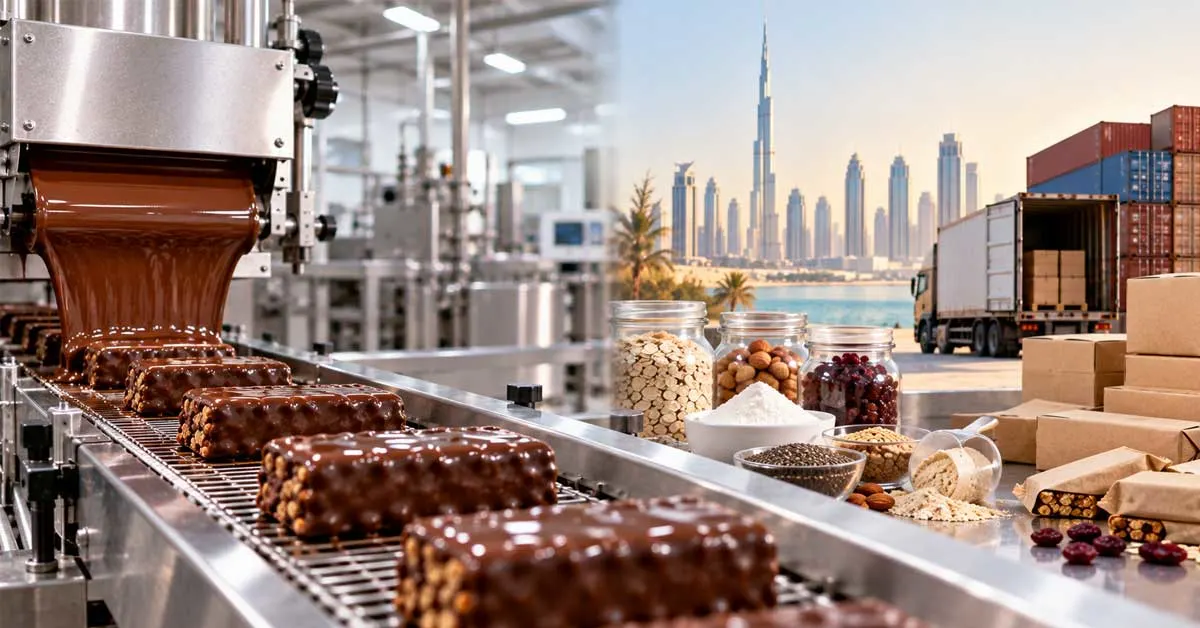
Despite the growth opportunities, manufacturers still need to navigate ingredient costs, consumer price sensitivity, regulatory requirements and competition.
Import Dependency & Supply Chain Costs
The Middle East remains highly dependent on imported food, while PwC reports that more than 50% of food consumed in MENA is imported.
Protein bar manufacturers may therefore face exposure to imported proteins, nuts, flavours, sweeteners and other ingredients.
Local sourcing can reduce some supply-chain risks, but ingredient availability, quality consistency and pricing still need to be assessed product by product.
Consumer Education on Protein Nutrition
Protein bars have a larger potential audience than the traditional gym consumer, but not every consumer automatically understands protein claims, serving sizes or nutritional differences between products.
This creates an opportunity for brands to explain the product clearly rather than relying entirely on technical nutrition terminology.
Price Sensitivity vs Premium Positioning
Premiumisation is growing, but consumers remain price-conscious.
PwC found that 44% of Middle Eastern consumers rank price among their top three food-selection considerations, while taste is prioritised by 36% and brand trust by 34%.
This means manufacturers need to balance protein content and formulation quality with an accessible price point.
The Future of the Protein Bar Market in the Middle East 2026–2028
The Middle East Protein Bar Market is moving beyond the idea of a protein bar as simply a gym product.
The strongest signals point toward a broader category built around convenience, health, regional flavours, plant proteins, digital distribution and premium product differentiation.
Protein bars within the Middle East snack bar market are projected to grow at 7.70% through 2031. Plant protein in the MEA protein bar market is projected to grow at 11.22% through 2030, while online retail is projected to grow at 11.37%. Fruit-based protein bar formulations are also projected to expand at 10.88%.
For investors and food entrepreneurs, this suggests that the opportunity may not be another standard chocolate whey bar. More differentiated opportunities are emerging around plant proteins, regional flavours, fruit-based formulations, functional nutrition, everyday convenience and digital-first distribution.
These developments will continue to shape Protein Bar Trends in Middle East through the 2026–2028 period.
For manufacturers, the implication is equally important. Production systems need to support changing recipes and consumer preferences rather than being designed around only one product.
Conclusion
The Middle East Protein Bar Market is not simply becoming larger. It is becoming more diverse.
The category is moving from a narrow sports-nutrition proposition toward products designed for everyday convenience, wellness and regional taste preferences. Plant protein is growing faster than the broader protein segment, fruit-based formulations are gaining momentum, online retail is expanding and regional flavours are creating new ways for brands to differentiate themselves.
For brands looking to enter the market, the opportunity lies in identifying a clear consumer need and building the formulation, distribution and manufacturing model around it.
For manufacturers, the equipment behind the bar matters just as much as the marketing in front of it.
That’s where Foodsure Machines come in. With over 13 years of experience building food processing machinery, Foodsure supports manufacturers across the GCC with everything from protein bar machine consultation to complete protein bar factory setup.
The right time to evaluate production capacity, machinery configuration and plant requirements is before the product launch, not after demand has already arrived.
Have a Question? Let’s Connect
Need expert guidance on food processing machines, production setup, or process optimization? Our team is ready to help you choose the right solution for your business.
Frequently Asked Questions
How big is the protein bar market in the UAE and Saudi Arabia?
The broader Middle East snack bar market was valued at approximately USD 305.60 million in 2025 and is projected to reach USD 432.22 million by 2031. Protein bars within this category are forecast to grow at a 7.70% CAGR through 2031. Saudi Arabia accounted for 24.10% of the regional snack bar market in 2025, while the UAE is projected to record the highest country-level CAGR at 7.64%.
Which protein bar trends are emerging in the GCC?
Key Protein Bar Trends in Middle East include plant-protein formulations, regional flavours such as date and pistachio, fruit-based protein bars, functional products, everyday nutrition, premiumisation and online-first distribution. Plant protein is projected to grow at 11.22% and online retail at 11.37% in the MEA protein bar market through 2030.
Which protein bar flavours have potential in the Middle East?
Regional ingredients and flavours such as dates, figs, pomegranate, pistachio, almond and sesame are emerging opportunities. Mordor Intelligence also highlights date-based and pistachio-kunafa variants within the broader Middle East snack bar market.
Is plant protein a growing opportunity for protein bar manufacturers?
Yes. Plant protein is projected to grow at an 11.22% CAGR in the MEA protein bar market through 2030, compared with the existing dominance of animal protein formulations.
Is online selling important for protein bar brands in the Middle East?
Yes. Online retail is projected to grow at an 11.37% CAGR in the MEA protein bar market through 2030. PwC also reports that 30% of regional consumers use on-demand delivery platforms for daily and weekly shopping.
Is halal certification required for protein bars sold in the GCC?
Protein bars containing animal-derived ingredients need to be assessed against the halal and food-regulatory requirements of the target market. Manufacturers should verify the applicable certification requirements for their specific ingredients, formulation and destination country before commercial launch.
Why are companies considering protein bar manufacturing in the GCC?
Regional manufacturing can provide greater control over production, formulation changes, quality and product development. The opportunity is particularly relevant because MENA remains highly dependent on imported food, while consumers are also showing interest in locally produced products.
What is the future outlook for protein bars in the Middle East?
The category is expected to continue expanding, with growth opportunities around plant protein, fruit-based formulations, regional flavours, functional nutrition, premium products and digital distribution. Protein bars are forecast to grow at a 7.70% CAGR within the Middle East snack bar market through 2031.




