
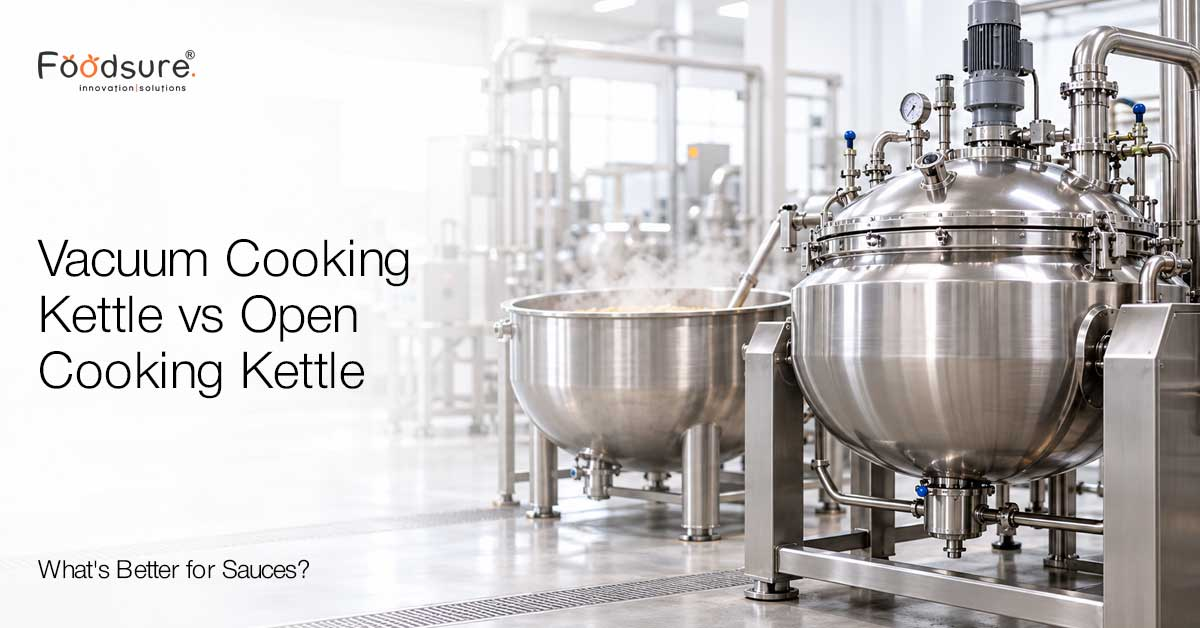
Sauce manufacturers sometimes find themselves choosing between different kinds of cooking systems based on the kind of sauce they manufacture, the size of their production, and other processing parameters.Knowing the distinction between a vacuum and an open kettle system will assist in selecting the correct equipment for manufacturing tomato sauces, chutneys, gravies, condiments, and other heat-processed foods.
This guide compares a Vacuum Cooking Kettle vs Open Cooking Kettle and explains their working principles, applications, benefits, and key selection factors for commercial sauce production.
Vacuum Cooking Kettle vs Open Cooking Kettle: The Basic Difference
The key difference is that the pressure of cooking is different. While the open cooking kettle for sauces works at atmospheric pressure, the vacuum cooking kettle for sauces works at a lower pressure.
How a Vacuum Cooking Kettle Works
A vacuum kettle reduces internal pressure, allowing moisture to evaporate at a lower temperature. This provides better control over concentration and heat exposure in sauces.
The unit typically consists of:
- Cooking pan
- Agitator
- Heat source
- Vacuum system
- Temperature control system
- Pressure/vacuum control system
- Product discharge system
The design will vary according to the product and process requirements.
How an Open Cooking Kettle Works
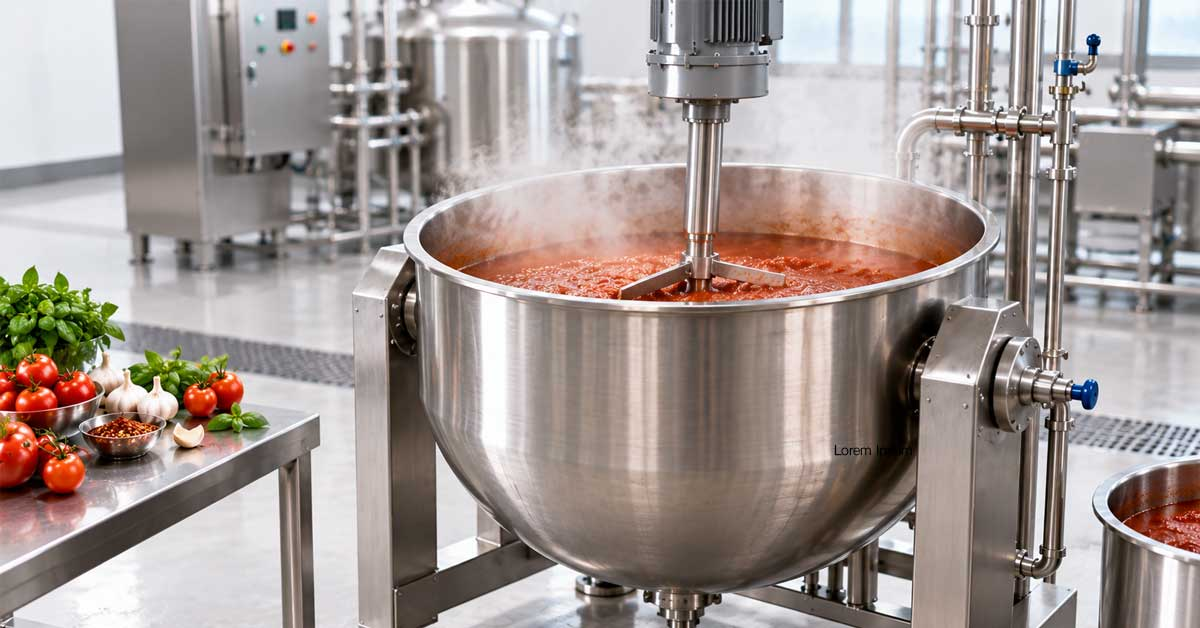
An open cooking kettle for sauces operates under normal atmospheric pressure. Ingredients are added to the vessel and heated while an agitator keeps the product moving.
With the rise in temperature in the product, there is direct evaporation of moisture from the open vessel. This makes the system quite simple and well-suited for most applications involving the processing of sauces.
Some of the products processed in open kettles include:
- Tomato sauces
- Chutneys
- Gravies
- Cooking sauces
- Fruit sauces
- Dips
For companies that have simple heating and stirring requirements, the open kettle provides a good solution.
Temperature Control and Product Quality
Temperature control is another factor that one needs to consider while evaluating the Vacuum Cooking Kettle vs Open Cooking Kettle.
The open kettle means that the product is cooked in atmospheric cooking conditions. Based on the process being undertaken, it may require high temperatures and more heat exposure.
In the vacuum method, evaporation can take place at low temperatures, which can be ideal for the product since high temperatures may have an effect on some of its properties.
However, whether there will be an advantage or not will depend on the formulation, time, and other factors.
Evaporation and Concentration
Evaporation plays a vital role during the manufacturing of the sauce due to the requirement of attaining a particular percentage of solid content and viscosity.
In an open kettle, the moisture will evaporate naturally due to the heating of the product. It is ideal for the normal process of cooking and concentration.
A vacuum cooking kettle for sauces has the advantage of evaporation through lowering the boiling point of the product, thus enabling the manufacturer to concentrate.
It all depends on the production process to choose which kettle to use.
Texture and Consistency
Both kettle types support consistent sauce texture through proper agitation, while vacuum processing offers better control over moisture removal and heat exposure.
The agitator design should therefore be selected according to:
- Product viscosity
- Batch size
- Solid content
- Heating requirements
- Mixing characteristics
Open Cooking Kettle for Sauces: Key Advantages
An open cooking kettle for sauces may prove to be a feasible choice for manufacturers seeking a fairly straightforward cooking solution.
These include:
- Operation is straightforward
- Convenient addition of ingredients
- Can use conventional cooking
- Easy process observation
- Simpler system design
- Suitable for various common sauces
This type of cooking kettle is especially beneficial for manufacturers whose products do not need vacuum treatment.
Vacuum Cooking Kettle for Sauces: Key Advantages
A vacuum cooking kettle for sauces offers greater control over pressure and evaporation.
Advantages may include:
- Evaporation at lower temperatures
- Moisture extraction is controlled
- Less heat exposure
- Concentration control
- Appropriate for particular heat-sensitive applications
- Processing is performed in a closed system
However, vacuum systems involve additional components and controls, making equipment selection and operation more complex.
Vacuum vs Open Cooking Kettle for Different Sauces
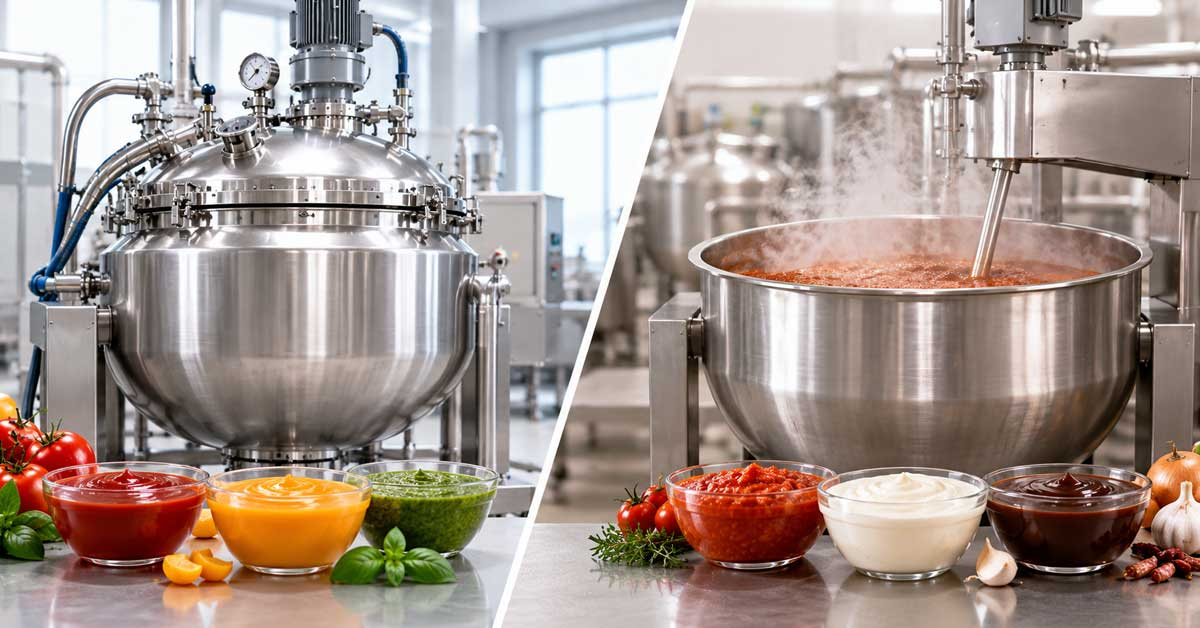
There is no universal kettle for all types of sauces, because the selection of the equipment depends on the requirements of the product.
- Open cooking kettle: Applicable for the ordinary cooking process, mixing, and sauce manufacturing by means of normal heating.
- Vacuum cooking kettle: Applicable for the controlled evaporation and concentration at low temperature.
- Heat-sensitive sauces: Vacuum technology will enable avoiding overheating of sauces, if required.
- Simple manufacturing process: In case advanced vacuum technology is not needed, open kettles might be preferable.
Role of Agitation in Both Cooking Systems
Stirring is essential, regardless of whether the cooking kettle works at either a vacuum or atmospheric condition.
Stirring keeps the product in motion and promotes even heating. This can help minimize ingredient settling in sauces, especially when solid particles are present or viscosity increases during cooking.
For potential customers looking into a high shear mixer cooking kettle, it should be clear that high shear mixing and agitation play two different roles.
Conventional agitation is mainly used for controlled movement of the product, whereas high shear systems create much higher mechanical forces.
Vacuum Cooking Kettle vs High Shear Mixing
Comparing the kettle system should not be mistaken for comparing traditional versus high shear mixing.
A high shear mixer cooking kettle may be able to incorporate both heating and mixing in applications that require more dispersion and emulsification.
This could be beneficial when making some types of sauces that will not get the required consistency by merely heating and mixing the product.
When looking for an equipment comparison, companies may also consider the comparison of a Cooking Kettle vs High Shear Mixer.
Factors to Consider Before Choosing a Kettle
The best kettle depends on the complete processing requirement rather than one feature.
Manufacturers should consider:
- Product formulation: Ingredients and viscosity influence equipment selection.
- Heating requirements: Determine whether conventional or lower-temperature processing is needed.
- Evaporation: Consider how much moisture needs to be removed and how precisely it must be controlled.
- Batch size: Equipment capacity should match production requirements.
- Agitation: The agitator should handle the product throughout the cooking cycle.
- Automation: Select controls according to production volume and process complexity.
- Cleaning: Product-contact areas should be accessible for routine cleaning and maintenance.
- Future expansion: The equipment should fit the manufacturer’s long-term production plans.
Installation and Line Integration
The cooking kettle must be treated as a component of the total process line for sauce making rather than a standalone piece of machinery.
Depending on the product being made, the cooking kettle may be linked to processes of material handling, mixing, homogenization, storage, filling, and packaging.
Proper layout will assist in maintaining smooth material flow and minimizing any unnecessary manual handling between processing steps.
In case of vacuum systems, extra space and utilities may have to be provided for vacuum equipment and its controls.
Foodsure Machines for Sauce Processing
Foodsure Machines offers machinery and solutions for those manufacturing industries that manufacture sauces, gravies, and other food items.
The machinery arrangement will depend upon the product to be manufactured, the batch size, need for heating, mixing, level of automation, and production sequence.
As per the needs, the manufacturer could look at an open cooking kettle, a vacuum kettle, or a mixture of both a cooking and a high shear mixer machine.
Foodsure could assist the manufacturers in developing a good sauce-processing plant by process planning, machinery selection, plant layout, commissioning, and training of operators.
Conclusion
The decision of choosing either a Vacuum Cooking Kettle vs Open Cooking Kettle is largely dictated by the processing needs of the sauce. While open kettles offer an easy way to heat and mix the sauce, vacuum kettles allow better control of evaporation and processing at lower temperatures.The manufacturer should take into account the product characteristics, viscosity, batch size, heating needs, evaporation, agitation, automation, and future needs when choosing the equipment.When the product requires intensive dispersion or emulsification, one should think about a high-shear system along with the cooking kettle.
Have a Question? Let’s Connect
Need expert guidance on food processing machines, production setup, or process optimization? Our team is ready to help you choose the right solution for your business.
FAQs
What is the main distinction between a vacuum and open cooking kettle?
The main difference between a vacuum cooking kettle and an open cooking kettle is that in a vacuum cooking kettle, cooking/evaporation takes place under reduced pressure. In an open cooking kettle, the process happens at normal pressure using traditional heating conditions.
Are vacuum cooking kettles good for making sauces?
Yes. A vacuum cooking kettle for sauces may come in handy when evaporation/concentration/reduced thermal treatment is required for the sauce.
Is it appropriate to use an open cooking kettle?
Yes. The open cooking kettle for sauces may be useful when traditional conditions of sauce cooking are needed, such as heating, agitation, and evaporation.
Is it possible to use a high shear mixer with a cooking kettle?
Yes. A high shear mixer cooking kettle combination may be used when there is a need for both heating and intense mixing/emulsification.
Which one is better: vacuum or open cooking kettle?
Neither of them is better. It all depends on the particular recipe, heating conditions, evaporation requirements, batch size, viscosity, and product needs.




