Inconsistent mixing. Blockages in production. Wasteful of expensive materials. These are the daily challenges manufacturers face, and exactly why the twin screw extruder machine has surged in demand. This extruder machine swiftly and precisely solves core production issues across plastic mixing, pharmaceuticals, and food processing. As an essential piece of equipment, the screw extruder is also an important investment that directly affects product quality and the bottom line.
What is a Twin Screw Extruder Machine? (Core Working Principle)
The twin screw extruder machine functions as a precise thermal processing machine that uses two intermeshing screws to move, press, and process raw materials. The synchronized rotation of the system creates a positive displacement pump effect, which results in an even distribution of time spent in the system while increasing its ability to clean itself.
The core mechanism depends on three essential components:
- Segmented Temperature Zones: The heating and cooling barrels use precise PID control to maintain the material’s viscosity and thermal sensitivity.
- High Shear Force: The kneading blocks produce high mechanical energy, which enables complete molecular structure disintegration for better product mixing.
- Controlled Pressure: The system uses hydraulic pressure to control melt flow through the die, which produces consistent output product shapes.
The Process Flow:
- Feeding: The system uses either gravimetric or volumetric methods to measure material intake.
- Melting: Mechanical friction and barrel heat transition solids to a viscoelastic state.
- Mixing: Distributive and dispersive mixing of additives or ingredients.
- Shaping: High-pressure forcing of the melt through a specialized die.
- Output: The system produces its final product through extrusion, which undergoes cooling before cutting.
What Twin Screw Extruder Type Fits Your Production Needs
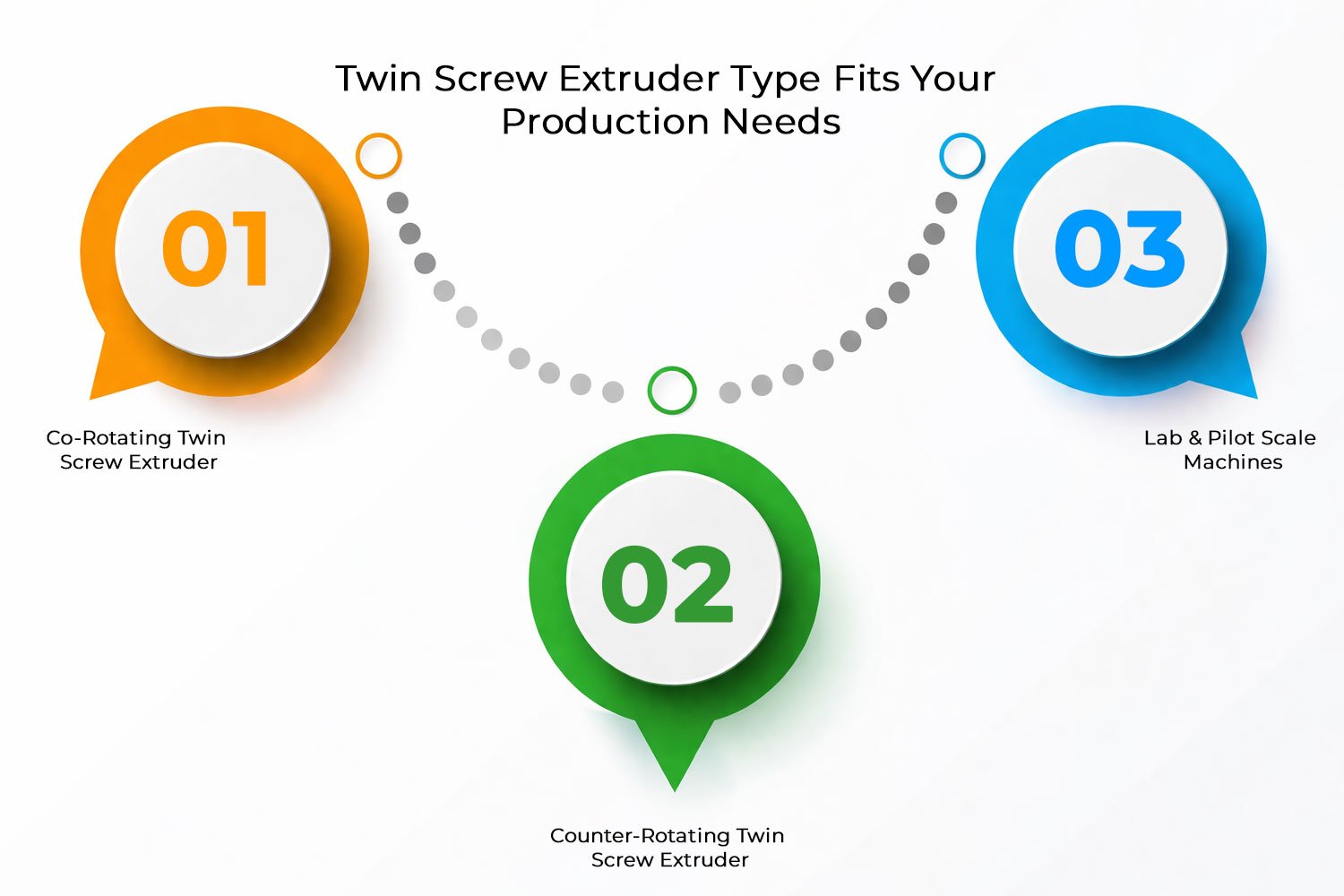
Businesses rely on a twin screw extruder configuration to achieve return on investment because this choice determines both end product material properties and manufacturing effectiveness.
Co-Rotating Twin Screw Extruder
- High-Intensity Mixing: The screws operate in synchronized motion to produce a self-wiping mechanism that guarantees complete surface refresh while stopping material from remaining inactive.
- Plastic Compounding: The co-rotating extruder serves as the best option for plastic compounding because it performs masterbatch and reinforced polymer dispersive mixing at its highest level.
Counter-Rotating Twin Screw Extruder
- High-Pressure Stability: Screws turn in opposite directions, acting like a positive displacement pump. This generates the high torque needed for rigid PVC pipe and profile extrusion.
- Thermal Sensitivity: It operates at lower RPMs with minimal frictional heating, making it a specialized solution where the counter-rotating twin screw extruder price is justified by the need to process heat-sensitive formulations without degradation.
Lab & Pilot Scale Machines
- Diverse R&D Applications: A lab-scale twin screw extruder machine for pharmaceutical research allows for precise hot-melt extrusion (HME) and bioavailability testing.
- Scalability: These units provide the critical data needed to transition from small-batch research to high-capacity industrial production lines.
Twin Screw Extruder vs Single Screw Extruder Comparison for Manufacturers
The most important manufacturing decision that impacts return on investment is selecting operational technology. The twin screw extruder vs single screw extruder difference serves different purposes because the twin screw extruder system can manage advanced materials while providing multiple processing options.
| Feature | Twin Screw Extruder | Single Screw Extruder |
|---|---|---|
| Mixing Efficiency | High (Dispersive) | Moderate (Simple) |
| Process Flexibility | High (Modular) | Low (Fixed) |
| Pumping Ability | 100% (Consistent) | 40–60% (Pressure-reliant) |
| Self-Cleaning | Yes (Intermeshing) | No (Purging required) |
| Energy Efficiency | High (Mechanical) | Moderate (Thermal) |
| Initial Cost | Higher | Lower |
| Maintenance | Complex | Simple |
How Twin Screw Extruder Screw Elements Design Improves Performance
The twin screw extruder screw elements design guide requires a modular system to achieve optimal mechanical energy performance throughout the machine operation. The manufacturers design specific segments to achieve precise control over the material’s residence time and structural properties.
Core Components:
- Conveying Elements: The system uses large-pitch flights, which enable quick material movement and delivery to users.
- Kneading Blocks: The staggered discs create strong shear forces, which help in the melting process and dispersive mixing operation.
- Mixing Zones: The specially designed notched elements enable distributive mixing while maintaining low-pressure conditions.
Why Screw Design Matters:
- Output Quality: The system controls how evenly the melt distributes with its added materials.
- Energy Efficiency: The system achieves optimal performance by creating a balance between motor torque and frictional heating.
- Product Consistency: The system maintains a constant flow, which decreases waste during high-volume manufacturing.
Twin Screw Extruder Machine Price Range and Extruder Price Factors
The extruder price is determined by three factors are torque capacity, wear resistance, metallurgy, and degree of automation. The appropriate twin screw extruder price range for small manufacturers requires proper equipment selection because it affects their operational efficiency and results in equipment downtime.
| Category | Typical Price Range | Key Features |
|---|---|---|
| Lab Scale | ₹5 – 15 Lakh | R&D, Small Batches, HME (Hot Melt Extrusion) |
| Small Scale | ₹15 – 50 Lakh | SME Production, Versatility |
| Industrial | ₹50 Lakh – ₹2+ Cr | 24/7 High-Capacity, Full Automation |
Cost Factors
- Screw Configuration: The design process uses modular segmented systems, which need high-chrome or PM-steel materials to achieve specific structural performance requirements.
- Output Capacity: The system needs motor torque and gearbox strength to grow at an exponential rate when moving from 50 kg/h to over 1000 kg/h.
- Automation Level: The introduction of PLC systems for real-time PID temperature control, together with gravimetric feeding systems, increases the initial cost of extruder equipment.
- Material Compatibility: The processing of abrasive and corrosive materials needs special barrel liners and screw coatings that protect against early equipment failure.
Twin Screw Extruder Spare Parts Suppliers and Lifecycle Performance
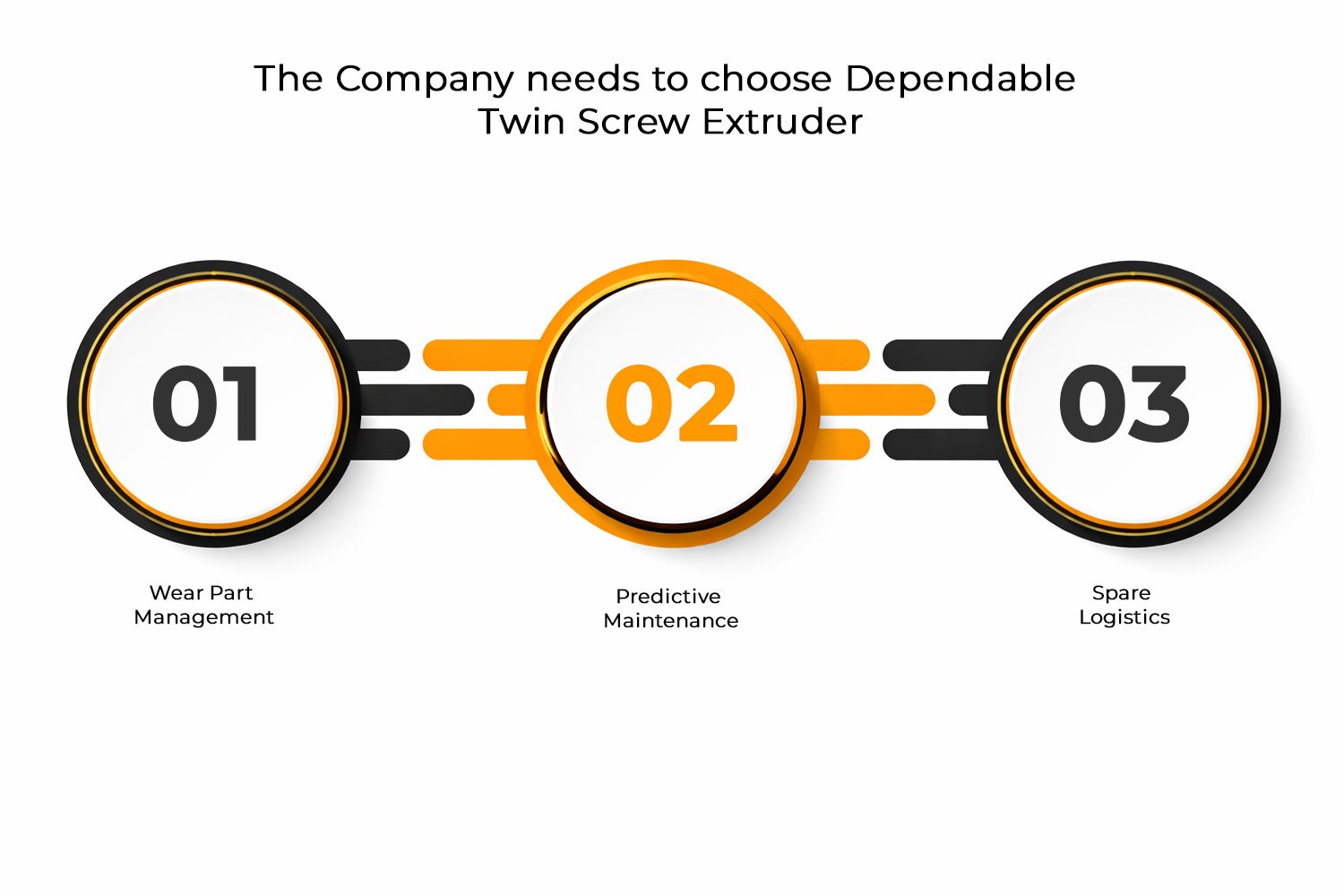
The company needs to choose dependable twin screw extruder spare parts suppliers because the choice of suppliers directly impacts operational continuity. Advanced maintenance work requires technicians to handle the mechanical connection between the screw and barrel.
- Wear Part Management: The solution uses high-quality alloys to produce screw segments and barrel liners, which provide protection against both abrasive and corrosive wear.
- Predictive Maintenance: The system uses vibration analysis together with real-time barrel temperature monitoring to detect misalignment that will lead to equipment breakdown.
- Spare Logistics: The company keeps an on-site stock of heating elements and gaskets, which enables them to maintain 99% production uptime by avoiding lead-time stoppages.
Conclusion
The selection of an appropriate twin screw extruder machine determines both operational efficiency and production scalability and return on investment. The team at Foodsure Machines provides dependable, high-performance equipment that we customize to your specific production requirements. The company maintains its dedication to quality through system designs that achieve maximum output with consistent performance and extended operational success.
FAQ
What is the best twin screw extruder machine for plastic and food processing industries?
The best twin screw extruder machine for plastic and food processing industries depends on three factors, which include output requirements, material specifications and automated system functionality.
What are the industrial twin screw extruder machine specifications and capacity details?
Industrial twin screw extruder machine specifications with capacity details change according to the two parameters of screw diameter and L/D ratio and production throughput.
Why use an automatic twin screw extruder machine for high-output production lines?
The automatic twin screw extruder machine operates in high-output production lines to deliver three benefits, which include consistent quality, reduced labor requirements, and improved operational efficiency.
How does an energy-efficient twin screw extruder machine improve continuous processing?
The energy-efficient twin screw extruder machine, designed for continuous processing operations, achieves lower power usage during operations while delivering consistent production performance.
How to choose the right twin screw extruder machine for manufacturing?
The selection process for the appropriate twin screw extruder machine requires evaluation of three essential factors, which include material compatibility, capacity needs and future growth possibilities.