
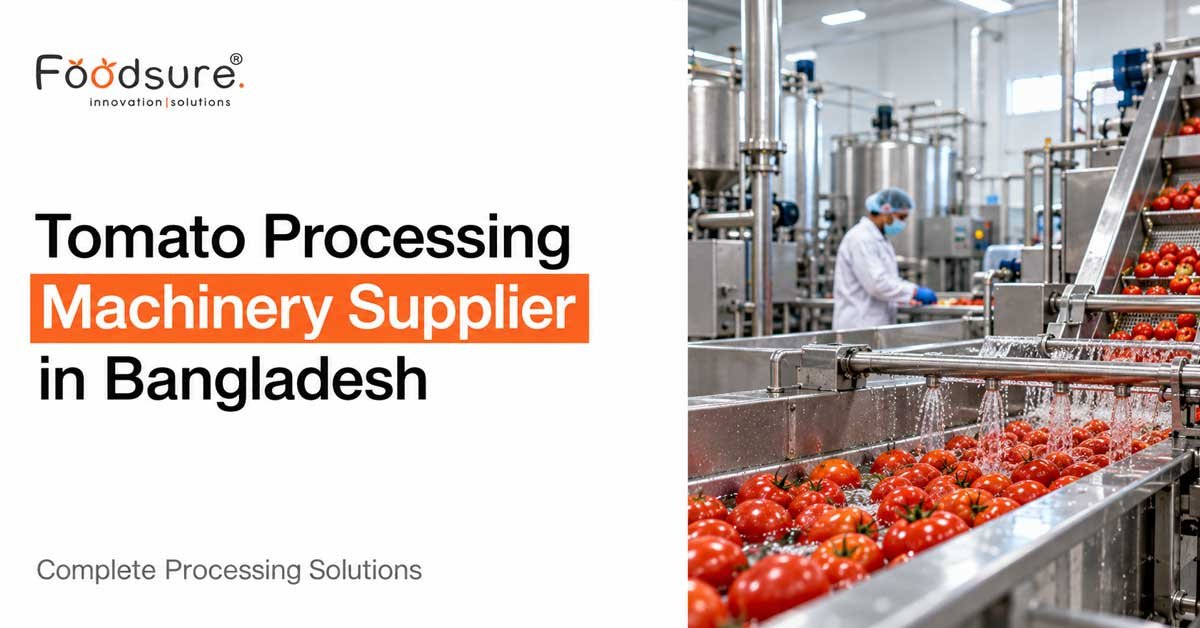
The food processing industry in Bangladesh is expanding and therefore creating more need for efficient tomato processing equipment. The best Tomato Processing Machinery Supplier in Bangladesh will plan the whole line based on the kind of product you wish to manufacture and the capacity required.
Well-planned tomato processing machines in Bangladesh can help in making tomato pulp, puree, paste, sauce, ketchup, and others.
In this blog, you will learn about the whole tomato processing line, what equipment is needed, the capacity required, the suppliers, and the important points to be considered when manufacturing tomato products in Bangladesh.
Why Tomato Processing Is a Growing Opportunity in Bangladesh
Tomato pulping, puréeing, pasting, saucing, and manufacturing of ketchup not only enhances shelf-life but also minimizes waste and allows year-round sales.
A typical commercial tomato processing company could consider:
- Supermarkets and groceries
- Restaurants and Quick Service Restaurants (QSRs)
- Hotels and caterers
- Food manufacturing
- Institutional cooking
- Private label foods
This provides an opportunity for the manufacturer to explore several revenue streams instead of relying on one alone.
What Is a Complete Tomato Processing Production Line?
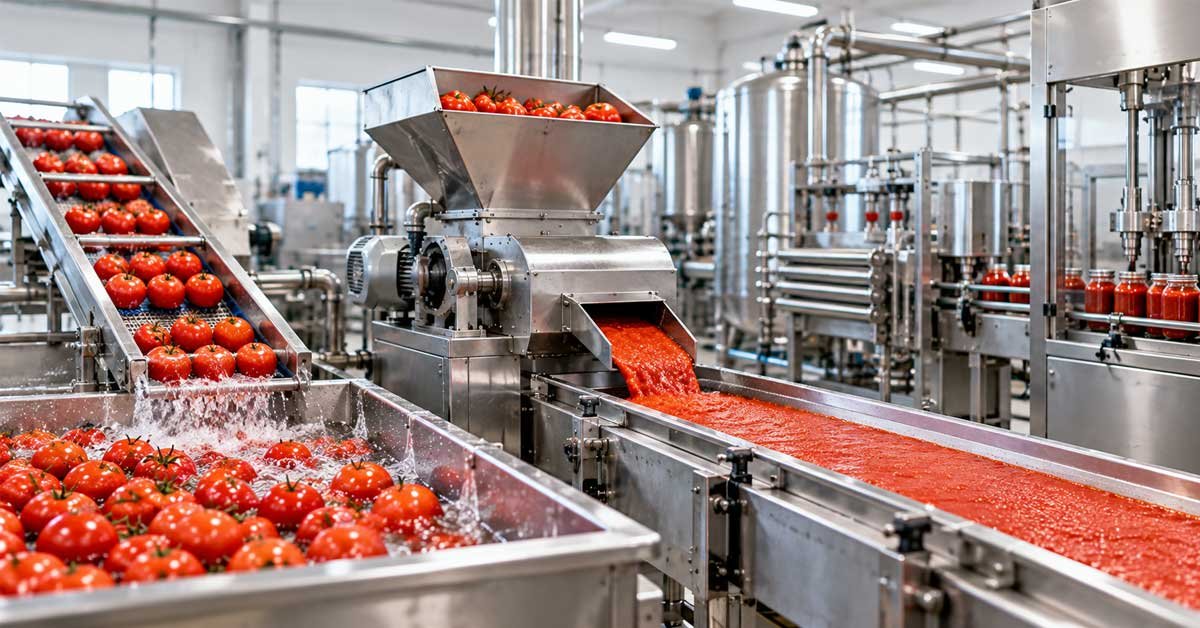
The tomato processing line consists of a series of processes, beginning from receipt of raw tomatoes to the packaging stage. This can differ depending on the type of product the processing plant is making, which may be paste, puree, sauce, pulp, or ketchup.
Fresh Tomato Receiving
↓
Washing System
↓
Sorting Unit
↓
Crushing Unit
↓
Pulping Machine
↓
Mixing / Ingredient
Addition
↓
Cooking & Heating
↓
Concentration / Evaporation
↓
Homogenization
↓
Storage Tanks
↓
Transfer System
↓
Filling Machine
↓
Sealing & Labelling
↓
Finished Product
A tomato processing equipment in Bangladesh setup can therefore be customised according to the final product, required capacity, automation level, and packaging format.
Tomato Processing Machine in Bangladesh: How the Production Line Works
The production process starts from the tomato receiving stage and ends with the final product packaging stage for distribution.
Stage 1: Tomato Receiving and Inspection
The tomatoes undergo inspection at the time of their reception, and unsuitable tomatoes are separated out.
Stage 2: Tomato Washing
This step involves cleaning the tomatoes to remove any dirt, dust, and leaves present on them.
Stage 3: Sorting
Sorting is done after washing in order to get rid of unsuitable tomatoes.
Stage 4: Crushing
The tomatoes are crushed in order to facilitate the separation of pulp, seed, and skin.
Stage 5: Pulping
This process involves the separation of tomato pulp from its seed and skin. It results in a fine base that can be used for preparing puree, pastes, sauces, and ketchup.
Key Factors That Affect Tomato Processing Quality
Several factors influence the efficiency of a tomato processing line and the quality of the finished product. Manufacturers should consider these factors while selecting equipment and designing the production process.
Quality of Raw Materials
Quality, ripeness, freshness, and variety of tomatoes have a direct impact on color, flavor, and pulp yield of tomato paste.
Pulp Yielding
Good pulp extraction increases pulp yield while minimizing losses from seeds, skins, and product.
Processing Control
Controlled processing and homogenization of products contribute to the maintenance of constant viscosity, product quality, and texture.
Compatibility of Equipment
All units should have the same capacities in order to prevent bottlenecks at some stage of the production process.
Hygiene and Maintenance of Equipment
Equipment which contacts with food should be hygienic and easy to wash.
Machinery Required for a Commercial Tomato Processing Plant
The selection of appropriate machinery is critical for any commercial tomato processing plant. An experienced Tomato Processing Machinery Supplier in Bangladesh can suggest appropriate machinery depending upon the type of product and future expansion plans.
Tomato Washing Machine
The washing process makes the fresh tomatoes ready for processing by cleaning them of soil, dust, leaves, and other foreign particles. It is important that the machine offers good cleaning without damaging the raw material.
Tomato Sorting System
The sorting machine helps sort out damaged or unsuitable tomatoes before sending them to the processing area. Good raw material quality ensures good color, taste, and consistency of the final product.
Tomato Crusher
The crusher crushes fresh tomatoes before pulping. Good crushing ensures good flow of the material and efficient operation of the pulping machine.
Tomato Pulping Machine
The pulping machine separates the tomato pulp from its seeds and skin. The tomato pulping machine is one of the important pieces of Tomato Processing Equipment in Bangladesh, as the quality of pulp affects products like puree, paste, sauce, and ketchup.
Mixing and Cooking System
The mixing tanks help in blending the ingredients uniformly, while the cooking system helps in heating the product. The system design is determined by the product being processed and its desired consistency.
Homogenizer
A homogenizer facilitates the smoothing out of products like ketchup and sauces. This can be chosen based on the viscosity of the product and output requirement.
Storage and Transfer System
Tanks for storage and transfer pumps are used in moving the tomato products from one stage to another in production while minimizing unnecessary manual transport.
Filling and Packaging System
The product can be packaged into bottles, pouches, sachets, jars, or bulk packers based on the desired market. The filling and sealing machine needs to be chosen alongside the processing line and not as a separate process.
Capacity Planning for Tomato Processing
The production capacity should be established prior to deciding on the equipment arrangement. The right capacity will depend on demand, number of working hours, variety of products, available factory space, and expansion plans.
Manufacturers will need to consider:
- Expected production per day
- Processing capacity per hour
- Availability of tomatoes seasonally
- Number of products
- Packaging capacity
- Demand from retail and B2B markets
- Sales growth in the future
The manufacturer catering to the local foodservice industry might require a different arrangement of equipment than the one targeting supermarket chains and private labels.
All major equipment must be of similar capacity to process the production at all stages equally.
Capacity Planning for Tomato Processing
The production capacity needs to be decided prior to the decision about machinery. There are many factors that need to be considered in order to decide the correct capacity.
It is important to consider the following by the manufacturers:
- Daily production
- Processing capacity per hour
- Availability of tomatoes seasonally
- Number of products
- Volume of packaging
- Demand for retail and business-to-business
- Future growth in sales
The machine used by a manufacturer catering to the food service business would be different from one catering to supermarkets or private labels. All large machines should have a similar capacity to match production at each stage.
Tomato Ketchup Processing Machine in Bangladesh
Ketchup is a significant commercial product that is made from tomato pulp. A tomato ketchup processing machine in Bangladesh needs further processing than simple tomato pulping.
An example of a ketchup line would involve:
- Tomato cleaning and sorting
- Mashing and pulping
- Ingredients mixing
- Cooking
- Homogenization
- Storage
- Transfer pumps
- Filling
- Capping
- Labeling
The layout will depend on the consistency of the product, package type, volume of production, and automation requirements. In the case of a tomato ketchup processing plant in Bangladesh, it is advisable to incorporate the processing and packaging process together.
What Makes a Good Tomato Processing Machine Supplier in Bangladesh?
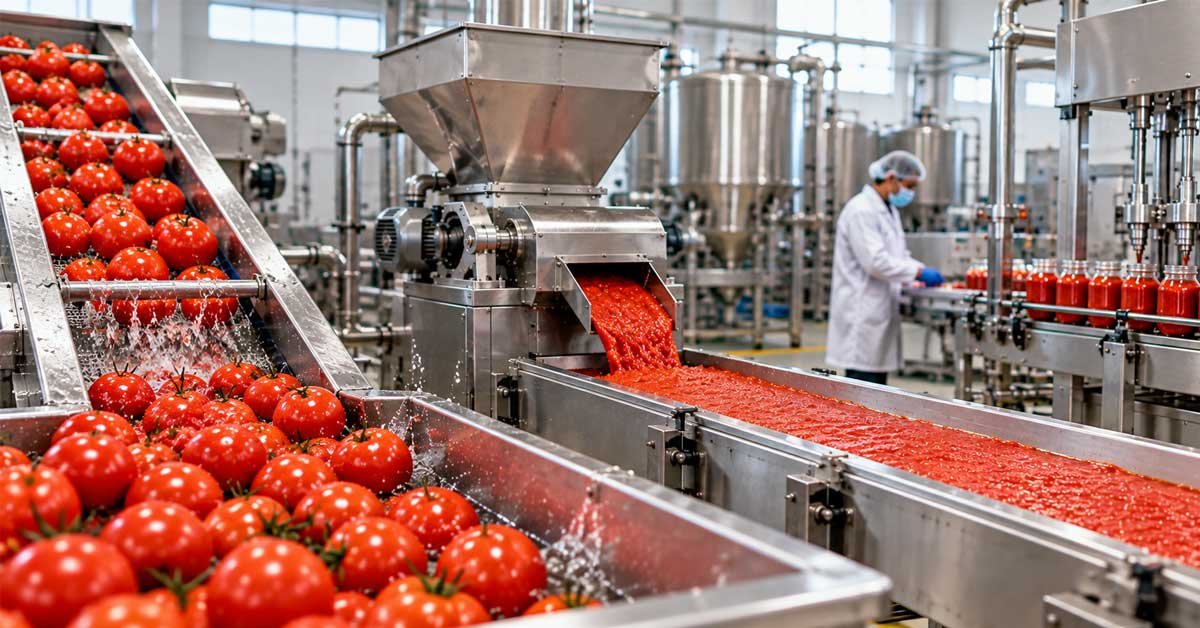
The selection of the supplier is very important, considering that machinery efficiency determines production. An efficient tomato processing machine supplier in Bangladesh will provide pre-order and post-order installation advice.
Equipment Choice Related to Product Production
It will be necessary to know what type of product the company is going to produce: pulp, puree, paste, sauce, ketchup, etc.
Food-Grade Construction
Contact with the product should be provided by food-grade construction materials and design.
Line Integration
Integration of all washing, pulping, cooking, storage, and packaging equipment will help in simplification of project management.
Installation and Commissioning
Correct installation helps ensure that the machinery works as designed. The commissioning procedure will involve testing of the entire line.
Operator Training
The operators should be trained in machine operation and cleaning, basic troubleshooting, and safety procedures prior to start-up.
Spare Parts and Technical Assistance
Spare parts and technical support are necessary to avoid downtime.
Why Import Tomato Processing Machinery from India?
Bangladesh food producers will find India close by for material and machinery procurement in the field of food processing. Procurement decisions must take into account technical expertise and production needs.
To be checked before purchasing:
- Specifications of the machine
- Material used for construction
- Production capability
- Utility considerations
- Delivery schedule
- Documentation for export
- Installation plans
- Spare parts arrangement
- Warranty provision
The commercial quotation must clearly state the following: equipment cost, installation cost, freight charges, training cost, etc.
Factory Setup Requirements for Tomato Processing
Moreover, an effective production line needs proper factory facilities too.
Raw Material Section
A proper facility should be set aside for raw materials like tomatoes, among others.
Processing Section
The facility should allow for an orderly flow of material from one process to another, such as washing, sorting, crushing, pulping, cooking, and homogenization.
Storage Section
The storage of tanks and finished products should be located in such a way as to reduce unnecessary movement of materials from processing to packaging.
Packaging Section
All filling, sealing, labeling, and handling of finished product should be done in a well-thought-out section.
Utilities
Electricity, water supply, heating system, drainage, and all other utilities should be taken into consideration during factory planning.
Common Mistakes When Purchasing Tomato Processing Equipment
Manufacturers should evaluate the entire processing line rather than focusing only on isolated equipment choices.
Buying Only Individual Machines
If machines are bought from various sources without thinking about compatibility, then there could be capacity matching and material handling difficulties.
Choosing Equipment Based on Cost Only
A low quotation does not cover installation, maintenance, spare parts, and technical assistance; therefore, full costs must be taken into consideration.
Neglecting Packaging
The processing plant needs to be designed along with the packing and filling plant.
Underestimating Future Demand
Equipment chosen just for present production needs might prove inadequate when the company grows. Hence, future needs should also be estimated at the time of selecting equipment.
Not Verifying After-Sales Assistance
When it comes to importing equipment, after-sales support and spare parts availability matter a lot.
Importing Tomato Processing Machinery from India to Bangladesh
For companies looking for a tomato processing machinery supplier in Bangladesh, it is possible to import from India as there are geographic and trade links. However, before placing an order, one should be well prepared.
Confirmation of Machine Specifications
Before finalizing the order, all technical details relating to the capacity, dimensions, power supply, materials used in the construction, and machine configuration must be provided.
Commercial Documentation
The supplier must give all necessary documentation to support the shipment. Buyers must ensure that all such documentation, including invoices, packing list, machine specifications, and other export documentation, are verified prior to shipment.
Mode of Transport
The mode of transport will depend on the size of the machine, the source of the shipment, the destination, and the commercial terms.
Installation and Commissioning
Once the equipment is installed in Bangladesh, installation and commissioning are necessary before beginning commercial production. Operator training will help the production team become familiar with how to operate and clean the machines.
Quality Control in Tomato Processing
It is important that quality be maintained while selling the tomato products to various consumers. There should be quality controls set up at various levels of production.
Quality of Raw Materials
Tomatoes used in processing should be checked for their freshness, maturity, color, damage, and foreign materials.
Processing Control
It is important that parameters such as the temperature at which the processing is done, consistency, efficiency of pulp, and processing time be considered.
Finished Product Inspection
Finished products should be checked for:
- Colour and appearance
- Texture and consistency
- Moisture or concentration
- Packaging integrity
- Batch uniformity
- Product weight
A structured quality-control system helps reduce batch variation and improve customer confidence.
Automation in Tomato Processing
The tomato processing machine in Bangladesh automates the process in the areas of handling, processing, filling, and packing.
Material Handling
The use of conveyors, pumps, and controlled material transfer systems can minimize the need for manual handling of products through different stages of production.
Process Monitoring
The control system will enable operators to monitor and regulate processing parameters.
Filling and Packing
Automated filling, sealing, and labeling will help to increase production rate and improve packaging quality.
Automation of the entire production process is much better for large-scale plants than just one machine.
Building a Successful Tomato Processing Business in Bangladesh
Establishing a tomato processing plant entails integration of different components like equipment, raw material, production, quality control, packaging, and distribution.
The manufacturers need to:
- Identify their products.
- Make estimates of production demand.
- Choose suitable processing equipment.
- Develop an initial design for the factory before installation.
- Combine packaging with the process line.
- Develop quality control systems.
- Think about future production expansions.
- Choose suppliers who offer technical services.
This will assist organizations in avoiding typical mistakes in choosing equipment and in developing a production system capable of accommodating future expansions in production demand.
Why Choose an Integrated Tomato Processing Line?
The advantages of an integrated production line include the following compared to acquiring unrelated machines.
Improved Material Flow
Machines can be arranged in accordance with the processing sequence, minimizing unnecessary handling of raw materials and processed materials.
Stable Production
Compatibility of machines facilitates stability in the flow of production from one processing stage to another.
Project Management
It becomes easier to coordinate installation and commissioning of the machines with a supplier that is experienced in multiple production line stages.
Scalability
If done with proper planning, there can be future scalability in terms of increasing capacity or automating the process.
For the manufacture of a tomato ketchup processing plant in Bangladesh, integration of equipment can be quite advantageous because the ketchup manufacture requires processing and packaging at various stages.
Foodsure Machines for Tomato Processing in Bangladesh
Foodsure Machines offers turnkey solutions to tomato processing facilities, which include processes like washing, sorting, crushing, pulping, cooking, concentrating, filling, and packing. The line can be configured in accordance with the production capacity, product range, level of automation, line layout, and packing process. As a tomato processing machinery supplier in Bangladesh, Foodsure Machines can help in selecting the appropriate machinery and line configuration, as well as its installation, commissioning, and training of operators.
Conclusion
A commercial tomato processing factory in Bangladesh requires a comprehensive system that includes handling, washing, sorting, pulping, cooking, concentration, storage, and packaging. A proper tomato processing machinery supplier in Bangladesh would be able to supply machinery according to the needs of capacity, design, automation, and future development. Tomato processing equipment in Bangladesh allows manufacturers to produce tomato pulp, puree, paste, sauce, and ketchup. Proper design of a tomato ketchup processing plant in Bangladesh provides an optimal base for commercial production.
FAQs
What kind of machinery is required for a tomato processing plant in Bangladesh?
The tomato processing plant would require washing, sorting, crushing, pulping, mixing, cooking, concentration, homogenizing, storing, filling, and packing machinery. The machinery used will depend on the product produced by the plant, such as pulp, puree, paste, sauce, ketchup, among others.
How do I select a Tomato Processing Machinery Supplier in Bangladesh?
The producers need to consider factors such as machine quality, production capacity, food-grade machinery, processing technology, line integration, installation, operator training, spare parts, and customer service. Experience of suppliers in other similar food processing projects is also an advantage.
Can Indian companies provide tomato processing machinery in Bangladesh?
Yes. Indian food processing machinery suppliers can deliver their machines in Bangladesh as long as import procedures are completed.
What are the products that I can produce using tomato processing equipment?
Using the processing line, the companies can produce tomato pulp, puree, paste, sauces, ketchup, and other products using tomato.
What are the requirements for a tomato ketchup processing plant?
A tomato ketchup processing plant normally involves washing, sorting, crushing, pulping, mixing, cooking, homogenizing, storing, filling, sealing, and labeling of the product.




