
The tomato ketchup manufacturing industry is evolving rapidly, with an increase in demand for processed, packaged, and ready-to-eat food items and sauces. A comprehensive Tomato Ketchup Project Report guide for entrepreneurs to understand the investment, machinery involved, production capacity, operational costs, and profit. This Tomato Ketchup Business Project Report describes how to set up a factory, CAPEX, OPEX, licenses, utility, and RO for a Tomato Ketchup manufacturing business setup in 2026.
Setting up a satisfactory tomato ketchup production facility requires modern processing machinery and equipment, a well-designed factory layout, appropriate raw materials, and an effective processing method. In conjunction with modern machinery and automation manufacturers, a continuous stream of standard Ketchup is produced, reducing operational costs. Manufacturers like Foodsure Machines offer complete turnkey solutions: selecting the right machinery, designing the plant layout, installation, commissioning, and technical support to establish a flourishing Tomato Ketchup business.
Tomato Ketchup Manufacturing Process Flow Chart
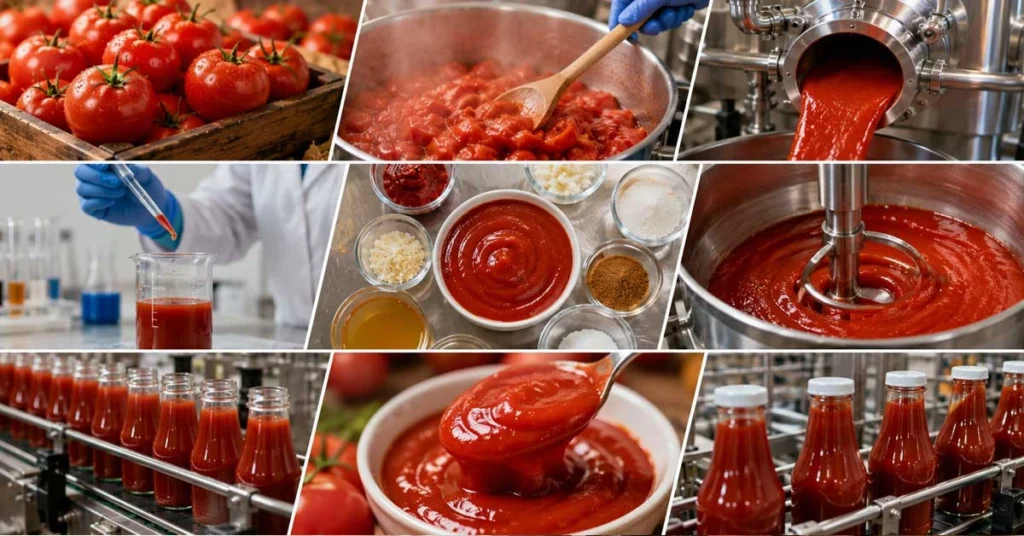
Quality and hygiene of a product are made superior and its manufacturing process more efficient with a series of production steps; this systematic manufacturing process can be explained by looking into major steps of a commercially produced ketchup, depicted through the following flowchart
1. Cleaning and Sorting
Washed of soil, dust, and external impurities, the fresh tomatoes are sent through an automatic washing machine. Then the damaged and rotten tomatoes are separated, and only fresh and good-quality tomatoes can be used for production.
2. Pulping and Juice Extraction
The clean and good tomatoes are sent to the tomato pulper machine to separate the pulp of the tomato from the seeds, skin, and other impurities. The pulp of tomatoes will be very delicate and smooth and could be used for making ketchup.
3. Cooking and Mixing Ingredients
The tomato pulp will be sent to the cooking tank, where sugar, salt, vinegar, spices, etc. The cooking will help develop and maintain the special flavor, density, color, and stability of its quality.
4. Homogenizing
The cooked ketchup mixture will be sent to the homogenizer to control the particle sizes to get more uniformity and a smooth texture. The quality could be better preserved so that there would be no separation when stored.
5. Pasteurizing
In this step, the ketchup is heated at a certain time and temperature to control harmful bacteria and make the products can last longer. Food safety is ensured while retaining good quality.
6. Filling and Packaging
The cooked and ready-to-eat ketchup will be filled into bottles, pouches, sachets, etc by the automatic filling machine. In this process, to keep the food from contamination and to fill the accurate volume is important.
7. Storing and Distribution
The filled ketchup will be placed in a clean and temperature-controlled warehouse and then distributed to every retailer.
Tomato Ketchup Plant Capacity & Machinery Requirement
Tomato Ketchup Plant Project Report: Choosing a production scale can balance investment with the supply required. A tomato ketchup plant is feasible for setting up at a small-scale business, medium-scale business, or as a large-scale business.
| Plant Capacity | Production Output | Suitable For |
|---|---|---|
| Small Scale | 100–200 Kg/hr | Startups and local markets |
| Medium Scale | 500 Kg/hr | Regional distribution |
| Large Scale | 1000 Kg/hr and above | Industrial production |
CAPACITY EXPLANATION
Small scale Plant (100-200 Kg/hr)
Suitable for those entrepreneurs/businesses who are entering the market for the 1st time with the least investment for the low volume target with minimal expansion. This kind of capacity is best to test the market before expanding the operation.
Medium Scale Plant (500 kg/hr)
Suitable for medium volume producers targeting régional markets, which is an optimum balance between investment, operating costs & operational efficiencies, which is ideal for food manufacturers in expansion.
Large scale Plant (1000 Kg/hr & above)
Larger plants are aimed at the producers who cater to superstores, large chains, bulk buyers, and export markets. The demand for producing these large volumes justifies higher investment levels, but in return, they benefit from increased levels of automation & production efficiencies
Machinery Required For Tomato Ketchup Plant
The commercialized ketchup production plant needs adequate food processing machines; by this means, we can ensure the product and fulfill the needed amount of output. Businesses looking to buy tomato ketchup machine India should compare machine configurations, production capacity, automation features, and after-sales support before making a purchasing decision.
| Machinery | Function |
|---|---|
| Tomato Washing Machine | Removes dirt and impurities from tomatoes. |
| Sorting Conveyor | Separates damaged and unwanted tomatoes. |
| Tomato Pulper Machine | Extracts smooth tomato pulp. |
| Cooking System | Mixes and processes ingredients. |
| Homogenizer | Improves ketchup texture. |
| Pasteurizer | Controls microbial activity. |
| Filling Machine | Fills ketchup into containers. |
| Packaging Machine | Packs finished products. |
How it Works!
1. Tomato Washing Machine
This is a machine used to wash fresh tomatoes before it gets into the process. This washing is to remove dirt, soil, and dust on the surface of the tomatoes so as not to interfere with food hygiene in the next step. The tomato washing machine reduces manpower requirements.
2. Tomato Sorting Conveyor
This tomato sorting conveyor machine can help our workers to discard defective tomatoes, stones, and other foreign impurities, etc. So that only the quality tomatoes enter the production process. Sorting can avoid secondary loss in the subsequent processing to enhance the finished product.
3. Tomato Pulper Machine
It consists of a screen to help extract the smooth pulp from the skin and seeds of tomatoes. This tomato pulper machine provides uniform and smooth pulp with suitable quality needed in the whole process of ketchup manufacturing.
4. Ketchup Cooking System
The cooking system integrates tomato pulp with other ingredients of sugar, salt, spices, vinegar, etc. Controlling heating to process for obtaining a desired concentration, taste, and colour in your ketchup product. Controlled blending ensures all ingredients cook together evenly.
5. Ketchup Homogenizer
A homogenizer (optional) improves ketchup appearance by reducing the size of particles and provides an emulsion that is more stable, thus reducing the risk of separation. It helps tomato ketchup manufacturers get a more premium product in terms of texture.
6. Ketchup Pasteurization System
The pasteurization process utilizes controlled heat exposure for reduced microbial activity. The purpose of pasteurization for ketchup is to make your product safe to consume, increase the shelf life of your product, and maintain consistency during storage and transit.
7. Filling Machine
An automatically controlled filling machine that helps in the precise measurement and dispensing of Ketchup into bottles, pouches, sachets, etc. Automated filling reduces product waste in the production process. High efficiency ensures hygienic production.
8. Packaging Machine
Packaging is the last production process to make your packaged ketchup ready for selling and marketing. A highly efficient, functioning, and high-quality packaged product with good looks attracts customers to purchase your Ketchup.
Tomato Ketchup Plant CAPEX (Capital Investment)
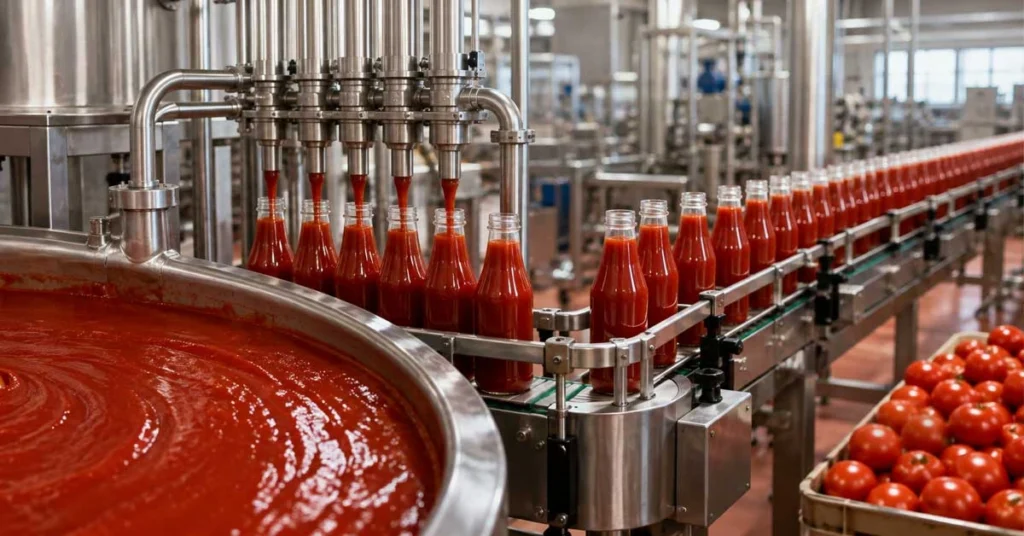
The capital expenditure involved for a tomato ketchup plant is the preliminary sum that you may need to invest for the factory setup. It covers the costs of acquiring all types of machinery, setting up the factory and infrastructure, electrification, packaging plants, and the installation costs before commercial production can commence.
An exact calculation of the CAPEX gives businessmen an idea of the total investment to set up the manufacturing plant. Investment changes depending on factors such as how many units you want to produce, your level of automation, and the demands of the factory.
Estimated CAPEX for Tomato Ketchup Plant As Per Tomato Ketchup Plant Project Report
| Investment Area | Estimated Cost |
|---|---|
| Processing Machinery | ₹40 Lakhs – ₹2 Crore |
| Factory Infrastructure | ₹30 Lakhs – ₹1 Crore |
| Electrical & Installation Setup | ₹10 Lakhs – ₹30 Lakhs |
| Packaging Equipment | ₹20 Lakhs – ₹80 Lakhs |
| Total Estimated Investment | ₹1 Crore – ₹4 Crore |
CAPEX Explanation:
1. Processing Machinery
Processing equipment comprises the most significant investment in a tomato ketchup plant design. It will vary according to the capacity of the plant, the level of automation, and the technology used. Good quality machinery enhances productivity and minimizes operating costs in the long run.
2. Factory Infrastructure
The factory infrastructure encompasses the production hall, store, quality control room, and raw material section. Factory structure must be designed for smooth process and hygienic manufacturing conditions. Infrastructure requirement is depending on the size of the plant and production capacity.
3. Electrical & Installation Setup
Electrical installation encompasses power connections, wiring for control panels, and commissioning of the machines. Correct installation of the machine makes it operate correctly and safely. Professional installation plays an effective role in reducing production startup downtime.
4. Packaging Equipment
Packaging equipment such as filling, sealing, and packing would be needed to pack the ketchup in bottles. The amount of investment that would be needed for packaging would largely depend on the type of packaging used, the level of automation introduced, and the production speed. Today, most packaging equipment helps to enhance the appearance of the product and also decrease wastage.
5. Total Estimated Investment
The total investment is based on the selected production capacity and factory layout. Investment in a small-scale plant is less; automated industrial plants demand more capital. Good project planning secures better financial management.
Tomato Ketchup Plant Project Report: Tomato Ketchup Plant OPEX (Operational Cost)
OPEX (Operating Expenditure): Operational expenditures refer to all of the regular ongoing costs needed for producing tomato ketchup in a unit. Effective operational expenditures can significantly impact profitability and sustained growth.
A rigorous OPEX analysis is required to calculate the production costs on a monthly basis. Raw materials, labor, utilities, packing, and manufacturing & repair are essential operating expenditures.
Major OPEX Components
| Investment Area | Estimated Cost |
|---|---|
| Processing Machinery | ₹40 Lakhs – ₹2 Crore |
| Factory Infrastructure | ₹30 Lakhs – ₹1 Crore |
| Electrical & Installation Setup | ₹10 Lakhs – ₹30 Lakhs |
| Packaging Equipment | ₹20 Lakhs – ₹80 Lakhs |
| Total Estimated Investment | ₹1 Crore – ₹4 Crore |
OPEX Explanation
1. Raw Materials
Raw materials (mainly tomatoes and blending spices) are the highest operating costs in ketchup production. The cost of production and the quality of the end result are directly influenced by raw materials like tomatoes, spices, sugar, and vinegar. Bulk purchasing and supplier management should be the strategy to put a stop to raw material costs.
2. Labour Cost
Operators are needed to run machines, perform quality control, and monitor production. Labour needs vary according to automation and the scale of the plant. Proper management of manpower increases efficiency and cuts down losses.
3. Electricity & Fuel
Energy is needed to operate processes, cooking, pasteurization, and packaging operations. Operating costs are minimized by utilizing energy-saving equipment. With good utility planning, production won’t be disrupted.
4. Packaging Material
Depending on the finished product, packaging material may entail bottles, pouches, labels, and cartons. It is a figure appropriate to the design of packaging, quality of material and volume of production. Effective packaging choice assists in preserving the value of the product.
5. Maintenance Cost
Maintenance ensures the smooth operation of machinery and prevents unscheduled dismantling. Maintenance comprises component replacement and servicing as well as technical inspection. A preventive maintenance schedule can enhance plant reliability.
Licences Required for Tomato Ketchup Manufacturing Business
To be able to legally manufacture commercial ketchup, you’ll need to get specific approvals. Licenses confirm that the plant meets food safety and tax compliance rules, along with regulations about establishing an industrial unit. Getting appropriate licenses will make you customers feel more comfortable and will help you run your company efficiently. However, the specific licenses will depend on where you are operating your facility and relevant regulations.
Important Licences Required
| Licence | Purpose |
|---|---|
| FSSAI Licence | Food safety approval for manufacturing. |
| GST Registration | Tax compliance and business transactions. |
| Factory Licence | Permission for industrial operations. |
| Pollution Control Approval | Environmental compliance. |
| Trade Licence | Local business operation approval. |
Licence Explanation!
1. FSSAI licence
You need an FSSAI licence if your food business processes any packaged food items, which ultimately comes under packaging regulations for food safety and quality, and so every tomato ketchup manufacturer needs it before starting any.
2. GST Registration
To do business and for tax purposes, it needs gst registration, which will legally allow you to supply all over India with the country. You also know how to keep the accounts correct.
3. Factory Licence
If you do any type of factory work for your production, then your Factory licenseneeded to follow the labour and work rules and also to protect workers’ environment. Depending on the size of the factory, it also varies with local acts and regulations.
4. Pollution Control
Since all food production units have many waste types, such as, water and other chemical waste, based on the Food type. So to avoid problems caused by pollution, the manufacturers also get polluted with them to stay in environment rules and avoid fines for the same.
5. Trade Licence
The most common license for any business, and it helps you work around the country or anywhere you sell products for your business. You also get a trade licensefrom thelocal governmentdepartment.
Utilities Required For Tomato Ketchup Plant Setup
As per the Tomato Ketchup Plant Project Report, Continuous production requires an efficient supply of utilities as well as maintaining hygiene standards within the production facilities. Correct layout of utilities contributes towards overall efficiency of machines in operation, smooth production flow, etc.
Utilities required for a commercial ketchup plant include Electricity; Water supply; heating systems; and sewerage disposal, etc. Such arrangement should be according to plant capacity.
Major Utility Requirements
| Utility | Requirement |
|---|---|
| Electricity | Power supply for machinery operation. |
| Water | Food-grade water for processing and cleaning. |
| Steam System | Heating and pasteurization operations. |
| Waste Management | Treatment and disposal system. |
Utilities Requirements
1. Electricity
Electricity supply is used for operating processing, filling and packaging machines. Rate of consumption is proportional to plant capacity and degree of automation; any interruption in supply will lead to stoppage of production work.
2. Water Supply
Water is mainly used for washing and cleaning of tomatoes and as a component of all food processing jobs. The supplied water must be of food-grade quality so that the standards of hygiene are met.
3. Steam System:
Steam has mainly been used for cooking and pasteurization of ketchup/processing and is produced by a boiler with its distribution system. The required parameters for heat-based processes, such as temperature and rate, must be maintained to attain process control and ensure quality and safety.
4. Waste Disposal Plant
Waste management services are provided for proper treatment of wastewater as well as solid organic wastes created throughout the process. Proper solid/liquid waste management ensures compliance with prevailing environmental conditions/ standards and practices.
Profit: Tomato Ketchup Business Project Report & ROI Analysis
Profitability while framing Tomato Ketchup Business Project Report is indeed significant to take into account. Ultimately, returns are an offshoot of not just scale of production, cost of procurement, demand and value at price, and operational efficiencies.
But a ketchup production setup that is carefully devised would also see consistent growth with smart manufacturing. And ROI tells you just that – the break-even period of the investment.
Estimated Profit & ROI Overview
| Parameter | Details |
|---|---|
| Production Capacity | 500 Kg/hr (Example) |
| Working Hours | 8 Hours/Day |
| Daily Production | Approx. 4,000 Kg |
| Expected Profit Margin | 15%–30% |
| ROI Period | Approx. 2–4 Years |
Profit & ROI Explanation:
1. Production Capacity
Production capacity: Increase the production capacity, manufacture large volumes, and provide products in a larger-scale market to gain maximum revenue. Production capacity should be decided according to the customers and the capacity of investment.
The product planning can increase the revenue.
2. Working Hours
Hours of production define how much will be produced in a day in a manufacturing unit. Usually, commercially used plants work by market & production schedule. Best working hours increase the utilization of machines.
3. Daily Production
Production capacity and efficiency determine the volume of output in a day. Increased output improves delivery and distribution of finished goods. Production planning enhances business.
4. Profit Margin
Profit margins are determined by: sales price of product, cost of production, and sales channel. Machinery and cost reduction serve to get better profits. Demand of the product is influenced by branding and business distribution.
5. ROI Period
By ROI, we see how much time the company takes to return its initial investment. Investment recovery is around years in a well-managed ketchup plant. The period depends on the market growth level and operational efficiency.
Foodsure Machines: Complete Tomato Ketchup Plant Setup Solution
Foodsure Machines offers comprehensive turnkey solutions for aspiring entrepreneurs looking to set up a tomato ketchup manufacturing business. They help their customers from scratch to the point of commercial production. They prepare a critical analysis and a Tomato Ketchup Plant Project Report and design the plant as per clients’ requirements.
Businesses planning to buy tomato ketchup machine India can benefit from Foodsure Machines’ complete turnkey support, including machinery selection, plant design, installation, commissioning, and technical assistance.
Here’s what they do:
1. Plant Design & Layout Planning:
They design a layout for your factory to achieve a smooth workflow based on capacity. Foodsure makes it clean, efficient, and helps to produce in the right way.
2. Machinery Manufacturing & Supply:
They have a full range of commercial production of machines that efficiently turn raw tomatoes into a final product. They are made using proper food-grade standards to ensure great production consistency.
3. Installation & Commissioning:
Their technicians are ready on-site to ensure the smooth installation, testing, and commissioning of the machinery so you hit the ground running and produce more.
4. Operator Training & Technical Support:
Once the plant setup is complete, they will teach you and your employees everything they need to know about how the machines run and how they are best maintained, to produce effectively.
Conclusion
A Comprehensive Tomato Ketchup Project Report assists business owners in identifying required machinery, capital investment, capacity & setup requirements of the business. While a proper Tomato ketchup Business Project Report aids in decision-making before launching a production unit. However, with the support of state of Art Machine with adequate utilities and an efficient cost-control process, you can make Tomato Ketchup production a profitable business for your company.
Foodsure machines offer turnkey project solutions for a state-of-the-art tomato ketchup plant. Invest in sophisticated food processing machinery for a long and sustainable journey for your food processing business.
FAQs
How much is the investment in tomato ketchup plants?
Investment is normally from INR 1 crore to INR 4 crores, depending on scale, level of automation, machinery, and infrastructure.
What type of machinery is needed to make tomato ketchup?
The machinery typically needed for a tomato ketchup plant manufacturing is washing machines, pulping systems, cooking systems, pasteurizing systems, filling machines, and packaging equipment.
Is ketchup manufacturing profitable in India?
Yes. The manufacturing process is profitable as you can control costs by utilizing efficient methods, procuring locally, and packaging smartly in addition to meeting demand with adequate supplies in the market.
What is the required license for a ketchup-making business?
Manufacturers need to be compliant and obtain the FSSAI license, GST registration, factory license, pollution clearance, and trade permission.
What is the tomato ketchup plant manufacturing capacity?
Commercial Tomato Ketchup plant machine capacity ranges from 100 Kg/hr. Up to 1000 Kg/hr depending on need and requirement.




