
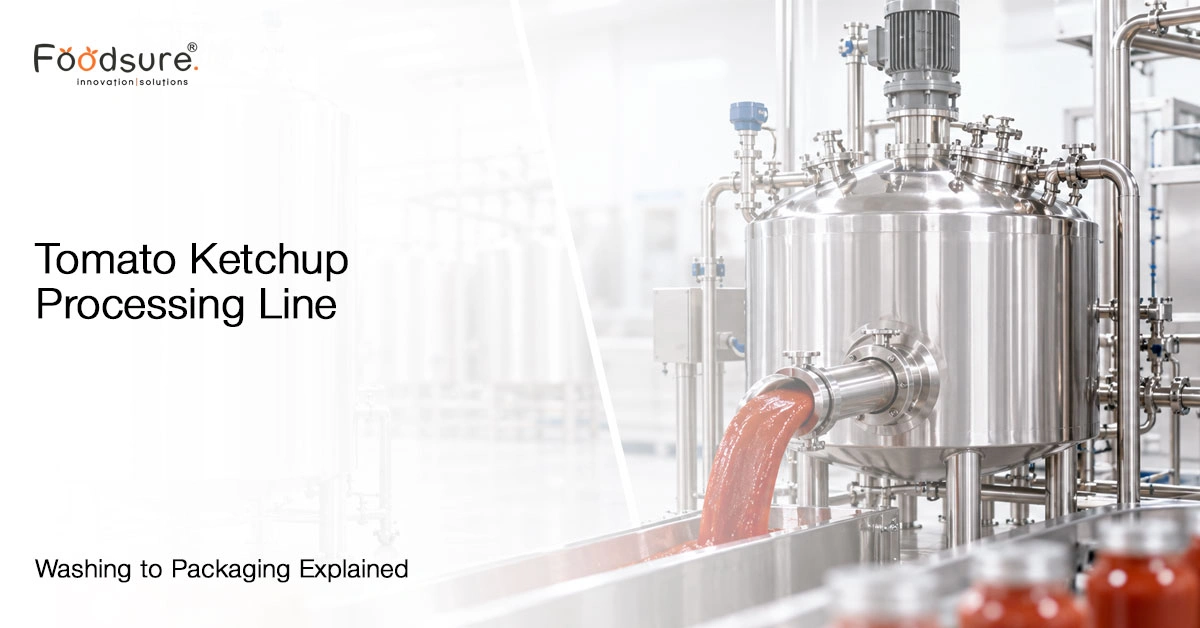
Tomato ketchup processing line refers to the series of machines that convert fresh ripe tomatoes to packaged ketchup. Food manufacturing companies use the equipment to make food in large quantities and maintain high quality while minimizing the cost of labor and reducing chances of contamination.
In case you are planning to set up a ketchup manufacturing plant or improve your already existing one or even just know more about the making of ketchup, this article takes you through all the stages of production and the different machines used in the process.
What Is a Tomato Ketchup Processing Line?
A tomato ketchup processing line is a production system which makes use of specific mechanical and thermal operations in a certain order in converting fresh tomatoes into ketchup. The process involves one stage feeding into the next, hence the tomatoes are moved from crates to bottles without any manual intervention.
The typical commercial tomato ketchup processing line comprises the following steps:
- Receipt of raw materials/washing
- Sorting/inspection
- Tomato crushing/pulping
- Pre-heating/de-aeration
- Refining
- Concentration
- Homogenizing
- Seasoning/blending
- Sterilization
- Packaging/filling
In smaller processing units, some of the above steps can be combined. In larger plants, the various steps have specialized equipment for each.
Why Does Processing Sequence Matter?
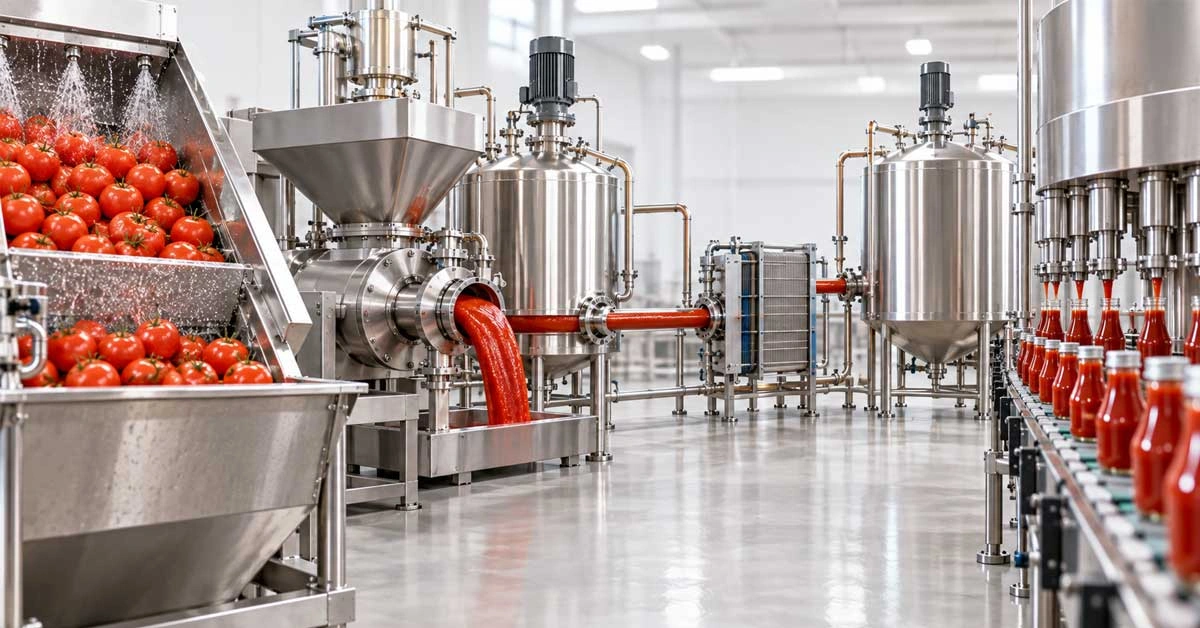
This is due to the fact that tomatoes are very perishable fruits; delays in between different stages will allow enzymatic browning, microorganisms’ development, and nutritional content losses. A well-designed sequence of equipment for tomato ketchup production ensures smooth operation without quality losses between stages.
Manufacturing plants, which neglect some stages or accelerate the process sequence will get:
- Irregular texture or grainy ketchup
- Color that will brown faster than usual
- Different viscosity of the batches
- Higher level of microbes
Proper designing of the sequence and equipment saves money.
Stage-by-Stage Breakdown
1. Washing and Cleaning
Raw tomatoes contain soil, pesticides, and other impurities that need to be washed out prior to cutting.
The process is done by bubble washing or spray washing, and sometimes their combination. The use of bubble washing is based on the application of water and air jet streams for cleaning of fruit without bruising, as bruised tomatoes oxidize faster and may cause unpleasant flavors of the final product.
2. Sorting and Inspection
During the next stage, tomatoes undergo inspection through a conveyor belt, during which workers or optical sorters reject the damaged, green or rotten tomatoes. Such a procedure is necessary for preserving the quality of ketchup in terms of both color and flavor, as even a small portion of such fruit can change the flavor of the whole batch of ketchup.
3. Crushing and Pulping
Sorted tomatoes are subjected to crushing, and the result is a coarse mixture of tomatoes with skins and seeds. This tomato pulp goes to a pulper, where pulp is separated from seeds and skins with the help of rotating paddles pressing against a sieve.
4. Pre-Heating (Hot Break or Cold Break)
Prior to refinement, the pulp is subjected to heating process by either of the two ways:
- Hot break: The pulp is heated up to 90-95°C immediately after crushing. This stops the action of pectin enzyme rapidly and thus forms thick or viscous ketchup.
- Cold break: The pulp is heated at low temperature (60-65°C). Though it leaves more fresh tomato taste, it gives thinner texture.
Most manufacturers of commercial ketchup use hot break as there should be body in ketchup.
5. Refinement
The pre-heated pulp is run through finer screens to ensure removal of skin particles, seeds, and fibres. This process gives smooth consistency to the ketchup pulp, unlike tomato paste.
6. Concentration and Cooking
There is still a lot of water content in refined pulp which must be concentrated into required consistency. Usually, the concentration takes place in vacuum evaporator where pulp gets cooked.
Cooking in vacuum is necessary as it ensures preservation of the colour and nutrients in the tomatoes, whereas, cooking at higher temperature in atmospheric conditions would affect the taste of the product negatively.
7. Homogenization
The pulp needs to be broken down into uniformly fine particles such that when it is bottled as ketchup, it is smooth and does not have separation. Here is when a 2-Stage Homogeniser for Ketchup comes in handy.
- A two-stage homogeniser forces the mixture to flow through a narrow valve under high pressure in two successive steps; in the first step, the large particles are broken, and in the second step, the particles are dispersed evenly so that they do not clump together again.
- Single-stage homogenizers can break down the particles too, but are highly likely to allow for the formation of particles again, resulting in water accumulation on the upper part of the bottle.
8. Seasoning and Blending
Here, the concentrate is blended with salt, sugar, vinegar, and various flavors in a formulation tank provided with an agitator. The recipes differ based on brands, but the blending machine should be able to ensure uniform flavor production throughout the batches.
9. Sterilization
The experienced ketchup is passed through a sterilizer, which could be a plate or tubular heat exchanger, in order to elevate its temperature sufficiently to kill harmful bacteria. This process ensures that the ready ketchup will remain shelf-stable for several months without the need for refrigeration.
10. Filling and Packaging
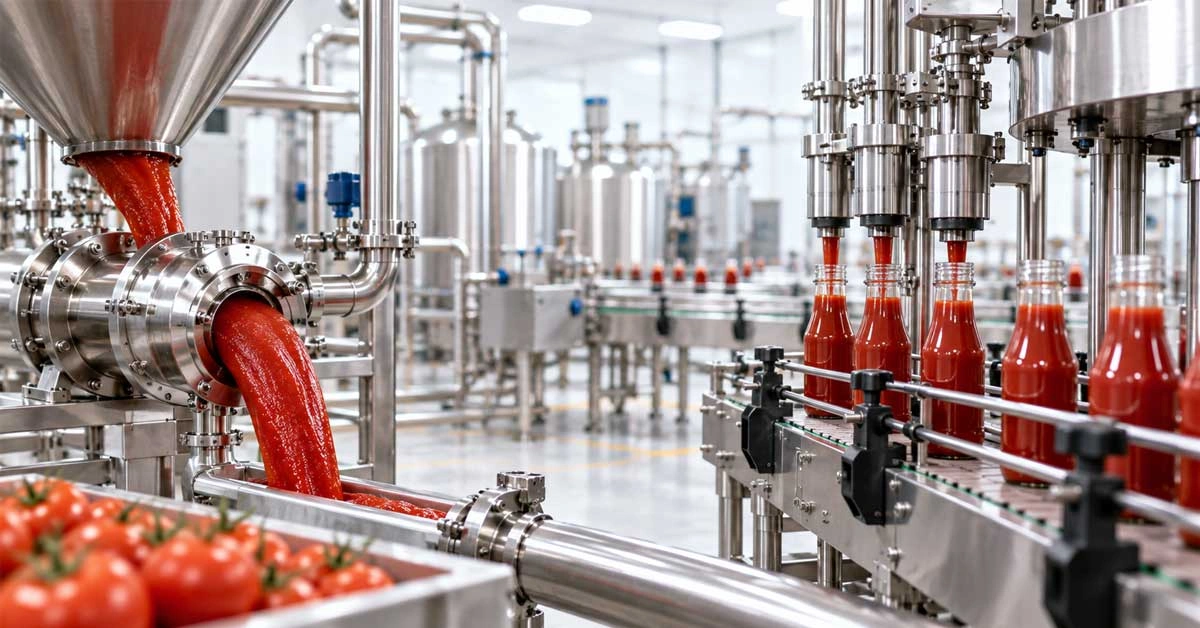
The sterilized ketchup is packed into bottles, pouches, or sachets by filling machines automatically and sealed. The packing of the product when it is hot (hot-fill packaging) contributes to further sterilization of the bottle itself and of the cap, which increases shelf stability of the product.
Automatic vs Semi-Automatic Tomato Ketchup Processing Line
Manufacturers generally choose between a semi-automatic setup and a fully automatic tomato ketchup processing line depending on production volume, labor availability, and budget.
An automatic tomato ketchup processing line typically integrates PLC controls, in-line sensors for temperature and viscosity, and automated CIP (clean-in-place) systems, which reduce downtime between production runs and cut manual cleaning labor significantly.
Common Mistakes in Ketchup Line Setup
Even seasoned processors face problems that are easily avoidable. Some of the common problems include:
- Under-sizing of the pulper or refiner, which causes a choke point that makes the whole processing chain slow no matter how fast other machines operate.
- Omitting the second homogenization process to cut costs, which causes separation of the products and customers’ complaints.
- Poor design of the CIP system, which takes more time and results in higher risks of contamination between batches.
- Neglecting the capacity of the vacuum evaporator, which causes over or under-concentration of the batches.
- Using filling machines which do not go well with the containers, causing weight filling problems and seal breakages.
Using an experienced tomato ketchup machine manufacturer who can size each of the processes to meet your production capacity is essential.
When Should You Upgrade to a Fully Automatic Line?
A completely automated tomato ketchup production line becomes appropriate once the costs of labor, inconsistency problems, or increased volume of orders begins to negatively affect profit margin. In general,
- < 500 kg/hour: Semi-automatic production line is more than enough.
- 500 kg – 2 tons/hour: A combination of automated cooking, mixing, and filling processes with sorting done manually is the optimal solution.
- > 2 tons/hour: Completely automated line becomes absolutely necessary.
Key Takeaways
- The process line involved in tomato ketchup processing includes stages such as washing, pulping, refining, cooking, homogenizing, and packing done in an automated process.
- Hot break process and 2-Stage Homogeniser for Ketchup are the ones that make the commercial ketchup thick, smooth and non-separating.
- Vacuum evaporation used in the process of cooking saves the flavor and color compared to atmospheric cooking.
- Automatic tomato ketchup processing process line cuts down labor dependency and ensures consistency of production, but involves a larger initial capital compared to a semi-automatic processing line.
- Sizing all machines in the process line to your target production rather than choosing equipment alone avoids any process problem.
Conclusion
The process of setting up and enhancing a tomato ketchup processing line will come down to knowing how the processes such as washing, packaging, and others impact the final products’ texture, color, and shelf life. It is the knowledge of the right order of operations, the proper homogenization system to implement, and automation of the processing line based on the production capacity that will help distinguish a working line from one requiring constant maintenance. Knowing these basics about a tomato ketchup processing line, either semi-automatic or automatic, will help make the right choice of equipment.
FAQs
Have a Question? Let’s Connect
Need expert guidance on food processing machines, production setup, or process optimization? Our team is ready to help you choose the right solution for your business.
What constitutes a complete tomato ketchup processing line?
It consists of a line of machines that will wash, sort, pulp, refine, cook, homogenize, season, sterilize, and package the ketchup.
How does an automatic and semi-automatic tomato ketchup processing line differ?
The automatic line has PLC control and allows uninterrupted continuous process, whereas semi-automatic requires manual transfer between some of the stages.
Why is the 2-Stage Homogeniser for Ketchup necessary?
It avoids re-aggregation of particles ensuring non-separated ketchup with an even smooth consistency.
How many tomatoes are required to make one kilogram of ketchup?
Approximately 7–8 kg of fresh tomatoes are needed for the production of one kilogram of ketchup depending on the natural solids content of the tomatoes.
Which capacity tomato ketchup machine would be suitable for small businesses?
Lines with processing capacity less than 500 kg per hour should suit the small and regional businesses.
Should hot or cold break be used when making ketchup?
Hot break process should be used for ketchup production since the process results in high viscosity and cold break process works well for light products.




