
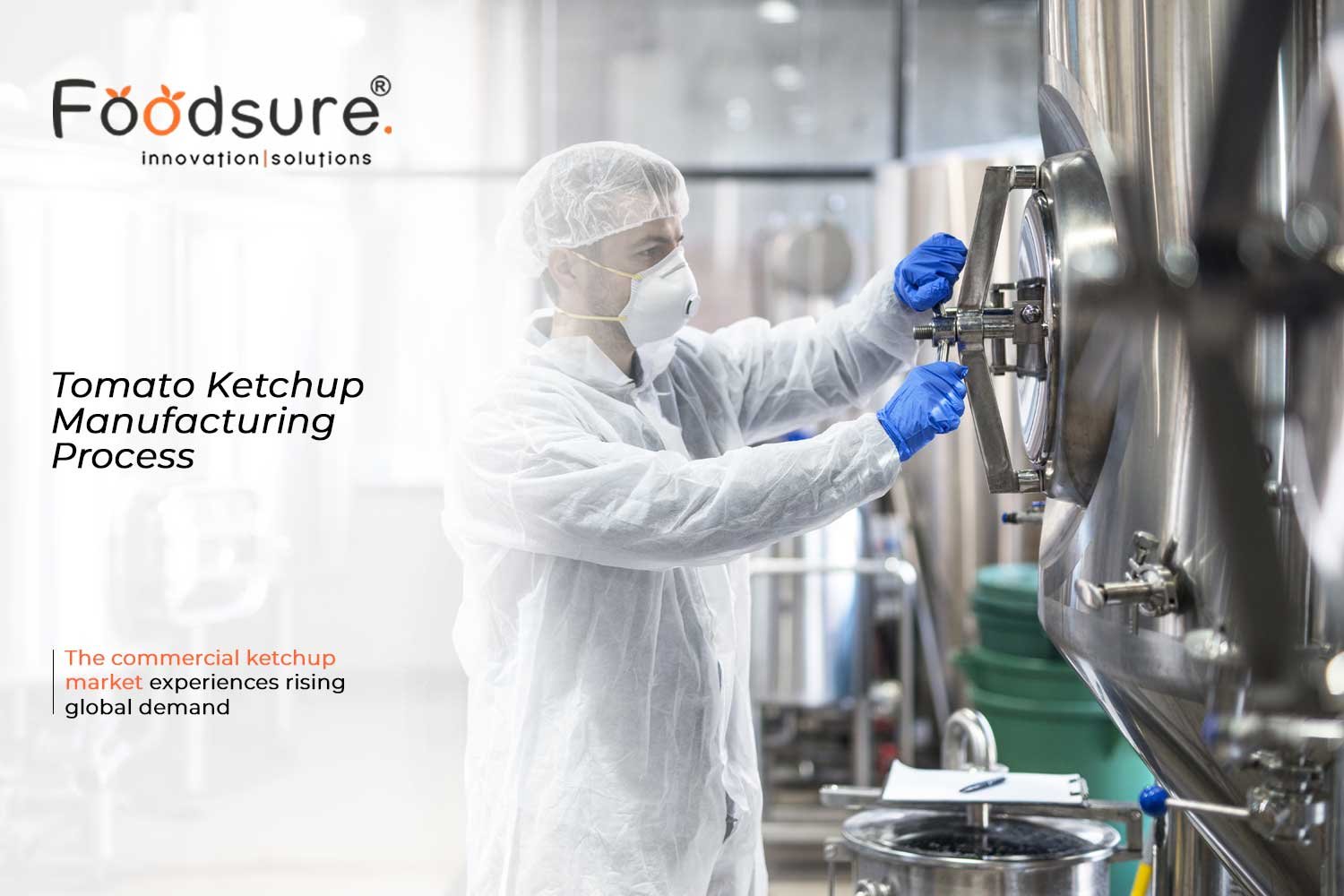
The product demonstrates its extreme nature when someone observes a ketchup line ceasing operation because of a viscosity problem. The finished product results from three factors, which include a slight decrease in tomato solids, an inconsistent hot-break temperature, and a brief evaporator holding time. The finished product looks simple. The process is anything but.
The commercial ketchup market experiences rising global demand, which creates pressure on producers to maintain uniform colour, texture and shelf stability throughout their ketchup production process. The complete understanding of the tomato ketchup manufacturing process begins with the acquisition of paste and brix standardisation, which continues through cooking, homogenisation and aseptic filling to its final stage.
This blog provides a complete overview of industrial ketchup production, which includes all required equipment specifications and operational parameters, how ketchup is made, procedures for quality control that ensure each production batch meets required standards.
Raw Materials Used in the Tomato Ketchup Production Line

The tomato ketchup manufacturing process requires a precise balance between the quality of raw materials and the exact formulation of its components. Ingredient balance serves as a business requirement because it enables every production run to fulfil particular customer requirements while maintaining profit margins through efficient processing methods.
- Tomato Paste & Brix Levels: The brix level of the paste is the most vital metric. The use of high-solids paste allows for energy savings by eliminating extended evaporation processes, which also helps maintain the bright red colour that customers consider to be high-quality.
- Vinegar & pH Stability: Tomato acidity requires variable vinegar application because of its natural acidity range. The establishment of pH stability at levels below 4.0 (which must be maintained) serves two purposes because it protects against microbial threats and preserves the distinct tangy flavour.
- Sugar & Sweetener Balance: Sugar not only sweetens food products, but it also adds to both total solids content and mouthfeel experience. The apparent viscosity of the product will experience disturbances whenever these two factors show variations.
- Stabilisers: The ketchup production process maintains its uniform emulsion state throughout its entire shelf life because modified starch and hydrocolloids work together to stop water separation.
- Preservatives: The complete process of professional sauce manufacturing ends with antimicrobial agents that protect products from spoilage under various temperature conditions.
Step-by-Step Tomato Ketchup Manufacturing Process
1. Strategic Tomato Selection and Grading
The first step in the tomato ketchup making process is at the intake bay. The chemical composition of the fruit determines operational efficiency.
- Brix-Driven Procurement: The processors prefer high-solids tomato varieties, as the “watery” tomatoes send up a high evaporation load.
- Commercial Impact: Each additional percentage of water will require additional steam and time, which will add to the utility costs and can cause thermal degradation.
- Colour and Ripeness Management: Colour variation from batch to batch is one of the main causes; this is due to inconsistent ripeness.
- Operational Control: The industrial optical sorters sort out green or overripe fruit, and even a small percentage of tomatoes that are not ‘bright red’ can dull the end colour.
- Phytosanitary Screening: Damaged or fungal tomatoes must be rejected.
- Risk Mitigation: Thermal processing may be insufficient to destroy mould spores, resulting in catastrophic spoilage and product recalls.
2. High-Impact Washing and Sorting
The main objective is to reduce the microbial load before entering the closed system.
- Microbial Reduction: Turbulent water flow is required on microbial reduction industrial flume washers or rotary drums to remove soil and pesticide residues.
- Sanitation Goal: Downstream pasteurisation will be more efficient with a reduced initial “bioburden.”
- Mechanical Protection: Washing isn’t only a hygiene threat but an equipment threat as well.
- Asset Management: Abrasive wear or catastrophic failure of downstream pulping and pumping equipment can be caused by abrasive wear and catastrophic failure resulting from residual stones, grit, or tough stems.
3. Crushing and Precision Pulping
Cleaned tomatoes are fed into the crusher, which crushes the skin and flesh but does not crush the seeds.
- Flavour Integrity: Over-crushing is a major concern of modern tomato processing plants.
- Bitterness Control: When seeds are broken, tannins and oils are released, which add a distinct “seed-bite” or bitterness to the ketchup.
- Yield Recovery: Inefficient pulping directly affects the bottom line (yield recovery).
- Consistency Control: Fine-tuned finishers to remove juice from fibre. It is important here to achieve a smooth pulp consistency that will be important for downstream processing.
4. Critical “Hot Break” process
The final viscosity and mouthfeel of the ketchup are decided by the Hot Break (HB) process.
- Pectin Preservation: The pulp is heated very quickly to 85-95°C.
- Enzyme Deactivation: This temperature immediately inactivates enzymes that can break natural pectin. If the sauce does not heat up in a timely manner, it will be thin and watery.
- Thermal Regulation: Steam-jacketed vessels must have absolute temperature control.
- Quality Guardrail: Hot spots or overheating in a small area can lead to sugar caramelising, changing the flavour of the ketchup.
5. Final formulation and homogenization
The concentrated pulp is pumped to mixing tanks where vinegar, sugar, and stabilisers are added.
- Emulsion Stability: High-pressure homogenization is sometimes used to ensure emulsion stability; that is, the product does not separate in the container.
- Physical Properties: Provides a stable emulsion with ideal shear-thinning characteristics: a thick bottle and thin squeeze.
Hot Break vs Cold Break in Tomato Ketchup Manufacturing Process
The professional tomato ketchup processing plant selects between hot break and cold break to determine the final product, which will be sold to customers.
| Feature | Hot Break (HB) | Cold Break (CB) |
|---|---|---|
| Temperature | 85°C – 95°C | 65°C – 75°C |
| Viscosity | Higher thickness prevents syneresis. | Lower, more fluid consistency. |
| Pectin Status | Total enzyme deactivation (preserved). | Partial enzyme activity (broken down). |
| Flavour/Colour | Robust, cooked profile; deeper red. | Fresher flavour; bright natural colour. |
| Primary Use | Tomato ketchup and thick pastes. | Pizza sauces and tomato juice. |
The Hot Break method serves as the only way to produce premium ketchup. The tomato ketchup manufacturing process creates the shelf-stable body and mouthfeel through its ability to stop pectin-destroying enzymes from functioning. Cold break serves as a better option for products that require a fresh-from-the-vine taste instead of high viscosity. The technical distinction between these two products defines industrial-grade ketchup as separate from regular tomato sauces.
How Modern Tomato Ketchup Production Line Maintains Product Consistency
Ingredient Mixing
The mixing stage is the last in a professional tomato ketchup making process, where the structure of the product is completed. To make the emulsion smooth and stable, a high shear mechanical force is required to ensure that the functional additives are activated.
- Hydration Dynamics: Modified starches and gums as stabilisers tend to hydrate unevenly under low shear. If they are not given enough power, these particles aggregate and result in batch inconsistencies.
- The “Fisheye” Risk: When a stabiliser additive is added too rapidly, the resulting surface hydration traps dry powder within. The “fisheyes” or lumps are almost impossible to dissolve later and make the texture unusable.
- High-Shear Solution: In modern tomato ketchup processing plants, high-shear mixers and controlled powder incorporation systems, such as venturi injectors, are used. This means that no particles will even agglomerate and ensure a perfect, high-quality mouthfeel.
High-Pressure Homogenization
If a tomato ketchup making machine is used, a homogeniser has to be included to make it bridge the gap between a normal sauce and a premium condiment. This is not simply about smoothness; it’s about molecular stability.
- Serum Separation: If the homogenization is not strong enough, the solids will settle, and the liquid will rise, resulting in “serum separation” or “weeping” while in storage.
- Colour Preservation: The operators need to understand that they have to use force along with aesthetics; high pressure makes fine emulsion, but too much pressure can actually shear the tomato chromoplasts away, causing the natural bright red colour to be diminished.
Thermal Processing: Pasteurisation
The last microbiological protection is the pasteurisation process. This is a crucial balance to strike between safety and sensory quality in a professional tomato ketchup production line.
- Processing Precision: Under-processing may allow residual microbial growth, and over-processing (cooking at high temperatures for too long) affects flavor freshness, and flavour becomes cooked or caramelised.
- The Hot-Fill Standard: During filling, ketchup is usually stored at a temperature of 85°C-90°C, which is called the Hot-Fill Standard. This guarantees the product and the container are commercially sterile, which is essential for obtaining a long shelf life without the need for preservatives.
The automation of filling and packaging
The performance of the ketchup filling machine is controlled by the rheology of the sauce. The combination of the physical properties of the ketchup and the mechanical limitations of the ketchup line is in the packaging.
- Viscosity & Speed: The viscosity of ketchup has a direct effect on the volume and filling speed when being filled. If the batch is too thick, it will cause tailing or dripping, while if it is too thin, it will cause splashing, which will affect the sealing.
- Condensation Control: If filled at the wrong temperature (too high), steam condensation can form within the bottleneck, resulting in the growth of surface mould after the cap is placed.
- Hygienic Sealing: The automated systems need to be in a positive-pressure, hygienic area. Any failure to seal the improper cap instantly raises the likelihood of contamination, as though all the pasteurisation efforts were lost.
Technical Quality Control (QC)
All bottles making their way out of the plant pass through a technical QC protocol, guaranteeing uniformity. This is how brand authority and trust are created.
- pH Monitoring: The pH of commercial ketchup is usually controlled within a range of 3.8 – 4.2, which can be done to improve shelf stability and minimise the risk of spoilage during transportation.
- Rheological Testing: Periodic viscosity testing (typically with a Bostwick Consistometer) and Brix level checks are used to maintain constant mouthfeel and sweetness.
- Colour and Microbial Audits: Continuous colour consistency checks are performed with a spectrophotometer, and microbial tests for yeast and mould are performed to ensure that the product is safe for its intended life.
How Advanced Machinery Improves the Tomato Ketchup Manufacturing Process
A contemporary tomato ketchup production line is an intricately engineered system that has been developed such that each piece of ketchup manufacturing equipment must be manufactured utilising 304 or 316L stainless steel to provide maximum corrosion resistance as well as safe food processes.
From an operational standpoint, a tomato processing plant’s operational efficiency is determined by utilising high-quality pieces of equipment:
- Evaporators Using Vacuum (A Concentrator): These ketchup making machine concentrate tomato pulp without losing any flavours; they reduce the boiling points of tomato pulp, thereby avoiding thermal destruction and retaining the natural colours of tomatoes.
- Mixers Using High Shear (High Speed): These mixers shorten the time required to prepare a batch of ketchup compared with traditional agitators due to their ability to instantly hydrate stabilisers before mixing when processing high-viscosity (thick) products.
- Ketchup Filling Machines Using Pistons: These machines provide volumetric accuracy when filling bottles or jars with thick (non-Newtonian) ketchup and do not drip or splash during operation.
The integration of automation and CIP-compatible systems (Clean-in-Place) is critical. The system provides fast flavour changes together with complete sanitation, which allows operations to remain active while meeting international food safety requirements
Conclusion
Modern ketchup production has evolved beyond its traditional method of cooking tomatoes with seasoning ingredients. The success of any tomato ketchup manufacturing process today relies on four essential elements are process control and viscosity consistency, hygienic automation, and effective ingredient handling during all production stages. The texture, color stability, filling performance, and shelf life of a product are all affected by even minor changes that occur during the processes of heating and homogenization and ingredient mixing.
At Foodsure Machines, we understand the operational challenges involved in commercial ketchup manufacturing. Our processing solutions enhance mixing efficiency and decrease batch inconsistencies while enabling effective hygienic production throughout all ketchup production stages. Manufacturers achieve consistent product quality and faster production cycles, and long-term operational reliability through proper equipment and process optimisation and automation support.
Launch Your Whipping Cream Brand
Complete setup & production support in India.
FAQ
How does the tomato ketchup manufacturing process maintain product consistency?
The process of controlled heating, together with ingredient homogenization and mixing procedures, establishes uniform texture, colour, and viscosity standards.
What equipment is commonly used in a tomato ketchup processing plant?
A contemporary tomato ketchup processing facility operates its production process through the use of pulping equipment, high-shear mixing devices, homogenization systems, evaporators and ketchup filling machinery.
Why is the hot break method important in the tomato ketchup making process?
The hot break method preserves pectin, which helps create the thick texture required in ketchup production.
How does a tomato ketchup production line improve manufacturing efficiency?
The automated tomato ketchup production system decreases processing duration while enhancing sanitation practices and boosting the reliability of production output.
What challenges are commonly faced during the ketchup production process?
Manufacturers encounter difficulties with viscosity variability stabiliser clumping, serum separation problems, and filling precision challenges.




