
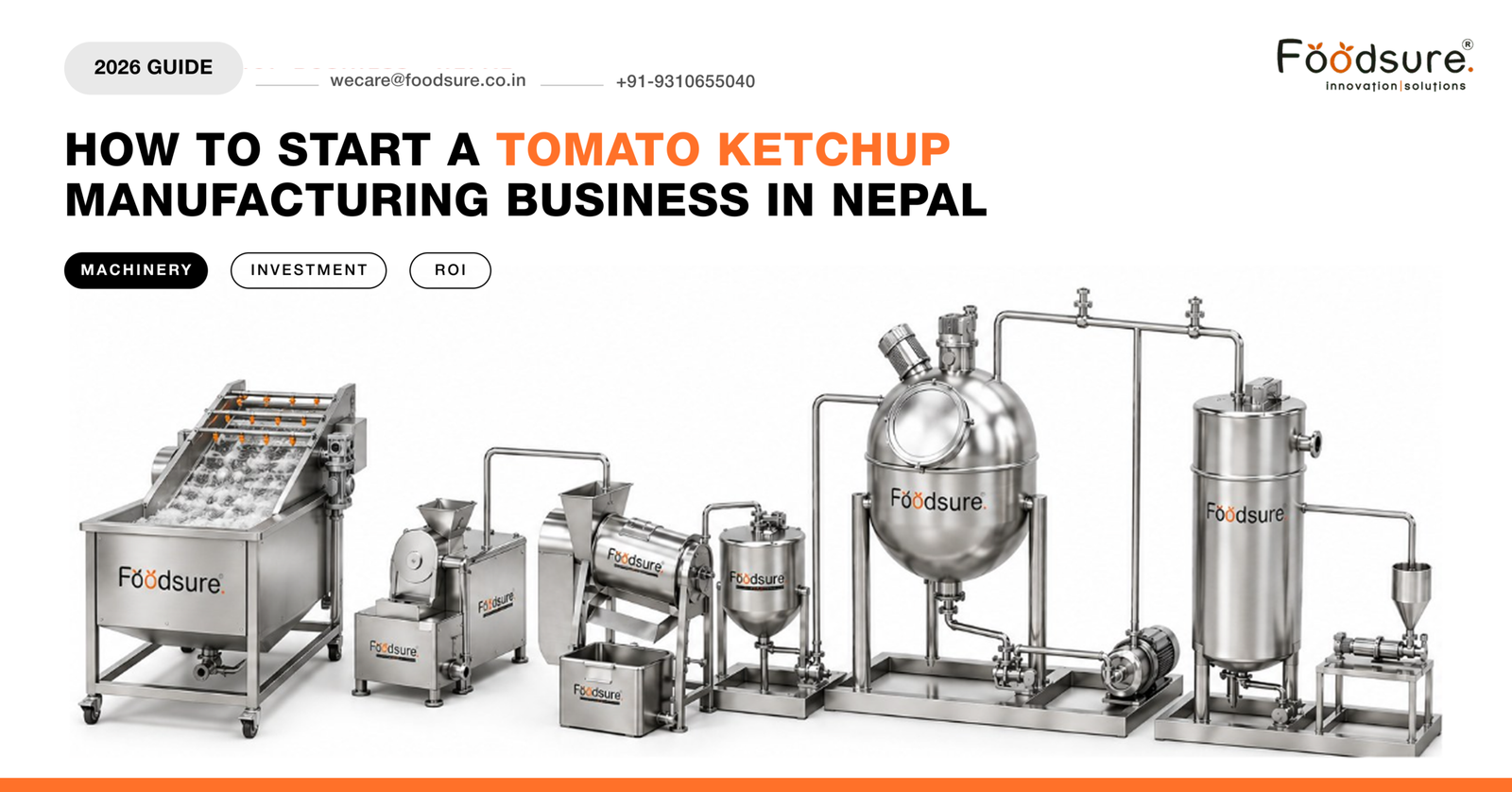
Starting a tomato ketchup manufacturing business in Nepal requires more than a recipe and a filling machine. You need the right processing equipment, a reliable supply of ingredients, food safety approvals, suitable packaging and a plan for selling the finished product.
There is already a market for packaged ketchup in Nepal. According to World Bank WITS trade data for 2024, India reported exports of 345,473 kg of tomato ketchup and other tomato sauces to Nepal, worth approximately US$834,180. This shows that imported products are part of the market, but it does not guarantee that a new local brand will be profitable. World Bank WITS.
For a new manufacturer, the next step is to understand the cost of setting up a production line, the capacity required to meet expected orders and the expenses involved in taking the product to market.
This guide covers the tomato ketchup manufacturing process, machinery requirements, investment planning, food industry licensing in Nepal and the factors that affect profitability. It also explains when a mayonnaise making machine could be worth considering as an additional investment.
Is Tomato Ketchup Manufacturing a Good Business in Nepal?
Tomato ketchup can be sold through grocery stores, supermarkets, restaurants, hotels, fast-food outlets and wholesale distributors. However, the best sales channel depends on your target customers, selling price, packaging and production capacity.
Nepalese entrepreneurs can explore three main customer groups:
- Retail customers: Households buying ketchup in small bottles and pouches.
- Restaurants and fast-food businesses: Buyers that may need regular supplies or larger packs.
- Distributors and wholesalers: Businesses that supply multiple shops and food service outlets.
Each group has different requirements. Retail buyers may care more about taste, brand recognition and packaging, while restaurants may focus on price per kilogram, consistency and reliable delivery.
Before buying a tomato ketchup machine in Nepal, speak to potential buyers and estimate how much product they could realistically purchase each month. A machine that produces more ketchup than you can sell will increase your storage, labour and working capital costs without necessarily increasing profit.
What Does Nepal’s Import Data Tell Us?
The World Bank WITS database reports that India exported 345,473 kg of tomato ketchup and other tomato sauces to Nepal in 2024, valued at US$834,180. The same dataset lists additional shipments from the United States, Thailand, Turkey and Italy.
These figures relate to HS code 210320, which covers tomato ketchup and other tomato sauces. They should not be treated as total Nepalese ketchup consumption because they do not include all domestic production or every related product category.
What this means for a new manufacturer: Study the prices, pack sizes and products already available in your target market. Then decide whether your business can compete on price, supply consistency, flavour, packaging or service to bulk buyers.
How Much Does It Cost to Start a Tomato Ketchup Manufacturing Business in Nepal?
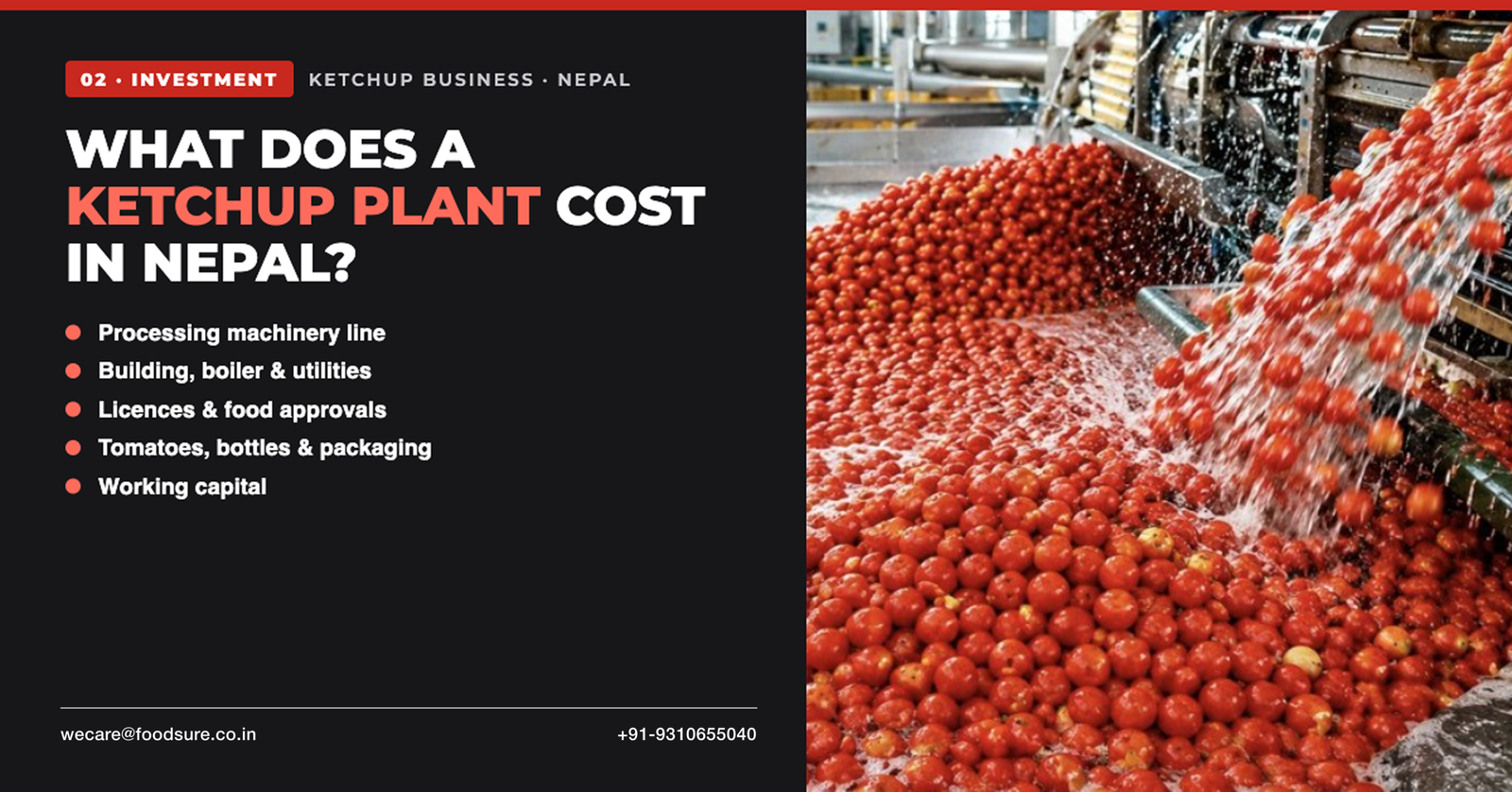
The total investment depends on production capacity, the level of automation, the condition of the factory building, packaging requirements and the amount of working capital available.
A complete budget should cover the following expenses:
| Investment component | What to include |
| Processing machinery | Washing, pulping, cooking, mixing and homogenizing equipment, as required |
| Filling and packaging | Bottle or pouch filling, capping, sealing, labelling and coding |
| Factory preparation | Flooring, drainage, water supply, electrical work and hygienic production areas |
| Utilities | Heating equipment, water treatment, electricity and other required services |
| Ingredients | Tomatoes or tomato paste, sugar, salt, vinegar, spices and other approved ingredients |
| Packaging materials | Bottles, caps, labels, cartons and transport packaging |
| Testing and compliance | Product testing, licensing, labelling and related expenses |
| Working capital | Salaries, rent, transport, inventory, distributor credit and day-to-day expenses |
The earlier estimate of NPR 19–35 lakh for a small plant should not be treated as a verified 2026 project cost without a matching equipment quotation and a complete list of inclusions.
For comparison, Foodsure Machines’ published tomato ketchup machine price guide provides indicative Indian machine-price ranges. These are not installed prices for Nepal. Freight, customs duties where applicable, taxes, installation, utilities and other project expenses must be checked separately.
How to Prepare a Realistic Investment Estimate
Request a written quotation from a tomato ketchup machine manufacturer that specifies:
- Processing capacity and whether it refers to raw tomatoes or finished ketchup.
- The equipment included in the quoted price.
- Contact-part material and machine specifications.
- Heating method, power requirements and water requirements.
- Filling and packaging options.
- Installation, operator training, warranty and spare parts.
- Freight, applicable import costs and delivery to your factory in Nepal.
Compare quotations with the same scope of supply. A low price for a pulping machine is not comparable to the price of a complete ketchup processing and packaging line.
Which Tomato Ketchup Machine Do You Need?
A tomato ketchup manufacturing plant may include several machines working together. The right combination depends on whether you process fresh tomatoes or use ready-made tomato paste, the consistency of your recipe and the output you need.
Essential Equipment for a Ketchup Manufacturing Plant
- Tomato washing and sorting machine
If your production process starts with fresh tomatoes, washing and sorting equipment helps remove dirt and allows damaged or unsuitable tomatoes to be separated before processing.
- Tomato pulper or extractor
A pulper breaks down tomatoes and separates much of the skin, seeds and coarse material from the pulp. Its capacity should match the next processing stage.
- Cooking kettle with a mixing system
The cooking kettle heats the tomato pulp while ingredients are added and mixed. A suitable mixing arrangement helps maintain a consistent product and reduces the risk of uneven heating or burning.
- Homogenizer or colloid mill, where required
This equipment helps produce a smoother and more uniform texture. The exact requirement depends on the recipe, the pulp preparation method and the texture you want to achieve.
- Filling and capping machine
The filling machine dispenses a controlled quantity of ketchup into bottles, jars or suitable pouches. The capping or sealing equipment must match the selected packaging format.
- Labelling and coding equipment
The final packaging stage may include product labels, batch identification and date coding. The information printed on the pack must meet applicable Nepalese requirements.
A tomato ketchup machine manufacturer should explain how these stages work together rather than recommending equipment based on capacity alone.
How to Choose the Right Production Capacity
Before selecting a tomato ketchup processing machine, estimate your expected finished-product demand.
For example, if you expect to sell 500 kg of ketchup per day, calculate the required processing output using your planned operating hours. A line that delivers 100 kg of finished product per hour would theoretically produce 500 kg in five hours, before accounting for preparation, cleaning, changeovers and downtime.
This is an illustration, not a recommendation to purchase a 100 kg/hour machine. Actual output depends on the equipment, recipe, batch size and complete production cycle.
Also check whether the stated machine capacity refers to raw tomatoes, tomato pulp or finished ketchup. These figures are not interchangeable because processing and concentration change the product’s weight.
When evaluating a tomato ketchup processing machine in Nepal, ask the supplier to explain the expected finished output and the time required for a complete batch.
How to Select a Tomato Ketchup Machine Manufacturer
The machine supplier affects more than your initial investment. Equipment quality, installation, training and spare-part availability can influence production consistency and downtime.
Use this checklist when comparing suppliers.
- Food-contact materials: Ask for the material specifications for all parts that touch the product. SS304 or a suitable higher-grade stainless steel may be appropriate, depending on the application and design.
- Production capacity: Check whether the quoted capacity matches your expected finished-product output.
- Equipment coverage: Confirm whether the quotation includes processing, transfer, filling, capping and packaging equipment.
- Installation and training: Ask what support is included and whether travel or accommodation costs are extra.
- Maintenance: Confirm warranty terms, spare-part availability and the process for requesting technical support.
- Customer references: Request examples of comparable installations, where available.
- Factory utilities: Confirm the required electricity, heating, water supply, drainage and floor space before installation.
Foodsure Machines offers tomato ketchup processing machinery for businesses planning commercial sauce production. If you are comparing suppliers, request the proposed equipment list, specifications and quotation for your planned capacity before making a decision.
What Is the Tomato Ketchup Manufacturing Process?
Commercial ketchup production generally follows these steps. The exact sequence changes according to the raw material, recipe and equipment used.
- Raw material inspection: Check tomatoes or tomato paste for quality and suitability.
- Washing and sorting: Clean fresh tomatoes and remove damaged produce, if fresh tomatoes are used.
- Pulping and extraction: Break down the tomatoes and separate coarse material.
- Cooking and mixing: Add the required ingredients according to the approved recipe and process instructions.
- Texture adjustment: Use the selected homogenizing or refining equipment if the formulation requires it.
- Heat treatment: Apply a validated process suitable for the product and packaging.
- Filling and sealing: Fill the ketchup into suitable containers and seal them using the specified process.
- Labelling and storage: Apply the required product information and store the finished goods under appropriate conditions.
A commercial ketchup recipe must be tested before the product is sold. The process should be validated for the formulation, acidity, heat treatment, packaging and intended shelf life.
Why pH, Brix and Shelf-Life Testing Matter
Three important terms to understand are pH, Brix and shelf life.
- pH measures how acidic a product is. It is one factor used when assessing food safety and process requirements.
- Brix measures soluble solids and is commonly used to monitor the concentration of products such as ketchup.
- Shelf life is the period during which the product remains safe and meets its expected quality under stated storage conditions.
Do not assume that a particular pH value or the addition of a preservative alone guarantees a safe product. The correct formulation, permitted ingredients, processing conditions and packaging must be assessed together.
For Nepal, check the applicable requirements with the Department of Food Technology and Quality Control (DFTQC). Its official regulations and standards page provides access to food laws, regulations and product standards.
Food Industry Registration and Licensing in Nepal
Before selling commercially, establish which registrations and approvals apply to your business and product.
The process may involve:
- Company registration through the Office of the Company Registrar, or the relevant business registration route for your chosen business structure.
- PAN and VAT registration, as applicable, through Nepal’s Inland Revenue Department.
- Industry registration and any required local permissions.
- Food industry establishment recommendations and operating permission through the relevant DFTQC process.
- Product testing, labelling and other applicable food safety requirements.
- Additional environmental, fire or building approvals where required for the premises and activity.
The Nepal Food and Feed Industry Licensing System (NeFFILS) provides an official online route for food industry establishment recommendations and licensing.
DFTQC’s official FAQ also explains the technical information required for food industry establishment recommendations. This includes information about raw material sources, machinery, sanitation, production methods, technical staff and quality control.
Prepare your production plan, equipment list and product details early. Confirm the current procedure and required documents directly with DFTQC and the relevant registration offices before committing to a launch date. Do not rely on a fixed processing timeline unless the responsible authority confirms it.
How Much Profit Can a Tomato Ketchup Factory Make?
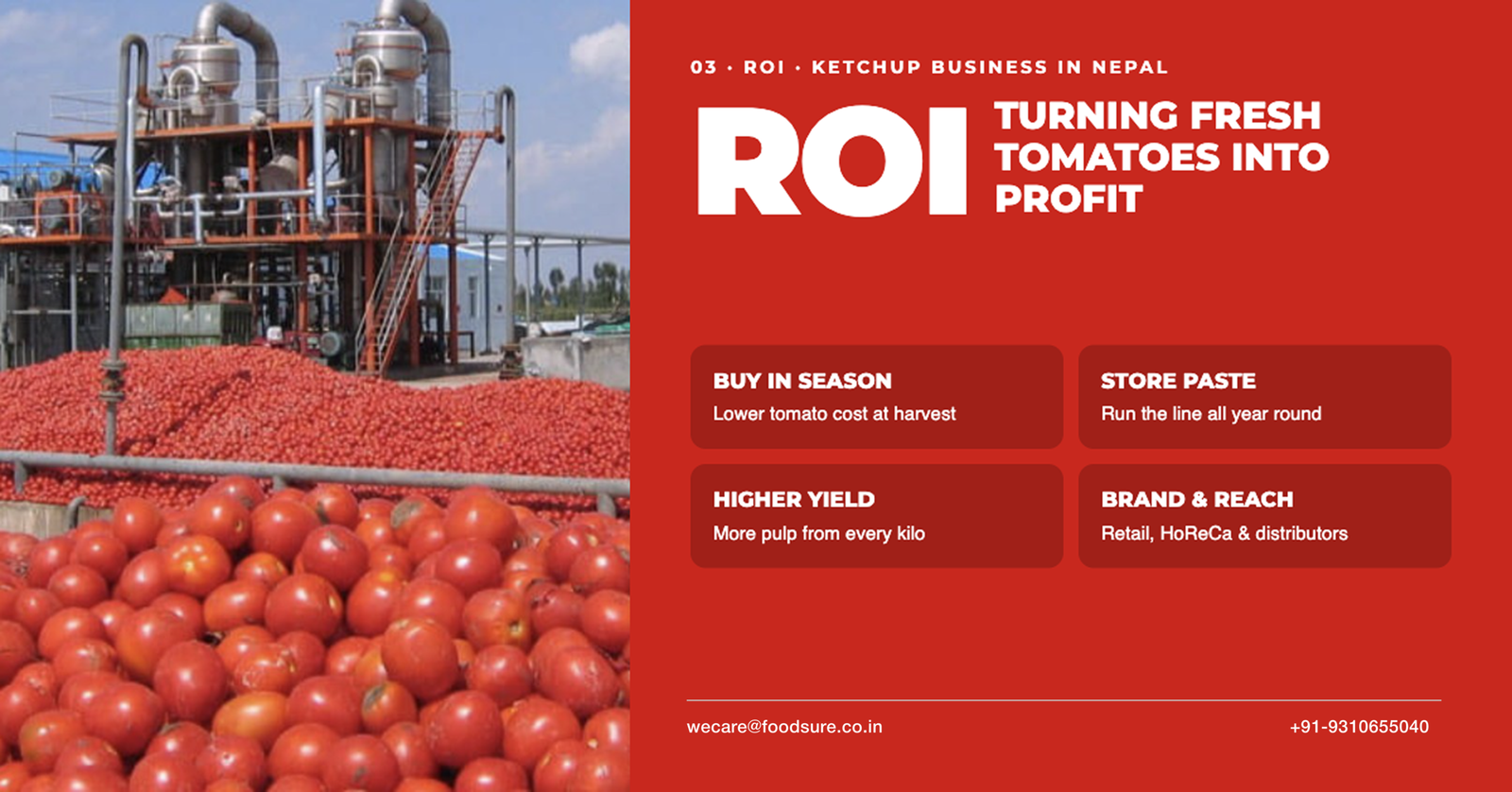
There is no reliable profit margin or break-even period that applies to every ketchup factory. Profit depends on the selling price, ingredient costs, packaging, production efficiency, distribution expenses and the quantity sold.
The best way to assess the opportunity is to prepare a monthly operating model.
Example of a Break-Even Calculation
Suppose a factory sells its ketchup at an average net realization of NPR 180 per kg after discounts and trade deductions. Assume its variable production and selling costs are NPR 125 per kg, and monthly fixed costs are NPR 275,000.
These are illustrative assumptions, not verified market prices or a forecast for a Nepalese ketchup business.
| Calculation | Amount |
| Net selling price per kg | NPR 180 |
| Variable cost per kg | NPR 125 |
| Contribution per kg | NPR 55 |
| Monthly fixed costs | NPR 275,000 |
| Break-even sales volume | 5,000 kg/month |
The calculation is:
Break-even volume = Monthly fixed costs ÷ Contribution per kg
In this example, the business needs to sell 5,000 kg per month to cover the stated fixed and variable costs. It would need to sell more than that to generate an operating profit under these assumptions.
The model does not include every possible expense, such as loan interest, depreciation and taxes. Add those costs when preparing a full investment appraisal.
What Can Improve Your Returns?
Control ingredient costs. Compare fresh tomato procurement with the cost and suitability of tomato paste during periods when fresh tomatoes are expensive or unavailable.
Reduce production waste. Match batch sizes to demand and establish consistent procedures for cleaning, processing and filling.
Choose packaging carefully. Compare the cost of bottles, caps, labels and cartons with the price customers will pay for the finished pack.
Build regular sales channels. Repeat orders from restaurants, distributors and retailers can help make production planning easier.
Track actual output. Measure saleable finished product, rejected packs, downtime and labour hours instead of relying only on the machine’s rated capacity.
Prepare conservative, expected and high-sales scenarios before deciding how much to invest. A break-even calculation is more useful than assuming a factory will recover its investment within a predetermined number of months.
Can You Add Mayonnaise to Your Product Range?
Once your ketchup business has established regular sales, you may consider adding mayonnaise or another condiment. This should be based on customer demand, available capital and the production requirements of the additional product.
A mayonnaise manufacturing machine typically uses a mixing and emulsifying system to combine oil, water-based ingredients and other components into a stable product. The equipment and process requirements differ from those used for tomato ketchup.
Mayonnaise also needs its own formulation, process validation, packaging assessment and shelf-life testing. Do not assume that a ketchup production line can manufacture mayonnaise without additional equipment or process changes.
If you plan to serve restaurants and fast-food outlets, ask potential buyers whether they would also purchase mayonnaise. Their expected monthly volume can help you decide whether investing in a separate mayonnaise making machine makes financial sense.
Common Mistakes to Avoid
Buying machinery before estimating demand: A high-capacity line can increase the amount of money tied up in equipment and inventory.
Comparing machine prices without checking the scope: One quotation may cover a single processing machine, while another includes a complete line.
Ignoring working capital: The business needs money for ingredients, packaging, wages, transport and other expenses before customer payments arrive.
Using an untested recipe: A product that separates, changes texture or spoils can result in customer complaints and financial losses.
Overlooking food safety and labelling: Complete the required approvals and ensure the product meets applicable standards before commercial sale.
Assuming that installed capacity equals sales: A factory earns revenue from products it sells, not from its theoretical production capacity.
Conclusion
Starting a tomato ketchup manufacturing business in Nepal can be worth exploring if you have a clear customer base, a realistic investment budget and a suitable production plan. The key is to match the machinery to the quantity you can sell, check food safety requirements early and calculate costs using actual supplier quotations and market prices.
Foodsure Machines can help you explore the equipment needed for your planned ketchup production capacity. Share your expected daily output, packaging format and available factory space to request suitable machine specifications and a quotation.
Planning to start a ketchup factory in Nepal? Contact Foodsure Machines to discuss your tomato ketchup processing machine requirements and compare suitable production line options.
Frequently Asked Questions
How much does a tomato ketchup manufacturing plant cost in Nepal?
The cost depends on production capacity, automation, equipment included, packaging requirements and factory preparation. Obtain a quotation for the complete line and calculate freight, import costs, installation, working capital and other project expenses separately.
What is the price of a tomato ketchup processing machine in Nepal?
There is no single price for every setup. A standalone pulper costs less than a complete processing and packaging line. Request a written quotation specifying the capacity, equipment, materials, installation and support included.
Which machines are needed to manufacture tomato ketchup commercially?
Depending on the process, a plant may need a tomato washer, pulper, cooking kettle, mixing system, homogenizer or colloid mill, filling and capping machine, labelling equipment and date coder.
Which licences are required to start a ketchup factory in Nepal?
Requirements depend on the business structure, premises and product. They may include business and industry registration, tax registration, DFTQC establishment and operating permissions, and other applicable local approvals. Confirm the current requirements with the responsible authorities.
Can a ketchup manufacturing plant also produce mayonnaise?
Not automatically. Mayonnaise generally requires suitable mixing and emulsifying equipment, along with a separate validated recipe and process. Assess the additional equipment, testing, packaging and operating costs before expanding.
How can I choose the right tomato ketchup machine manufacturer?
Compare food-contact materials, finished-product capacity, the complete equipment list, installation, operator training, warranty, spare parts and technical support. Ask for a quotation based on your actual production requirements.




