
If you need a tomato ketchup machine exporter to UAE, you probably have moved past the stage of wondering whether to enter the business of producing ketchup and have reached the stage of obtaining the right equipment that will endure transit and usage in the Gulf environment.
This is a complete guide to the right ketchup production line, capacity determination, the difference between good and bad suppliers, and the questions to be asked before making any advance payments. It is meant for food processing entrepreneurs, contract manufacturers, and procurement managers interested in the machines for UAE, Saudi Arabia, Oman, Qatar, Kuwait, and neighboring countries.
Why the UAE and Saudi Arabia Are Growing Markets for Ketchup Production
Processed tomatoes represent the largest share of the imports into the Middle East. That is precisely the reason why the production of ketchup has emerged as a rising trend in the region. The need for packaged condiments, growth in the HORECA segment, and the government initiatives towards food security and localized manufacturing (Vision 2030 of Saudi Arabia, for example), all contribute towards more food entrepreneurs planning to set up their own tomato ketchup production facility in UAE.
Some of the reasons behind the trend include:
- High imports of tomato paste and ketchup in GCC countries, which create scope for value addition in the region
- Incentives provided by the government for food manufacturing in Saudi and UAE diversification strategies
- Private label requirements of the supermarkets and restaurant chains who prefer to have products packaged in their own region
- Shorter chain length in comparison to importing the ketchup ready-made
This is fundamentally a transactional search. The buyer is aware of the fact that he requires the equipment, but the issue here is to identify what kind of exporter will suit his needs best.
What Exactly Is a Tomato Ketchup Machine?
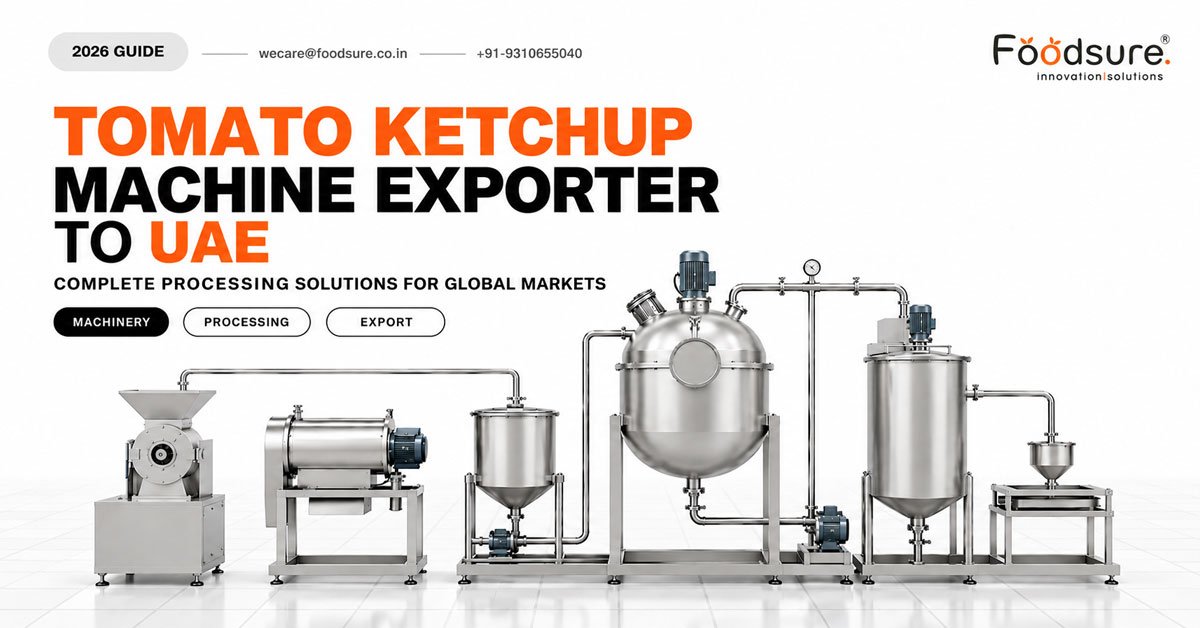
The tomato ketchup machine is not a single machine as it consists of a number of machines that are involved in processing raw tomatoes and make them clean, crush and mix in the appropriate mixture along with bottling the tomato ketchup.
At least, a working line consists of:
- Tomato washing and sorting machine – Removes dirt, stones and unsuitable tomatoes
- Crusher and pulper – Crushes tomatoes to form pulp with removing skins/seeds
- Pre heater and enzyme deactivation machine – Inhibits enzymes from breaking down prior to cooking
- Vacuum concentrator (Evaporator) – Removes water content to give appropriate consistency
- Seasoning and mixing tank – To incorporate sugar, vinegar, salt and spices
- Homogenizer – Provides ketchup its consistent texture
- Sterilizer – To ensure microbial safety and stability on shelf
- Filling and Capping machine – Fills ketchup bottles/ pouches/ sachets
- Labeling and Packaging machine – Completes the product manufacturing process.
Some of the companies manufacture this as complete industrial tomato sauce production line whereas some sell it as a modular equipment that can be gradually scaled up.
Types of Tomato Ketchup Machines Available for Export
Not every company requires the same configuration. Configuration depends on capacity, automation, and the budget of the company.
- 1. Semi-automatic ketchup production line
This line is best suited for companies which have a smaller to medium volume capacity of production. More manual effort is needed in the process, which makes the initial cost of production less, but the labor will be greater.
- Fully automatic ketchup production line
This line is designed for manufacturers which require continuous production in large scale from 2 up to 20+ tons per day. It is widely used by our clients in UAE which manufacture tomato ketchup machines. The control through PLC provides proper temperature regulation, mixing, and filling without much manual labor.
- Compact/small-scale ketchup machines
Designed for startups or cloud kitchens or businesses trying out their own private-label ketchup production.
- Customized multi-purpose sauces lines
There are some exporters which design a line where there is production of ketchup, chili sauce, etc. together on the same line with minor changes.
Comparison: Semi-Automatic vs. Fully Automatic Ketchup Machines
| Factor | Semi-Automatic Line | Fully Automatic Line |
|---|---|---|
| Typical Capacity | 500 kg – 2 tons/day | 2 – 20+ tons/day |
| Labor Requirement | High | Low to moderate |
| Initial Investment | Lower | Higher |
| Consistency of Product | Depends on operator skill | Highly consistent (PLC-controlled) |
| Best For | Startups, small producers | Established manufacturers, export-focused units |
| Maintenance Complexity | Simpler | Requires trained technicians |
| Scalability | Limited without major upgrades | Easier to scale with add-on modules |
There’s no universally “better” option here — it comes down to your production targets, available workforce, and how fast you expect to scale.
What to Look for in a Tomato Ketchup Machine Exporter to UAE
Not every supplier that claims export experience actually has the compliance and logistics track record needed for Gulf markets. Here’s what genuinely matters.
- Food-Grade Material Certification
All materials that will be in direct contact with tomatoes should be made of SS304 or SS316 stainless steel. This requirement should be met without exceptions in regards to compliance with food safety regulations in case of UAE/Saudi imports.
- CE, ISO and Other Compliance Marks
It goes without saying that a reliable ketchup production machine manufacturer should have a CE mark (European quality construction standard) and ISO 9001 manufacturing certificate as a minimum.
- Prior Experience in Middle Eastern Markets
All you need to do is just to find out how many units the exporter has delivered to GCC countries and whether they can give you some references. Humidity levels, voltage specifications (220V/380V, 50Hz) and customs rules in the Middle East are different from other geographical locations, so experience counts much more than export records.
- After Sales Service and Availability of Spare Parts
Machine failures are inevitable in the course of time. You need to clarify:
- If there is a regional representative for this exporter in UAE/Saudi Arabia;
- How fast you will get spare parts;
- What is the warranty period and what is included into it;
- If installation/commissioning services can be provided by the exporter;
- Customization Options
Tomato type, required sugar content level, bottle/pouch design and required capacity will influence machine specifications. If an exporter offers only one configuration for each buyer, this is definitely a bad sign.
- Transparent Price Terms and Documents
Professional manufacturers always provide proforma invoice, HS code and detailed Incoterms (FOB, CIF, CFR) in advance.
How Much Does a Tomato Ketchup Machine Cost?
There is a wide variation in prices depending on capacity and automation, so take any figure as approximate.
- Small-scale or compact lines: Typically the cheapest option, suitable for low production
- Semi-automatic medium-scale lines: Moderate investment option, compromise between cost and production
- Fully automated high-capacity lines: Most expensive option, but low cost per unit produced over time
Shipping charges, custom duty, and installation charges are normally extra and not included in the machinery cost , always insist on a full landed cost quotation before comparison.
Common Mistakes Buyers Make When Importing Ketchup Machines
Based on hope rather than information – Purchasing of a 10-ton line in reality manufacturing only 1 ton per day is not wise.
- Not considering voltage or utility compatibility – Equipment that needs different voltages may lead to delays in installation or conversion costs.
- Disregarding factory audits or video inspections – Failure to visit the factory prior to payment or virtually before payment increases fraud.
- Failure to consider installation and training requirements – Equipment that lacks proper commissioning will operate at reduced efficiency.
- Failure to consider after-sales services – Low-cost equipment that lacks support can be much costlier than higher-priced machines.
Best Practices Before Finalizing Your Purchase
- Request a tour of the factory, not photos from brochures
- Request references from customers in UAE, Saudi Arabia or Middle East
- Check that installation, training, and commissioning are included or separately charged
- Request written specs on capacity, energy consumption and material grade
- Specify the lead time from placing an order until delivery after clearing customs
- Negotiate payment tied to production milestones rather than upfront payment
When a Tomato Ketchup Machine in Middle East Setup Makes Sense (and When It Doesn’t)
It makes sense when:
- You have consistent access to tomato raw material or paste supply
- You’re targeting retail, HORECA, or export-focused distribution
- You’ve validated demand through smaller batch production or private-label trials
It may not make sense yet when:
- Your projected daily volume doesn’t justify even a compact line’s minimum output
- You haven’t secured stable raw material sourcing or cold storage
- You’re still validating product-market fit through co-packing arrangements
Many producers actually start with a co-packer or a small compact line before investing in a full tomato ketchup production line UAE setup — it reduces risk while demand is confirmed.
Key Takeaways
- Exporters of tomato ketchup machine to the UAE market must ensure that there is food grade certification, GCC export history, and proper after sales service provided.
- The capacity of the machine needs to be based on achievable output levels, and not desired output levels.
- Landed cost will consist of cost of the machine plus freight charges, duties, installation, and commissioning – always request a landed cost quotation.
- Mistakes made when importing include wrong voltage levels, lack of factory inspection, and 100% advance payment without milestones.
- It is better to begin with small production runs and then move on to industrial production.
Conclusion
Getting the ideal tomato ketchup machine exporter to UAE entails setting practical production objectives in line with the machines that have been designed to meet Gulf environment requirements and not necessarily the one with the most affordable quotation in your mailbox. Factors like certification and export history as well as after-sales service will play a bigger role in the life span of the machine than its cost.
FAQs
What is the average capacity of a tomato ketchup machine exporter to UAE typically offers?
Exporters have models ranging from 500 kg per day compact units to 20+ ton per day automatic lines, based on customers’ requirements.
How do I verify a tomato ketchup machine supplier UAE businesses recommend?
Ensure that there is CE/ISO certification, get GCC client referrals, and see the factory through live video presentation before making the payment.
Is a tomato ketchup machine manufacturer UAE better than importing from overseas?
This is not always the case since many UAE-based customers continue to purchase from reputable manufacturers outside the country who have been exporting to the Middle East region before.
What’s included in a full tomato ketchup production line UAE setup?
Generally units for washing, crushing, cooking/ concentration, flavoring, homogenization, sterilization
How long does shipping and installation take for a tomato ketchup machine in Middle East?
This may vary depending on the exporter and the process involved, but buyers must always ask for a written lead time estimate from shipment to commissioning.
Can one machine handle both ketchup and an industrial tomato sauce production line?
While some customized multipurpose lines can do so with slight modifications, dedicated lines tend to be more efficient.




