
The majority of the makhana produced in the world comes from India, but the vast majority of this crop comes from the ponds in Mithila, Bihar. Nonetheless, the best profits to be made in makhana exports do not come from the growers but from the roasting, grading, flavoring, and packing of the crop for export.
If you are in the food processing industry, a trader, or an entrepreneur planning on exporting makhana abroad, here are the basics that you need to know.
What Is a Makhana Export Business?
An makhana exporter procures raw fox nut seeds (gurri) or processes them on their own, followed by exporting popped, roasted, or flavored makhana to international customers. In this regard, an exporter takes care of procurement, processing, grading, packaging, certification, and shipping, which is generally done in the USA, the UK, UAE, Canada, and Australia.
Makhana is the popped seeds of Euryale ferox also known as fox nuts, lotus seeds, or gorgon nuts. International buyers may look out for this product as “foxnuts” or “phool makhana.” So you should include all the three terms in your listings.
The supply is concentrated in nature. Bihar provides the majority (85-90 percent) of India’s makhana production, particularly from Darbhanga, Madhubani, Purnia, and Katihar districts. In 2022, Mithila Makhana was awarded a Geographical Indication tag while the Union Budget of 2025 proposed to set up a Makhana Board for Bihar.
Is the Makhana Export Business Profitable?
However, this happens mainly if you export value-added makhana as opposed to the seed itself. Normal popped makhana will go at commodity prices. The roasted, flavored, and packaged version makes money due to the fact that the customer is paying for consistency, shelf-life, and presentation
Here are a few reasons why there is rising demand for makhana in the international market:
- Healthy snacking: Makhana is naturally gluten-free, low in fat, and has moderate protein and fiber content.
- North American, UK, and Gulf countries’ Indian diaspora buy it as a snack and fasting food.
- Vegans and plant-based consumers regard it as a healthier substitute for chips and popcorn.
- Brands are searching for Indian producers of flavored makhana in consistent batches.
Here’s how the main export forms compare:
| Export form | Processing needed | Typical buyer | Margin and risk |
|---|---|---|---|
| Raw seed (gurri) | Cleaning, drying, bagging | Other processors | Lowest margin; seasonal price swings |
| Plain popped makhana, bulk | Pre-grading, roasting and popping, sorting, bulk packing | Importers, repackers | Moderate; competes on size and colour |
| Roasted and flavoured, bulk | All of the above plus flavouring | Private-label brands | Higher; needs tight quality control |
| Retail-ready branded packs | All of the above plus nitrogen-flushed pouches and labelling | Retail chains, online sellers | Highest; also highest compliance and marketing cost |
How to Start a Makhana Export Business: Step by Step
Starting a makhana export business takes seven steps: pick an export model, register the business, secure raw material, set up processing, test the product, find buyers, and organise logistics. Most delays come from paperwork and lab testing, not machines.
Step 1: Pick Your Export Model
Here you have three choices: selling bulk raw makhana, making flavoured makhana for another brand, or creating your own brand abroad.
New exporters generally do well with bulk or private labels because establishing a brand overseas requires funds and time which the new exporter doesn’t possess in the first year.
Step 2: Register the Business and Get Your Licences
Ensure all these are obtained before giving quotation to any buyer:
- Business registration, either proprietorship, LLP, or private limited, and GST registration
- Importer Exporter Code (IEC) from DGFT
- FSSAI license for manufacturing unit
- APEDA registration that will assist in promoting exports and in establishing buyer connections
- Bank AD code and LUT for exporting goods without paying IGST upfront
- Destination country requirements, such as FDA facility registration and Prior Notice for exporting to the USA
The rules and fees keep changing, so check with DGFT, FSSAI, and CHA before applying.
Step 3: Secure Your Raw Material
Harvesting of Makhana seeds is a seasonal affair and therefore, you are likely to purchase gurri during one short span of time in a year and keep it safely till the next season arrives. It is important to have dry and well-graded raw material as the starting point.
Always source from two or three dependable suppliers, for instance farmer cooperatives in Bihar, and take samples for testing quality before you decide to go ahead. You must check the size grading, moisture content, percentage of adulterants and proportion of broken seeds.
You should also factor in the yield. The yield on popping of raw seeds will be around 40 percent of its weight. But this will depend upon the seed size, moisture and method of roasting. So for example, 10 tons of graded gurri normally yields 4 tons of pops.
Step 4: Set Up Your Processing Line
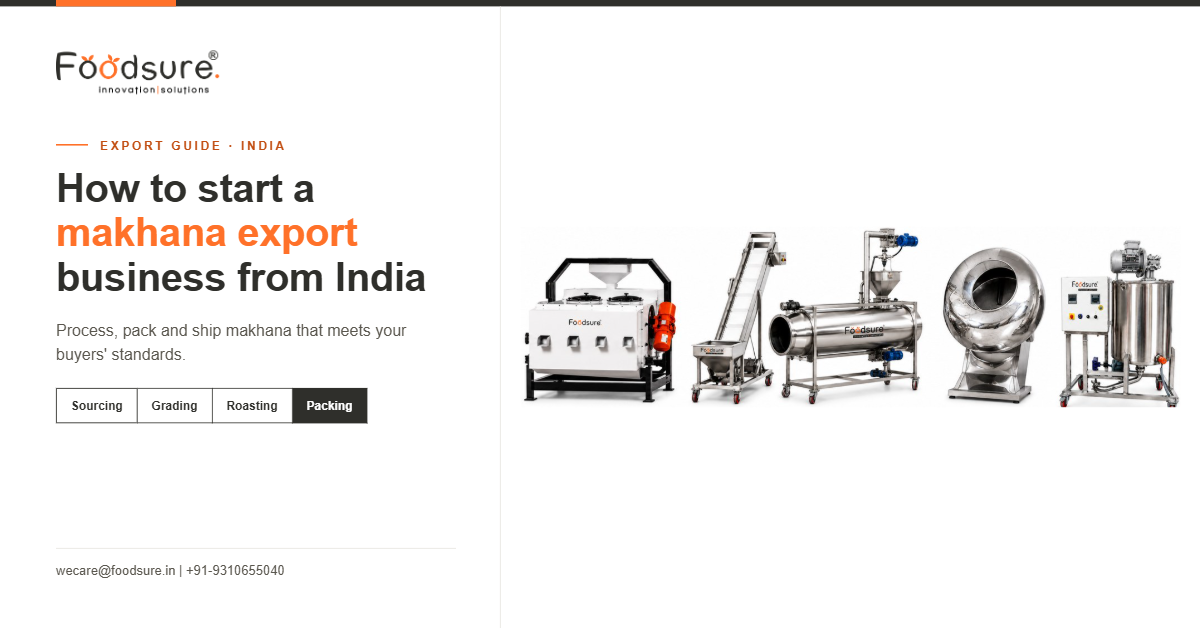
This is where you determine the quality of your products. You require a makhana roaster, grading machine, flavoring machine, and packaging machine, and each of these is elaborated upon in the next section.
Step 5: Test and Certify Your Product
The overseas importers will not accept a shipment on good faith. Get your produce checked at a lab which is accredited by NABL for:
- Moisture and water activity
- Aflatoxins and other mycotoxins
- Pesticides based on the limits of the destination country
- Heavy metals
- Microbiology: total plate count, yeast & mould, E. coli, and Salmonella
Some of the common certifications which are required by retail and private label buyers include HACCP, ISO 22000, FSSC 22000, and BRC certification. Gulf region buyers often require Halal certification.
Step 6: Find Buyers and Price Correctly
Fairs like Gulfood, held in Dubai; Anuga, organized in Cologne; and the US Fancy Food fairs are perhaps the quickest means of meeting the importers. The APEDA buyer seller meetings and B2B sites are other means, but involve some follow up.
A little labelled sample along with a spec sheet should be sent to them. Quotations should be made by size grade and packing, normally on FOB or CIF basis. In case of new buyers, you may go for either L/C or advance.
Step 7: Plan Logistics Early
Since Makhana is a light and bulky commodity, the capacity of the box will be reached even before reaching the required weight capacity. Thus, the pack density is a very good opportunity for reducing your shipping costs through better use of packaging.
Use the services of a CHA and freight forwarder with experience in shipping of food items. Be sure to have the commercial invoice, packing list, certificate of origin and health certificates prepared before the shipment is dispatched from your premises.
Which Export Markets Should You Target First?
Begin by targeting those markets where people know about makhana and where the entry requirements are not too difficult. UAE, as well as other parts of the Gulf, UK, USA, Canada, and Australia are places with large communities of Indians and an increasing number of health-snack products shelves.
- Gulf: Shorter travel time, high diaspora demand, halal requirement common.
- UK & Europe: Strict residue requirements and labeling guidelines; thus, test reports will be of real value.
- USA & Canada: The largest market, but also the highest documentation, such as FDA registration in the case of the USA.
- Australia & New Zealand: Stringent import regulations, plus liking for well-documented supply chains.
Focus on one or two markets, understand their requirements well. If you try to enter five countries during your first year, you may fail at all of them.
The Makhana Processing Line: Machines Behind Export-Quality Makhana
A makhana processing line moves seed through five stages: pre-grading, roasting and popping, post-pop grading, flavouring, and packaging. Export buyers care most about three results: uniform pop size, consistent colour, and low moisture.
| Stage | Machine | What it does | What to check |
|---|---|---|---|
| 1. Pre-grading | Makhana grading machine (for seed) | Sorts gurri by size so each batch roasts evenly | Number of size grades, throughput |
| 2. Roasting and popping | Makhana roasting machine / roasted makhana machine | Tempers and roasts seed, then pops it | Temperature control, pop percentage, labour needed |
| 3. Post-pop grading | Makhana grading machine (for pops) | Separates by size, removes broken pieces | Sieve options, breakage rate |
| 4. Flavouring | Makhana flavouring machine | Coats pops with oil and seasoning | Dosing accuracy, gentle tumbling |
| 5. Packaging | Makhana packaging machine | Weighs, fills, flushes with nitrogen, seals | Fill accuracy, residual oxygen, film compatibility |
Makhana Roasting Machine
“Popping” is the essence of the process. Traditionally, farmers first roast the kernels and then manually split them using a wooden hammer.
The latest makhana roasting machines regulate temperature and pop the kernels mechanized. They make the process much more consistent. When you test different makhana roasting machines, remember that pop rate and breakage should be measured on your sample seeds, not the ones that the supplier demonstrates.
Makhana Grading Machine
Export-size grades are offered based on size; bigger pops (classified in “suta” in the industry) are more expensive. The makhana sorter uses vibrating sieves to classify both the raw seeds and the pops.
Some high-end consumers could also be interested in color sorting, which separates out any darker or burnt pops. This would be a worthwhile additional step once you start producing enough volume.
Makhana Flavouring Machine
Oil is quickly absorbed by pops, and therefore any unevenness in their coating will result in soggy and tasteless pieces. A makhana seasoning machine turns very gently while spraying oil and adding seasonings, ensuring an even coating without damaging the pops.
Some popular export seasonings include peri-peri, cream and onions, salt and pepper, pudina, and cheese. Stable oils should be used since the oil quality determines the shelf life of pops.
Makhana Packaging Machine
Pops are delicate and highly absorbent, so packaging will make sure that your pops reach your consumer crunchy. The makhana packaging machine will weigh the pop, fill the pouch, flush with nitrogen and seal.
The flush with nitrogen and metallized barrier film will preserve the crunch and rancidity of flavoured products. For export purposes, add metal detection before cartoning.
How to Choose Makhana Machines: Decision Factors
- Capacity must match seed availability. Having a large machine stand idle due to lack of seeds is costly.
- Make sure that you perform a trial using your own seeds before paying.
- Ensure the use of food-grade stainless steel on all surfaces that come in contact.
- Ensure that spares and services are available in India.
- Inquire about whether the various stages are compatible such that adding automation will not require replacement of all stages.
- Do a comparison of operating costs including power, fuel, and labour costs, besides capital cost.
Manual popping is feasible for small samples but not for larger container loads. Foodsure Machines offers machines for all stages.
How Much Does a Makhana Export Business Cost?
There’s no single number, because capacity decides everything. A small export-ready unit costs tens of lakhs. A fully automatic line with packing, testing, and working capital runs into crores. Raw material is the largest ongoing expense.
| Cost head | What it covers | Planning note |
|---|---|---|
| Machinery | Roasting, grading, flavouring, packaging | Largest one-time cost; get quotes for the same capacity from two or three makers |
| Building and utilities | Hygienic floors, drainage, power, storage | Food-safe design matters for audits |
| Raw material stock | Seasonal gurri purchase | Biggest working-capital demand |
| Certifications and testing | FSSAI, lab tests, audits | Recurring, not one-time |
| Packaging material | Films, cartons, labels | Custom designs usually carry minimum order quantities |
| Logistics and paperwork | CHA, freight, insurance | Priced by volume, so pack density matters |
| Samples and marketing | Courier, trade fairs, travel | Often underbudgeted |
Treat these as planning categories, not quotes. Plan working capital for at least one full buying season plus 60 to 90 days of receivables from overseas buyers.
Common Mistakes in the Makhana Export Business
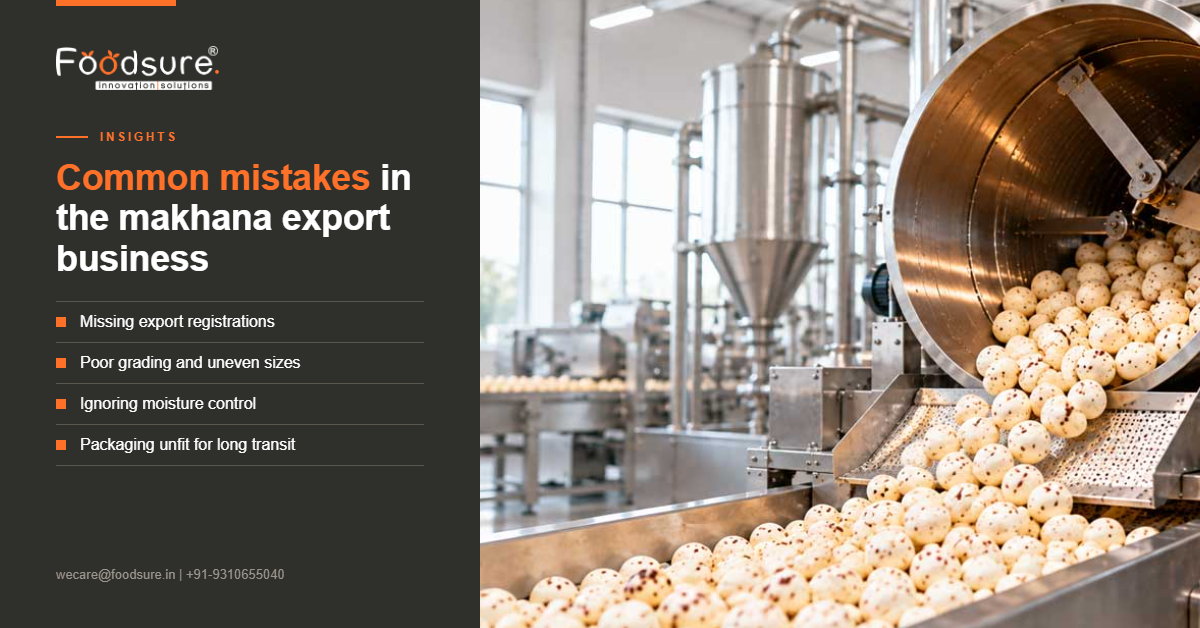
- Shipment before testing. A failure of a lab test in the destination port is much more expensive than testing at home.
- Skimping on seed sorting. Uneven roasting occurs because seeds are different sizes.
- Neglecting packaging. Moisture and damage are the most frequent problems buyers complain about.
- Choosing machinery by price only, with the cost showing up in rejects and lost time.
- Neglecting bulk shipping. Light and bulky goods penalize bad box design.
- Dependence on one seed supplier in a seasonal business.
- Quoting without checking HS code and destination labelling requirements with the CHA.
Who Should Start a Makhana Export Business, and Who Should Wait?
If you:
- Have experience in food processing or trading and have some working capital
- Can procure graded seed from Bihar with reliability
- Are ready to make investment before making the first purchase
Then don’t proceed if you:
- Have not even talked to a single buyer
- Wish to compete solely on the basis of lowest cost
- Do not have someone to ensure quality control and documentation
Key Takeaways
- The value-added makhana (cooked, seasoned, and packed) is more profitable than the seed or plain pops.
- Register your firm for IEC, GST, FSSAI, APEDA, and the destination country prior to quotation.
- There are five stages in the makhana processing line: pre-grading, cooking, post-pop grading, seasoning, and packing.
- Check every batch and issue a certification at the earliest because buyers go by lab tests and audits.
- It is the raw material and working capital, not merely the machinery that decides the cost of production.
Conclusion: Is a Makhana Export Business Worth Starting?
For the right person, indeed. There is great potential for those who approach the makhana export business from a point of view of treating it as a food safety and food consistency business and then as a trading business.
First of all, it’s important to develop a strategy for exports; the right size of the line and the right investment budget should be determined. Secondly, it would be useful to communicate with the machine manufacturers who will do trials with your seed first.
FAQs
How can I set up a makhana export business with little capital?
Start out by procuring bulk plain or private label makhana, and just the equipment for the initial production volumes. Flavoring and packaging will be introduced as demand increases.
Which licenses are required to export makhana from India?
GST number, IEC license, FSSAI license, APEDA license, and all destination country licenses like FDA registration would be required.
What does a makhana processing line consist of?
It consists of a makhana seed grading machine, roaster machine, popper machine, pop grading machine, flavoring machine and packaging machine. Ideally all would be integrated.
What is a roasted makhana machine and how does it work?
It performs the roasting and tempering of the graded seeds, then pops the seeds mechanically. Pop quality is better than manual popping.
Is a makhana grading machine essential for exporting makhana?
Yes. Buyers buy according to the grade of sizes. A makhana grading machine will give you consistent batches and eliminate breakages.
Why should I invest in a makhana flavoring machine rather than flavoring manually?
It flavors the makhana uniformly without breaking it and ensures that each bag has the same taste.




