If you are planning to start a soya nugget manufacturing business in Nepal, understanding the soya nugget machine price in Nepal is an important first step. However, the price alone will not tell you how much money you need to set up a working production unit.
Your total investment depends on the machine’s capacity, the level of automation, the drying system, raw material handling, packaging equipment, and installation requirements. You also need to consider electricity consumption, labour, maintenance, and the cost of bringing machinery into Nepal if you are buying from another country.
Soya nuggets, also called soya badi or soya chunks, are made by processing soy-based ingredients through extrusion. The finished product can be sold to retailers, wholesalers, food distributors, hotels, restaurants, and institutional buyers.
For Nepalese entrepreneurs, the practical goal is to select equipment that matches the size of the business, the raw materials available, and the demand they can realistically serve.
This guide explains soya nugget machine prices, production capacity, equipment requirements, and the factors to check before investing in a commercial plant.
Soya Nugget Machine Price in Nepal at a Glance
There is no single fixed price for every soya nugget machine in Nepal. A basic machine and a complete production line can have very different costs because they include different equipment.
One Nepal-based supplier, Changing Nepal, publicly lists a soyabean processing machine package in the range of NPR 135,000 to NPR 2,645,000. Its listing describes an extruder with an output of around 80–100 kg per hour and a continuous dryer rated at approximately 100–200 kg per hour. The supplier also states that delivery, installation, and training are quoted with the machine.
These are published supplier figures, not a verified average price for the entire Nepalese market. The listed price range should not be interpreted as the cost of every configuration.
| Equipment category | What to check | How to budget |
| Standalone extruder | Capacity, motor, cutting system | Ask for a machine-only quotation |
| Semi-automatic setup | Extruder, mixer, drying arrangement | Include manual handling and labour costs |
| Integrated production line | Mixing, extrusion, cutting, drying and conveying | Request an itemised project quotation |
| Complete commercial plant | Production line, packaging, installation and utilities | Calculate the total installed cost |
Before comparing quotations, confirm whether the quoted capacity refers to wet extruded material or finished, dried soya nuggets. This distinction can affect your actual production plan.
What Is the Current Soya Nugget Machine Cost in Nepal?
The soya nugget machine cost in Nepal depends on the equipment included in the package, the production target, and the supplier’s specifications.
A standalone extruder may cost less than a line that includes a mixer, automatic feeding, a conveyor, a continuous dryer, and a packaging machine. However, buying individual machines separately can also increase installation and integration costs.
For a meaningful comparison, ask suppliers to divide the quotation into these categories:
- Main extruder and cutting system
- Raw material mixer and feeding equipment
- Conveyor and material transfer system
- Dryer and cooling arrangement
- Electrical control panel
- Packaging equipment
- Installation and operator training
- Freight, import charges, and spare parts
This makes it easier to identify what is included and what you may need to purchase separately.
For example, a low-priced extruder may be suitable for a business that already owns a compatible dryer. A new manufacturer starting from an empty factory, on the other hand, may need a more complete setup.
Why Soya Nugget Manufacturing Is Worth Evaluating in Nepal
Soya nuggets offer food manufacturers a way to produce a convenient, shelf-stable soy-based food product for household cooking and commercial food preparation.
Nepal also has domestic soybean production. According to the Ministry of Agriculture and Livestock Development’s Statistical Information on Nepalese Agriculture 2081/82, soybean production was reported at approximately 34,102 metric tonnes in FY 2024/25, compared with 28,520 metric tonnes in FY 2023/24. These figures provide context for the country’s soybean supply, although they do not establish the size or growth rate of Nepal’s soya nugget market.
For an entrepreneur, local soybean production is only one part of the calculation. You must also check whether suitable defatted soy flour or other required ingredients are available at the quality and price your production process needs.
Before investing, research the local market in your intended sales area. Speak to wholesalers, grocery distributors, retailers, and food-service businesses to understand the products they already buy, their preferred pack sizes, and the prices they expect.
A machine should be selected after this demand assessment, not before it.
How Much Production Capacity Do You Need?
Capacity determines how much product a machine can process in a given period. It also affects the required floor space, power supply, drying system, labour, and initial investment.
A small manufacturer supplying a limited number of local retailers may not need the same setup as a company distributing products across Kathmandu, Pokhara, Biratnagar, Bharatpur, and other markets.
Consider these capacity ranges as planning categories rather than fixed recommendations.
50–100 kg per hour
This range may suit a small commercial business or a new brand testing demand. Before selecting a machine, confirm whether the quoted output refers to the extruder’s output or finished product after drying.
100–200 kg per hour
This range may suit an established producer supplying regular wholesale orders. At this scale, the mixer, feeding system, dryer, and packaging arrangements must support the intended production schedule.
300 kg per hour and above
Higher-capacity equipment may suit manufacturers with established distribution, institutional contracts, or a clear expansion plan. These projects need careful planning for utilities, factory space, raw material supply, storage, and finished-product handling.
Do not select a machine solely because it offers a higher advertised output. Estimate how much product you can sell, how many hours you plan to operate, and how much finished product the entire line can produce.
What Machines Are Required for Soya Nugget Production?
A commercial soya nugget production line usually involves several connected stages. The exact equipment depends on the raw material, nugget shape, desired texture, and production capacity.
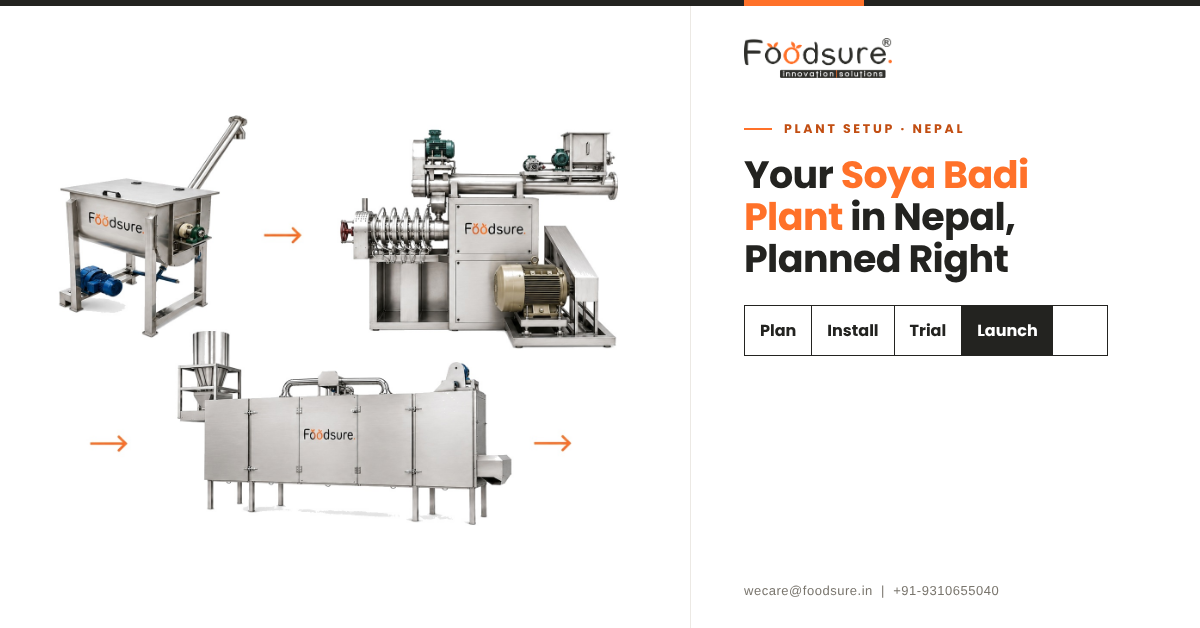
1. Raw material mixing
The mixer blends the required ingredients and prepares a consistent feed for extrusion. Correct mixing helps the extruder process the material more consistently.
2. Feeding and conveying
A feeding system transfers the prepared mixture into the extruder. Conveyors or elevators may be used to move material between different stages.
3. Extrusion and cutting
The extruder processes the soy-based mixture under controlled heat, pressure, and mechanical force. The material is then shaped and cut into the required nugget or chunk size.
4. Drying
The freshly extruded product passes through a dryer to reduce moisture to the level required by the product specification. Drying conditions must be established through product trials and suitable quality checks.
5. Cooling
The product is cooled before packing. Packing it while it is still warm can cause moisture to collect inside the packaging under unsuitable conditions.
6. Weighing and packaging
The finished nuggets are weighed and packed in the selected format. Packaging requirements will differ for bulk wholesale orders and retail packs.
A complete line should be planned as one connected production system. If the extruder produces material faster than the dryer can handle it, the dryer can become a bottleneck and reduce the output of the entire plant.
Standalone Extruder vs Complete Soya Nugget Production Line
One of the most common mistakes buyers make is comparing an extruder quotation with the price of a complete production line.
These are not equivalent purchases.
| Feature | Standalone extruder | Complete production line |
| Main equipment | Extruder and specified accessories | Multiple connected processing stages |
| Existing equipment | May require a compatible mixer and dryer | More stages supplied as part of the project |
| Installation | Depends on the supplied package | Requires coordination across the line |
| Best fit | Businesses with suitable existing equipment | New plants or manufacturers expanding their setup |
| Price comparison | Compare the machine and included accessories | Compare the full equipment and installation scope |
A standalone extruder can be a reasonable option if your factory already has suitable equipment for mixing, drying, and packaging.
For a new business, a complete line may simplify planning because the supplier can specify how the different machines should work together. Ask for a clear equipment list rather than assuming that every necessary component is included.
Semi-Automatic vs Fully Automatic Soya Nugget Machine
Automation affects the way material moves through the production line and how much manual work operators need to perform.
A semi-automatic setup may require workers to handle some feeding, material transfer, or packing tasks. It can suit businesses that want to start with a manageable production system and have the labour available to operate it.
A fully automatic line can automate more stages and coordinate equipment through control systems. It may be more suitable for manufacturers running regular production schedules or handling larger orders.
Before paying extra for automation, consider:
- How many hours per day will the plant operate?
- How many workers will be needed?
- Which stages currently require manual handling?
- Can the equipment maintain the required product quality?
- What happens if one machine stops?
- Is local technical support available?
- Can the line be expanded later?
Automation is useful when it solves a real production problem. The right configuration depends on your factory and business plan, not simply on whether the machine is labelled automatic.
Why Raw Material Quality Matters
Soya nugget production depends on more than the machine. The quality and consistency of the raw material can affect extrusion, product texture, shape, and final moisture.
Depending on the process, manufacturers may use defatted soy flour or other specified soy-based ingredients. Before purchasing machinery, share your intended raw material specification with the supplier.
Discuss these points:
- Protein and moisture content
- Fat content and particle size
- Ingredient consistency between batches
- Required pre-treatment
- Desired nugget size, density, and texture
- Expected finished-product moisture
Ask whether the supplier can conduct a production trial using your intended raw material. This can help identify processing problems before the equipment is installed at your factory.
What Nepalese Buyers Should Check Before Importing Machinery
If you plan to buy a soya nugget machine from India or another country, the advertised machine price is not necessarily the final amount you will pay.
Your landed and installed cost may include freight, insurance, customs duty, VAT where applicable, transport to your factory, installation, electrical work, and commissioning.
Nepal’s Department of Customs publishes official tariff schedules, and the Nepal National Single Window provides a tariff search facility. The applicable charges depend on the correct classification of the imported machinery and the current rules. Do not assume that all food-processing machines have the same import duty.
Before placing an order, ask your supplier for:
- A detailed commercial quotation
- Machine specifications and itemised accessories
- Packing dimensions and shipment weight
- Country of origin and shipping terms
- Technical documentation
- Installation and commissioning charges
- Warranty terms and spare-parts availability
Then ask a Nepalese customs agent to confirm the relevant tariff classification and applicable charges before finalising your budget.
For the latest rules, consult the Department of Customs, Nepal or the Nepal National Single Window tariff search.
How to Calculate the Cost of Producing Soya Nuggets
The purchase price is only one part of your investment. You also need to estimate how much it costs to produce and pack each kilogram of finished product.
Use this basic calculation:
Production cost per kg = Raw material + Electricity + Labour + Packaging + Processing losses + Maintenance + Other operating costs
To calculate it accurately, use your expected production volume and actual supplier quotations. Avoid relying on generic profit margins or payback periods that do not reflect your factory’s operating conditions.
For example, a business producing bulk packs for wholesalers may have different packaging and distribution costs from a brand selling small retail pouches. Your selling price will also depend on product quality, pack size, distributor margins, transport, and competition.
You should also estimate how many kilograms you expect to sell each month. A machine’s theoretical capacity does not guarantee that you will have enough orders to operate it continuously.
Why Dryer Capacity Should Match the Extruder
Drying deserves particular attention when comparing soya nugget machinery.
The extruder may produce material at a high rate, but the product still needs to pass through the drying stage before it is ready for packaging. If the dryer cannot handle the extruder’s actual output, material may accumulate between stages and slow down production.
When reviewing a quotation, check:
- Dryer capacity under the intended operating conditions
- Expected moisture before and after drying
- Temperature and airflow controls
- Energy consumption
- Cleaning and maintenance requirements
- Cooling arrangements before packaging
Ask the supplier to explain how the quoted capacity was established. The objective is to achieve the required finished-product quality at a practical production rate, not simply to purchase the machine with the largest capacity figure.
Food Safety and Equipment Construction
Food-contact parts should be made from materials suitable for their intended use and compatible with the ingredients and cleaning methods used in your factory.
Ask the manufacturer to specify the material grade of product-contact components, the construction of the machine, and the recommended cleaning procedure. If stainless steel is specified, confirm the grade in the technical documentation rather than relying on a general claim that the machine is food-grade.
Your production plan should also account for hygienic handling, pest control, water quality where relevant, suitable storage, and checks on the finished product.
Before commercial production begins, verify the applicable Nepalese food business registration, licensing, labelling, and food safety requirements with the relevant authorities.
How Foodsure Machines Fits Into Your Equipment Planning
When comparing machinery suppliers, look beyond the quoted price. You should understand the proposed production process, the equipment included, and the support available after installation.
Foodsure Machines offers a Soya Badi Machine for commercial soya nugget production. Its published product page describes a 200 kg/hour configuration with SS304 construction, PLC and HMI controls, and a listed price of ₹25,00,000. Treat this as the supplier’s published specification and price for that configuration, not as a Nepal-delivered quotation. Confirm the current price, final equipment scope, and export-related costs directly with the company.
Foodsure Machines also supplies other food-processing equipment. If you plan to develop a broader snack portfolio, the following options may be relevant:
- High Protein Snack Machine: For suitable extruded snacks such as protein puffs, chips, and other shaped snack products, depending on the selected configuration.
- Makhana Machine: For roasting and processing makhana into ready-to-eat snack products.
- Popcorn machine: Worth evaluating if you intend to add popcorn to your snack range. Ask the supplier for the appropriate model and specifications for your product and target output.
These machines serve different purposes. A soya nugget extruder should not be assumed to manufacture every type of high-protein snack, and a general snack extruder may not replace the equipment required for soya nugget production.
Foodsure’s published product pages describe its manufacturing and technical support offerings, including installation and operator training. Nepalese buyers should confirm whether these services are available for their location and what travel, freight, and commissioning charges apply.
How to Choose the Right Soya Nugget Machine
Before selecting a machine, work through these steps.
- Estimate monthly demand. Speak to potential buyers and estimate the volume you can sell.
- Decide your product range. Confirm whether you will produce standard nuggets, larger chunks, granules, or other textured soy products.
- Calculate your required output. Convert your sales target into daily production requirements, allowing for cleaning, changeovers, maintenance, and downtime.
- Match the complete line. Check the mixer, extruder, cutter, dryer, cooling equipment, and packaging machine together.
- Check utilities and factory space. Ask for the electrical load, installation layout, ventilation needs, and operating requirements.
- Compare itemised quotations. Check the same equipment scope across suppliers before deciding which price represents better value.
- Confirm after-sales support. Get written details of installation, training, warranty coverage, replacement parts, and service arrangements.
Final Takeaway
The right soya nugget machine for your business in Nepal is the one that matches your production target, raw material, budget, and expected sales.
A low advertised price may cover only the extruder, while a higher quotation may include mixing, drying, conveying, controls, and installation. Compare the same equipment scope before making a decision.
Start by researching your local buyers, estimating the volume you can sell, and calculating your production cost per kilogram. Then request itemised quotations from suppliers and confirm the landed cost, technical specifications, and after-sales arrangements.
If you are considering Foodsure Machines, request a configuration designed around your intended output and ask for a written quotation covering equipment, installation, operator training, and delivery to Nepal. That gives you a more useful basis for comparing suppliers than the machine price alone.
Frequently Asked Questions
What is the soya nugget machine price in Nepal in 2026?
The price depends on capacity, automation, and the equipment included. One Nepal-based supplier publicly lists a soyabean processing machine package between NPR 135,000 and NPR 2,645,000. This is a supplier-specific listing, not a verified market-wide price range. Request a current quotation for your required configuration.
How much does a 100 kg/hour soya nugget machine cost?
There is no single confirmed price for every 100 kg/hour configuration. The final cost depends on whether the quotation includes a mixer, cutting system, dryer, conveyor, control panel, and packaging equipment. Ask for an itemised quote and confirm whether the stated output refers to finished dried nuggets.
Which is better for a small business, a semi-automatic or automatic machine?
A semi-automatic setup may be suitable when production volumes are limited and workers can manage the manual stages. An automatic line may make more sense when you have regular orders and need coordinated production. Compare the full operating cost before deciding.
What equipment is needed to manufacture soya nuggets?
A typical production line includes a mixer, feeding system, extruder, cutting arrangement, dryer, cooling equipment, and packaging machine. Additional equipment depends on the raw material, product specification, and desired production capacity.
Is a dryer necessary for commercial soya nugget production?
A suitable drying stage is generally required to achieve the intended moisture level and product stability. Its capacity must be matched to the production line, and the final drying conditions should be established through suitable product and quality checks.
Can Nepalese businesses buy a soya nugget machine from India?
Yes, businesses can evaluate machinery from Indian suppliers. However, the final cost depends on the machine quotation, freight, applicable customs duty, VAT, transport, installation, and commissioning. Confirm the current import requirements before placing an order.
What is the difference between a soya nugget machine and a high protein snack machine?
A soya nugget machine is designed for producing textured soy products such as nuggets and chunks. A high protein snack machine may be configured for products such as protein puffs, chips, or other extruded snacks. The appropriate equipment depends on the formulation and finished product you want to manufacture.
How can I estimate the profitability of a soya nugget business?
Calculate the cost of raw materials, electricity, labour, packaging, maintenance, distribution, and other operating expenses. Compare the total cost per kilogram with your realistic selling price and expected sales volume. Do not assume a fixed profit margin or payback period without using your own costs and demand estimates.
What should I check before paying a machinery supplier?
Confirm the hourly output, raw material requirements, food-contact materials, electrical load, dryer capacity, included accessories, warranty, installation, training, spare parts, and final delivered cost. Request written specifications and, where possible, a product trial before making the purchase.