
Starting a soya badi manufacturing business requires more than buying an extruder. You need to plan your production capacity, raw materials, drying system, packaging, electricity supply and distribution network before investing in machinery.
For entrepreneurs searching for soya badi machine price in Bangladesh, soya badi plant cost, or soya chunks manufacturing plant setup, the first step is to understand how much the business can realistically produce and what it will cost to operate.
Soya badi, also known as soya chunks or textured vegetable protein (TVP), is made from soy-based ingredients through a process called extrusion. It is used in curries, pulao, biryani, snacks and other food products. Manufacturers can sell it in retail packs or supply it in bulk to wholesalers, retailers and food businesses.
The market opportunity, however, needs to be assessed carefully. A March 2025 report from the United States Department of Agriculture’s Foreign Agricultural Service (USDA FAS) forecast Bangladesh’s soybean production at 160,000 metric tonnes for marketing year 2025/26. The report also noted that domestic soybean production met only about 7% of the country’s annual soybean requirement, with most locally grown beans used in animal feed rather than human food. These figures describe the wider soybean supply chain, not the demand for packaged soya badi specifically. Read the USDA FAS report.
This distinction matters when planning a food manufacturing business. Soybean availability alone does not guarantee sales of soya chunks. Entrepreneurs must also evaluate consumer demand, ingredient prices, competing brands and distribution opportunities.
Foodsure Machines offers soya badi production solutions in capacities ranging from 200 kg to 1,000 kg per hour, according to the supplied machine specifications. This guide explains the available options, investment considerations, production process and practical method for calculating profit and return on investment (ROI).
Important pricing note: The machine price discussed below is listed in Indian Rupees (INR), not Bangladeshi Taka (BDT). It is a reference price for the stated configuration, not a confirmed quotation for a complete factory in Bangladesh.
Soya Badi Plant Investment at a Glance
The total investment depends on the production capacity, equipment included in the line, factory space, electrical infrastructure, packaging requirements and working capital.
The following figures are based on the machine specifications supplied for this article. They should be confirmed with Foodsure before being used for budgeting or equipment procurement.
| Production capacity | Listed power requirement | Indicative area requirement |
| 200 kg/hour | 100–110 kW | 2,000 sq ft |
| 300 kg/hour | 120–130 kW | 5,000 sq ft |
| 500 kg/hour | 150–160 kW | 10,000 sq ft |
| 1,000 kg/hour | 200–210 kW | 15,000 sq ft |
The power and area figures above relate to the supplied production-line specifications, not independently verified requirements for every configuration.
The 200 kg/hour machine also has a separate published specification listing a power requirement of 45–50 kW. This discrepancy must be resolved with the manufacturer before calculating electricity consumption, sanctioned load or installation costs.
A higher-capacity line can produce more in the same operating period, but it also requires greater investment in infrastructure and a stronger sales network. For this reason, the right plant capacity is the one that matches your expected demand, not simply the largest machine available.
What Is the Soya Badi Machine Price in Bangladesh?
The supplied Foodsure Machines information lists a reference price of ₹25,00,000 for a 200 kg/hour machine configuration.
The associated specifications are as follows.
| Parameter | Published specification |
| Production capacity | 200 kg/hour |
| Machine material | SS304 |
| Power requirement | 45–50 kW |
| Control system | PLC + HMI |
| Standard warranty | 12 months |
| Minimum order quantity | 1 set |
| Listed reference price | ₹25,00,000 |
These details describe the supplied machine listing. They do not establish the total cost of a commissioned production plant in Bangladesh.
Before making a purchase decision, request a written quotation covering the exact machine configuration, included equipment, installation, training, warranty, delivery terms and after-sales support.
For a Bangladesh-based project, the quotation should also clarify the applicable currency, freight, customs duties, taxes, inland transport and any other charges that may apply.
This is particularly important because the broader production-line table gives a different power requirement for the 200 kg/hour capacity.
What Is Included in the Total Soya Badi Plant Cost?
The cost of setting up a soya badi factory is not limited to the main extruder. The complete budget should account for all the equipment and operating requirements needed to turn raw ingredients into packaged products.
The following are the main cost heads to evaluate.
1. Production machinery
The machinery budget depends on the selected capacity and the equipment included in the line. A complete setup may include mixing, extrusion, cutting, drying, cooling and packaging systems.
Ask the manufacturer whether each of these components is included in the quoted price or supplied separately.
2. Factory space and preparation
The factory needs sufficient room for machinery, ingredient storage, finished-product storage, movement of materials and safe access for cleaning and maintenance.
The supplied area figures range from 2,000 sq ft for the listed 200 kg/hour production line to 15,000 sq ft for the 1,000 kg/hour option. Confirm the final layout before leasing or constructing a facility.
3. Electrical infrastructure
The required electrical load depends on the actual equipment configuration and the machines that operate together.
The installation budget may need to account for electrical panels, wiring, protection systems and other site-specific work. A qualified electrical professional should confirm the load and connection requirements.
4. Raw materials and packaging
The plant needs a reliable supply of suitable soy-based ingredients, packaging materials and any other ingredients used in the approved product formulation.
Working capital should cover purchases made before customers pay for finished goods.
5. Installation and staff training
The project budget should clearly state whether installation, commissioning, operator training and initial testing are included in the machinery quotation.
6. Working capital
Working capital covers the day-to-day expenses of running the business, including raw materials, wages, electricity, packaging, transport and credit given to distributors.
A plant can have suitable machinery and still face financial pressure if it does not have enough money to operate while building its customer base.
The practical approach is to obtain a complete project quotation rather than treating the machine price as the total investment.
Choosing the Right Soya Badi Manufacturing Machine Capacity
Foodsure’s supplied specifications list four production capacities. Each option should be assessed against expected sales, production targets and available infrastructure.
200 kg/hour soya badi machine
The 200 kg/hour option may suit a business planning medium-scale commercial production.
The supplied production-line specifications list an area requirement of 2,000 sq ft and a power requirement of 100–110 kW. A separate machine listing states 45–50 kW, so the exact configuration must be confirmed.
Before selecting this capacity, estimate how much product your business can sell each week. Also check whether your raw-material supplier can provide consistent ingredients at a workable price.
300 kg/hour soya badi machine
The 300 kg/hour option is intended for higher commercial production requirements.
The supplied figures list a power requirement of 120–130 kW and an area requirement of 5,000 sq ft.
This capacity may be worth evaluating if your business has established distribution, bulk buyers or a clear plan to increase production.
500 kg/hour soya badi machine
The 500 kg/hour option is designed for larger production volumes.
The supplied specifications list 150–160 kW of power and 10,000 sq ft of space.
At this scale, it becomes especially important to plan ingredient purchasing, storage, drying capacity, packaging speed and product dispatch together. A bottleneck in any one of these stages can limit the output of the entire line.
1,000 kg/hour soya badi machine
The 1,000 kg/hour option is intended for industrial-scale requirements.
The supplied specifications list 200–210 kW of power and 15,000 sq ft of space.
Before investing at this level, assess the sales volume required to keep the plant economically productive. A high-capacity machine should not be selected solely because it offers greater theoretical output.
How Much Can a Soya Badi Plant Produce?
Machine capacity is usually expressed as kilograms per hour. It represents the stated production rate, not a guarantee of saleable output or daily production.
For example, at the listed capacities, one hour of operation corresponds to the following nominal throughput.
| Machine capacity | Nominal output in one hour | Nominal output in eight hours |
| 200 kg/hour | 200 kg | 1,600 kg |
| 300 kg/hour | 300 kg | 2,400 kg |
| 500 kg/hour | 500 kg | 4,000 kg |
| 1,000 kg/hour | 1,000 kg | 8,000 kg |
The eight-hour figures are mathematical illustrations based on continuous operation at the stated rate. They are not verified daily production figures.
Actual output can be lower because of startup, shutdown, cleaning, maintenance, product changeovers, drying constraints, downtime and rejected material. The finished product’s weight can also differ from the incoming mixture’s weight because processing changes moisture content.
For investment planning, use the manufacturer’s confirmed saleable output under the intended operating conditions.
Soya Badi Manufacturing Process
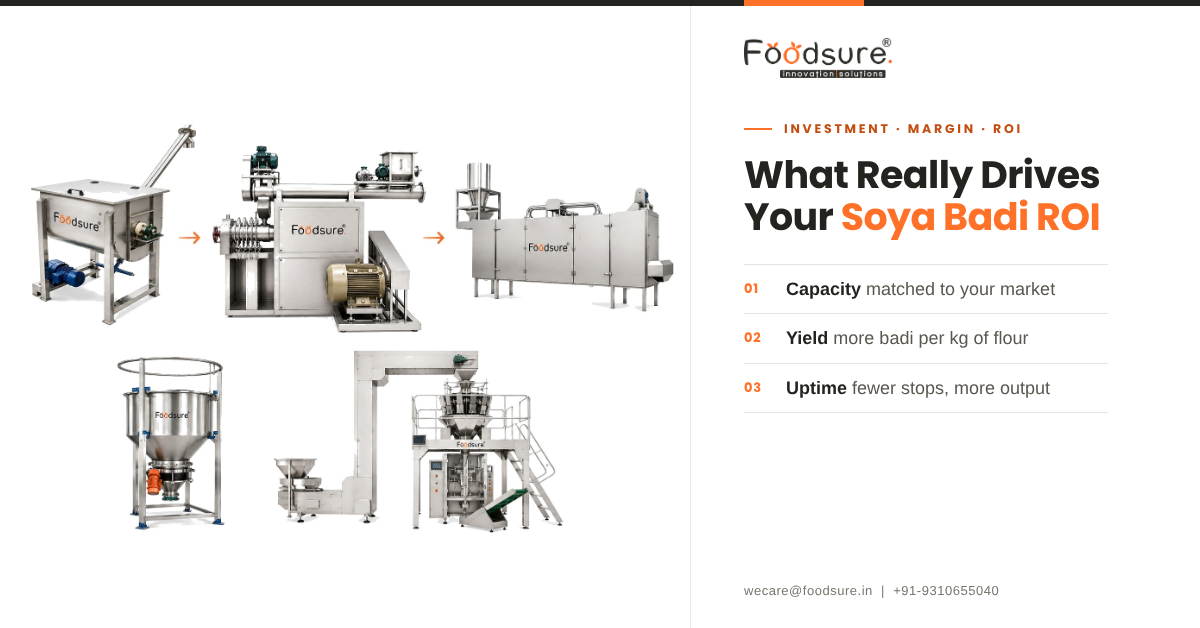
A commercial soya badi production line typically includes mixing, extrusion, cutting, drying, cooling and packaging. The exact process depends on the formulation, ingredient specifications and machine configuration.
Step 1: Ingredient mixing
Suitable soy-based ingredients, such as defatted soy flour, are mixed with the required amount of water and other formulation ingredients.
The mixture must meet the moisture and consistency requirements for the selected extruder.
Step 2: Extrusion and cooking
The prepared mixture enters the extruder, where controlled heat, pressure and mechanical action transform the material into a textured protein product.
The operating conditions and die design influence the final product’s texture, shape and density. These settings should be established through trials using the intended ingredients.
Step 3: Cutting
The extruded material is cut into pieces of the required size. Consistent cutting helps produce uniform soya chunks that are easier to pack and sell.
Step 4: Drying
The freshly formed product passes through a drying stage to reduce moisture to the level required by the product specification.
Drying conditions should be validated for the intended formulation, packaging and shelf-life requirements. A manufacturer should not assume that a particular drying time or temperature will suit every product.
Step 5: Cooling
The dried pieces are cooled under appropriate hygienic conditions before packaging. Packaging a product before it has cooled sufficiently can cause condensation and affect product quality.
Step 6: Packaging
The finished soya badi is packed in retail pouches or bulk packs, depending on the target customer.
Pack size, sealing quality, storage conditions and label information should be selected according to the intended market and product requirements.
For Bangladesh, manufacturers should check the applicable requirements of the Bangladesh Food Safety Authority (BFSA) and the relevant standards and packaging rules before selling the finished product.
What Determines Profit Margin in a Soya Badi Business?
A soya badi plant’s profit margin depends on the difference between its sales revenue and the complete cost of producing and selling the product.
Machine capacity alone does not determine profitability. Two factories using similar machinery can have different financial results because they buy ingredients at different prices, operate at different utilization levels or sell through different distribution channels.
The main factors include the following.
Raw-material cost: The price and quality of soy-based ingredients influence the cost of every kilogram produced. Changes in ingredient prices can affect margins if selling prices remain unchanged.
Electricity consumption: The plant’s actual power draw, operating hours and local electricity tariff determine its electricity expense. Confirm the machine’s actual power requirements before estimating this cost.
Labour and maintenance: Operator wages, routine maintenance, spare parts and downtime should be included in the operating budget.
Drying and packaging: Drying affects energy use and finished-product moisture. Packaging materials and packaging speed also influence the cost per saleable kilogram.
Product losses: Breakage, rejected pieces, startup waste and products that fail quality checks reduce the quantity available for sale.
Selling price and distribution: Wholesale prices, retailer margins, transport costs, promotional discounts and customer payment terms all affect the money the business retains.
For example, a manufacturer supplying wholesalers may sell at a lower price per kilogram but move larger volumes. A retail brand may earn a higher selling price but face additional packaging, marketing and distribution costs.
The business plan should compare these options using actual quotations and buyer discussions.
How to Calculate Soya Badi Profit Margin
Before calculating profit, estimate the cost of producing one kilogram of saleable soya badi.
A basic cost model is:
Production cost per kg = Total production expenses ÷ Saleable output in kg
Production expenses should include ingredients, electricity, direct labour, packaging, maintenance and other costs directly related to manufacturing.
For a more complete business calculation, add factory rent, administration, distribution, marketing, interest and other applicable expenses.
The gross profit margin can then be estimated as:
Gross profit margin (%) = (Net sales revenue − Cost of goods sold) ÷ Net sales revenue × 100
Net sales revenue should account for relevant discounts and returns. The cost of goods sold should be calculated consistently with the business’s accounting method.
For example, if a manufacturer sells a product for BDT 100 per kg and its cost of goods sold is BDT 75 per kg, the gross profit is BDT 25 per kg and the gross profit margin is 25%.
This is an illustration of the formula, not a claim about the actual selling price, production cost or profit margin of a soya badi business in Bangladesh.
How to Calculate ROI for a Soya Badi Plant
Return on investment measures the profit generated in relation to the amount invested.
ROI (%) = Annual net profit ÷ Total investment × 100
Suppose a business invests BDT 1 crore in a complete plant and earns BDT 20 lakh in annual net profit. Its illustrative annual ROI would be 20%.
This example is only for explaining the calculation. It is not a forecast for a Foodsure installation or a typical soya badi factory.
A reliable ROI estimate requires the following information:
- Complete machinery and installation cost
- Factory setup and electrical infrastructure expenses
- Initial working capital
- Expected monthly saleable output
- Expected selling price per kilogram
- Raw-material and packaging costs
- Electricity, labour and maintenance expenses
- Rent, logistics, administration and other operating costs
- Expected sales volume and payment collection period
The original machine information does not provide all these Bangladesh-specific figures. Therefore, a reliable plant ROI or payback period cannot be stated without additional project data.
For a more useful estimate, prepare conservative, expected and optimistic financial scenarios. This shows how changes in sales, utilization, ingredient costs and selling prices could affect the investment.
How Foodsure Machine Features Can Affect Operating Costs
When comparing a soya badi manufacturing machine, look beyond the advertised production rate. Consider the features that affect product consistency, maintenance and the amount of saleable product produced.
The supplied Foodsure information identifies the following features for consideration.
Stainless-steel construction
The supplied specifications list SS304 for the machine material and food-contact construction. Ask the manufacturer to confirm the material grade for every relevant component in the final quotation.
PLC and HMI controls
The published 200 kg/hour machine specification lists a programmable logic controller (PLC) and human-machine interface (HMI).
These provide a control system and operator interface. Ask for a demonstration of the actual controls and confirm which process parameters can be monitored or adjusted.
Product consistency
Consistent extrusion, cutting and drying can help maintain the intended product shape, texture and moisture level. These factors should be evaluated during product trials rather than assumed from a machine description alone.
Cleaning and maintenance
Ask how the equipment is cleaned, which parts can be removed, what routine maintenance is required and how readily replacement parts can be obtained.
These details matter when calculating the time and expense required to keep a commercial plant running.
Installation and training
Confirm the scope of installation, operator training, commissioning and after-sales support before placing an order. These services can be particularly important for first-time manufacturers setting up a food processing facility.
Expanding Into Other High-Protein and Snack Products
Entrepreneurs planning a food manufacturing business may also evaluate related product categories. The right choice depends on local demand, raw-material availability, product positioning and distribution.
Foodsure’s wider food-processing machinery range provides options to explore beyond soya badi production.
- High protein snack machine: A relevant option to investigate for manufacturers planning extruded or other high-protein snack products. The required equipment depends on the recipe, product shape and processing method. Do not assume that every high-protein snack can be produced on the same line.
- Protein bar machine: Suitable for evaluating a separate production route for formulated protein and energy bars. Foodsure publishes a Protein Bar Machine listing. Confirm the actual configuration, capacity and price directly with the supplier.
- Makhana machine: Relevant for businesses exploring roasted and flavoured fox nuts. Foodsure lists a Makhana Machine for commercial and industrial applications.
- Popcorn machine: An option to investigate for a separate popcorn processing business. Confirm the availability of the relevant Foodsure equipment and the required roasting, seasoning and packaging configuration before linking it to a project plan.
These are different product categories, not automatic add-ons to a soya badi line. Each requires its own production assessment, equipment quotation and financial calculation.
Is a Soya Badi Manufacturing Business Suitable for Bangladesh?
Bangladesh has an established soybean supply chain, but the available industry data needs to be interpreted correctly.
The USDA FAS report for Bangladesh, published in March 2025, forecast soybean production of 160,000 metric tonnes for marketing year 2025/26. It also estimated soybean crushing at 2.4 million metric tonnes for that marketing year, with the crushing industry primarily serving soybean oil and meal markets. The report described human consumption of soybean products, excluding oil, as relatively small at the time of publication.
These findings provide context about the country’s soybean industry, but they do not prove that demand for packaged soya badi is growing at a particular rate.
For a prospective manufacturer, the next step is to test the actual food market. Speak with wholesalers, retailers, distributors, institutional buyers and food-service businesses. Check the prices and pack sizes of competing products, and determine whether buyers want plain soya chunks, smaller pieces, larger chunks or other product formats.
Also evaluate the cost and availability of food-grade raw materials. Soybeans used for oil crushing or animal feed should not automatically be considered suitable for a human-food manufacturing line without checking the ingredient specification and food-safety requirements.
What About Nepal, India and Sri Lanka?
Although this article focuses on Bangladesh, the same investment principles apply to other South Asian markets.
In India, entrepreneurs should evaluate regional demand, competing brands, ingredient costs and applicable food-business requirements. A plant serving local wholesalers may have different needs from one supplying national retail chains.
In Nepal, transport, import costs, electricity availability and distribution across different regions should be assessed before finalizing the project. Confirm the requirements for food registration, labelling and imported machinery that apply to the specific business.
In Sri Lanka, ingredient sourcing, currency exposure, energy costs and the availability of local distributors should form part of the feasibility assessment.
Across all these markets, the machine’s listed capacity is only one part of the decision. The business must also be able to source suitable ingredients, produce consistent products, meet local requirements and sell enough finished goods to cover its operating expenses.
Do not use Bangladesh’s soybean production or import figures as evidence of demand in Nepal, India or Sri Lanka. Each country needs its own market research and cost assumptions.
How to Reduce Investment Risk Before Buying a Soya Badi Machine
A practical feasibility check can help you avoid spending money on capacity or equipment that does not match your business plan.
- Validate demand. Speak with potential buyers and estimate realistic monthly sales before choosing a machine.
- Confirm the recipe. Identify the intended product type, ingredient specification and desired texture before selecting the extrusion configuration.
- Request a complete quotation. Ask for the exact machine configuration, included equipment, installation, training, warranty and delivery terms.
- Verify power requirements. Resolve the difference between the two supplied power figures for the 200 kg/hour configuration.
- Plan the factory layout. Check the required space for production, raw materials, finished goods, cleaning and movement of materials.
- Calculate working capital. Include the cash needed for ingredients, packaging, wages, electricity and customer credit.
- Check food-safety and labelling rules. Confirm the requirements applicable to the country where the product will be manufactured and sold.
- Prepare financial scenarios. Calculate profitability using different sales volumes and input costs instead of relying on a single optimistic forecast.
Why Consider Foodsure Machines?
When evaluating a supplier for a commercial soya badi manufacturing project, ask for technical details and support arrangements that match your business needs.
The supplied Foodsure information describes production options from 200 kg/hour to 1,000 kg/hour and identifies SS304 construction for the listed equipment. The published 200 kg/hour specification also lists PLC + HMI controls and a 12-month standard warranty.
Before proceeding, request confirmation of the exact configuration, machine capacity, power consumption, factory layout, included equipment and project price. Ask whether installation, operator training, spare parts and after-sales support are included.
For buyers in Bangladesh and other South Asian countries, the quotation should clearly state delivery terms, payment terms, installation responsibilities and any applicable import-related costs.
A supplier should be able to explain how the proposed equipment fits the product you want to manufacture. That is more useful than choosing machinery based on capacity or price alone.
Final Takeaway
A successful soya badi manufacturing business starts with a realistic investment plan, not simply a machine purchase.
Foodsure’s supplied specifications cover production capacities from 200 kg/hour to 1,000 kg/hour, giving entrepreneurs several configurations to evaluate. However, the correct option depends on expected sales, actual operating costs, available factory space and the level of production the business can support.
The listed reference price of ₹25,00,000 for a 200 kg/hour machine should not be treated as the total cost of setting up a factory in Bangladesh. The power discrepancy in the supplied specifications must also be resolved before preparing an accurate project budget.
For entrepreneurs in Bangladesh, Nepal, India and Sri Lanka, the most useful next step is to validate local demand, confirm the required product specification and obtain a complete machinery quotation.
With those figures in hand, you can build a more reliable estimate of production cost, profit margin, working capital and ROI before committing to the investment.
Frequently Asked Questions
What is the investment required for a soya badi plant in Bangladesh?
The investment depends on the machine capacity, complete production-line configuration, factory setup, electrical infrastructure and working capital. The supplied Foodsure information lists a reference price of ₹25,00,000 for a 200 kg/hour machine configuration, but this is not a confirmed total project cost in Bangladesh.
What is the soya badi machine price in Bangladesh?
A Bangladesh-specific price cannot be confirmed from the supplied information. Request a quotation that states the machine price, currency, delivery terms, installation costs and any applicable import-related expenses.
Which soya badi machine capacities are available?
The supplied Foodsure specifications list capacities of 200 kg/hour, 300 kg/hour, 500 kg/hour and 1,000 kg/hour. Confirm the available configurations and actual output with the manufacturer.
How much space is required for a soya badi plant?
The supplied production-line figures range from 2,000 sq ft for the 200 kg/hour option to 15,000 sq ft for the 1,000 kg/hour option. These figures should be confirmed against the final machine layout and site requirements.
How much electricity does a soya badi manufacturing machine consume?
Electricity consumption depends on the machine’s actual power draw and operating time. The supplied 200 kg/hour production-line table lists 100–110 kW, while a separate machine specification lists 45–50 kW. Confirm the correct figure before estimating electricity expenses.
What is the soya badi manufacturing process?
The process generally includes ingredient mixing, extrusion and cooking, cutting, drying, cooling and packaging. The exact process and settings depend on the ingredients and final product specification.
How can I calculate the profit margin of a soya badi plant?
Subtract the relevant production costs from sales revenue to calculate gross profit, then divide gross profit by net sales revenue and multiply by 100. Include raw materials, electricity, labour, packaging and other applicable production expenses.
What is the ROI of a soya badi manufacturing business?
ROI is calculated by dividing annual net profit by total investment and multiplying by 100. A reliable estimate requires actual selling prices, sales volume, operating expenses and the full project cost. There is no verified universal ROI percentage for this business.
Can a soya badi machine be used to manufacture high-protein snacks?
Not necessarily. Soya badi, extruded snacks and protein bars can require different formulations, machine designs and processing conditions. A manufacturer should assess the product and select the appropriate equipment for it.
Is the soya badi business suitable for Nepal, India and Sri Lanka?
It may be worth evaluating in these markets, but suitability depends on local demand, ingredient costs, competition, electricity, distribution and regulatory requirements. Bangladesh market data should not be used as a substitute for country-specific research.




