Starting a soya badi manufacturing business in Nepal requires more than purchasing an extruder. You need the right raw materials, a suitable production capacity, a drying system, packaging equipment, sufficient electrical power, and the necessary food industry approvals.
For entrepreneurs supplying grocery stores, supermarkets, hotels, wholesalers, and private-label food brands, a well-planned production line can help maintain consistent product quality and manage production costs.
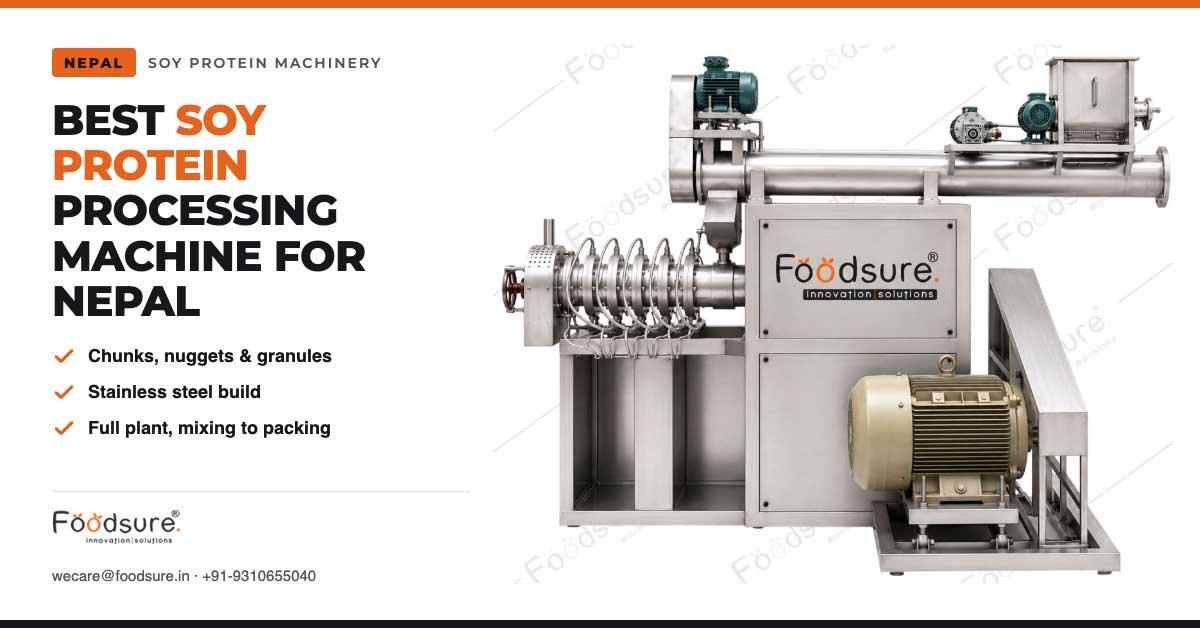
The first step is choosing the right Soy Protein Processing Machine in Nepal based on your expected sales, available investment, factory space, and production targets.
Foodsure Machines offers soya badi production equipment, including mixers, extruders, conveyors, drying systems, cooling conveyors, and packaging machines. The line can be configured according to the manufacturer’s production requirements rather than forcing every business to purchase the same setup.
This guide covers the manufacturing process, machinery specifications, indicative costs, Nepal’s food industry licensing process, and the factors to consider before purchasing equipment from India.
Why Consider Soya Badi Manufacturing in Nepal?
Soya badi, also known as soya chunks or textured soy protein, is used in curries, noodles, snacks, and other prepared foods. Its dry format makes it convenient to store, transport, and distribute when it is manufactured and packaged correctly.
However, a new manufacturer should not assume that local production will automatically be cheaper than imported products. Profitability depends on raw material prices, machinery efficiency, electricity costs, packaging, distribution, and the wholesale price buyers are willing to pay.
Before investing in a Soy Protein Production Machine in Nepal, evaluate these potential customer groups.
- Retail stores and supermarkets: Businesses that need regularly supplied, retail-ready soya badi packs.
- Food wholesalers and distributors: Buyers interested in consistent supply and competitive bulk pricing.
- Hotels, restaurants and institutional kitchens: Customers that may require larger packs for regular food preparation.
- Private-label brands: Businesses that want to sell soya chunks under their own brand without manufacturing them in-house.
- Existing food manufacturers: Companies looking to add textured soy protein to their current product range.
The opportunity should be assessed through local market research. Speak to distributors, compare competing brands, check shelf prices, and estimate how much product you can sell each month before selecting a machine.
What does the technical evidence tell us?
The Food and Agriculture Organization (FAO guide to textured soy protein production) explains that textured soy protein can be produced by processing soy flour, concentrate, or isolated soy protein through suitable texturization methods. In conventional extrusion-based production, the material is processed under controlled moisture, heat, pressure, and mechanical shear to develop its characteristic texture.
This makes the quality of the raw material and the control of extrusion conditions important considerations when choosing a machine.
What Is a Soy Protein Processing Machine?
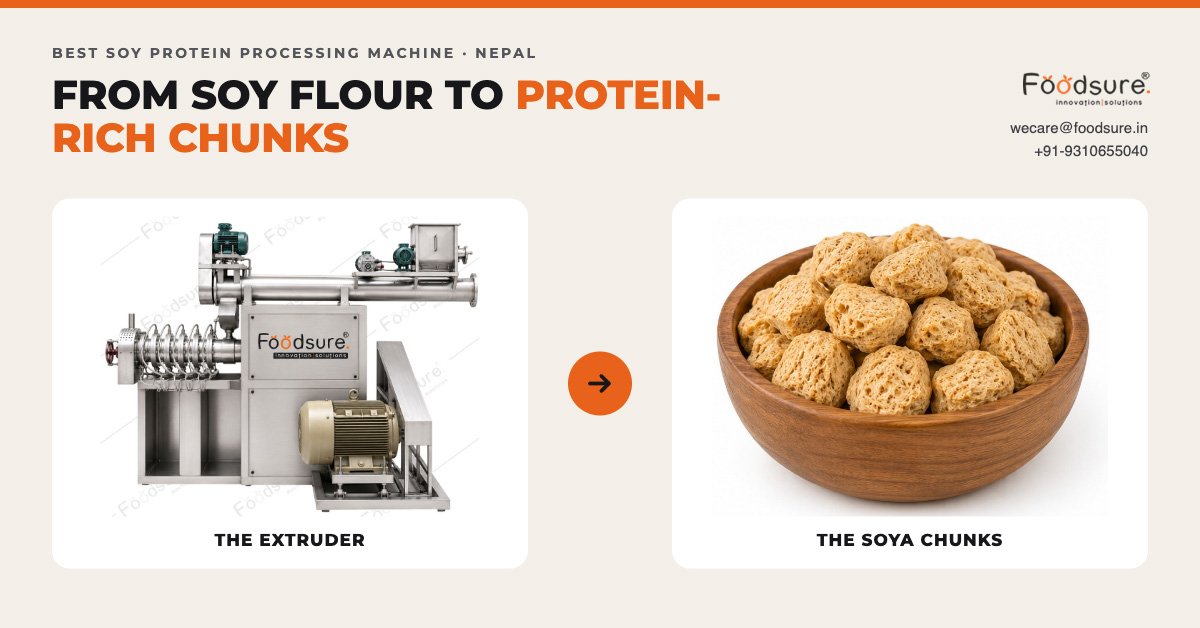
A Soy Protein Processing Machine in Nepal is equipment used to manufacture textured soy protein products, including soya badi, soya chunks, and granules, through a suitable processing and extrusion system.
A commercial production line may include:
- A raw material feeding system
- A mixer for blending soy flour and other approved ingredients
- A screw extruder for cooking and texturizing the mixture
- A cutting mechanism for shaping the product
- A dryer for reducing moisture
- A cooling conveyor
- A grading machine, where required
- A packaging machine for finished products
The exact configuration depends on the product, raw material, production target, and level of automation.
One important distinction is that conventional extruded soya badi production does not necessarily require soaking and grinding whole soybeans. Many commercial systems use defatted soy flour as their primary ingredient. A whole-soybean processing setup would require a different upstream process.
Why does machine selection matter?
The right machine should produce the required product shape and texture at a practical operating cost. It should also work with the selected formulation and the drying and packaging systems.
For example, a machine producing 200 kg of wet or freshly extruded product per hour cannot guarantee 200 kg of finished, packaged product per hour. Moisture loss during drying, production interruptions, cleaning, and rejected pieces can all affect the final saleable output.
Ask suppliers to specify whether their quoted capacity refers to raw material input, extruder output, dried product, or finished packaged product.
Complete Soya Badi Manufacturing Process
The commercial soya badi manufacturing process generally involves six main stages. The exact sequence may change depending on the raw material and machine configuration.
Step 1: Raw Material Inspection and Preparation
The process begins with checking the quality of defatted soy flour or another suitable soy protein ingredient.
Manufacturers should check the supplier’s specifications, moisture level, protein content, storage conditions, and food safety documentation. Any additional starches, flours, or ingredients must be suitable for the intended product and comply with applicable food requirements.
Step 2: Mixing and Ingredient Feeding
A mixer blends the raw material with water and other ingredients according to the formulation. The mixture must have a suitable and consistent moisture level before entering the extruder.
A uniform mixture helps reduce differences in texture, density, and shape between batches.
Step 3: Extrusion and Cooking
The mixture enters the extruder, where controlled heat, pressure, and mechanical shear change the structure of the soy protein.
The screw design, temperature profile, moisture level, feed rate, and die opening all influence the final product. These settings must be developed and tested for the selected formulation.
Step 4: Shaping and Cutting
The extruded material passes through a die and cutting system to create the required shapes, such as chunks, nuggets, or granules.
Consistent cutting helps create a uniform product that is easier to pack, price, and prepare for cooking.
Step 5: Drying, Cooling and Grading
The freshly extruded product is dried to reach the moisture specification required for the intended shelf life.
After drying, the product is cooled before packaging. A grading machine can then separate pieces by size where uniform grading is required.
The dryer must be matched to the actual product output. If the extruder produces material faster than the dryer can process it, the dryer becomes a production bottleneck.
Step 6: Packaging and Storage
The finished soya badi is packed in suitable food-grade packaging that protects it from moisture and contamination.
Packaging equipment should match the required pack sizes, weighing accuracy, sealing requirements, and production speed. Finished packs should be stored in clean, dry conditions.
For a reliable production line, the extruder, dryer, conveyor, and packaging machine must be planned as one system. Buying each machine separately without checking its capacity can lead to unnecessary handling, product losses, and production delays.
Machines Required for a Complete Soya Badi Production Line
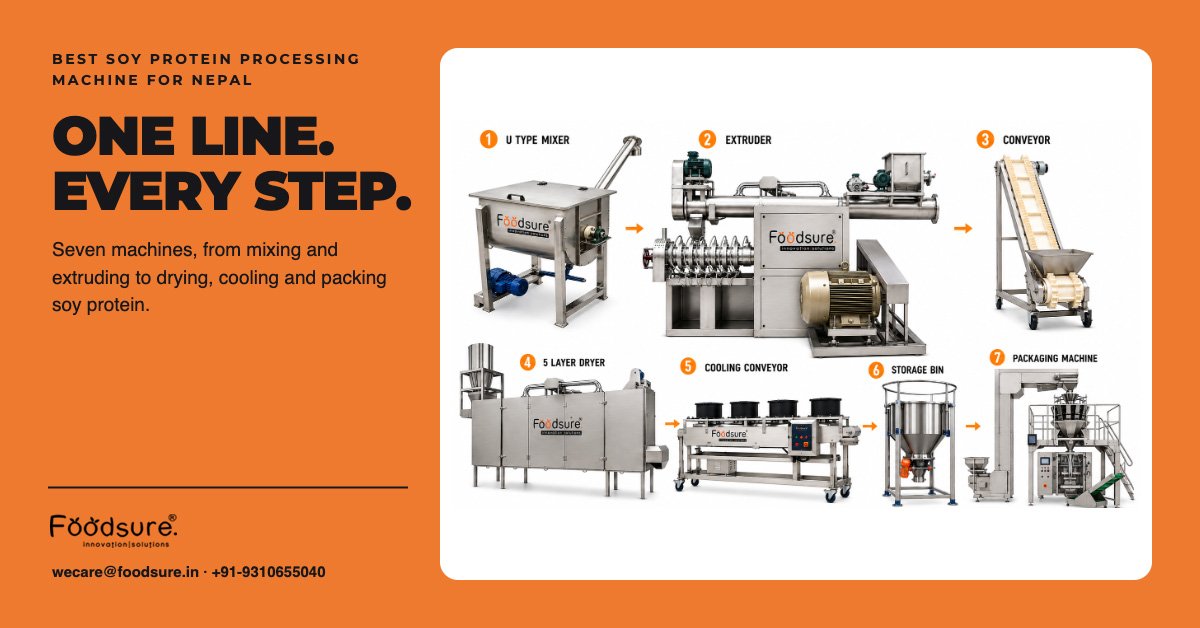
When comparing a Soy Protein Manufacturing Machine in Nepal, look beyond the main extruder. Supporting equipment plays an important role in production consistency, product quality, and packaging speed.
Soya Badi Extruder and Mixing System
The mixer and extruder form the core of the production line.
The mixer prepares a consistent blend, while the extruder cooks and texturizes it. The equipment should be selected according to the formulation, desired product shape, and target output.
Foodsure Machines can help manufacturers evaluate the appropriate line configuration and the supporting equipment required for commercial production.
Grading Machine
A grading machine separates finished pieces according to size or other selected physical characteristics.
It is useful when a manufacturer wants more uniform product sizes for retail packs, institutional buyers, or specific customer requirements.
Grading is not compulsory for every product. Its value depends on the final specification and the buyer’s expectations.
Roasting Machine
A roasting machine may be required when the intended product involves a roasting stage or when the manufacturer is producing additional roasted soy-based snacks.
However, roasting is not a standard replacement for the controlled cooking and extrusion stage used to manufacture conventional textured soya badi.
Before purchasing a roaster, confirm whether the selected product formulation actually requires it. Adding equipment without a clear process requirement increases the initial investment and operating costs.
Conveyor Belt
A conveyor belt transfers material between processing stages, reducing manual movement and helping maintain a more organised production flow.
Depending on the layout, conveyors can connect the extruder, dryer, cooling section, grading equipment, and packaging area.
The conveyor’s width, belt material, speed, incline, and cleaning requirements should suit the product and the equipment connected to it.
Packaging Machine
The packaging machine weighs or receives the required quantity of product, fills the selected pack, and seals it according to the chosen packaging system.
Manufacturers selling retail products may need smaller pouches, while wholesalers may require larger bulk packs.
Before finalising the machine, specify pack weight, bag material, required packs per minute, sealing method, and whether automatic weighing is included.
Dryer and Cooling Conveyor
A dryer removes moisture to help the product reach its required storage specification. A cooling conveyor allows the product to cool before packaging.
Packaging a product before it has cooled sufficiently can lead to moisture-related quality problems. The required drying conditions must be established through product trials and suitable testing rather than assuming that one setting works for every formulation.
Foodsure Machines can help buyers plan these supporting sections as part of an integrated production line.
Soya Badi Machine Capacity, Power and Factory Space
The best machine capacity depends on the volume you expect to sell, your production schedule, and the size of your available investment.
Foodsure Machines’ published soya badi machine specifications include commercial models in the 200 kg/hour and larger capacity categories. The page lists a 200 kg/hour configuration with SS304 construction, a PLC and HMI control system, and a standard 12-month warranty.
The same page also contains differing power and layout figures across its specification sections. Buyers should therefore obtain a model-specific technical quotation before using those figures for factory planning.
The following table provides a starting point for evaluating production needs, not a guarantee of achievable output.
| Planning factor | What to check |
| Production capacity | Confirm whether the figure refers to input, extrusion output or dried product |
| Power requirement | Obtain the connected load and actual operating load for the complete line |
| Factory space | Include raw material storage, processing, drying, packaging and finished goods |
| Construction material | Confirm food-contact materials and the specifications of non-contact parts |
| Automation | Check feeding, cutting, drying, weighing and packaging arrangements |
| Warranty | Confirm the coverage period and the components included |
| Installation | Confirm whether commissioning and operator training are included |
How much can a machine produce in one day?
Consider a hypothetical production line with a verified output of 200 kg/hour.
If it operates for eight hours at its full rated output:
200 kg/hour × 8 hours = 1,600 kg per day
This is a theoretical calculation, not a production guarantee. Actual finished output can be lower because of cleaning, downtime, raw material changes, drying limitations, and product losses.
For business planning, calculate output using the supplier’s confirmed finished-product capacity and your expected operating efficiency.
How much factory space is needed?
The space requirement depends on the entire line, not just the extruder. Your layout must allow for raw material handling, operator movement, cleaning, drying, packaging, and finished product storage.
Ask the supplier for a complete plant layout showing equipment dimensions, service clearances, material flow, and utility connections before finalising a factory lease or construction plan.
Soya Badi Machine Price and Investment in Nepal
The total cost of establishing a soya badi manufacturing unit depends on production capacity, automation, the number of machines included, and the readiness of the factory.
As a supplier-published reference, Foodsure Machines lists a 200 kg/hour soya badi machine at ₹25,00,000 (INR 25 lakh) on its website. This is an indicative published machinery price, not a confirmed quotation for delivery and installation in Nepal.
See the Foodsure soya badi machine page for the current listed details.
What should the investment budget include?
| Cost category | What it covers |
| Core machinery | Mixer, extruder and the required processing modules |
| Supporting machinery | Dryer, cooling conveyor, grading machine and other required equipment |
| Packaging | Weighing, filling, sealing and coding equipment |
| Factory preparation | Flooring, drainage, electrical work, ventilation and storage |
| Installation | Transport, installation, commissioning and operator training |
| Import and logistics | Freight, customs duties, applicable taxes and clearance |
| Working capital | Raw materials, packaging, salaries, electricity and distribution |
The INR 25 lakh reference should not be treated as the complete Nepal factory setup cost. The final landed cost must be confirmed after checking the machinery configuration, shipping route, applicable customs classification, duties, taxes and installation arrangements.
How can you estimate the operating cost?
Calculate the cost per kilogram of saleable product using the following formula:
Cost per kg = Total production cost ÷ Saleable finished output
Include raw materials, electricity, labour, packaging, maintenance, rejected product, and other operating expenses.
For example, if a factory spends NPR 100,000 to produce 2,000 kg of saleable soya badi, its production cost is NPR 50 per kg. This is a hypothetical calculation, not a Nepal market price or a Foodsure quotation.
To estimate profitability, compare the actual cost per kilogram with the selling price after allowing for distributor margins, transport, discounts, and other selling expenses.
Do not calculate payback using the machine price alone. Include the total project investment and realistic monthly sales.
DFTQC Licensing and Food Industry Compliance in Nepal
Before starting commercial production, manufacturers must check the applicable business registration, food industry licensing, product standards, labelling, and food safety requirements.
Nepal’s Department of Food Technology and Quality Control provides the Nepal Food and Feed Industry Licensing System (NeFFILS). The government describes the platform as a system for facilitating the process of obtaining an industry establishment recommendation and the required licence before food products enter the market.
The DFTQC also publishes relevant laws and regulations through its official acts and rules portal.
What should a manufacturer check?
- Business and industry registration
Confirm the appropriate business structure and industry registration requirements with the relevant Nepalese authorities. The Department of Industry publishes information on industry registration and the required documents.
- Food industry approval and licensing
Check the applicable establishment recommendation and operating licence requirements through DFTQC and NeFFILS before starting production.
- Product standards and testing
Confirm which food standards and laboratory tests apply to the intended soya badi product, including its ingredients, composition, safety and shelf-life requirements.
- Packaging and labelling
Check the applicable rules for product names, ingredients, net quantity, manufacturer details, batch identification, dates, storage instructions and other required label information.
- Hygiene and production controls
Plan appropriate cleaning procedures, pest control, raw material storage, worker hygiene and production records. Your actual requirements should be confirmed with the relevant authority.
Do not assume that a machine’s construction material or a supplier’s quality claims automatically make the finished product compliant with Nepalese food law. The manufacturer remains responsible for the applicable approvals and the safety of its products.
How to Choose the Best Soy Protein Machine in Nepal
Choosing the best Soy Protein Machine in Nepal means finding a supplier that can match the equipment to your product, production target, factory conditions, and service needs.
Use the following checklist before placing an order.
- Confirm the raw material: Ask whether the machine is designed for defatted soy flour, soy concentrate, or another formulation.
- Request a product trial: Check the finished shape, texture, expansion, moisture and breakage rate using your intended raw material.
- Verify rated capacity: Ask for the expected output of dried, saleable product rather than relying only on extruder capacity.
- Check power requirements: Obtain the full electrical load and confirm compatibility with your factory’s supply.
- Review the construction: Confirm the material used in product-contact parts and the cleaning requirements.
- Check supporting machinery: Make sure the dryer, conveyor and packaging equipment can handle the planned output.
- Confirm installation support: Establish who will handle commissioning, operator training, spare parts and technical assistance.
- Obtain a written quotation: Request a detailed equipment list, price, payment terms, delivery schedule, warranty, and exclusions.
Why consider Foodsure Machines?
Foodsure Machines offers soya badi manufacturing equipment and supporting machinery for commercial food production. Buyers can discuss the capacity, processing stages, automation level, factory layout, and packaging requirements before finalising a configuration.
For businesses planning to manufacture other products alongside soya badi, Foodsure also offers a High Protein Snack Machine for selected extruded snack applications and a Makhana Machine for makhana processing.
These are separate product lines, so each should be evaluated according to the intended product and its manufacturing requirements.
If you are sourcing equipment from India, request a detailed quotation that clearly identifies the machinery supplied, installation arrangements, shipping terms, and after-sales support available in Nepal.
Common Mistakes to Avoid Before Buying a Soya Badi Machine
Choosing capacity without checking demand
A higher-capacity machine is not always the best investment. Estimate your monthly sales, working days, operating hours, and distribution requirements before deciding.
Ignoring the dryer
If the dryer cannot keep pace with the extruder, production may slow down even when the main machine is working correctly.
Confusing machine capacity with finished output
Rated extrusion output and final packaged output are not necessarily the same. Ask the supplier to define the capacity clearly.
Buying unnecessary equipment
A grading machine or roaster should be included when it serves a defined production or product requirement. Do not add equipment simply because it appears in another manufacturer’s production line.
Underestimating working capital
You will need funds for raw materials, packaging, salaries, utilities, maintenance, transport and distribution while building your customer base.
Delaying compliance checks
Check licensing, product testing and labelling requirements before commercial production. Avoid committing to a factory layout without understanding the applicable requirements.
Ignoring after-sales support
A breakdown can interrupt deliveries and affect customer relationships. Confirm spare parts availability, warranty coverage and the process for obtaining technical support.
Conclusion: Choose the Right Soya Badi Machine for Your Business
Starting a soya badi manufacturing unit in Nepal requires a clear understanding of the production process, machinery capacity, factory requirements, investment and food industry compliance.
The right Soy Protein Processing Machine in Nepal should match your intended product and sales target. A complete production line may include a mixer, extruder, cutting system, dryer, cooling conveyor, grading machine and packaging machine, depending on the requirements.
Before purchasing, compare the complete project cost rather than the price of the main machine alone. Verify the output using your intended raw material, confirm the dryer and packaging capacity, and check the applicable licensing requirements.
Foodsure Machines can help you evaluate suitable soya badi production equipment and plan the supporting machinery needed for your business.
Planning a soya badi manufacturing plant in Nepal?
Contact Foodsure Machines to discuss your required capacity, machinery configuration, factory layout and export quotation.
Frequently Asked Questions
What is a soy protein processing machine used for in Nepal?
A soy protein processing machine is used to manufacture products such as soya badi, soy chunks and textured soy protein granules. The production line generally includes mixing, extrusion, cutting, drying and packaging equipment.
Which is the best soy protein processing machine in Nepal?
The best machine depends on your required output, raw material, product shape, budget, factory space and automation needs. Compare complete production lines and verify finished-product capacity before choosing a supplier.
What is the price of a soya badi machine in Nepal?
The price depends on capacity, automation and the equipment included. Foodsure Machines lists a 200 kg/hour machine at INR 25 lakh on its website, but buyers in Nepal should request a quotation covering shipping, applicable taxes, installation and the final configuration.
Is soya badi manufacturing profitable in Nepal?
Soya badi manufacturing can be commercially viable when production costs, product quality, distribution and selling prices are managed well. Calculate the cost per kilogram and confirm demand with local buyers before investing.
What raw materials are required to manufacture soya badi?
Conventional extruded soya badi is commonly made from defatted soy flour or other suitable soy protein ingredients mixed with water. Additional ingredients depend on the formulation and the required product characteristics.
What is the complete soya badi manufacturing process?
The process generally involves raw material preparation, mixing, extrusion and cooking, shaping and cutting, drying, cooling, grading where required, and packaging.
What capacity should a new soya badi manufacturer choose?
A new manufacturer should select capacity according to expected orders, available working capital, factory utilities and distribution reach. A smaller line may be suitable for a regional business, while higher-capacity equipment may suit established wholesale suppliers.
How much electricity does a soya badi manufacturing machine consume?
Electricity requirements vary with capacity and the equipment included in the line. Ask the supplier for the connected load, operating load, and expected energy consumption per kilogram of finished product.
How much space is required for a soya badi manufacturing plant?
The space depends on the production line, dryer, packaging section, raw material storage and finished goods area. Request a complete factory layout before renting or constructing the premises.
Is a grading machine necessary for soya badi production?
A grading machine is useful when the finished product needs consistent size categories. It may not be necessary for every product, so the decision should depend on customer specifications and the intended packaging.
Is a roasting machine required to manufacture soya badi?
Roasting is not a standard replacement for extrusion and cooking in conventional soya badi production. A roaster may be useful for separate roasted soy snacks or other products that require a roasting stage.
Which approvals are required to manufacture soya badi in Nepal?
Manufacturers should verify business and industry registration, applicable DFTQC food industry licensing, product standards, testing, hygiene and labelling requirements. The current process should be checked through the official DFTQC and NeFFILS portals.
Can I import a soya badi machine from India to Nepal?
Yes, machinery can be sourced from India subject to applicable import procedures. Confirm the correct customs classification, duties, taxes, freight, documentation and delivery terms with the supplier and a qualified customs professional.
What should I check before buying a soya badi machine from an Indian supplier?
Check raw material compatibility, actual finished output, construction materials, power requirements, dryer capacity, packaging speed, warranty, installation support, spare parts and the total landed cost in Nepal.
Does Foodsure Machines provide complete soya badi production line solutions?
Foodsure Machines offers soya badi machinery and supporting equipment that can be configured according to production requirements. Contact the company to confirm the available models, complete equipment list, export arrangements, installation support and quotation for your Nepal factory.