Flavouring, the final step in the process, could have an enormous impact on how the snacks taste, look, and sell in the marketplace. A good snack flavouring process helps in evenly spreading seasoning onto each snack while minimizing human intervention and wastage of snacks. Snack seasoning process knowledge would be useful for snack manufacturers making chips, namkeen, extruded snacks, popcorn, and many more coated snacks.This blog explains how automated snack flavouring works, how seasoning is applied inside a flavouring drum, and what manufacturers should consider when setting up an efficient coating system.
What Is the Snack Flavouring Process?
The snack flavouring process is the stage where prepared snacks are coated with dry seasoning, flavour powder, oil-based flavouring, or a combination of ingredients.
After frying, baking, or extrusion, snacks are transferred towards the seasoning section. The product is introduced into the rotating drum, where continuous movement allows the seasoning to come into contact with different surfaces of each snack.
The objective is simple: achieve consistent flavour coverage without damaging the product.
The exact process can vary according to the snack type, seasoning characteristics, production capacity, and desired flavour intensity.
Read more: – healthy snack bar manufacturing business
Why Consistent Seasoning Matters in Snack Production
The seasoning consistency will greatly affect the consumer’s perception of the product. Some snacks may get more seasoning than others, hence making them taste different from those that have not gotten enough seasoning.
A well-controlled snack seasoning process may help companies achieve:
- Consistent flavor distribution
- Consistent seasoning application
- Minimized manual labor
- Reduced seasoning wastage
- Consistency in batch processing
- Efficiency in the production process
It is especially important for snack producers manufacturing large volumes of snacks for commercial consumption.
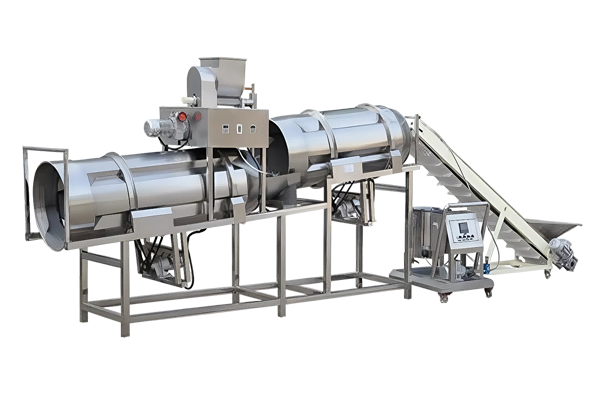
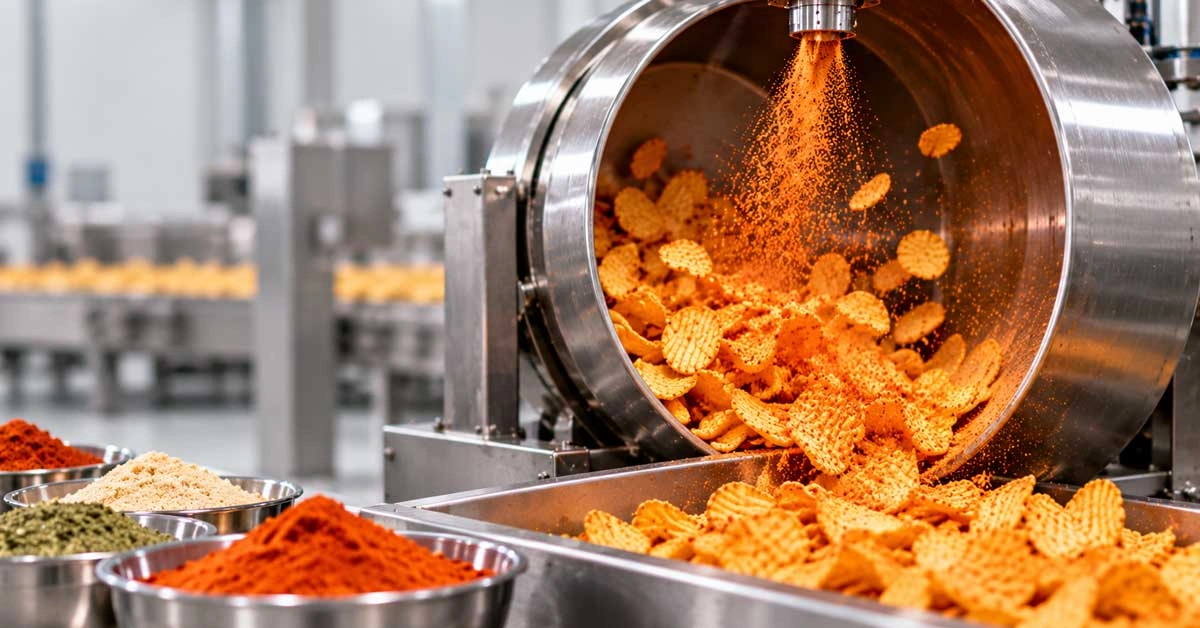
How a Flavouring Drum Machine Works
The flavouring drum machine rotates and tumbles snacks while controlled seasoning is added. This movement helps distribute the flavour evenly across the snack surface, with oil application used where required for better seasoning adhesion.
Loading of Products
Prepared snacks are fed either continuously or batchwise into the drum. The loading mechanism will vary based on the production line and the required production rate.
Tumbling
The drum is set to rotate in such a way that there is continuous movement of the snacks through the seasoning area. Movement must be enough to allow for seasoning to occur but not much breakage.
Seasoning
The process of adding seasoning takes place as the product moves within the drum. This process is controlled to ensure the desired flavor level is achieved.
Flavor Distribution
Tumbling ensures that the seasoning is distributed over the snack surfaces. The timing and operation of the drum can be varied depending on the properties of the snack and seasoning.
Discharge
After coating, the seasoned snacks move towards the next stage, which may include cooling, inspection, or packaging.
Understanding the Snack Flavour Coating Process
The snack flavour coating process depends on several factors, including the physical characteristics of the snack and seasoning. A light powder may behave differently from a heavier or more adhesive seasoning. Similarly, delicate snacks require gentler handling than stronger products.
Important processing parameters are:
- Drum Speed
- Product feed rate
- Quantity of seasoning
- Residence time
- Product properties
- Size of seasoning particles
- Application of oil, wherever required
The correct control of these parameters will enable manufacturers to get the right seasoning coat on their products.
Automated Snack Flavouring vs Manual Seasoning
Automated snack flavouring provides better control over the movement and seasoning of the product. It can also reduce dependence on manual labour during repetitive production operations.
Factors Affecting Seasoning Uniformity
Even with the use of automated equipment, the seasoning is dependent on the total setup of the seasoning process.
Snack Shapes and Sizes
Various snack shapes vary not only in size but also in movement and surface area; therefore, some shapes might need special seasoning conditions.
Seasoning Properties
Some characteristics of the powder, like particle size, density, flowability, and adherence ability, might affect the distribution of the seasoning.
Drum Speed
The speed of drum rotation is also important since excessive speed can result in unnecessary movements of snacks, while too slow speeds will lead to uneven coating.
Seasoning Dosage
The dosage of seasoning is supposed to depend on the flow of snacks and the intensity of taste desired.
Residence Time
The amount of time snacks remain inside the drum affects the opportunity for seasoning to distribute across the product.
Role of Oil in the Flavour Coating Process
Some snack products require oil application before or during seasoning to help dry flavour powders adhere to the surface.
In such applications, controlled oil distribution becomes an important part of the snack flavour coating process.
Too little oil may result in poor seasoning adhesion, while excessive oil can affect the snack’s texture and overall eating experience.
The oiling and seasoning stages should therefore be coordinated according to the specific product.
Snack Seasoning Process for Different Products
A single seasoning approach does not necessarily work for every snack.
Potato Chips
Chip products typically have to be carefully handled due to their fragile nature since they have thin pieces. Even coverage of seasoning is key on the large surface area of the snack.
Extruded Snacks
Extruded snacks can come in different shapes, densities, and surfaces. The seasoning process should have enough room for movement without compromising the product.
Namkeen
Namkeen snacks come in varied forms with different ingredients; hence, controlled seasoning can help ensure even distribution of flavor.
Popcorn
The popcorn snack has an irregular, large surface, hence the need for seasoning to allow enough contact with flavor without too much tumbling.
For each product, the snack seasoning process should be developed around its physical characteristics rather than using identical settings for every application.
Key Components of an Automated Snack Flavouring System
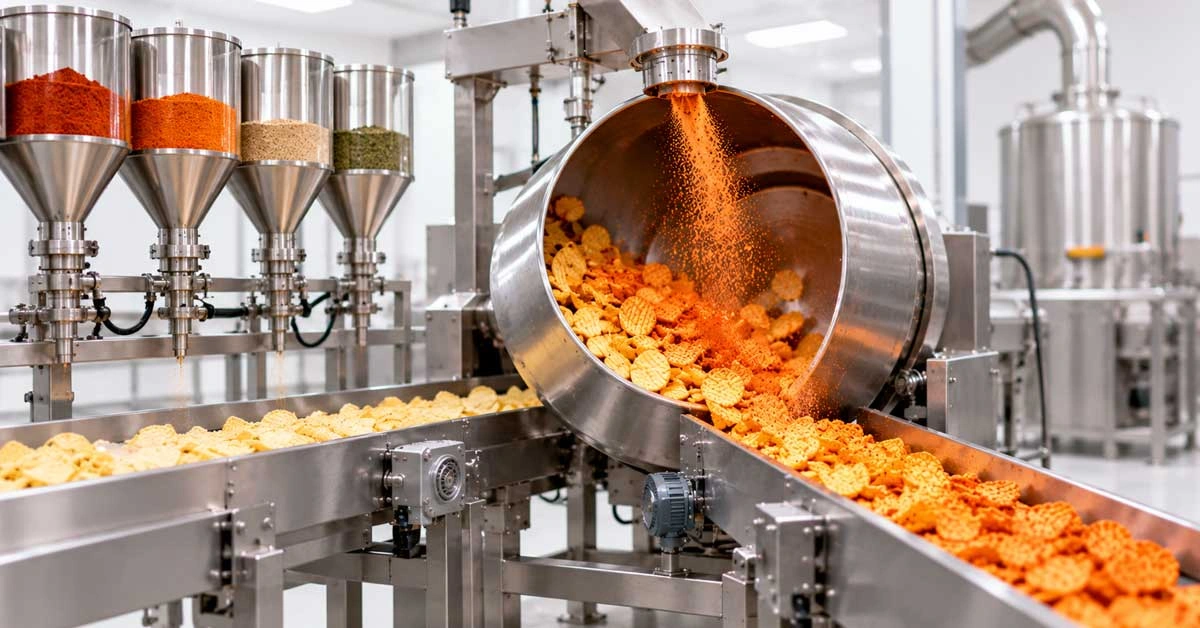
An effective snack flavoring process is not limited to just the rotating drum. The supporting systems such as feeding, seasoning, and conveying systems contribute to the effectiveness of the whole process.
Some common components include:
- Snack Product Feeding Mechanism: It conveys the snacks into the flavoring station at a regulated pace.
- Flavoring Rotating Drum: Snacks are rolled inside in order to expose different surfaces to the seasoning.
- Seasoning Metering Device: Flavor powder is added in a regulated amount depending on the product and the level of coating.
- Oil Spray Mechanism: An oil spray mechanism is added where necessary to help the seasoning stick to the snacks.
- Conveying Mechanism: The conveying mechanism helps in the transfer of the flavored product.
When these components work together, manufacturers can achieve a more controlled snack flavouring process.
Importance of Drum Speed and Residence Time
Drum speed and residence time should be balanced to ensure even seasoning while minimising product breakage and maintaining production efficiency.
The right operating conditions depend on:
- Snack type and size
- Product fragility
- Seasoning characteristics
- Required coating level
- Production capacity
This makes process adjustment an important part of automated snack flavouring.
Dry Seasoning and Wet Flavour Application
Not every snack seasoning process uses the same method. The choice between dry seasoning and oil-assisted application depends on the product and flavouring material.
Dry seasoning involves applying powdered flavour directly to the moving snack. It is commonly suitable for products where the seasoning can adhere effectively to the surface.
Oil-assisted seasoning uses a controlled oil application to improve the adhesion of flavour powder. This can be useful when the seasoning requires additional surface adhesion.
The application method should be selected according to the product’s texture, surface characteristics, seasoning type, and desired finish.
Reducing Seasoning Waste
Seasoning wastage can increase production costs and create unnecessary material loss. Poor application control may result in excess seasoning falling away from the product instead of adhering to its surface.
A controlled snack flavour coating process can help minimise this issue by regulating product movement and seasoning application.
Efficient use of materials may be achieved through:
- Seasoning dosage control
- Consistent feeding of products
- Drum speed regulation
- Oil application when needed
- Cleaning of equipment
- Process control
Efficient control does not imply reduction in the use of seasoning; rather, it implies consistent use of the right amount of seasoning.
Hygiene and Cleaning Considerations
Snack flavouring equipment should be food-grade, easy to clean, and hygienically designed to prevent seasoning buildup and maintain product quality.
Considerations for manufacturers:
- Accessibility to contact surfaces of the products
- Use of food-grade materials
- Facility to remove seasoning buildup easily
- Maintain easy access for maintenance purposes
- Appropriate cleaning methods
- Inspection after cleaning
All the above considerations become all the more essential when manufacturers have different flavors running through the same production line.
Managing Flavour Changeovers
Manufacturers making different flavours of snacks require a well-orchestrated process of changeover. Residues from one type may contaminate the taste of the other product.
A process of changeover can involve:
- Finishing the current run of products
- Getting rid of any product and seasoning left
- Cleaning the parts that come into contact with the products
- Checking the machinery
- Preparing the next seasoning
- Resuming the process of manufacturing
Well-coordinated processes of changeover can save time and maintain consistency of taste.
Choosing the Right Flavouring Drum Machine
The right flavouring drum machine should be selected according to the production line rather than simply choosing the largest available model.
Important selection criteria include:
- Production capacity: The drum needs to manage the required amount of production flow without becoming a bottleneck.
- Nature of the snack: Fragile and hard snacks will have their specific handling requirements.
- Nature of seasoning: Characteristics of powder affect the way it is dispensed and applied.
- Drum operation: Variable speed will give more flexibility when working with different types of products.
- Cleanability: Easy access will allow quicker flavor changes and cleaning.
- Integration: The unit must work well with other machines on the line.
For manufacturers planning a larger snack flavouring process, compatibility with conveyors, oiling systems, seasoning dispensers, and packaging equipment should also be considered.
Connecting Flavouring With Automatic Packaging
Flavouring is not the final stage of snack production. Once the product has been seasoned, it needs to move efficiently towards packaging.
An automatic snack packaging machine can be integrated after the flavouring section to automate filling, sealing, and other packaging operations according to the selected pack format.
Connecting these stages can provide a smoother production flow:
Seasoning → Transfer → Weighing/Filling → Sealing → Coding → Finished Packs
This reduces unnecessary manual movement and can help manufacturers maintain a more consistent production rate.
Why Automation Makes Commercial Snack Production Easier
For growing snack manufacturers, automated snack flavouring can provide greater control than manual seasoning methods.
With automation, manufacturers can control:
- Proper seasoning
- Constant movement of the product
- Fewer interventions by people
- Uniformity in the process of production
- Effective integration with packaging process
- Efficient production process
It is not just automation of one piece of equipment that matters. More important is the creation of an effective production chain where seasoning, transferring, filling, and packaging occur simultaneously.
Optimising the Snack Flavouring Process for Commercial Production
The success of the snack flavoring process is largely dependent on the need for consistency from the product feed through the end of discharge. Small changes in the dosage of seasoning, speed of the drum, or product flow may have an effect on the final output.
It is important that the manufacturers consistently check:
- Flavoring and its dosage
- Movement of the product within the drum
- Even coating
- Product breakage
- Flavoring loss
- Equipment cleanliness
Regular monitoring helps identify process variations before they affect larger production batches.
Common Problems During Snack Flavour Coating
Even automated systems can face coating issues if the process is not properly configured.
Uneven Seasoning
Uneven seasoning is caused by inconsistencies in either the product flow, seasoning addition rate, or the process of tumbling. Setting these parameters depending on the snack will help to improve seasoning distribution.
Overseasoning
Overseasoning leads to wastage and may affect the taste of the product. Consistent coating of the product and controlled seasoning dispensation will be helpful in maintaining adequate seasoning levels.
Inadequate Seasoning Adhesion
If seasoning does not stick well to the product, then an appropriate oil may be needed. This will depend on the nature of the snack and seasoning used.
Product Breakage
Inappropriate operating parameters may cause product breakage. This is especially for products that are easily broken.
Maintaining Consistency Between Batches
For commercial manufacturers, producing one good batch is not enough. The same flavour profile should be maintained across repeated production runs.
A controlled snack seasoning process can support consistency by standardising important operating parameters such as seasoning dosage, drum speed, product feed rate, and residence time.
Production teams should also maintain suitable operating records so that successful process settings can be repeated for future batches.
Scaling Up Snack Production
With rising snack demand, the producer may be forced to switch from batch seasoning to continuous commercial production.
The transition not only entails an increase in the processing speed of the equipment but also the evaluation of the whole production line, which includes:
- Frying/Extruding capacity
- Seasoning capacity
- Conveyor speed
- Packaging speed
- Handling of the product
- Storage of material flow
The snack flavour coating process should remain consistent even when production volume increases.
Integrating Flavouring With the Complete Production Line
A flavouring system works most effectively when it is properly integrated with the machines before and after it.
A commercial snack line may connect:
Snack Production → Cooling → Flavouring → Conveying → Packaging → Coding
Integration reduces unnecessary manual handling and allows the different stages to operate at compatible production rates.
For manufacturers planning automated snack flavouring, this complete-line approach can provide better efficiency than installing an isolated flavouring machine.
Choosing Equipment Based on Your Snack
Various snack foods need different processing conditions. A machine that works well for potato chips might not work well for popcorn, extruded snack foods, or namkeen.
Before purchasing a seasoning drum machine, the following factors must be considered:
- Size and form of product
- Brittleness of product
- Type of seasoning
- Level of coating required
- Capacity
- Oil application
This will help to ensure that the machinery selected is appropriate for the real-world application.
Role of an Automatic Snack Packaging Machine
Once seasoning is complete, the product needs to reach packaging without unnecessary delays or manual handling.
An automatic snack packaging machine can help automate the next stage by weighing or dosing the product, filling packs, and sealing them according to the selected packaging format.
Connecting the flavouring and packaging sections can help maintain a continuous production flow and reduce product handling between stages.
Benefits of Automated Snack Flavouring
Shifting from manual seasoning to automated seasoning for snacks may bring a number of advantages to commercial snack producers.
- Greater consistency: Controlled seasoning contributes to a consistent flavor profile.
- Greater efficiency: Continuous operation makes it possible to achieve greater production.
- Decreased manual operations: Automation eliminates repetitive seasoning procedures.
- Better material utilization: Controlled seasoning helps decrease the amount of wasted seasoning material.
- Greater scalability: Automation makes it easier to integrate machines with the production and packaging lines.
It depends on the particular product and production process whether any benefits can be achieved.
Conclusion
Consistency in the process of flavoring is critical in making the snacks taste consistent, as well as applying the coating uniformly. Automation of the flavoring process is beneficial in controlling handling, flavoring, and production while minimizing repetitive activities.
The appropriate flavouring drum machine must be chosen based on the type of snacks to be made, seasoning properties, production volume, hygiene level, and packaging arrangements. The proper integration of the flavoring process with an automatic snack packaging machine will result in a better commercial snack production line.It is advisable for snack makers planning to increase production to consider the investment in a better snack seasoning process.
Have a Question? Let’s Connect
Need expert guidance on food processing machines, production setup, or process optimization? Our team is ready to help you choose the right solution for your business.
Frequently Asked Questions
What is the process of flavouring snacks?
The process of flavouring snacks entails coating the prepared snacks with seasoning through control of the movement of the products being flavoured using a rotating drum.
What is the mechanism behind the operation of a flavouring drum machine?
A flavouring drum machine moves the snacks around, during which seasoning is applied.
What is the distinction between manual and automated snack flavouring?
The main difference is that the manual seasoning process is largely dependent on manual handling of the products, while the automated one involves better control over the movement of the products and the application of seasoning.
Is it possible for a single flavouring machine to flavour different types of snacks?
This may be possible, although the operational conditions of each machine will differ based on the type of snack being flavoured.
Can flavouring equipment be linked to snack packaging machines?
Yes, a flavouring machine can be linked to conveyors and an automatic snack packaging machine.