
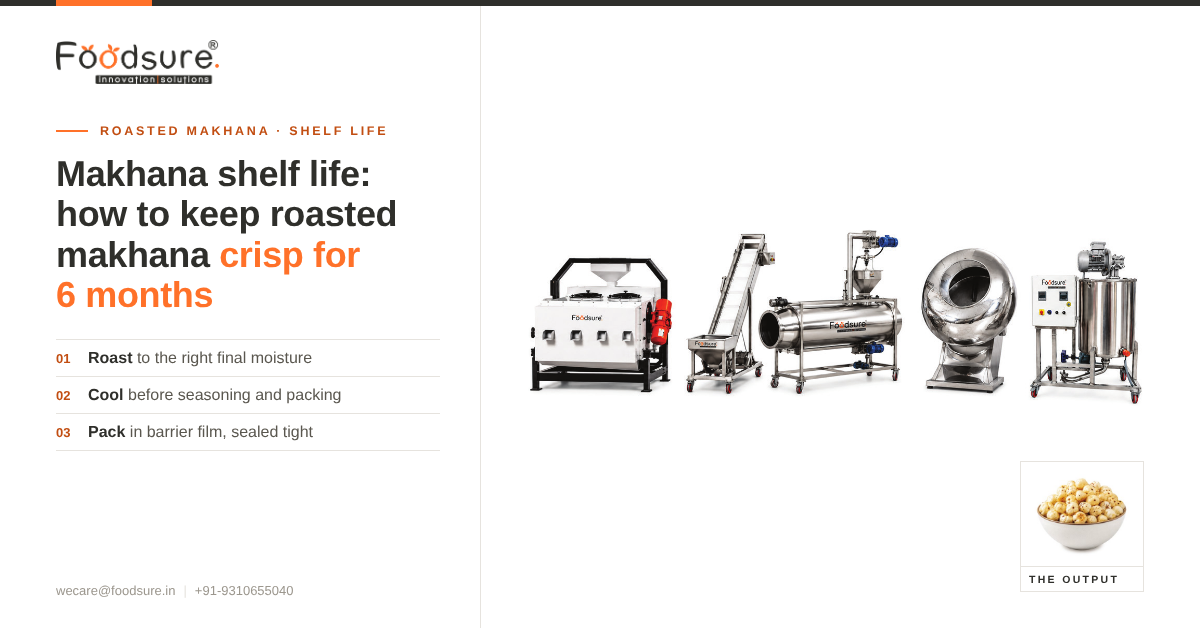
Roasted makhana is well-liked as an already prepared snacking item due to its light nature and its ability to absorb flavors. Nonetheless, keeping the item crispy is not always easy for manufacturers because of several factors like moisture, inappropriate packaging, cooling methods, and storage facilities.
The knowledge of roasted makhana shelf life is vital for companies that produce, package, and distribute makhana. When proper roasting methods are used along with moisture management, hygienic processing, and proper packaging, companies may try to achieve high-quality products for months ahead.
A six-month shelf life is not guaranteed in all roasted makhana products. The shelf life varies depending on several factors, including the product formula, processing method, packaging material, storage conditions, and confirmation of the shelf life by shelf life testing. This manual provides guidelines on how to maintain crispness, choose the right processing equipment, and select the right packaging method.
What Determines Roasted Makhana Shelf Life?
The shelf life of roasted makhana is the period during which the product retains acceptable quality, texture, flavour, and safety under specified storage conditions.
For commercially packaged products, roasted makhana shelf life depends on several factors.
1. Moisture Content
Moisture content is one of the major factors that affect the crispy nature of makhana. If roasted makhana takes up moisture from the surrounding atmosphere, it loses its crunchy property.
It is necessary for manufacturers to control the roasting process and ensure that the product does not come into contact with humid surroundings after roasting.
2. Roasting Quality
Proper roasting helps develop the expected texture and flavour. Inadequate roasting may leave the product less crisp, while excessive heating can affect colour, taste, and product quality.
A suitable roasted makhana machine helps manufacturers manage heating conditions more consistently, although the correct operating settings depend on the product and machine configuration.
3. Packaging Material
Packaging is a barrier for makhana that prevents it from the outside environment. Using material that possesses proper water resistance properties may prevent the product from moisture absorption.
Selection of packaging materials depends on the sensitivity of the product, distribution conditions, pack size, and desired shelf life.
4. Storage Conditions
Conditions like temperature, humidity, exposure to direct sunlight, and storage can affect the quality of goods. Roasted makhana needs to be kept in a cool and dry place.
Well-packed products might also spoil when the package becomes damaged or storage conditions become unsuitable.
5. Added Oils and Seasonings
Makhana with flavours may use oils, spices, cheese flavouring, and others that could influence shelf stability. Some may be more vulnerable to oxidation compared to roasted makhana without any flavour.
It is important for manufacturers to test each product formula individually and not give one expiration date to all flavours.
How to Keep Roasted Makhana Crisp for Six Months
Maintaining crispness for six months requires a combination of controlled processing, protective packaging, hygienic handling, and suitable storage. No single machine or packaging method can guarantee this duration for every product.
1. Use Controlled Roasting
The roast process must be uniform enough to give the required texture without burning or destroying the product. Suitable operational parameters should be identified by testing with the particular equipment and ingredients used.
A commercial makhana roasting machine may assist in ensuring process consistency and minimizing the variation in each batch.
The texture, color, and other related indicators should be monitored in the product. In some cases, moisture or water activity may give more insight into product stability.
2. Cool Makhana Before Packaging
It is necessary to ensure proper cooling before the packing of makhana takes place. There could be some condensation on packing of the item in the hot condition, depending on some situations such as changes in temperature.
Cooling has to take place in an environment that is both clean and dry and also protected from moisture and dust, etc., which are unnecessary.
The packing of the item must take place straight away after the correct packing temperature of the item is reached.
3. Maintain Hygienic Handling
Hygienic processing helps protect product quality throughout manufacturing. Equipment, food-contact surfaces, storage containers, and packaging areas should be maintained according to appropriate food-safety practices.
Manufacturers should also minimise unnecessary product transfers between roasting, cooling, seasoning, and packaging. An organised makhana processing line can help reduce handling and support a more consistent workflow.
4. Select High-Barrier Packaging
The choice of packaging becomes especially crucial in cases where an extended shelf life needs to be considered. The packaging must have sufficient barriers to protect the item from humidity and, if needed, from oxygen and light.
When dealing with different products and transport requirements, one can think about laminated films or other flexible packaging solutions for food products that have appropriate barriers.
The choice should be made taking into account the product composition, packaging tests, seal tests, and shelf-life tests, not only aesthetics or cost factors alone.
5. Ensure Reliable Sealing
Even though a right packaging material is available, it will fail to ensure protection for makhana in case of poor sealing. Poor seals, pinholes, and compromised packaging may lead to the entry of moisture.
A suitable makhana packaging machine can help maintain consistent filling and sealing when correctly configured and operated.
Manufacturers should inspect seals, check packaging integrity, and establish routine quality checks throughout production.
6. Store Finished Packs Correctly
The packaged products should be kept in a clean and dry place away from exposure to sunlight, heat, and moisture. Packages should be well protected against any form of damage while being transported.
Storage conditions should be documented when testing the shelf life so that the shelf life determined can reflect the storage conditions that the product will experience when distributed and marketed.
How Packaging Helps Preserve Roasted Makhana Crispness
Packaging plays a major role in protecting roasted makhana from moisture and environmental exposure. The right solution depends on the product’s formulation, packaging format, and expected distribution period.
| Packaging Consideration | Why It Matters |
| Moisture-barrier properties | Helps limit moisture absorption and texture loss |
| Seal integrity | Reduces the risk of air and moisture entering through weak seals |
| Film strength | Helps protect packs from punctures and handling damage |
| Oxygen barrier | May help reduce oxidation in products containing susceptible oils |
| Packaging compatibility | Supports reliable machine operation and consistent seals |
| Storage suitability | Helps maintain protection under intended distribution conditions |
For those products where oil or seasonings have been added, oxygen barrier needs might be very important. But the requirement for such a packaging structure should be decided through testing because not all roasted makhana products need the same barrier performance.
Role of Machinery in Maintaining Roasted Makhana Shelf Life
Commercial machinery enables the standardization of processing and packaging operations for manufacturing companies. While machinery cannot on its own ensure a six-month shelf life, appropriate machinery can be used to maintain quality controls.
Roasting Equipment
A suitable roasted makhana machine provides controlled heating for commercial processing. Consistent roasting can help manufacturers reduce batch-to-batch variations in texture and flavour.
Grading Equipment
A makhana grading machine separates makhana according to size or other specified grading criteria. Consistent product sizing can help improve processing uniformity and make it easier to establish suitable roasting and packaging settings.
Flavouring Equipment
A makhana flavouring machine helps distribute seasonings more consistently across the product. Manufacturers should consider the effect of added oils, spices, and other ingredients on product stability when developing a shelf-life target.
Packaging Equipment
A makhana packaging machine supports controlled filling and sealing of finished products. Depending on the production requirements, the packaging system may include weighing, pouch formation or feeding, sealing, and pack inspection.
Integrating these machines into a suitable makhana processing line can help improve workflow, reduce unnecessary handling, and support more consistent production.
How to Validate a Six-Month Shelf Life for Roasted Makhana
The manufacturer cannot make a shelf-life claim of six months based on the roasting method or type of packaging alone. There should be an assessment done on the final product under specific circumstances.
Step 1: Define the Product Formulation
Record whether the product is plain roasted makhana or contains oils, salt, spices, or other seasonings. Different formulations may have different stability requirements.
Step 2: Finalise the Processing Conditions
Note the parameters of roasting, cooling, seasoning, and packaging during production. These must stay constant enough during validation.
Step 3: Select the Packaging Material
Choose the proposed packaging structure and sealing method. Check that the material is suitable for food contact and compatible with the intended storage conditions.
Step 4: Conduct Shelf-Life Testing
The store-packaged samples should be kept under certain conditions and tested at certain intervals throughout the shelf-life period. The tests need to take into account various quality and safety parameters.Step 5: Establish Storage Instructions
From the outcomes, determine appropriate storage conditions and packaging needs. The shelf life claim at the end must be substantiated with relevant information and should meet food labelling regulations.
Common Mistakes That Reduce Roasted Makhana Shelf Life
Even well-roasted makhana can lose quality if basic processing and packaging controls are overlooked.
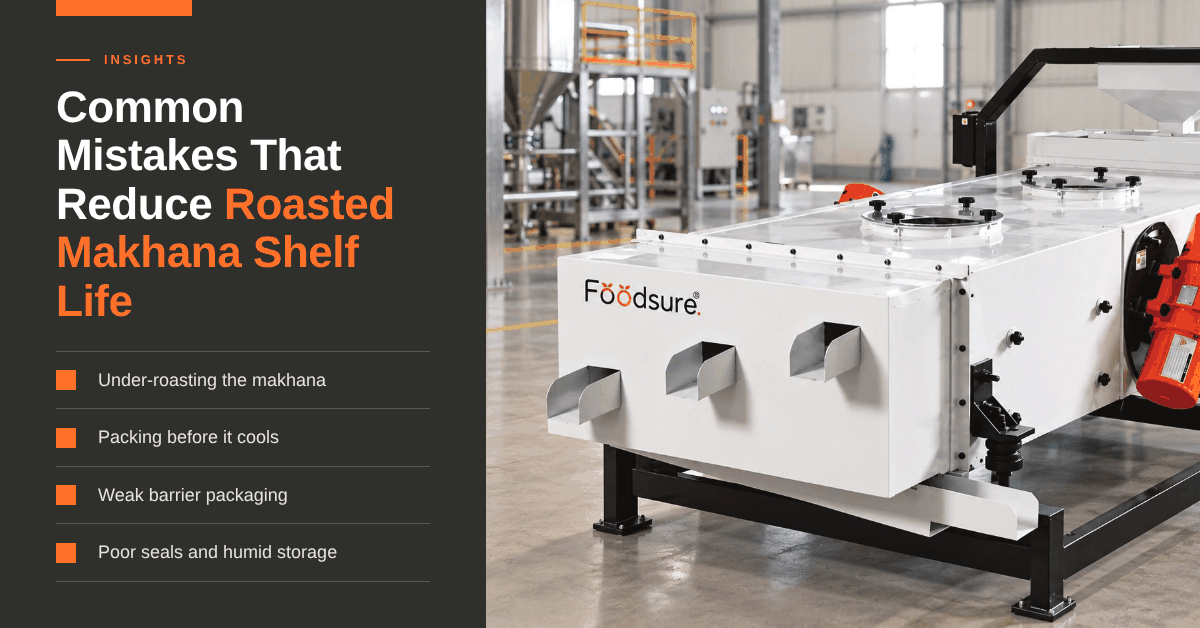
- Packaging without cooling properly: Trapped moisture can impact both the product and the environment inside the packaging.
- Use of inappropriate packaging film: Using packaging that does not have enough barrier characteristics means that moisture can get inside eventually.
- Not accounting for seal failure: Even minor leaks can have a negative effect on the protection of the product.
- Exposure of makhana to humid air after roasting: This can make makhana lose its crispness prior to packaging.
- Inconsistent roasting conditions: This can lead to variation in the texture and quality of makhana in each batch.
- Application of the same shelf life for all flavors: Seasoning oils and other ingredients can influence product stability.
- Lack of shelf-life testing: A six-month claim needs testing, not assumptions.
What Should Businesses Consider When Investing in Makhana Processing Equipment?
Those manufacturers intending to package their roasted makhana will require assessment of equipment based on the output required, range of products to be produced, and packaging requirements.
The pricing for makhana machines varies depending on the machine capacity, automation level, configuration, construction, and auxiliary equipment. Companies should also consider the overall cost of setting up a makhana processing plant.
When comparing a roasted makhana machine manufacturer, consider the technical specifications, installation service, availability of spare parts, maintenance guidelines, and the capability to integrate machines into the intended process flow.
Businesses looking to buy makhana machine in India should first define their required production capacity and product specifications. A properly planned setup can help manufacturers maintain consistent processing while avoiding unnecessary investment.
Commercial searches such as roasted makhana shelf life price, roasted makhana shelf life manufacturer, and buy roasted makhana shelf life may also appear when businesses research shelf-life solutions. These phrases do not represent a specific machine category; equipment should instead be selected according to the processing or packaging stage that requires improvement.
Conclusion
Crispness will be maintained for a long time by controlling the process at each stage, from roasting to packaging and storage. Understanding roasted makhana shelf life, manufacturers can be able to know what affects the texture and flavor.
A suitable roasted makhana machine, makhana grading machine, makhana flavouring machine, and makhana packaging machine can support consistent commercial processing when selected and operated appropriately. However, a six-month shelf life should only be declared after validating the finished product under defined conditions.
For businesses planning a commercial makhana processing line, combining suitable machinery with hygienic handling, protective packaging, and documented shelf-life testing provides a more reliable approach to maintaining roasted makhana quality.
Frequently Asked Questions
1. How long does roasted makhana usually stay crisp?
Factors that influence the shelf life include the way roasting was carried out, moisture exposure, composition of the food, packaging process, and storage techniques. Some of these foods are known to survive for several months, but that will have to be verified.
2. Can roasted makhana remain crisp for six months?
This could also be possible given proper handling, packing, sealing, and storage. However, six months ought to be viewed as an aim which requires verification with regard to the specific product.
3. Which packaging is suitable for roasted makhana?
Suitable food packaging with appropriate moisture barrier properties is important. The structural requirement of the material depends upon the formulation of the food and its shelf life.
4. Does a makhana roasting machine increase shelf life?
The right roasting machine will help improve process uniformity, but the machine alone is not enough to ensure an extended shelf life of the product. Cooling, packaging, storage, and formulation also influence the stability of the product.
5. Why does roasted makhana become soft after packaging?
The most common reasons can be attributed to moisture absorption, wrong packaging materials, poor seals, lack of cooling, or exposure to a humid environment.




